What Is First Party Data? a Plain Guide for Marketers
What Is First Party Data? Learn the definition, examples, collection methods and privacy rules that apply.
Published on 10 min read

Table of contents
- First-Party Data Explained in Plain Language
- What the name means
- Common Types of First-Party Data With Examples
- Where to look first
- How Businesses Collect First-Party Data
- Make the request understandable
- First-Party Versus Second-Party and Third-Party Data
- Judge the permission trail
- Privacy Rules That Shape First-Party Data
- Check the use, not just the field
- Why First-Party Data Does Not Prove Causality
- Turn observations into a test
- Audit Your First-Party Data Before You Act
- Keep the inventory usable
First-party data is information a business collects directly from its own customers and visitors, rather than buying or receiving it from someone else.
You may already have it scattered across your checkout, newsletter tool, and support inbox. The harder question isn't whether you have customer data. It's whether you can explain where it came from, what you're allowed to do with it, and which decisions it can support.
First-Party Data Explained in Plain Language
Say a shopper visits your clothing website. They read the pricing page for your membership programme, subscribe to your newsletter, and later buy a jacket. Your business collects information at each interaction, although you shouldn't assume you can connect those actions to the same person without a justified way to do so.
Think of a shop's guest book. A customer writes their name and asks to hear about new winter clothing. The shopkeeper knows how that entry arrived and what the customer requested. A mailing list bought from a stranger doesn't come with that direct context.
The guest-book comparison makes the relationship easier to see.

What the name means
First means closest to the original interaction. Party refers to the participants in that relationship, your business and the person interacting with it. The term describes how you obtained information, not a special kind of database.
Your records might contain a personal detail, such as an email address. They might also contain an aggregate result, such as total visits to the jackets category, without identifying individual shoppers. Keep those distinctions clear when deciding who needs access.
Practical rule: Ask whether your business collected the information through its own interaction, and whether you can explain when and in what context it happened.
That's the useful starting point when someone asks, what is first party data? You're identifying the original collector, not declaring that every record is accurate or available for any marketing use.
Common Types of First-Party Data With Examples
Direct interactions can produce different kinds of records, each useful for a different job.
| Data type | Examples | Collected through | Typical use |
|---|---|---|---|
| Website behaviour | Pages viewed, time on site, search terms used | Analytics tags and cookies, used with consent | Improving content and fixing funnel drop-offs |
| Purchase history | Orders, basket value, product categories | Checkout and order system | Repeat-purchase offers and upsells |
| Account details | Name, email address, company, country | Sign-up and account forms | Onboarding and audience segments |
| Customer service records | Support tickets, chat logs, complaints | Help desk and CRM | Support quality and product feedback |
| Email and subscription preferences | Newsletter topics, opt-in status | Preference centre and sign-up forms | Sending only relevant newsletters |
| Survey and declared preferences | Survey answers, quiz results, stated interests | Surveys and onboarding questions | Personalised recommendations |
Read the final column as a possible use, not automatic permission. An address supplied for order updates belongs in your first-party records, but its presence doesn't establish a lawful basis for advertising.
A running-shoe brand, for example, could ask customers which terrain they prefer. Where the intended use is properly covered, it could combine a returning customer's trail-running answer with their order history to recommend trail shoes. That's more grounded than guessing their interests from a single click.
Where to look first
Before adding another tracking tool, inspect records your team already uses:
- Sign-up details: Check what people supplied and which communications they requested.
- Purchase records: Look for product categories, completed orders, cancellations, and returns.
- Support tickets: Identify recurring questions without copying unnecessary personal details into marketing systems.
Keep observed behaviour separate from stated preferences. Buying a jacket doesn't necessarily mean someone wants more jackets, and buying a gift doesn't establish their own clothing size.
List your customer touchpoints, then mark which ones capture information today. Add the team responsible for each system so you know whom to involve when a field needs checking or correcting.
How Businesses Collect First-Party Data
Collection is a chain of decisions, not just a form submission. A useful record includes the customer's input and enough context to handle it responsibly.
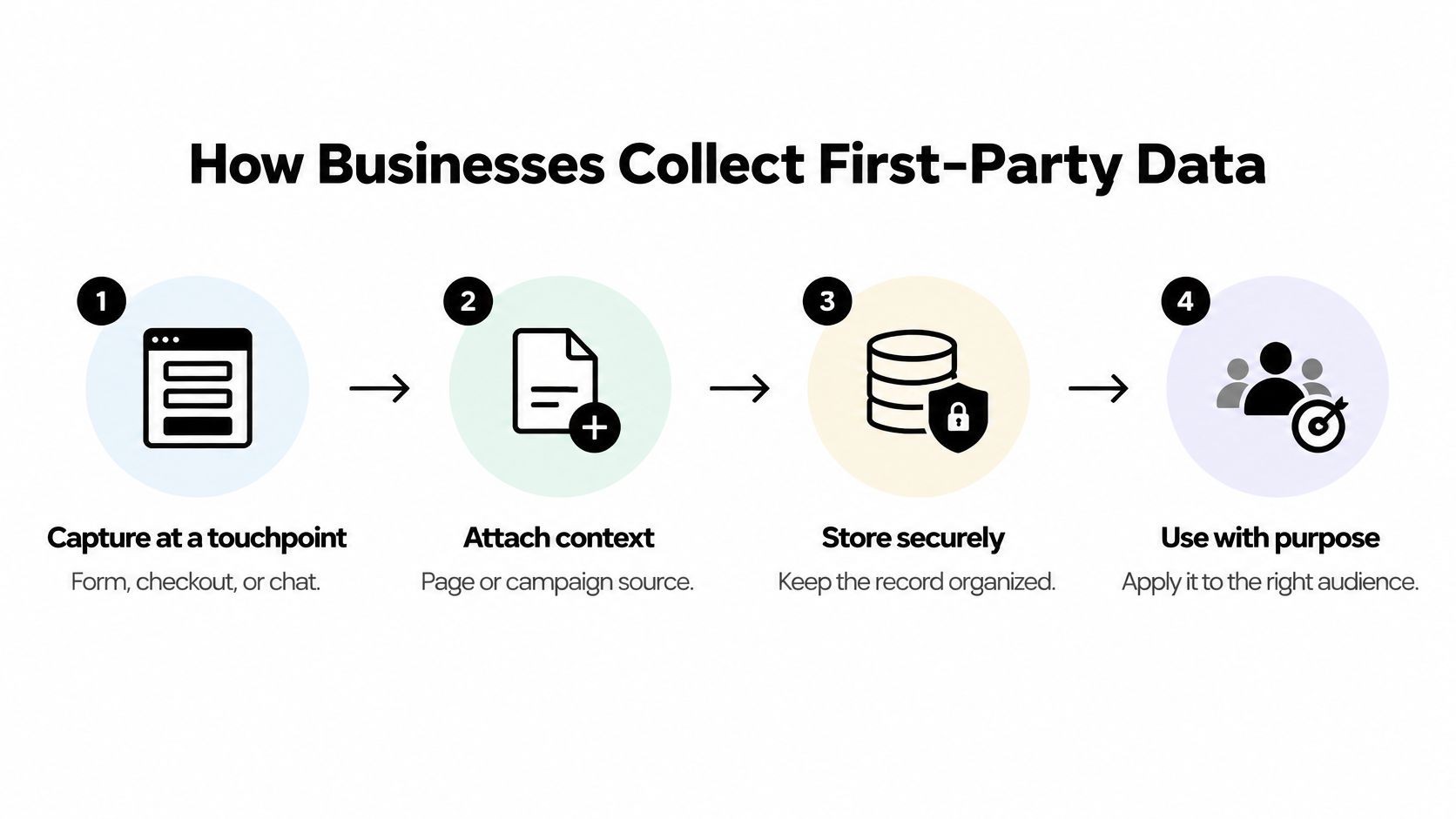
The flow below shows the broad process, with identity linking treated as a separate decision in the practical steps.
-
Capture information at a touchpoint. A newsletter form might request an email address and offer an unchecked subscription checkbox explaining what you'll send. For form design, the guide to website forms for lead generation provides a useful starting point.
-
Attach the collection context. Record the form's page, relevant campaign, submission time, and notice version, adding device or region only where justified. Without an origin and timestamp, your team may struggle to explain how a contact entered the system.
-
Store the record consistently. Send it to your customer relationship management system, or CRM, using agreed field names. Maintain an event dictionary, a shared document describing each event, its fields, its purpose, and its owner.
-
Decide whether identity linking is necessary. Keep session identifiers separate from names and email addresses unless there's a valid reason and lawful basis to connect them. Don't merge profiles merely because devices or browsing patterns look similar.
-
Use the record for an approved purpose. Send the requested newsletter, include the submission in appropriate reporting, or apply an authorised preference. Restrict access so another team can't repurpose the record.
Make the request understandable
The European Data Protection Board's guidance explains that processing needs a lawful basis and, when you rely on consent, it must be freely given, specific, informed, unambiguous, and withdrawable. Use plain checkbox wording rather than burying the intended use in a general policy.
If you're selecting a survey tool, Kiwiform's resource lets you explore alternatives to SurveyMonkey. Compare how the available tools handle optional questions, exports, and the records you'll need alongside each response.
First-Party Versus Second-Party and Third-Party Data
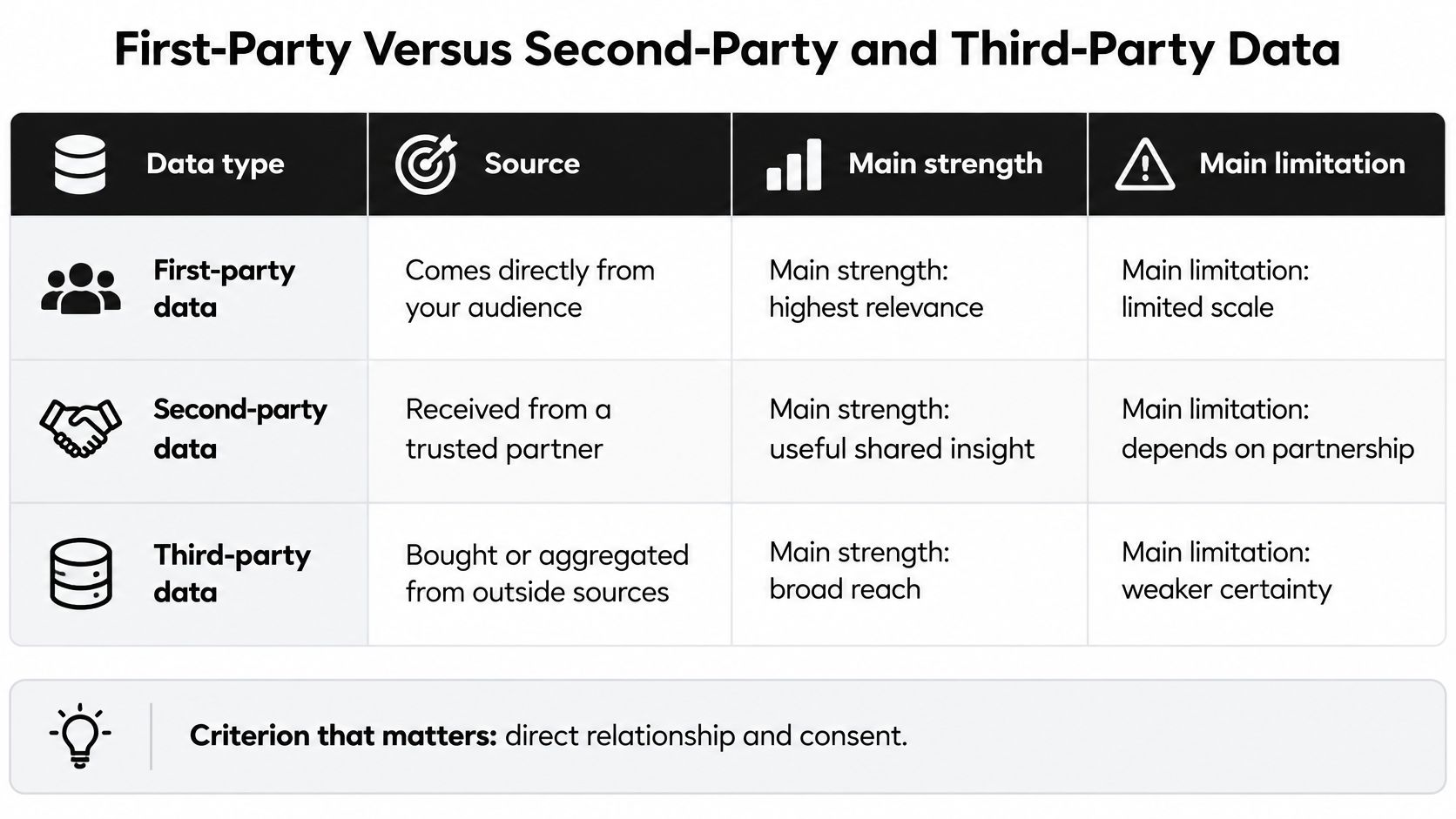
| Data type | Where it comes from | Main strength | Main limitation |
|---|---|---|---|
| First-party | Your own website, app, CRM and customers | Direct context and high relevance | Limited to people who already interact with you |
| Second-party | A partner's first-party data, shared under agreement | Specific audience with a known source | Relies on the partner's quality and contract terms |
| Third-party | External data brokers and aggregators | Large scale and broad reach | Potentially weak provenance and an unclear consent trail |
| Zero-party | Information customers volunteer, such as stated preferences | Explicit intent rather than inferred interest | Narrow coverage and a need for a reason to share |
The visual comparison highlights how distance from the original interaction changes what you can verify.
Zero-party data isn't necessarily separate from first-party data. A preference someone gives you directly can fit both descriptions. Volunteered answers can still be outdated, mistaken, or limited to a particular situation.
Judge the permission trail
The key criterion is provenance, meaning the record's origin and history, alongside permission for the proposed use. The Information Commissioner's Office guidance on valid consent explains why consent obtained for another organisation doesn't automatically authorise your organisation's processing.
A partner agreement therefore isn't enough by itself. Ask what the person was told, which organisations were identified, and which purposes they selected.
For a defensible personalisation setup, retain the source, event time, relevant device and region, consent status, processing purpose, identity-matching confidence, and rule or model version. Use coarse location or session-level information when that's sufficient, rather than keeping unnecessary identifiers.
A purchased record doesn't become unrestricted simply because it arrives with a consent field.
The embedded video provides another format for considering these data categories.
Use first-party records to understand direct customer interactions. Consider second-party information for a defined partnership use after checking collection and sharing terms. Treat third-party lists cautiously, particularly when the seller can't substantiate their origin or permission trail.
Privacy Rules That Shape First-Party Data
No, first-party data isn't automatically legal or safe to use. Information that identifies or relates to someone remains personal data, even when your own business collected it.
The EU's GDPR overview describes a framework applying to organisations processing personal data in the European Economic Area and companies outside the EU targeting people there. Relevant processing needs a lawful basis, clear purpose, transparency, security, and respect for individual rights.
A privacy review should connect those requirements to actual customer interactions.
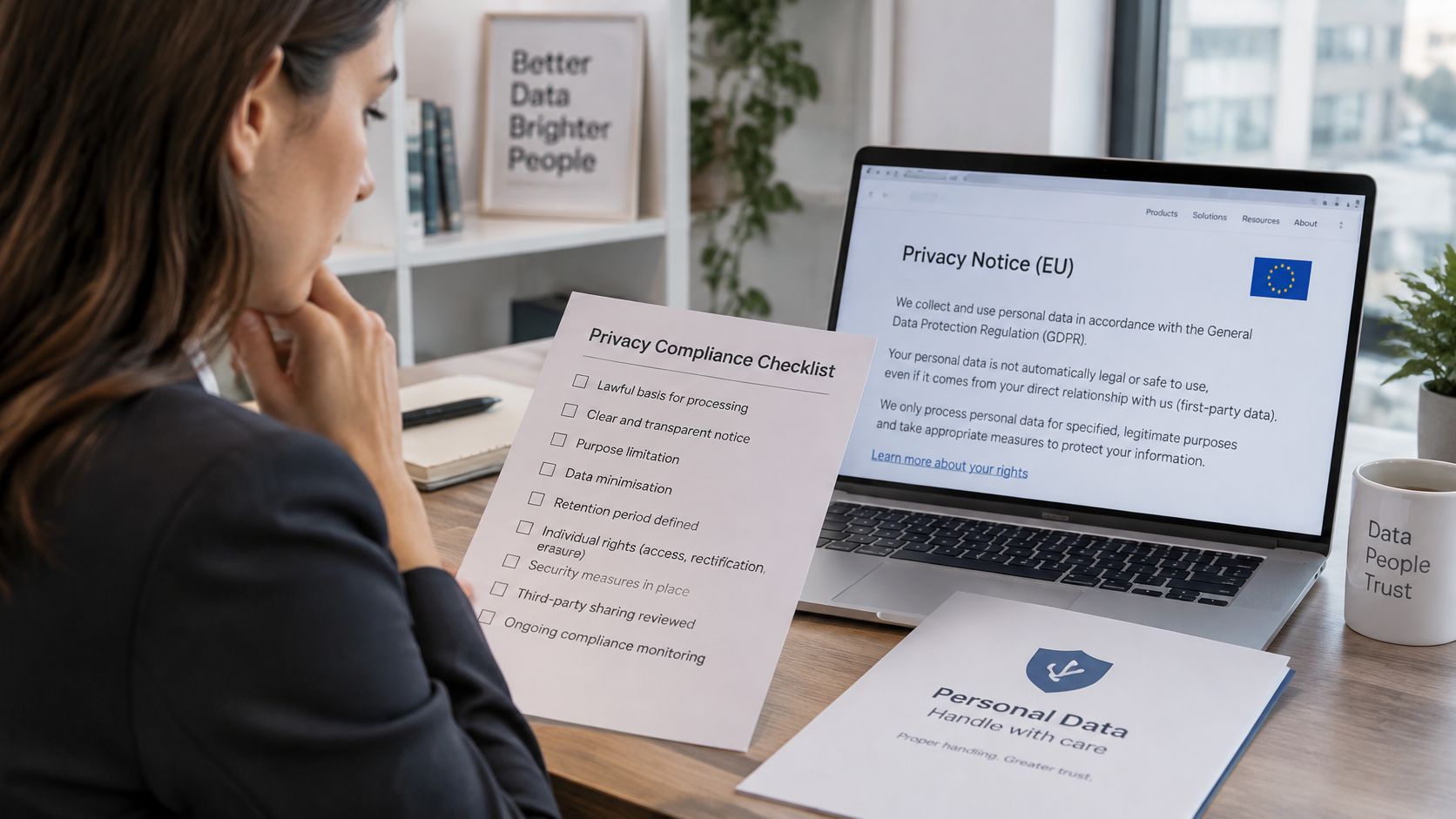
Check the use, not just the field
- Separate service from marketing: An order confirmation and a retargeting audience can use the same email address, but they need their own justification.
- Keep permission specific: A newsletter subscription doesn't, by itself, authorise uploading that address for paid advertising.
- Respect technical restrictions: Browser controls and user settings can limit first-party cookies too, as Google's explanation of cookie controls illustrates.
For operational planning, Freeform Company's guide to data mapping and rights request tools can help you identify systems to review. When planning data-driven personalisation, include permission checks in the design rather than treating them as a final approval task.
Keep the applicable notice, lawful basis, consent state where relevant, and retention rules attached to the record wherever it's used. A customer-facing choice is only useful if downstream teams honour it.
Why First-Party Data Does Not Prove Causality
In a 2025 survey of 750 employees at companies with more than 500 employees across the U.S., U.K., EMEA, APAC, and Australia, only 18% were very confident they could match app installs to the correct source, according to MediaPost's coverage of attribution and data challenges.
That coverage reports the following findings. The employee-survey results concern attribution and privacy, while the separate marketer findings concern data quality and integration.
| Finding | Figure |
|---|---|
| Employee respondents very confident they can match app installs to the correct source | 18% |
| Employee respondents saying privacy regulations created costly measurement blind spots | 74% |
| Employee respondents reporting greater cross-channel attribution difficulty | 41% |
| Marketers facing data challenges in separate 2025 research | 81% |
| Marketer challenge involving inaccurate personalisation data | 57% |
| Marketer challenge involving difficulty combining sources | 47% |
First-party collection isn't a complete replacement for third-party tracking. Customers can switch devices, decline tracking, or buy through a channel you can't connect. Even correctly matched records don't establish why someone purchased.
Turn observations into a test
Use a practical measurement workflow:
-
Connect permitted events to outcomes. Join relevant website events with CRM, campaign, and revenue records using documented matching rules. Keep uncertain matches distinguishable from confirmed ones.
-
Describe the missing population. Identify purchases without a linked session and visitors whose behaviour isn't observable. State which customer groups your analysis represents.
-
Avoid false precision. Label attributed revenue as attributed revenue, not revenue caused by a campaign. Don't turn an incomplete journey into a confident story about every touchpoint.
-
Create a holdout group. Randomly assign eligible visitors to the personalised experience or an unchanged version. Define the purchase outcome before you launch, and assess uncertainty before declaring a winner.
Attribution asks which recorded touchpoints get credit. Incrementality asks whether your intervention changed the outcome.
Say visitors who see a personalised banner convert more often than visitors elsewhere on the site. That comparison may reflect stronger purchase intent among the people selected for personalisation.
If a properly assigned control group converts at the same rate, and the test is sufficiently informative, you haven't demonstrated additional lift from the banner. The records helped you test a claim, not prove it in advance.
Audit Your First-Party Data Before You Act
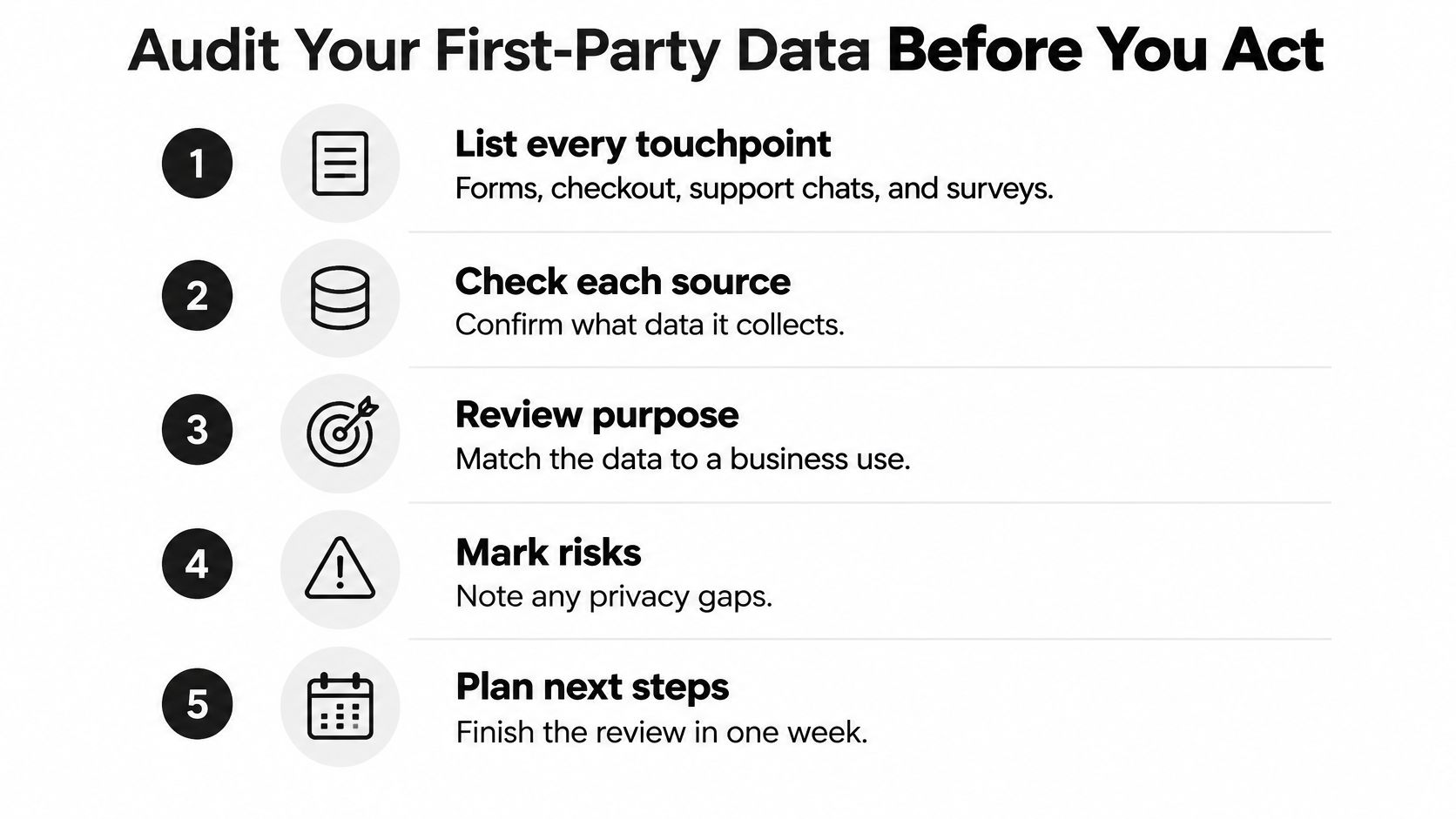
Set aside a working week for a focused inventory. Give each task a named owner and finish date, and keep the results in a shared audit document.
Use this checklist to organise the review.
-
List active touchpoints. Ask marketing, sales, support, and engineering to identify forms, checkout pages, chats, surveys, and tracking scripts. Include systems nobody currently uses for reporting.
-
Document fields and purposes. Have each system owner record what it collects, the applicable permission state, and the intended use. Flag records whose collection context can't be established.
-
Check the destination. Ask your analytics owner to trace sample records into the CRM or reporting system. Verify timestamps, origins, and field definitions rather than assuming an integration preserves them.
-
Remove unnecessary identifiers. Have the privacy and technical owners review access, retention, and deletion. Keep aggregate or session-level alternatives where they answer the business question.
-
Choose a testable decision. Ask your growth lead whether a sign-up preference could improve repeat purchases. Document an appropriate holdout before launching personalisation.
Keep the inventory usable
At Polish, we measure visits with our own first-party pixel, fully independent of the customer's analytics stack. Inventory independent measurement scripts alongside your existing analytics tools so the review reflects what is installed.
Pair the inventory with a conversion rate optimisation audit to connect collection choices to customer-facing decisions.
Finish the audit before expanding collection. Revisit the written record each quarter and whenever your team adds a touchpoint.
Polish uses visitor context to write and select landing-page headlines, subheadings, and calls to action. Once you've clarified which signals you can responsibly use, visit Polish to explore applying that context to your landing pages.
- first party data
- data privacy
- zero party data
- customer data
- marketing data
Your website rewrites itself until it converts.
Polish writes new versions of your headlines and CTAs, tests them on your real visitors and keeps the ones that win.
Start free