Conversion Rate Optimization Audit: What to Check
Run a conversion rate optimization audit that checks data, funnel drop-off, checkout friction, accessibility, and which test to run next.
Published on 12 min read

Table of contents
- Why a Conversion Rate Optimization Audit Starts at Checkout
- Treat abandonment as an economic signal
- Inspect the path to payment
- Check the Data Before You Trust the Funnel
- Use a pass-fail checklist
- Define success before collecting ideas
- Map Where Qualified Visitors Drop Off
- Separate journey steps from audience cuts
- Prefer valuable losses over impressive percentages
- Read Copy, UX, and Accessibility Together
- Connect the message to the action
- Test whether people can complete the task
- Choose Tools That Match the Audit Job
- Match capability to responsibility
- Put adaptive copy under measurement discipline
- Rank Hypotheses Before You Run a Test
- Make each hypothesis testable
- Reject tests your traffic can't support
- Turn the Audit into Your Next Experiment
- Choose the action the evidence supports
- Leave with a ship or stop decision
70.19% of shopping carts are abandoned globally, according to Baymard Institute's checkout usability research, covering 14 years and 49 studies, which also reports an average checkout with 11.3 form fields, complexity-related abandonment among 17% of users, and a potential 35% conversion increase through better checkout design on the average large ecommerce site. That's a stronger reason to inspect checkout than to spend your audit week debating homepage headlines.
A conversion rate optimization audit should help you decide where to spend engineering, design, and marketing effort. Start with demonstrated purchase intent, verify your measurement, and put checkout friction, accessibility defects, and message quality into the same ranked backlog.
Why a Conversion Rate Optimization Audit Starts at Checkout
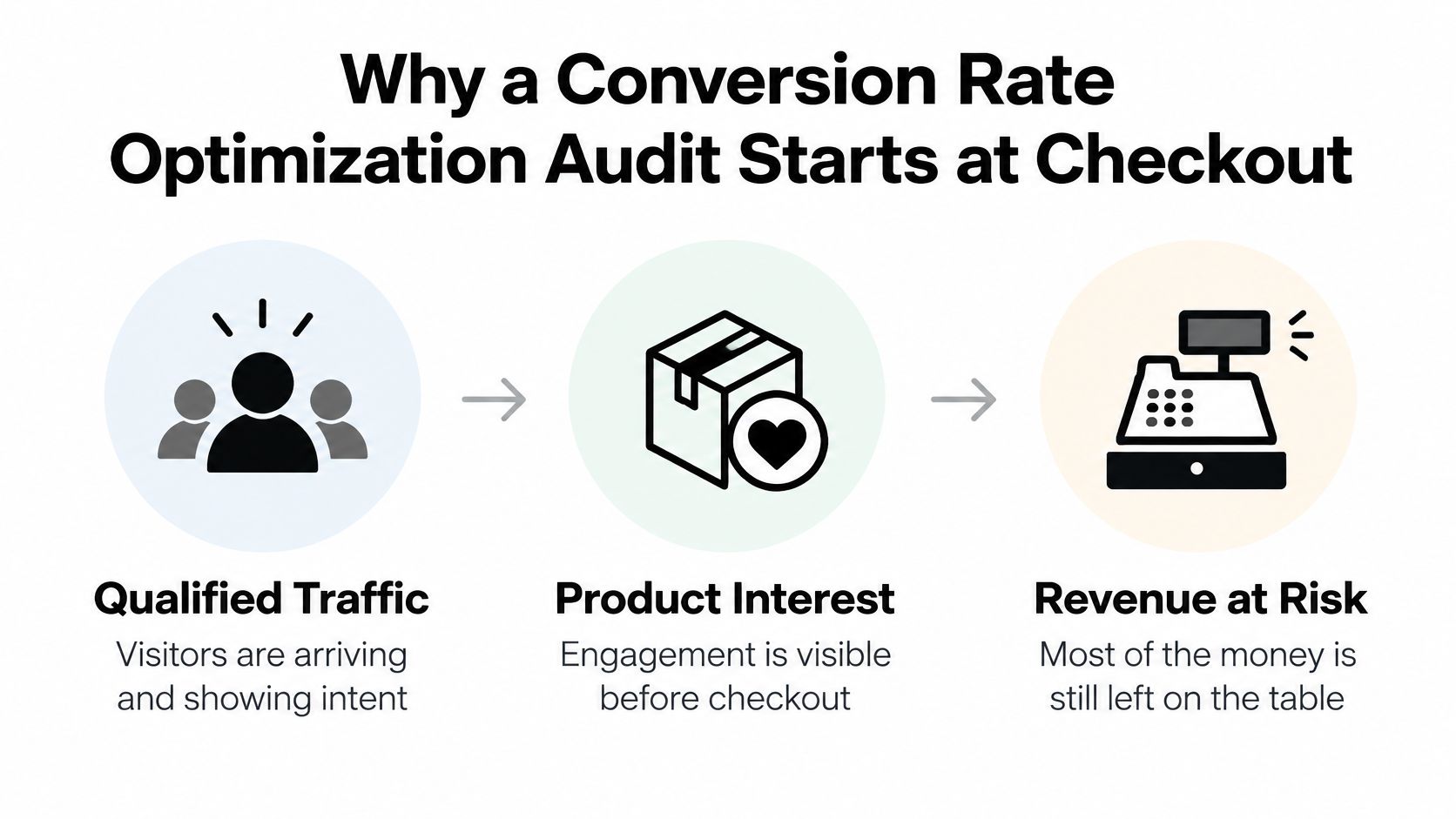
Qualified traffic is arriving. Visitors are exploring products and adding items to their carts. Your acquisition team has generated interest, but your order system isn't recording the purchases you expected.
That's where I'd start the audit. A visitor who has selected a product has shown more intent than someone who briefly opened a landing page. Before asking how to persuade more people, ask whether interested shoppers can finish.
Treat abandonment as an economic signal
Baymard's global benchmark is a structural reference, not a verdict on your website. Your product, audience, and buying cycle matter. Don't subtract your abandonment rate from an industry average and call the difference recoverable revenue.
The checkout design opportunity is also a potential improvement, not a promised result. Use it to justify investigation, then build the business case from your own completed orders, exits, and implementation costs.
Keep the relationship between traffic, intent, and revenue visible during the audit.
Inspect the path to payment
Run a purchase on a real phone and a desktop. Include a failed payment and a form error, not just the successful path your team already knows.
- Field count and guest checkout: Challenge each required field. Check whether shoppers can buy without creating an account.
- Error handling: Confirm that errors identify the problem, preserve entered information, and provide a clear recovery action.
- Mobile usability: Check whether the keyboard covers controls and whether shoppers can move between fields without losing context.
- Price transparency: Look for costs that appear only after shoppers have invested effort.
- Payment options and trust: Verify that payment choices work and that delivery, returns, and payment information are available where buyers need them.
When payment behavior needs technical investigation, bring the implementation owner into the review. Continuum Solutions' Stripe payment integration resource is a relevant starting point for that conversation, rather than treating every payment exit as a copy problem.
Economic priority: Remove obstacles for people who already want to buy before trying to persuade more people to want the product.
For a lead-generation business, apply the same logic to form completion or booking confirmation. Start near the valuable commitment. Headline and button experiments belong in the backlog, but they shouldn't automatically lead it.
Check the Data Before You Trust the Funnel
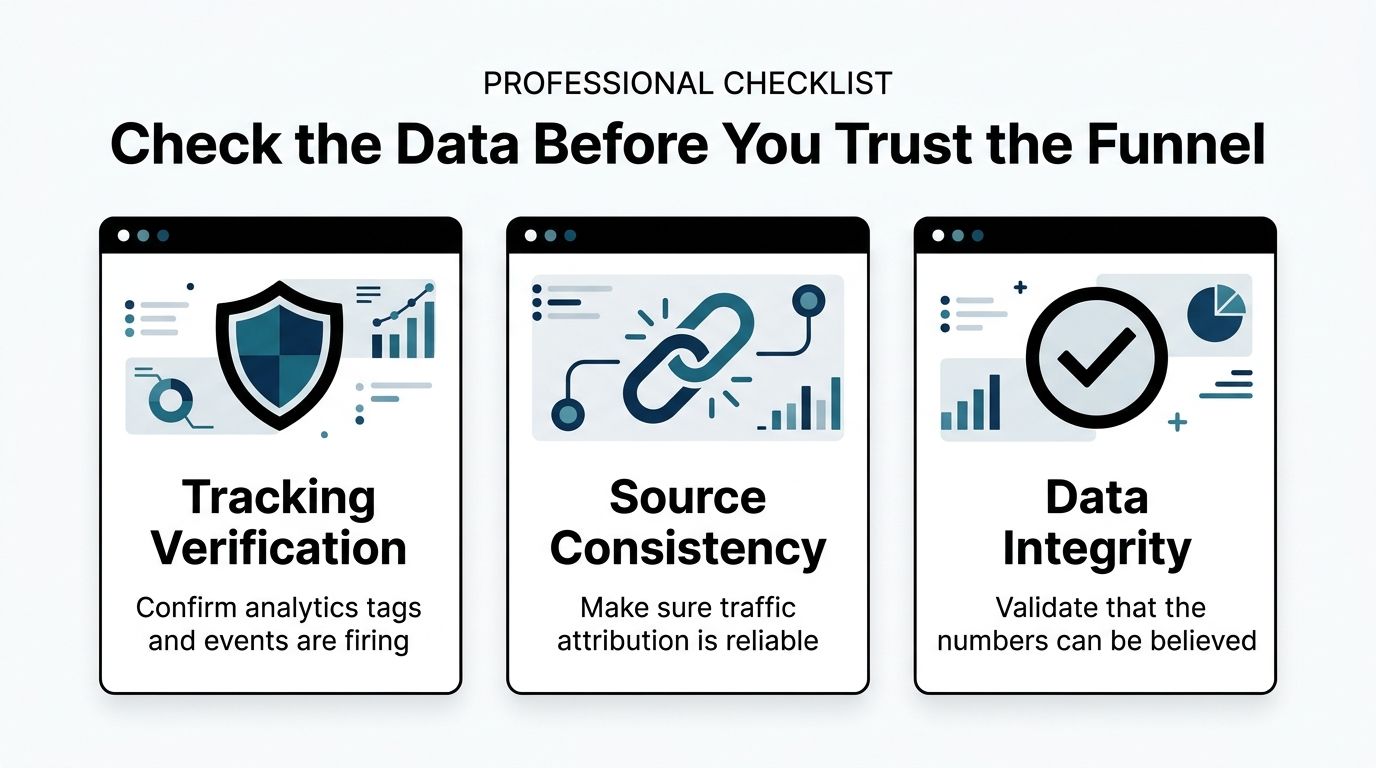
On Monday, give the growth lead and the tracking owner the same task: complete a real conversion and follow it through analytics and the business system. Don't open heatmaps until you know what a recorded conversion means.
A defensible audit begins by checking events, revenue, currencies, deduplication, attribution, and consent handling, then defining a primary metric and quality guardrails, as outlined in Omniconvert's CRO audit guidance. Treat this as a gate, not administrative cleanup.
Use a pass-fail checklist
Complete the checks together and attach evidence to each result.
- Conversion events: Confirm that the event follows an actual successful transaction or submission and doesn't fire again on refresh.
- Revenue and currency: Reconcile a test purchase with the order system. Document how discounts, shipping, taxes, and refunds enter reporting.
- Deduplication: Check whether browser and server events describe the same transaction without counting it twice.
- Attribution: Confirm that campaign identifiers survive the journey, including payment redirects.
- Consent handling: Test supported consent states and document what remains observable. Don't bypass a visitor's choice to improve reporting.
Use the checklist to record a pass, a failure, or a clearly bounded limitation.
A mobile shortfall might reflect a blocked tag rather than failed purchases. A campaign might appear weak because its revenue was recorded incorrectly. These are possibilities to eliminate before changing the customer experience.
Define success before collecting ideas
Write down the primary business metric in terms another team can reproduce. For qualified lead rate, specify what qualifies a lead, which visitors enter the denominator, and how long qualification can take.
Then choose guardrails appropriate to the business. Spam rate can protect lead quality; activation can protect signup quality; refund rate can protect purchase quality. Assign an owner to each metric and record where it comes from.
Don't reward a page for producing submissions the sales team can't use.
Finish this session with written definitions and a list of unresolved measurement issues. Later differences between devices, campaigns, or countries remain diagnostic until a preplanned experiment confirms them. A reporting split isn't permission to declare a winner.
Map Where Qualified Visitors Drop Off
On Tuesday, build a funnel view your team can defend without narrating every dashboard tab. Map the actual customer journey, then compare who completes each transition.
For ecommerce, that might run from landing page to product, cart, checkout, and purchase. For a service business, use landing page, form start, submission, and qualified booking. Keep separate journeys separate when they represent different commitments.
Separate journey steps from audience cuts
Device, country, and campaign aren't chronological funnel stages. They're dimensions you apply to the journey to locate concentrated losses.
Use this visual as a reminder of the cuts to inspect, not as a sequence every visitor follows.
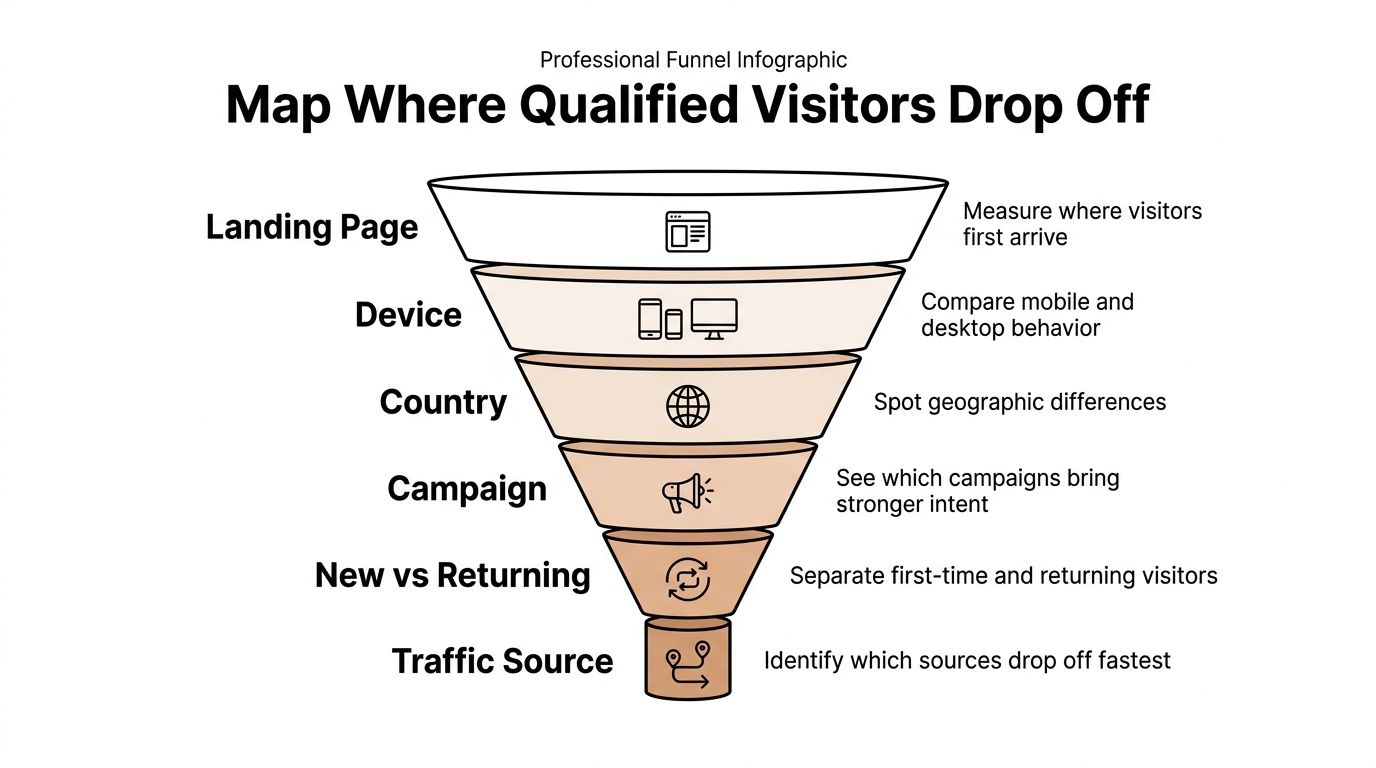
Compare landing pages, devices, countries, campaigns, new versus returning visitors, and traffic sources. Keep the reporting period and event definitions consistent so your comparisons describe the same underlying journey.
For each transition, record the following.
| Field | What to record |
|---|---|
| Visitors entering | Eligible visitors who reached the step |
| Completion rate | The share who reached the next defined step |
| Exits | Visitors who didn't make that transition |
| Business value | Known downstream value, or an explicit unknown |
| Segment | The audience cut under investigation |
| Measurement limitation | Any issue that affects interpretation |
Prefer valuable losses over impressive percentages
Consider a hypothetical paid campaign whose desktop visitors complete purchases while mobile visitors stall at checkout. That's a focused investigation candidate, not proof that mobile users need a different offer.
The useful observation is specific: visitors from the same acquisition context behave differently near purchase. Record the affected transition and target segment. Don't label desktop the winning experience or immediately redirect budget.
Compare absolute exits alongside completion rates and business value. A large audience leaving early may contain little buying intent; a smaller group leaving near payment may deserve more attention. Where value is unknown, mark it unknown rather than filling the sheet with optimistic revenue estimates.
Keep the page readable in a meeting. The growth lead should be able to point to the suspected loss, explain who it affects, and distinguish a measured observation from an interpretation. Save the explanation of why visitors leave for direct investigation.
Read Copy, UX, and Accessibility Together
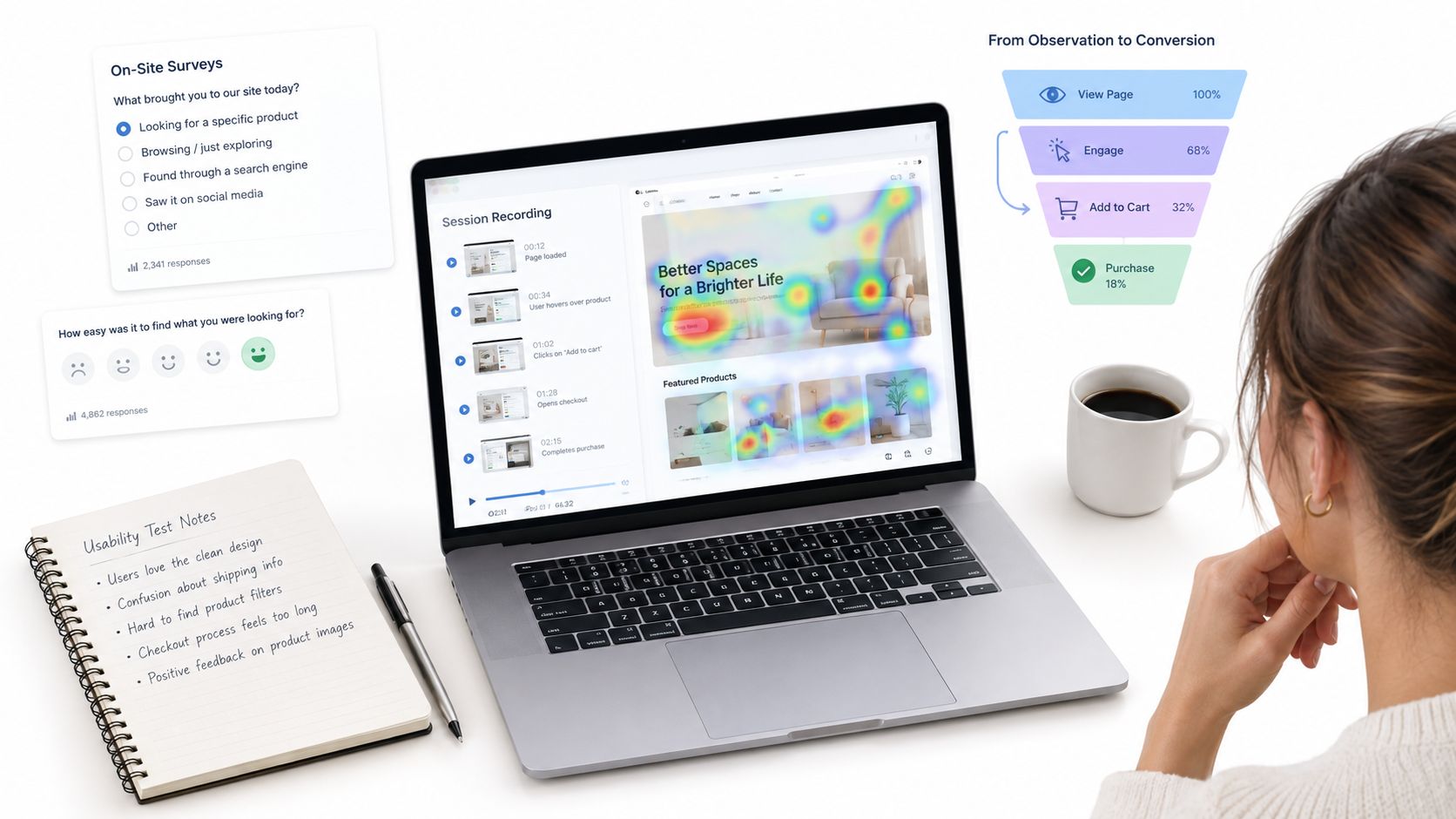
Wednesday is for watching people attempt the actions your funnel has flagged. Use session recordings, heatmaps, on-site surveys, and usability tests to investigate specific exits, not to collect an entertaining library of visitor behavior.
Keep the customer's task beside the evidence while you review.
Connect the message to the action
Inspect copy where it changes a decision: an unclear offer, missing price, unsupported reassurance, or a CTA that doesn't match the ad or search query. Pair the observation with a funnel event rather than writing that the page needs stronger messaging.
For service businesses, the emphasis on websites that bring in booked jobs from Aim Set Win is a useful outcome lens. Review whether visitors can understand the service and complete a booking, not merely whether they click the contact button.
A practical guide to making pages optimized for web can support the page review. Keep your findings tied to the customer's attempted action.
Test whether people can complete the task
A 2025 accessibility audit covering 250 ecommerce pages across five European markets and five global marketplaces found that 94% had inaccessible checkout flows, with no market reaching 50% compliance with the assessed WCAG 2.2 criteria. Don't leave accessibility in a separate compliance document that never reaches the growth backlog.
Pair automated scans with direct checks.
- Keyboard and screen reader: Follow focus through the form and confirm that controls have meaningful labels.
- Zoom and contrast: Verify that information remains readable and controls remain usable.
- Errors and payment: Trigger validation failures and complete the payment journey using assistive interaction methods.
Attach each defect to the affected action. Ask whether it appears differently for mobile, returning, or international visitors, without assuming those segments identify disability.
Use the following video as a discussion aid alongside your own task-based review.
Dynamic headlines, subheadings, and CTAs still need stable semantic structure, contrast, focus order, and button labels. A more relevant message doesn't compensate for an unusable control.
Removing a hard barrier can matter more than improving persuasion for visitors who can already complete the task.
Choose Tools That Match the Audit Job
Buy tools against a documented gap in the audit workflow. Don't buy another dashboard because your team hasn't agreed on the question.
Start with the measurement system you can reconcile to business outcomes. Add qualitative evidence and accessibility checks where you need an explanation. Choose experimentation or adaptation software only after you've established what it must measure.
Match capability to responsibility
| Audit job | What good enough looks like | What it shouldn't decide |
|---|---|---|
| Event and funnel measurement | Consistent events and reconcilable outcomes | Why a visitor left |
| Sessions and surveys | Evidence tied to an affected task | Whether a change caused improvement |
| Accessibility scanning | Repeatable findings with manual verification | Whether the entire journey is accessible |
| Experiment design | Planned allocation, sample requirements, and outcome reporting | Which business outcome matters |
| Message adaptation | Contextual variants with an independent comparison | Whether extra conversions are valuable |
Use this comparison of conversion rate optimization tools to organize your shortlist around these responsibilities. Avoid asking a qualitative tool to prove causality or an adaptation tool to define commercial success.
If unanswered shopper questions are the suspected issue, SignalZen's guide to ecommerce chatbots is relevant to evaluating conversational support. That's a different job from rewriting a landing-page headline.
Put adaptive copy under measurement discipline
Polish is an autonomous AI agent among the adaptive landing-page options. After script installation, it reads the page, writes headline, subheading, and CTA versions, and selects a version for each visitor based on what converts for similar visitors. Its context includes the originating ad, post, or search, campaign, device, country, and whether the visitor is new or returning; each visit informs subsequent selections.
Don't treat personalization as an automatic win. Small segments can produce unreliable conclusions, while repeated adaptive changes complicate comparisons. Evaluate the adaptation policy against a stable holdout, with a predefined primary metric, minimum sample, and guardrails.
Compare qualified conversion, revenue per visitor, retention, refunds, and complaints rather than immediate conversion alone. Check for discount dependence, poor-fit leads, cancellations, novelty, seasonality, acquisition-mix changes, and returning-user effects.
Finally, review whether the signals used are proportionate and compatible with applicable consent and data-minimization requirements. More targeting detail isn't a reason to collect more data by default.
Rank Hypotheses Before You Run a Test
On Thursday, turn observations into decisions. Put checkout defects, accessibility barriers, and message opportunities in the same backlog, ranked by expected impact, confidence, and implementation effort.
Prefer an observed barrier affecting high-intent visitors over a speculative improvement to a lightly used page. Don't give copy an automatic advantage because marketing can ship it without engineering.
Make each hypothesis testable
Each backlog entry should contain:
- Observed evidence: The event pattern and supporting task-level observations.
- Proposed change: A bounded intervention, not a request to redesign everything.
- Target segment and mechanism: Who should benefit and why their behavior should change.
- Detectable effect and stopping rule: The improvement worth detecting and the conditions for completing the experiment.
Use a clear A/B testing hypothesis to connect the proposed change to the business outcome. Keep confidence separate from impact: an expensive problem can still have an uncertain diagnosis.
Reject tests your traffic can't support
At 95% confidence and 80% power, the following planning examples illustrate how sharply sample requirements change with the effect you want to detect; the same statistical significance guidance explains that peeking can raise false positives from 5% to roughly 20–30%, while ten independent 95%-confidence tests create about a 40% chance of at least one false positive when no real effect exists.
Visitors Needed for Two Common Lifts
| Relative lift | From-to rate | Visitors per variant |
|---|---|---|
| 20% | 5% to 6% | Roughly 15,000 |
| 5% | 5% to 5.25% | About 240,000 |
These are planning examples, not universal sample requirements. Calculate your experiment using its baseline, minimum detectable effect, significance threshold, and power.
Predefine the primary metric, randomize assignment, and don't change traffic allocation midway through a conventional test. Wait for the planned sample or use a sequential-testing method specifically designed for continuous monitoring.
If the available traffic can't support the question, don't launch an underpowered experiment and hope for a clear dashboard result. Narrow the decision, collect stronger usability evidence, or acknowledge that a necessary repair won't produce a precise causal lift estimate.
Your deliverable is a ranked first action with a credible measurement plan. A long list of page tweaks isn't a testing strategy.
Turn the Audit into Your Next Experiment
Friday's meeting should end with a commitment, not another request for ideas. Pick the highest-ranked barrier and assign an owner who can deliver the change and coordinate measurement.
Write a decision record before anyone edits the page. Name the primary metric and a pair of guardrails, then specify the stopping rule and the date when the team will review results. That date is a checkpoint, not permission to declare success without sufficient evidence.
Choose the action the evidence supports
| Audit outcome | Next action |
|---|---|
| Instrumentation failed | Repair tracking, reconcile outcomes, and rerun the affected comparisons |
| Checkout friction is the strongest finding | Implement the bounded correction and evaluate it with a suitable comparison |
| Accessibility prevents completion | Fix the defect and verify the task manually |
| Landing-message mismatch is well supported | Test message changes if traffic supports the design |
For nonblocking checkout improvements, a holdout can help evaluate the repair. Don't deliberately preserve a known accessibility blocker just to maintain a control group. Correct it, confirm that people can complete the task, and be explicit about the limits of any before-and-after revenue comparison.
If the message is the gap, use the adaptive option described above with an independent holdout. Carry forward the established business-quality measures rather than replacing them with clicks because those results arrive sooner.
Leave with a ship or stop decision
The handoff should identify the observation, intervention, owner, review date, and decision conditions. Include what would make the team stop early for harm, ship after the planned evaluation, or continue because the evidence remains inconclusive.
Keep the scope narrow enough that everyone knows what changed. If the team simultaneously rewrites the offer, removes fields, changes payment options, and adjusts acquisition targeting, it won't know which decision to repeat.
A useful audit week ends with an actionable hypothesis and an accountable owner. Choose the barrier you can defend, make the smallest responsible intervention, and preserve enough measurement discipline to learn from the result.
If your audit identifies landing-message relevance as the next opportunity, Polish offers visitor-specific headline, subheading, and CTA adaptation through an installed script. Visit the site to evaluate that option, then carry your audit's primary metric, holdout, and quality guardrails into the rollout.
- CRO audit
- funnel analysis
- checkout UX
- A/B testing
- growth experiments
Your website rewrites itself until it converts.
Polish writes new versions of your headlines and CTAs, tests them on your real visitors and keeps the ones that win.
Start free