7 Converting Landing Pages Examples That Work
Explore 7 converting landing pages examples, including headlines, CTAs, layouts, personalization tactics, and measurable lessons you can apply.
Published on 13 min read
Table of contents
- 1. Polish
- Match the promise without changing the offer
- 2. Unbounce Smart Traffic
- Make each variant express a hypothesis
- 3. Pathmonk AI Personalization and CRO
- Connect behavior to a business outcome
- 4. Instapage Landing-Page Creation, Personalization, and Testing
- Separate structure from form friction
- 5. VWO Web Experimentation and Personalization
- Choose the method after the question
- 6. Optimizely Personalization and Experimentation
- Govern audiences as carefully as copy
- 7. Convert Experiences A/B Testing and Personalization
- Turn a redesign idea into a sequence
- Core Features Comparison of 7 Landing Page Conversion Tools
- Build Your Conversion Learning Loop
- Choose the bottleneck before the tool
- Keep what you learn, not just what wins
What makes a landing page convert when another page with an equally attractive design doesn't? A useful answer starts with the visitor, not the decoration: what brought them there, what they expect, and what might prevent them from taking the next step.
A high-performing landing page helps a qualified visitor understand the offer, recognize the problem, trust the solution, and act. You can find landing page best practices to guide that foundation, but copying a layout won't tell you which message fits your audience.
Benchmarks also need context. Unbounce's analysis of more than 41,000 landing pages found a 6.6% median conversion rate, but financial services reached 8.4%, compared with 3.8% for SaaS, according to MarketingProfs' landing-page benchmark summary. Those differences make a universal conversion target a poor basis for choosing software.
The seven tools below represent different ways to improve converting landing pages, from building controlled variants to autonomously adapting copy. They aren't seven independently proven conversion winners. The practical comparison is which conversion mechanism each tool supports, how much work your team retains, and what evidence you'll need before calling a change successful.
1. Polish
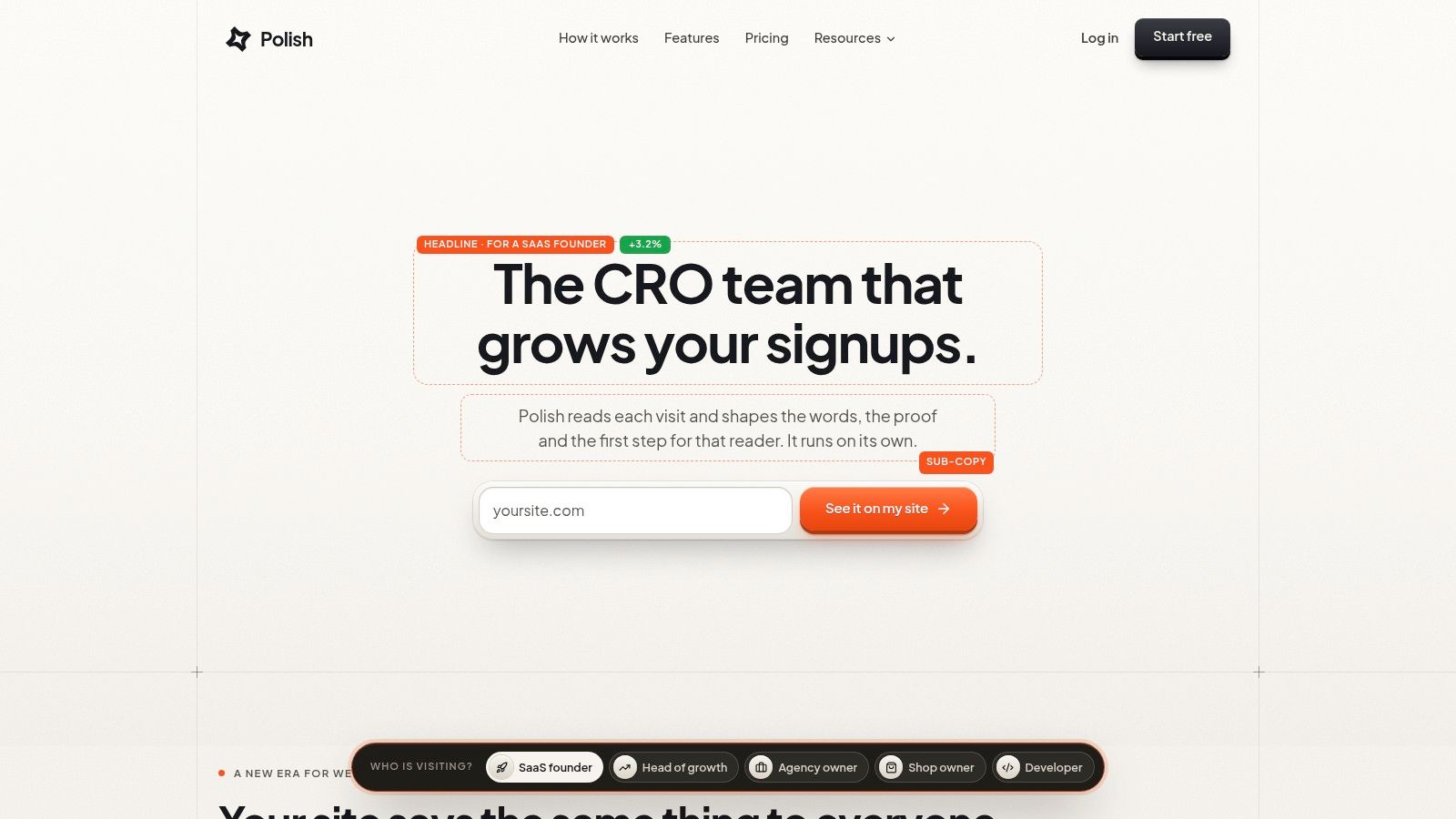
Polish addresses message mismatch rather than page construction. Its current engine adapts and tests headlines and calls to action using visit context, including referral source, campaign, device, country, and whether someone is new or returning. The distinction matters: instead of asking marketers to write every alternative, the agent generates copy and serves the best-performing options.
Installation uses a lightweight script, with support described for Next.js, Webflow, WordPress, and Shopify. Polish aims to preserve the existing design and brand voice, while a readable decision feed and review, guidance, and pause controls keep marketers involved.
Match the promise without changing the offer
Consider a proposed experiment for a software landing page. A visitor arriving from an onboarding campaign could receive a headline emphasizing implementation, while someone arriving from a reporting campaign could see the reporting benefit emphasized. Both messages must remain accurate descriptions of the same product.
CTA specificity should follow the actual next step. If the destination is a consultation form, the button shouldn't imply immediate product access. Personalization should make expectations clearer, not merely make the invitation more persuasive.
- Strength: Copy generation and testing reduce the need to manually prepare every headline and CTA alternative.
- Control: Marketers can guide the voice and pause changes rather than surrendering editorial responsibility.
- Current limitation: Broader personalization involving proof and section order is rolling out to early-access users; it shouldn't be treated as universally available.
- Evidence limitation: The supplied product material contains no published customer testimonials or quantified customer conversion results.
Practical rule: Automate message adaptation, but keep a stable baseline so you can distinguish incremental improvement from changes in traffic.
Polish is most relevant when you already have a credible offer, supporting proof, and a usable page, but suspect that a generic message underserves different acquisition contexts. It isn't a substitute for fixing an unclear product proposition or a broken form.
Its first-party, cookieless pixel is a measurement characteristic, not a blanket privacy exemption. Before deploying contextual personalization, review which signals the implementation uses, what visitors are told, and how regional requirements affect assignment and measurement.
2. Unbounce Smart Traffic
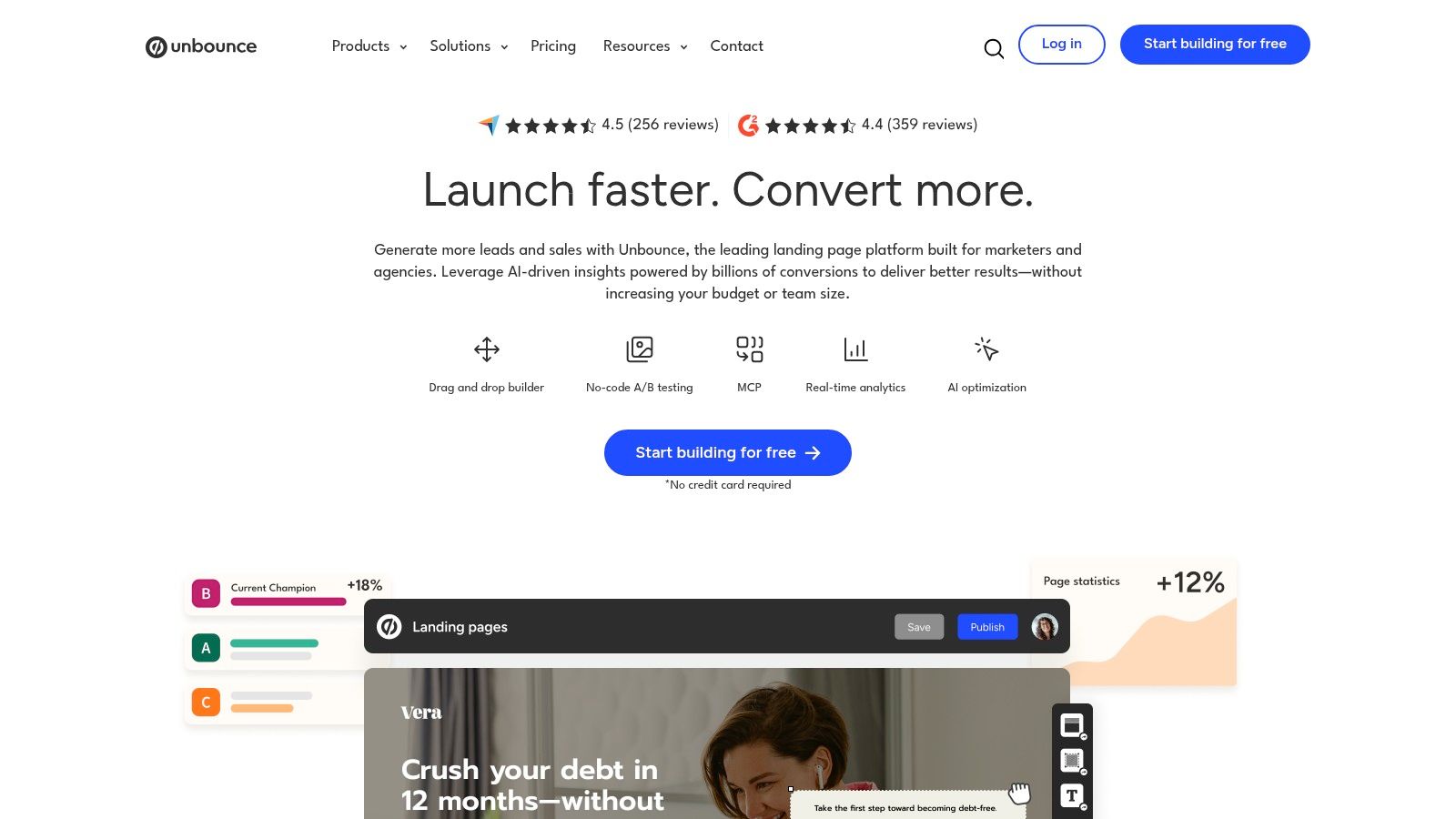
Do you need better messages, or a better system for building and distributing them? Unbounce combines a no-code landing-page builder, forms, templates, pop-ups, sticky bars, and testing. Smart Traffic routes visitors among marketer-created landing-page variants using contextual attributes such as location and device.
Unlike Polish's autonomous copy workflow, marketers remain responsible for the alternatives visitors can receive. That makes Unbounce a practical candidate for paid-campaign teams that want page creation and optimization in the same environment, while retaining direct ownership of each treatment.
Make each variant express a hypothesis
A useful proposed test would compare a broad product promise with a campaign-specific benefit while keeping the offer, proof, form, and destination unchanged. That isolates whether the message better matches the visitor's reason for clicking. Replacing the headline, layout, offer, and form together would answer a different question: whether the entire package performs better.
- Best fit: Marketers who need to publish campaign pages as well as optimize them.
- Operational advantage: Building and testing share a workflow, rather than requiring a separate page-building process.
- Important constraint: Smart Traffic applies to regular landing pages, not pop-ups or sticky bars.
- Planning consideration: Availability depends on the plan, and changes or republishing can return a page to a learning phase.
Don't confuse adaptive routing with a controlled explanation of why copy works. Routing can help distribute eligible traffic, but your team still needs a baseline and interpretable variants.
Choose Unbounce when page production is part of the bottleneck. If your existing pages already work operationally and you mainly want autonomous copy adaptation, its builder may be less central to the decision.
3. Pathmonk AI Personalization and CRO
A visitor who has explored your pricing may need a different next step from someone encountering the product for the first time. That's a behavioral-personalization hypothesis, not proof that either visitor should automatically receive a particular treatment.
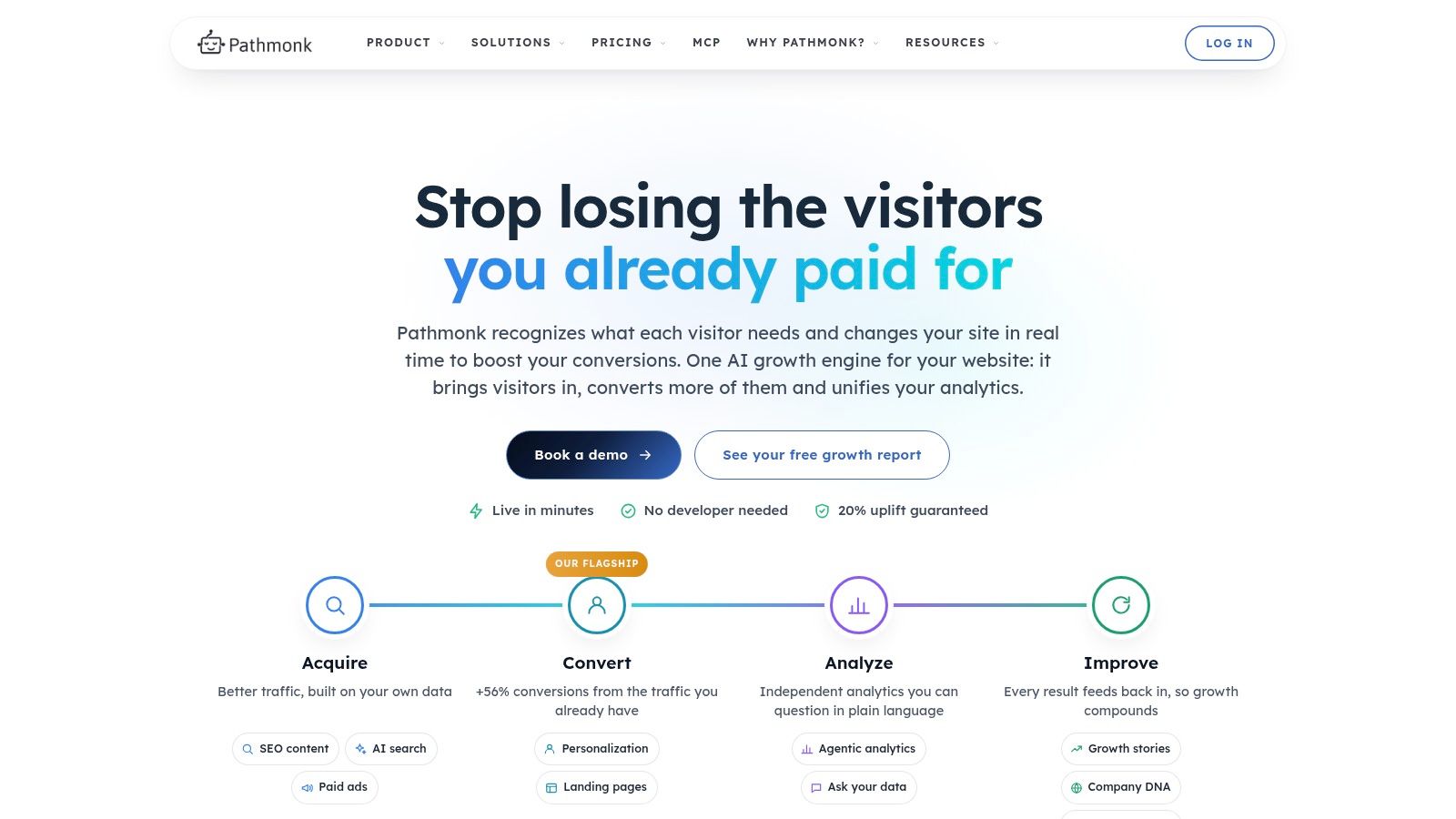
Pathmonk uses a site snippet and visitor behavior to personalize website experiences, including landing pages and funnels. Its platform combines personalization, analytics, and microexperiences, with testing against a control group and optional expert onboarding or managed optimization.
The strategic difference from campaign-led adaptation is the input. Campaign metadata describes how someone arrived; observed behavior can help a team form hypotheses about what they need next. These website personalization examples offer additional ways to think about that distinction without assuming every segment deserves its own experience.
Personalize around a decision the visitor needs to make, not simply around an attribute you happen to know.
Connect behavior to a business outcome
For a proposed experiment, returning pricing visitors could receive implementation guidance and an onboarding-focused action. The control would retain the existing experience. Evaluate whether the treatment generates qualified inquiries, not merely whether more people interact with the added element.
Pathmonk's breadth is both an advantage and a selection risk. A team seeking analytics and ongoing personalization may value the combined platform. A team seeking only a headline test may prefer a narrower workflow.
Pricing varies with traffic, credits, and selected services, so compare the intended implementation rather than an entry offer alone. Its conversion-lift guarantee is associated with the optional Performance Suite, not the base subscription.
The repeatable lesson is to document the behavior, your interpretation, the proposed experience, and the outcome before launching. Otherwise, you can build an elaborate targeting system without establishing whether visitors benefit.
4. Instapage Landing-Page Creation, Personalization, and Testing
A clearer headline can't resolve every conversion problem. If visitors understand the promise but can't find relevant proof or understand the commitment, test the page's hierarchy and friction rather than endlessly rewriting the opening.
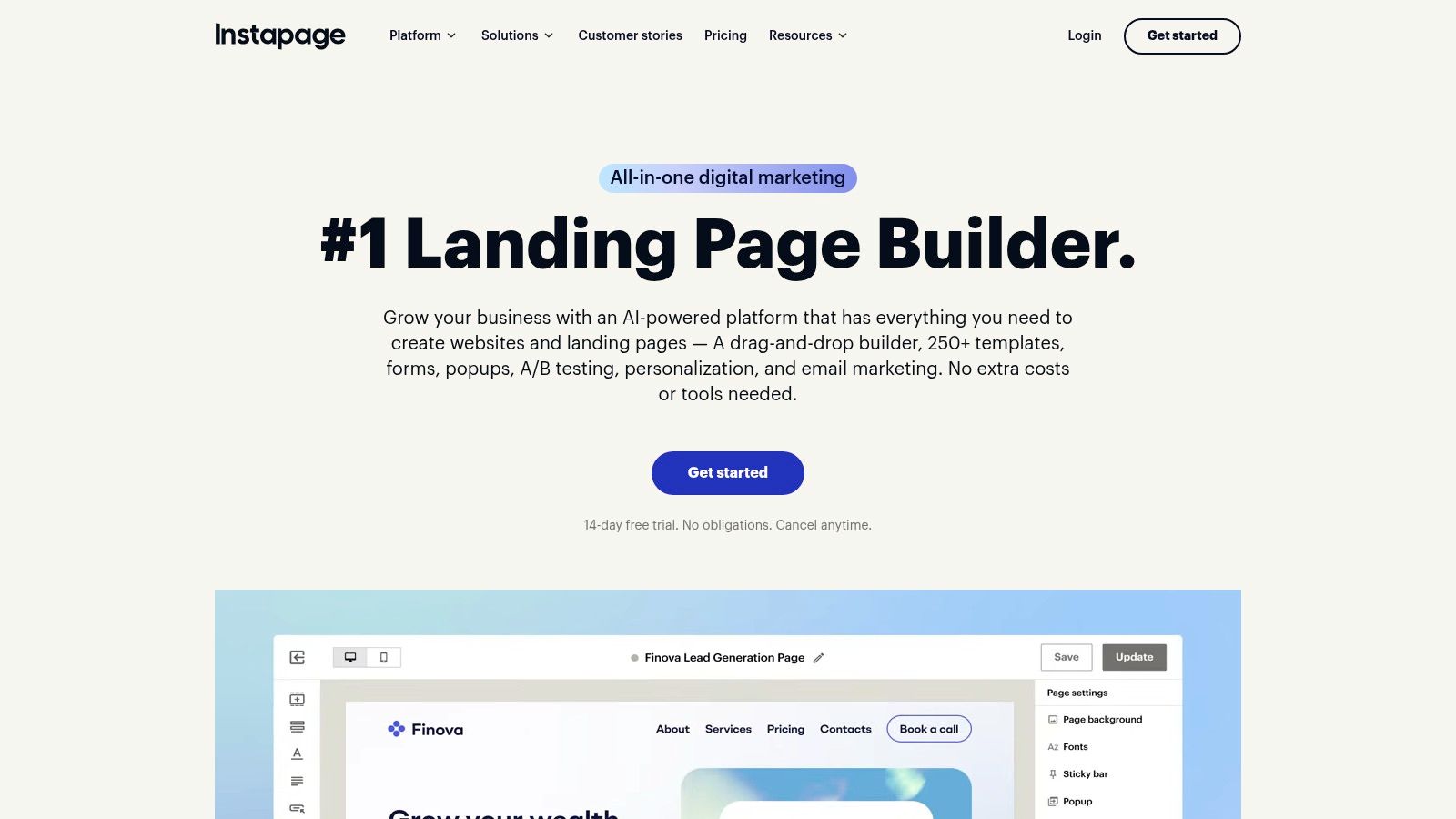
Instapage combines a visual builder, templates, audience-specific experiences, A/B testing, AI Experiments, and reusable content blocks. It suits teams that want to create and optimize campaign pages within the same platform, including changes that extend beyond copy.
Separate structure from form friction
Use reusable blocks to maintain a deliberate sequence: promise, relevant proof, explanation, and action. Then test whether a specific change, such as moving implementation reassurance closer to the form, helps the intended audience. Treat that sequence as a starting hypothesis, not a universal template.
Form friction deserves an independent test. A documented SaaS example reduced a form from 11 fields to four, increasing submissions from 3.8% to 7.6% across 5,400 visitors over two weeks, as described in StrategyC's conversion optimization case study. That result supports testing unnecessary data collection, but it doesn't establish that every shorter form produces better customers.
- Strength: Reusable blocks can help teams maintain multiple campaign pages without rebuilding shared content.
- Flexibility: Audience experiences can involve focused copy edits or broader page changes.
- Trade-off: An established site may not need another builder, and personalization availability depends on subscription.
When comparing landing-page tools, separate production needs from experimentation needs. Instapage is a stronger conceptual fit when your team needs both.
For any form experiment, preserve essential routing data through an appropriate post-conversion workflow. Judge success on qualified opportunities as well as submissions, so an easier form doesn't hide a qualification problem.
5. VWO Web Experimentation and Personalization
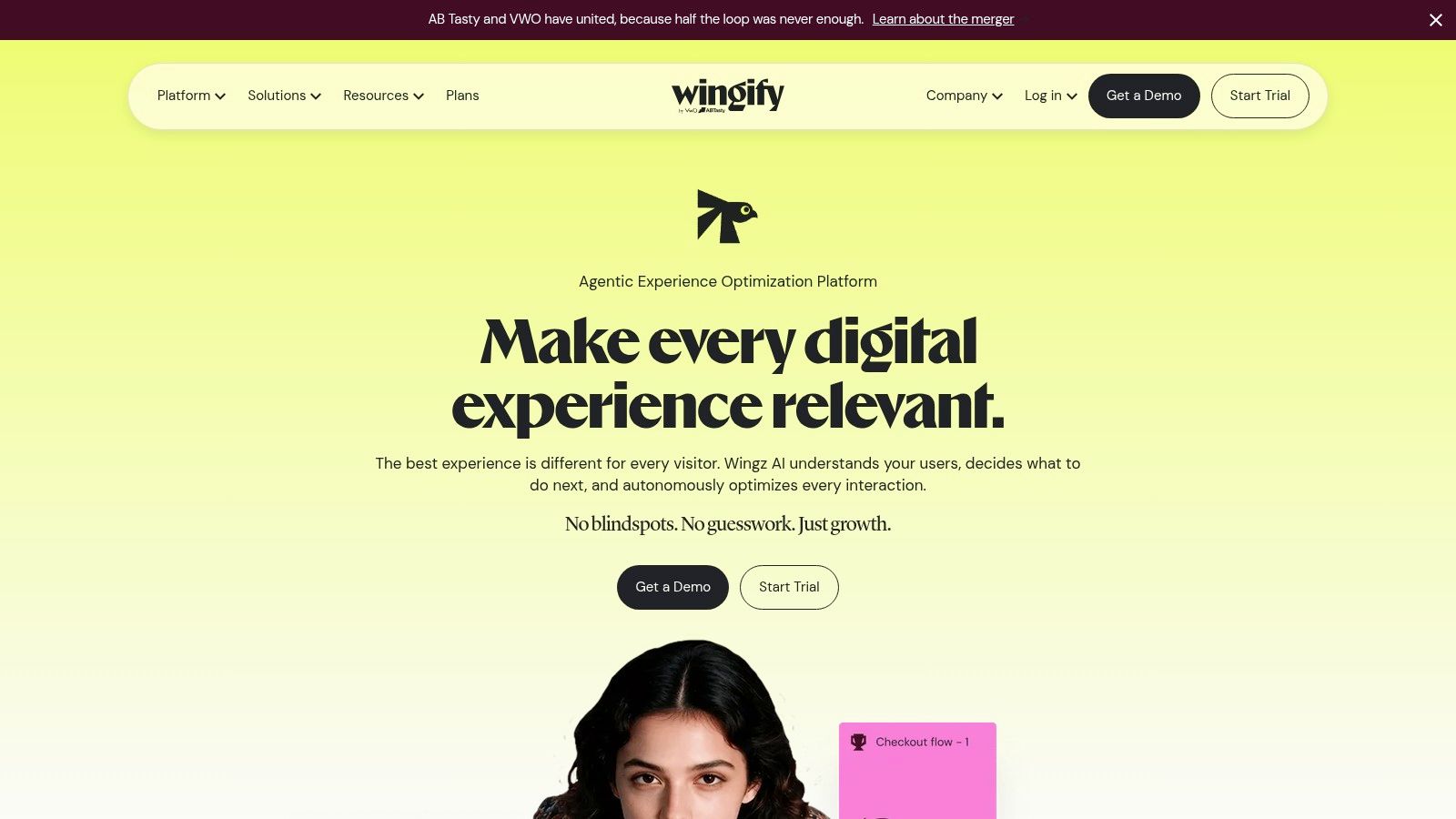
VWO is an experimentation choice, not primarily a page-building choice. VWO supports A/B, split-URL, and multivariate testing, alongside audience targeting and personalization. Its broader suite includes behavior analytics, making it relevant to teams running an ongoing program across an existing website.
The useful distinction is between changing a page and making a defensible decision about that change. A headline swap, a replacement page hosted at another URL, and a test involving combinations of elements require different experimental designs.
Choose the method after the question
For a headline hypothesis, keep the surrounding experience stable. For a substantial redesign, a split-URL test may fit the implementation, but the result won't identify which individual design change caused the difference. Multivariate testing introduces additional complexity, so don't choose it merely because the platform offers it.
Decision discipline: Define the audience, primary conversion, quality guardrails, and stopping rule before results start arriving.
Campaign-level differences can make a page look better without establishing that the page caused the improvement. The testing guidance summarized by Lapis emphasizes randomized assignment and stable campaign context, audience, offer, conversion event, and traffic window for causal interpretation.
VWO's strengths are its testing options and audience controls. Its trade-offs are platform breadth and the potential need for higher-tier features or a sales conversation. It supplies experimentation and targeting tools rather than independently writing fresh copy for each visitor.
Among conversion rate optimization tools, consider VWO when your main bottleneck is experimental rigor across existing pages. The repeatable decision is to match the test method to the hypothesis, then evaluate downstream quality before rolling the change out.
6. Optimizely Personalization and Experimentation
Personalization becomes an organizational problem when different teams define the same audience differently. My recommendation is to resolve those definitions before expanding targeted experiences, even if your software makes launching them straightforward.
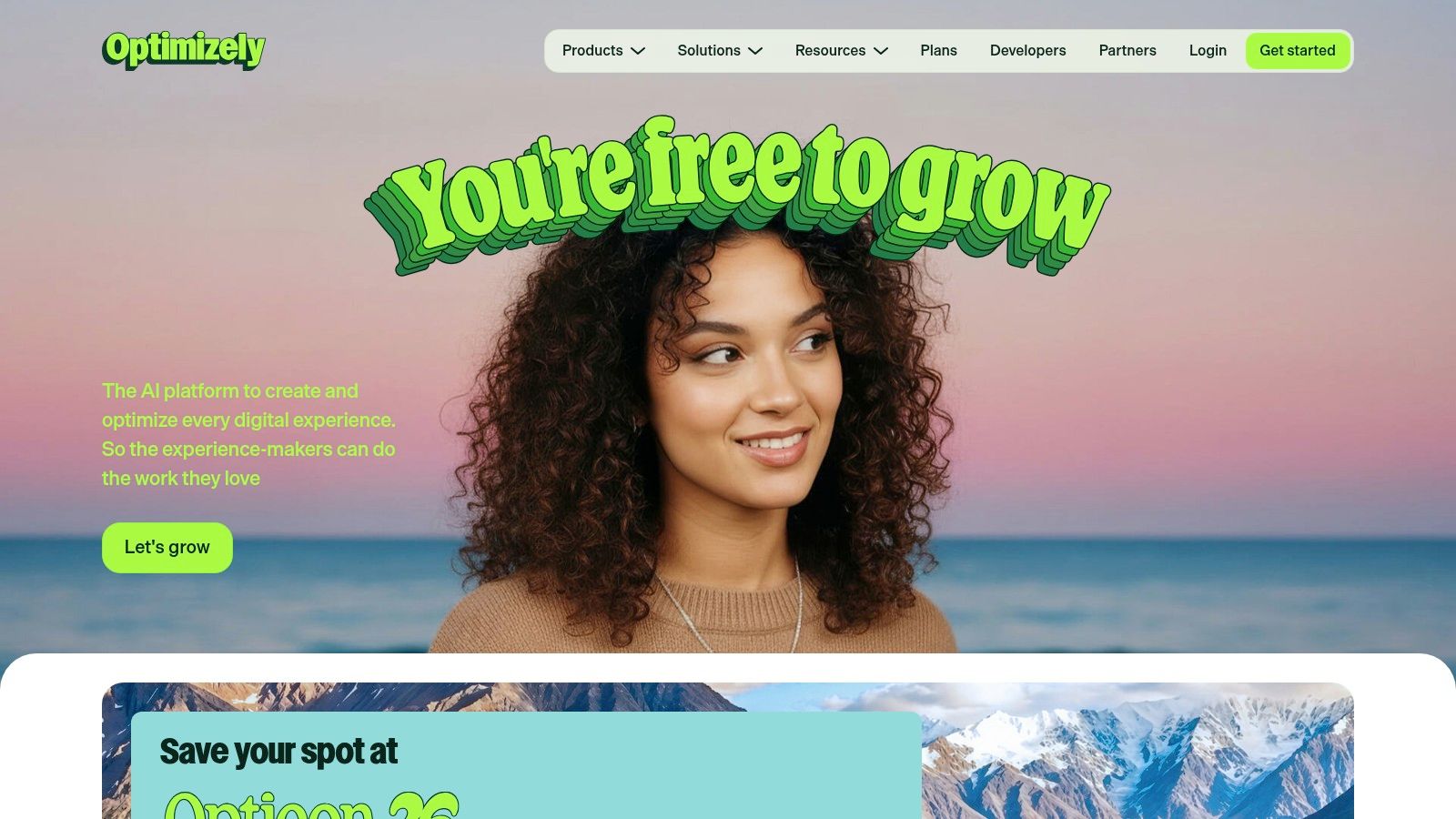
Optimizely combines web experimentation with personalization, including visual editing of text, buttons, images, and layout. Teams can create audiences using data from multiple sources, target experiences, and compare performance within a broader optimization program.
Govern audiences as carefully as copy
A useful proposed experiment might distinguish prospective customers from existing customers seeking support. Document who qualifies, who is excluded, what happens when signals conflict, and which experience appears when audience data is unavailable. The fallback deserves editorial attention too.
- Strength: Visual editing can let marketers implement page changes without coding every update.
- Program fit: Experimentation and audience targeting can sit within a shared measurement approach.
- Trade-off: The breadth may be excessive for a team focused on a small collection of campaign pages.
- Ownership: Teams define audiences and experiences; this isn't the same workflow as an agent independently writing visitor-level copy.
The strategic case for personalization is credible but easy to overstate. Deloitte's research reported 16% higher digital conversion and 50% more customer spending among the highest-maturity personalization brands compared with lower-maturity peers, according to its personalization research report. That's an organizational comparison, not a controlled estimate of what installing Optimizely or any other tool will deliver.
Choose this category when audience governance, implementation, and measurement must work across teams. Keep targeted treatments transparent and reviewable, with a stable control, so the program produces evidence rather than an expanding inventory of unexplained variants.
7. Convert Experiences A/B Testing and Personalization
BusinesSuites tested redesigned location-specific landing pages and recorded 88% more conversions with a 45% reduction in cost per action, according to the MarketingSherpa location-page case study. That's evidence for investigating geographic relevance, not evidence that Convert produced the result or that localizing a headline alone caused it.
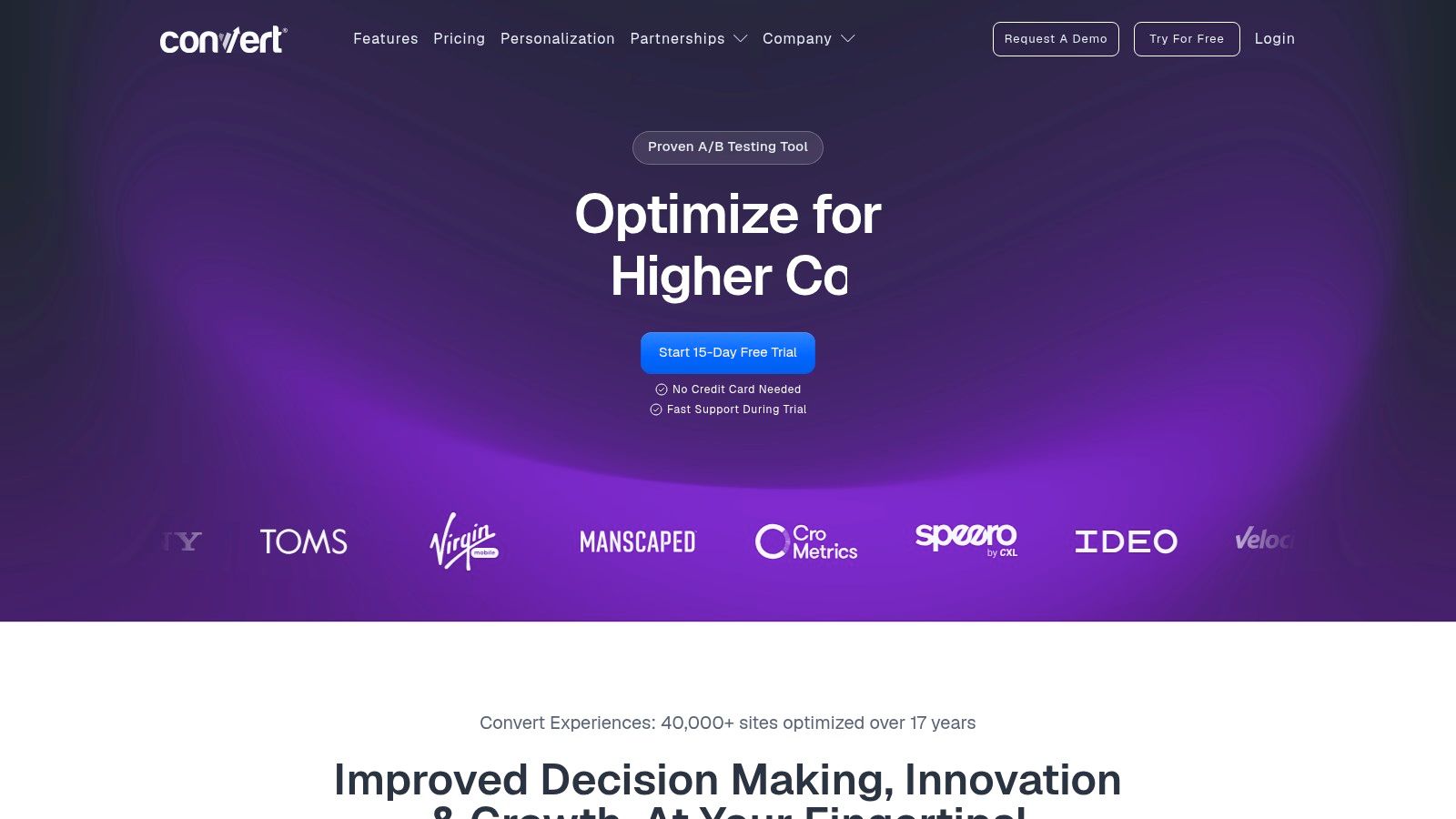
Convert Experiences focuses on testing existing pages through A/B and split-URL experiments, with multivariate and multipage options on higher plans. It also supports personalization, audience targeting, heatmaps, and session recordings.
Turn a redesign idea into a sequence
For a location-based hypothesis, begin by checking whether the current page accurately reflects availability and local intent. Then separate proposed changes to the headline, local proof, contact information, and CTA where practical. If you test them together, describe the winner as a package rather than assigning credit to a preferred element.
- Best fit: Teams that already have landing pages and need an experimentation platform rather than a builder.
- Buying advantage: Public pricing supports an initial plan comparison before a sales discussion.
- Scope limitation: Convert doesn't position itself as an autonomous visitor-level copywriting agent.
- Economic consideration: Assess the platform against your traffic and realistic experiment capacity, not the length of its feature list.
Heatmaps and recordings can help generate hypotheses, but they don't establish incremental conversion. A frequently clicked element might indicate interest, confusion, or an unexpected interaction.
For converting landing pages, Convert's most useful lesson is disciplined sequencing. Preserve the original experience, define the conversion event, and inspect audience and device results before generalizing an aggregate winner. A redesigned page can improve overall while still disappointing a commercially important segment.
Core Features Comparison of 7 Landing Page Conversion Tools
| Tool | 🔄 Implementation Complexity | ⚡ Resource Requirements | 📊 Expected Outcomes | Ideal Use Case | ⭐ Key Advantage |
|---|---|---|---|---|---|
| Polish | Low: add a script; agent tests copy | $99/month; 3-day trial; no ongoing developer work described | Visitor-specific headlines and CTAs tested on live traffic; lift not independently quantified | Teams seeking automated, context-based landing-page copy personalization | Cookieless, first-party measurement with controls to review or pause changes |
| Unbounce, Smart Traffic | Moderate: marketers build variants and set up tests | Marketing-team time; Smart Traffic is plan-dependent | Routes visitors among marketer-created page variants | Paid-campaign teams building and optimizing pages without heavy developer support | Combines no-code page creation, A/B testing, and variant routing |
| Pathmonk, AI Personalization and CRO | Moderate: install a snippet and configure personalization | Pricing varies by traffic and services; optional expert onboarding | Behavior-informed experiences, analytics, and controlled testing | Teams wanting personalization alongside broader CRO capabilities | Uses visitor behavior and includes control-group testing |
| Instapage, Landing-Page Creation, Personalization, and Testing | Moderate: build pages and configure audience experiences | Plan, visitor limits, and subscription features affect fit | Audience-specific pages and testing of copy or layout | Campaign teams managing and optimizing multiple landing pages | Combines a visual builder, reusable blocks, personalization, and testing |
| VWO, Web Experimentation and Personalization | Moderate to high: plan and govern experiments | Broader platform; advanced features may require higher-tier plans or sales contact | A/B, split-URL, or multivariate results across targeted audiences | Organizations running ongoing experiments across multiple web pages | Broad testing methods and targeting, with related behavior analytics |
| Optimizely, Personalization and Experimentation | Moderate to high: define audiences, experiences, and measurement | Pricing and fit generally require a sales conversation | Measures targeted experiences within an experimentation program | Larger organizations with established analytics and governance needs | Connects visual editing, audience targeting, and measurement |
| Convert Experiences, A/B Testing and Personalization | Moderate: configure tests and define conversion events | Public pricing; 15-day trial; costs may be high for low-traffic teams | A/B, split-URL, and higher-tier tests help identify effective page changes | Teams with existing pages seeking structured experimentation | Focused testing toolkit with personalization, heatmaps, and session recordings |
Build Your Conversion Learning Loop
The strongest converting landing pages aren't copied from a gallery. Teams improve them by connecting an audience's intent to a clear promise, a credible explanation, and an appropriate next action, then testing whether the change helps.
Start by defining the audience and the exact action you want qualified visitors to take. Audit the headline, subheading, CTA, visual hierarchy, proof, and form against that decision. If the offer itself is unclear, solve that before adding personalization.
Choose the bottleneck before the tool
The comparison produces a practical distinction. Unbounce and Instapage combine page creation with optimization; VWO, Optimizely, and Convert support experimentation on existing experiences; Pathmonk combines behavioral personalization with broader capabilities; Polish concentrates on autonomous contextual copy adaptation.
- If production is slow: Evaluate builders and reusable components.
- If messages miss intent: Test campaign alignment or contextual copy adaptation.
- If conclusions are unreliable: Prioritize stable controls, explicit metrics, and experiment governance.
- If targeting uses visitor data: Review signal necessity, disclosures, consent handling, and fallback experiences.
Privacy belongs inside the experiment design. The Shopify discussion of A/B-testing tools identifies potential processing of cookies, device information, IP addresses, and interactions, with disclosure and consent requirements depending on jurisdiction. Cookieless measurement alone doesn't settle every governance question.
Keep what you learn, not just what wins
Choose a focused hypothesis and compare the treatment with a defined baseline. Track qualified leads, opportunities, or revenue where appropriate, allowing for delayed outcomes rather than treating immediate submissions as the complete result.
When a variant wins, document the audience, acquisition context, offer, implementation, and measurement conditions. Preserve that result as evidence under those conditions, not a permanent rule that the same copy will work everywhere.
Teams using Polish can accelerate headline and CTA adaptation while retaining responsibility for strategy, factual accuracy, controls, and interpretation. The objective isn't to launch more experiments. It's to make each learning cycle produce a more relevant page and a clearer decision about what to improve next.
Polish adapts landing-page headlines and calls to action to visit context while working within your existing design and brand voice. Visit Polish to explore the script-based setup, review its controls, and plan a baseline comparison for your next campaign.
- converting landing pages
- landing page examples
- conversion optimization
- A/B testing
- landing page copy
Your website rewrites itself until it converts.
Polish writes new versions of your headlines and CTAs, tests them on your real visitors and keeps the ones that win.
Start free