7 Website Personalization Examples to Study in 2026
Explore 7 website personalization examples across B2B, ecommerce, and CRO, with tactics, trade-offs, and practical lessons for improving conversions.
Published on 12 min read
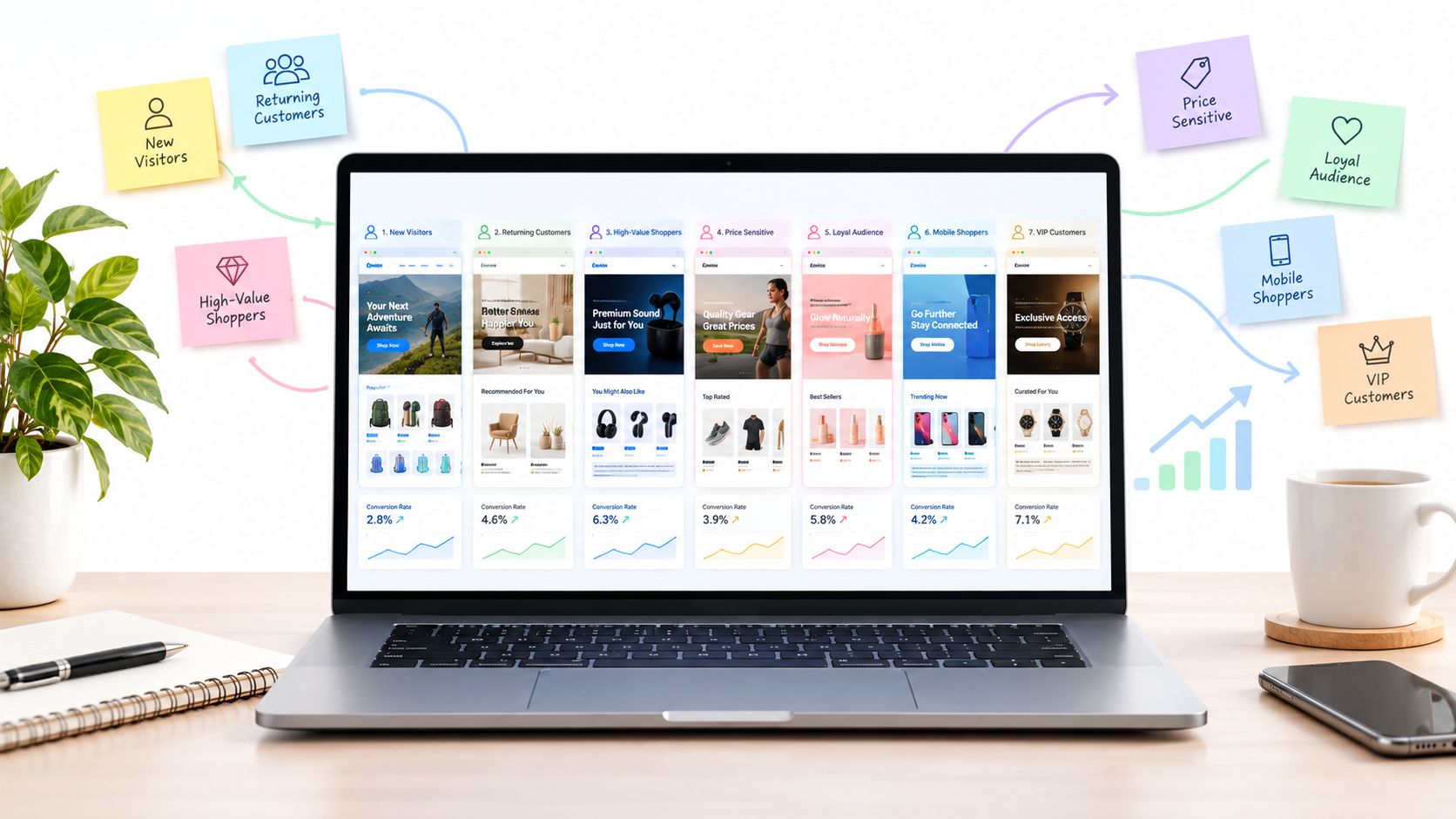
Table of contents
- 1. Polish
- Why this pattern is different
- 2. Mutiny
- Best fit and trade-off
- 3. Dynamic Yield by Mastercard
- Where it fits
- 4. Optimizely Personalization
- What teams replicate
- 5. Wingify Personalization
- Why the suite matters
- 6. Nosto
- Where it wins
- 7. Insider One Web
- The operational angle
- Top 7 Website Personalization Tools Comparison
- Choose the Signal Before the Software
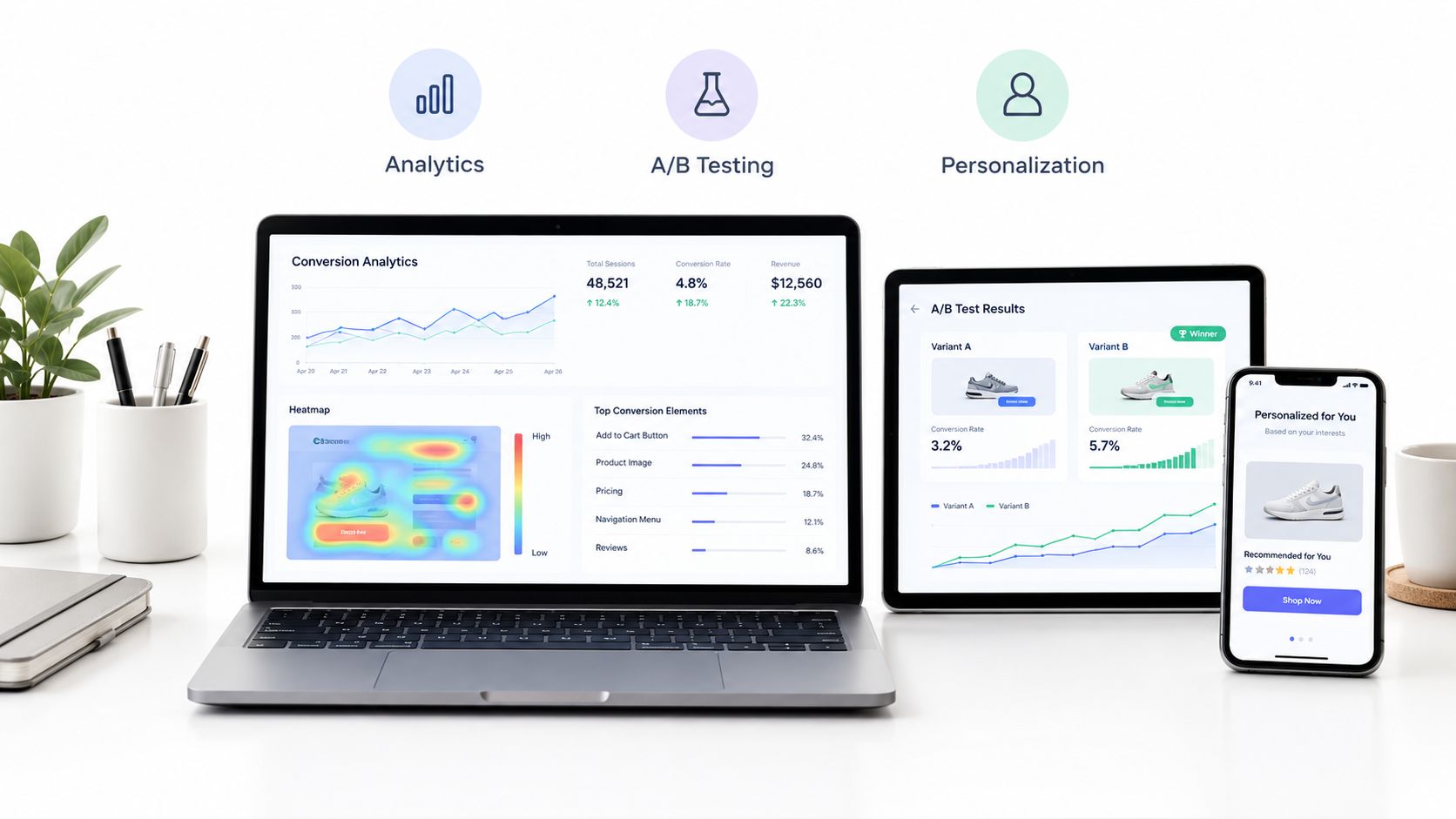
Most website personalization advice stops at “show different copy to different segments.” That's too shallow. The strongest website personalization examples tie a specific visitor signal, such as campaign source, device, country, returning status, or account intent, to a deliberate page change and a measurable conversion goal. The tool matters less than the match between signal, page element, and outcome.
That's why the best comparison isn't “which platform is best,” it's “which experience pattern does each platform make easy to run.” Some tools are built for per-visitor AI copy, others for B2B account targeting, ecommerce recommendations, or omnichannel templates. For context on why personalization keeps expanding in commerce, see this overview of ecommerce personalization trends.
1. Polish
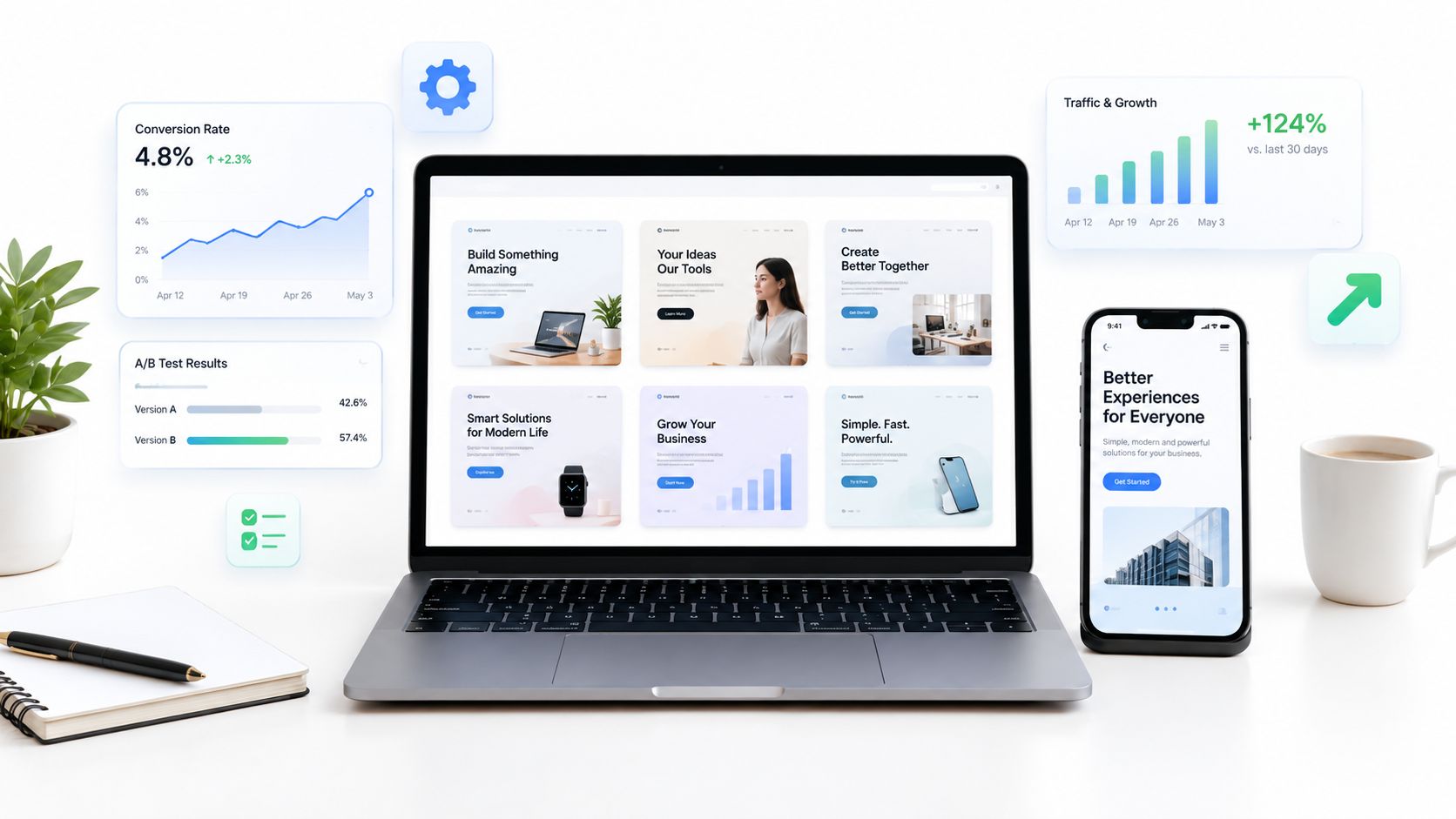
Polish treats each visit as its own landing page, making it distinct from platforms organized around account targeting, product recommendations, or reusable omnichannel templates. The URL and visual structure stay consistent, while copy responds to signals such as traffic source, campaign, device, language, country, or returning status. The resulting pattern is precise: match the visitor's immediate context to the headline, proof, and CTA instead of showing one general version to every visitor.
Polish is designed for teams that want headline, proof, and CTA changes without rebuilding the page. A snippet handles installation, the visual design remains intact, and a first-party, cookieless pixel ties measurement to the visit rather than to a large identity graph. The trade-off is operational. Fine-grained personalization requires clear voice rules, review processes, and approval settings so automatically generated copy remains consistent with the brand.
Why this pattern is different
Polish combines copy generation with ongoing testing. It creates variants, exposes them to live traffic, and retains stronger-performing versions. That shifts the workflow from isolated CRO experiments toward continuous optimization. The benefit is speed for growth teams; the constraint is that automated iteration still needs defined goals and safeguards.
The pattern works best when the strongest signal is already visible at the visit level and the conversion goal is signup or lead capture. A campaign visitor may need different proof from an organic visitor, while a returning visitor may respond to a more direct CTA. Polish lets a team test those distinctions without changing the site architecture.
Practical rule: Choose Polish when page copy should adapt in real time to observable visit context, and the team wants to reduce dependence on a manual CRO queue.
Its strongest fit is a site with stable page structure but varied acquisition sources, audiences, or languages. Teams can apply the same approach across different stacks while keeping privacy considerations in view. It is less suited to account-level B2B targeting or product merchandising, where identity, catalog data, and recommendation logic carry more weight.
2. Mutiny
Mutiny is strongest when the personalization signal is account and intent data, not just anonymous traffic behavior. Its public Playbooks library makes this useful because it translates B2B personalization into concrete patterns, like outbound microsites, ABM pages, and returning-visitor messaging. That framing is valuable for marketers who need examples they can copy into a sales-led motion rather than abstract “smart content” ideas.
The tool's practical appeal is the no-code visual editor combined with CRM and intent integrations. That lets teams swap headlines, proof blocks, and CTAs based on company context or account stage without waiting on engineering. For a deeper look at how visitor context can be turned into real-time page changes, the internal guide on real-time personalization pairs well with this B2B use case.
Best fit and trade-off
Mutiny fits companies where the page must support a defined account list, target industries, or outbound campaigns. It's less about broad consumer merchandising and more about making a buyer feel that the page was built for their business problem. The trade-off is that it tends to be a stronger fit for B2B and ABM than for ecommerce teams that need complex product merchandising.
The clearest use case is a homepage or campaign page that has to speak differently to a named account, a role, or a stage in the funnel.
The operational upside is speed. Marketers can launch without a long developer cycle, and the example library shortens the path from idea to page. The downside is scope, because the platform's strengths are concentrated in B2B motions, so teams that need deep commerce logic or highly dynamic product feeds may outgrow the pattern quickly.
3. Dynamic Yield by Mastercard
Dynamic Yield by Mastercard stands out because it treats personalization as a library of proven patterns across web, app, and email. Its public Inspiration Library is useful for teams that want to study concrete website personalization examples across industries instead of guessing at tactics. That makes it especially relevant when the problem isn't “can we personalize?” but “which format should we try first?”
The platform's decisioning layer is built for more complex environments, with proprietary models and affinity profiling that support recommendations and targeted messaging. For teams already working across multiple properties, that breadth matters more than a single clever homepage variant. The internal comparison with data-driven personalisation is useful here because Dynamic Yield leans into structured decisioning rather than one-off copy changes.
Where it fits
This is a strong match for organizations that need one system to coordinate multiple surfaces and multiple content types. The example library helps teams map signals to experiences, whether the signal is browsing intent, category affinity, or sector-specific needs. That's a strategic advantage when several teams, like ecommerce, lifecycle, and site operations, need a shared personalization model.
For smaller teams, the challenge is governance. Enterprise decisioning can become heavy if the team doesn't have clear rules for ownership, testing, and content updates. The upside is reach, but the cost is operational complexity, especially when multiple systems feed the decision layer.
A useful way to think about Dynamic Yield is this. If the team wants a broad catalog of example patterns and has the internal maturity to manage them, the platform makes sense. If the team needs a single copy experiment with minimal overhead, it's probably more platform than they need.
4. Optimizely Personalization
Optimizely suits teams that want testing and personalization in the same workflow. Its personalization features sit alongside experimentation, allowing teams to test whether a customized experience improves outcomes rather than treating novelty as evidence of value. The platform's documentation and inspiration resources reinforce that approach by starting with audience definition and test design.
The measurement model should extend beyond clicks. In the BMI Research example, the team assessed lead conversion, movement to key pages, account creation, and sales feedback. The personalized homepage produced a 25% conversion increase and more leads BMI Research personalization example. Optimizely fits this pattern because audience rules and experiment results can be evaluated within a broader optimization process.
What teams replicate
The clearest pattern is experiment-led audience targeting. A team can connect audience segments from its data platform, then test different messages, proof points, or calls to action for each group. This works well for paid-traffic landing pages, email-driven visits, and product discovery flows where the visitor's context is already available.
The operational trade-off is complexity. Optimizely provides a structured testing environment, but it demands more process than lighter personalization tools. Teams need experience with hypothesis design, audience definitions, reporting, and ongoing experiment governance. Smaller organizations may find that operating model heavier than their current use case requires.
Teams that already value statistical discipline can use Optimizely to make personalization a testable system rather than a one-off creative request.
Its strongest advantage is workflow coherence. Targeting, experimentation, and reporting remain closely connected, reducing the need to coordinate separate tools and interpretations. For a direct feature comparison, see our Optimizely vs VWO breakdown.
Optimizely is therefore most relevant when the goal is measurable adaptation across several page types and audience segments. Teams seeking rapid copy changes with minimal governance may prefer a lighter platform, while organizations with an established experimentation practice can justify the additional setup.
5. Wingify Personalization
Wingify's personalization suite is useful for teams that want a connected experimentation stack rather than a standalone personalization layer. The appeal is straightforward, marketers can ideate, test, and ship personalized experiences inside a broader platform that also includes experimentation, analytics, and feature management. That makes it a pragmatic choice for CRO teams that want repeatable workflows instead of isolated campaigns.
The strongest website personalization examples here are the classic ones, first-visit messaging, referrer-based variations, device-based adjustments, and widget-driven banners. Those patterns are simple, but they're often the right starting point because they map cleanly to the strongest usable signals. A first-time visitor usually needs a different proof structure than a returning lead, and a mobile user often needs a tighter message hierarchy than a desktop visitor.
Why the suite matters
Wingify's value is not that it invents a new personalization theory. It's that it helps teams operationalize common patterns quickly. Anonymous-traffic support is a practical advantage for sites that can't rely on third-party cookies or heavy identity matching.
The trade-off is that the setup still needs care, especially on the client side. Like any implementation that changes content on the fly, the team has to watch for flicker and make sure the variation feels native to the page. That's less glamorous than the promise of “personalization,” but it's where execution succeeds or fails.
For teams that need a balanced stack, Wingify is attractive because it doesn't force a choice between testing and tailoring. It also tends to be easier to justify than a heavyweight enterprise platform when the goal is to move fast on high-traffic pages without redesigning the whole site.
6. Nosto
Nosto is the clearest ecommerce-first example in this list because it focuses on merchandising, recommendations, and content personalization. That matters because retail personalization is usually about helping people find the right product or collection faster, not just changing a headline. The platform's product pages and case materials make it easy to think in terms of on-site patterns like geo-based content, affinity-driven blocks, and returning-visitor recommendations.
That commerce-native orientation is a major strength. If the visitor's intent is already shopping-related, Nosto can adapt the page to product affinity, browsing history, or region without forcing the team to invent a custom framework. The performance-minded script is also relevant for teams that are sensitive to speed, because commerce sites can't afford a personalization layer that slows the storefront.
Where it wins
Nosto is strongest when the business goal is product discovery and merchandising efficiency. It fits brands that need recommendation modules, content swaps, and retail-specific targeting more than B2B account pages or lead-gen funnels. The breadth of retail examples also helps teams scope experiments quickly because the patterns are already familiar.
The trade-off is focus. Ecommerce depth is an advantage, but it also means the platform is less naturally suited to ABM-style pages or non-retail journeys. Pricing is also typically customized by scale, so teams should expect a sales process rather than a simple self-serve decision.
For retail teams, the question is whether personalization should live inside a broader merchandising workflow. If the answer is yes, Nosto is a strong fit. If the team mainly wants one personalized landing page for paid traffic, it may be more platform than necessary.
7. Insider One Web
Insider is built for teams that need omnichannel coordination more than a single isolated page experience. Its web channel is backed by a large template library, which is useful because many teams don't need to design a personalization system from scratch, they need a proven structure they can deploy quickly. The breadth across web, app, email, push, and messaging also matters when the website is only one part of the conversion path.
That makes Insider a strong match for organizations that want the same signal to influence several touchpoints. A visitor may see one message on the site, a follow-up in email, and a related prompt in another channel. The benefit is consistency. The cost is onboarding complexity, because cross-channel systems tend to require more coordination than a single-site tool.
The operational angle
The main strength is template-led execution. Teams can move faster because common patterns are already packaged, which is especially helpful for multi-market brands that need to localize and coordinate experiences without rebuilding every page. The platform is also better suited to known and anonymous users across different touchpoints, so it supports broader lifecycle programs.
The limitation is budget and complexity. If a small team only needs one or two homepage variations, an omnichannel platform can feel heavy. If the team needs consistent personalization across several channels, the added scope becomes a feature, not a burden.
Insider belongs in the conversation because it reminds teams that website personalization examples don't have to stop at the website. The best programs often connect site behavior to the rest of the journey.
Top 7 Website Personalization Tools Comparison
| Product | Implementation 🔄 (complexity) | Resources & Speed ⚡ | Expected outcomes 📊⭐ | Ideal use cases 💡 | Key advantages ⭐ |
|---|---|---|---|---|---|
| Polish | Low, one-line snippet, autonomous agent | Low dev effort; fast live tuning; $99/mo plan | ⭐ High per-visitor conversion lift; continuous refinement | Growth/CRO teams wanting fast, privacy-friendly personalization | True per-visitor pages, cookieless pixel, auto-publish controls |
| Mutiny | Moderate, no-code editor + CRM triggers | Low dev for marketers; depends on CRM/intent data | ⭐ Strong ABM/B2B uplift when targeted correctly | B2B marketers running ABM, outbound microsites, returning-visitor flows | Playbooks library, CRM integrations, marketer-first tooling |
| Dynamic Yield (Mastercard) | High, enterprise integrations & governance | Significant engineering & data resources; slower rollout | ⭐ High-scale, cross-channel impact with advanced recommendations | Large enterprises needing multi-property personalization & recommendations | Mastercard insights, proprietary AI models, broad channel support |
| Optimizely Personalization | High, experiment-driven with ODP segments | Requires analytics/engineering; rigorous test setup | ⭐ Statistically robust lifts combining testing + personalization | Teams that need testing and personalization in one workflow | Stats Engine rigor, ODP segmentation, flicker-minimizing delivery |
| Wingify (VWO) | Moderate, no-code audiences + part of full stack | Quick launches via templates; careful client-side setup to avoid flicker | ⭐ Balanced CRO + personalization gains at accessible cost | CRO teams seeking testing + personalization without heavy enterprise cost | End-to-end stack, templates/widgets, privacy-forward approach |
| Nosto | Moderate, commerce-native modules and plugins | Fast for ecommerce with integrations; pricing scales by volume | ⭐ Strong merchandising/recommendation impact for retail | Ecommerce brands needing AI search, recommendations, and merchandising | AI recommendations, performance-minded script, retail playbooks |
| Insider (Insider One – Web) | Moderate–High, multi-channel orchestration & templates | Rapid template deployment but cross-channel setup required | ⭐ Quick multi-touch personalization and coordinated campaigns | Brands running omni-channel or multi-market programs | 140+ templates, unified orchestration, enterprise credibility |
Choose the Signal Before the Software
The smartest way to choose among website personalization examples is to start with the signal, not the vendor. Define the conversion goal first, then identify the strongest usable signal you already have, such as campaign source, account intent, product affinity, device, geography, or returning status. After that, pick the smallest page element that can respond to it, usually the headline, proof block, CTA, recommendation module, or order of sections.
The next decision is operational. Decide who approves changes, how long a test runs, what the holdout looks like, and which metric proves success. The evidence behind personalization keeps pointing to the same lesson, targeted selection beats generic treatment when the signal is strong, but weak or intrusive personalization can create the wrong experience and damage trust Netflix recommendation study consumer privacy and personalization research.
For fit, the shortlist is pretty clear. Polish is for autonomous per-visitor copy optimization. Mutiny is for B2B and ABM. Dynamic Yield is for complex enterprise decisioning. Optimizely and VWO are for experimentation-led programs where testing discipline matters. Nosto is for ecommerce merchandising. Insider is for coordinated omnichannel execution.
That doesn't mean the “best” tool wins. It means the best system documents the hypothesis, respects privacy and brand constraints, and turns each successful test into a repeatable playbook. Teams that do that end up with more than a personalization tool, they build a method they can reuse across pages, campaigns, and channels.
If you want a faster way to run this kind of per-visitor optimization, Polish turns the page itself into the personalization layer. It writes and tests headline, subheading, proof, and CTA variants for each visitor while keeping your design intact, so your team can focus on the signal and the conversion goal.
- website personalization examples
- website personalization
- conversion optimization
- personalized websites
- CRO tools
Your website rewrites itself until it converts.
Polish writes new versions of your headlines and CTAs, tests them on your real visitors and keeps the ones that win.
Start free