Data Driven Personalisation for Growth
Discover how data driven personalisation boosts conversions. Learn the tech stack, privacy-safe workflows, and AI agents that drive real revenue growth.
Published on 13 min read

Table of contents
- The Revenue Reality of Modern Personalization
- Revenue metrics reveal the difference
- Moving Beyond Static Segmentation
- Rules versus continuous decisioning
- Building the Required Data and Tech Stack
- Start with signals that explain intent
- Add a decision layer
- Protect the operating layer
- Navigating Privacy and Consumer Trust
- Use a clear value exchange
- Make the logic explainable
- Measuring Conversion Impact and Retention
- Build a measurement chain
- Let the page learn after conversion
- Autonomous AI Agents in Action
- A useful operating loop
- Implementing Your Personalization Strategy
A striking gap defines modern personalisation: brands estimated that they personalised 62% of customer experiences, while consumers said only 44% felt personalised, according to McKinsey's research on getting personalisation right. The same research found that 76% of consumers considered personalised communications when choosing a brand and 78% said personalised content made them more likely to repurchase. Later research found that 52% of consumers were more likely to buy from brands that personalise experiences, with those consumers spending an average of 30% more with those brands.
The commercial opportunity is clear, but many teams still approach personalisation as a collection of audience rules and isolated A/B tests. That approach can improve a page, but it doesn't respond fast enough to changing intent. Data driven personalisation now needs to operate as a living decision system, one that reads context, adapts the experience, respects consent, and learns from the outcome.
The Revenue Reality of Modern Personalization
Personalisation isn't valuable because it makes a website feel more polished. It's valuable when it changes what a visitor does next, whether that means considering the offer, completing a purchase, returning later, or choosing a higher-value option.
The expectation gap matters because it exposes a delivery problem, not an awareness problem. Most growth teams already understand that relevance helps conversion. The harder question is whether the page is relevant to this visitor, during this visit, in this context. A headline written for an entire audience may be directionally correct while still missing the visitor's immediate motivation.
A visitor arriving from a comparison article has a different information need from someone returning through a branded search. A mobile visitor may need a shorter path to proof, while a desktop visitor may be willing to evaluate a more detailed offer. Static personalisation usually treats these people as members of the same broad segment. Effective systems distinguish the signals that reveal intent.
Revenue metrics reveal the difference
Engagement metrics can hide weak personalisation. A customized headline may increase interaction while failing to improve qualified leads, completed checkouts, or repeat purchases. Growth teams should connect each experience variation to a commercial outcome rather than declaring success from clicks alone.
Track the relationship between:
- Message relevance and conversion quality: Did the visitor complete the intended action, or just interact with the page?
- Experience variation and order value: Did the offer support a more appropriate package or purchase decision?
- First-session behaviour and repurchase: Did the initial experience create a reason to return?
- Personalisation coverage and customer perception: Did visitors recognise the experience as useful rather than merely different?
The practical conclusion is uncomfortable. A company can invest heavily in personalisation and still deliver generic experiences if its rules are too broad, its signals arrive too late, or its content variants don't reflect genuine differences in intent. Revenue impact comes from execution quality, not from adding more audience labels to a campaign dashboard.
Moving Beyond Static Segmentation
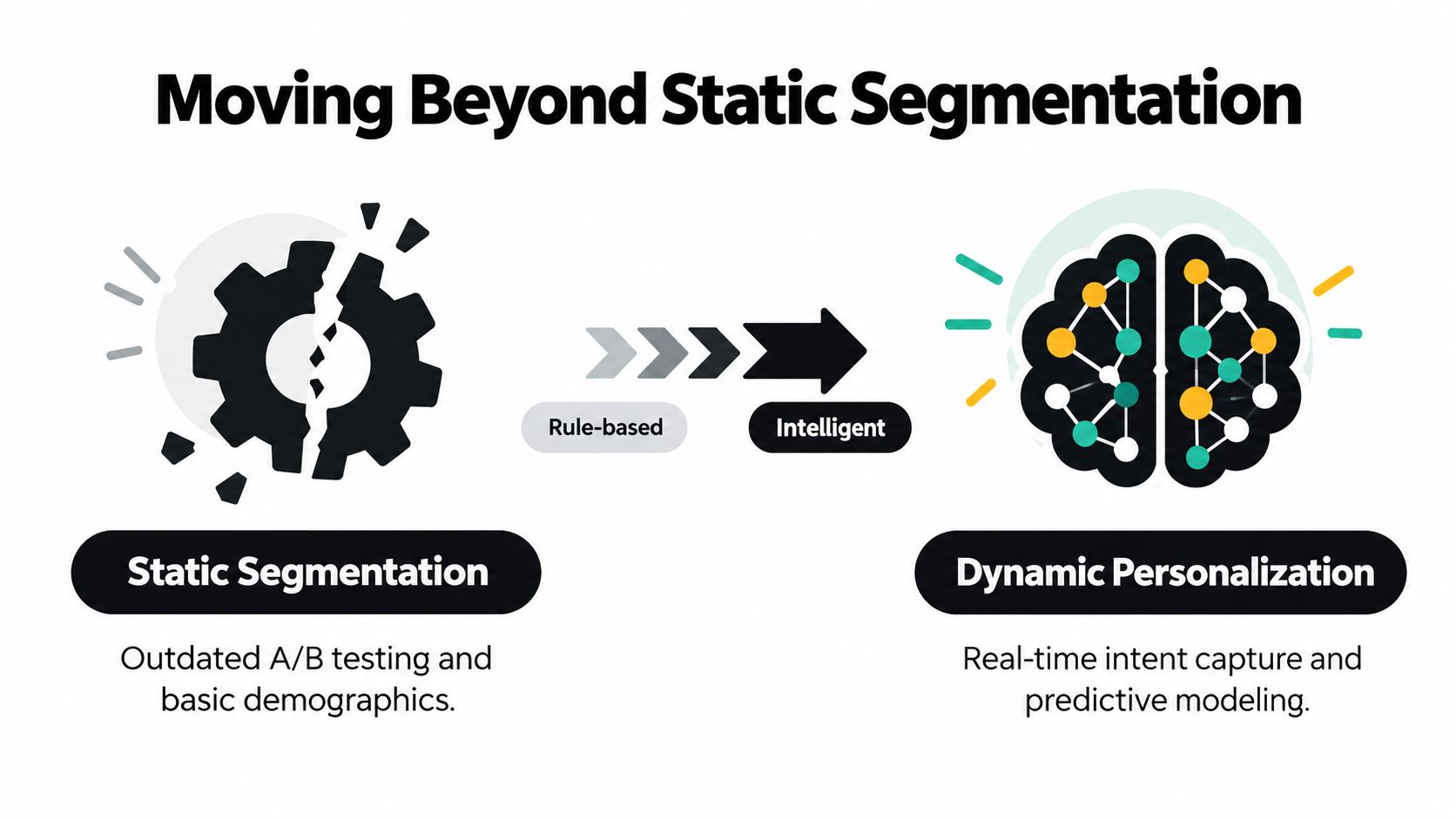
Static segmentation starts with a rule. If a visitor belongs to segment A, show message A. If the visitor arrives from campaign B, show message B. This approach is easy to explain, easy to implement, and useful for controlled campaigns. It also breaks down when several signals point in different directions.
A dynamic system weighs context continuously. It can consider acquisition source, search intent, device, visit history, page behaviour, consent status, geography, and the stage of the journey. Instead of forcing each person into a fixed persona, it estimates which experience is most appropriate for the current visit.
Rules versus continuous decisioning
A rule-based campaign might say, “Visitors from paid search see headline A.” A multi-signal system asks a better question: “Which headline fits a paid-search visitor who searched for a specific use case, is returning on mobile, and has already viewed pricing?”
That distinction changes the operating model.
| Static segmentation | Dynamic personalisation |
|---|---|
| Uses predefined audience rules | Interprets several live signals |
| Treats segments as relatively stable | Updates its view as intent changes |
| Relies on manually selected variants | Selects variants through a decision engine |
| Measures a campaign or test result | Learns from post-click behaviour |
| Often optimises one element at a time | Coordinates headline, proof, CTA, and context |
Traditional A/B testing still has a place. It can validate a major redesign, identify a strong baseline, or protect against a damaging change. It becomes limiting when teams treat the winning variant as a permanent answer. The winner usually represents an average effect across mixed visitors, not a universal truth.
Practical rule: Use experiments to establish reliable patterns, then give a controlled decision system room to adapt those patterns to visitor context.
Trust must sit inside the model, not outside it as a compliance review. A 2025 synthesis of 1,037 studies on the personalisation-privacy paradox identified trust as the central mediating construct, with research clusters covering humanised AI personalisation, platform dynamics, and behavioural responses to privacy trade-offs. That finding changes how growth teams should define optimisation. A relevant experience that feels intrusive isn't a successful experience.
For teams developing audience logic in messaging channels, the best practices for SMS segments from YipSMS Inc. offer a useful reminder: segmentation should reflect meaningful customer context, not every field available in a database. The same principle applies to landing pages. Personalisation should answer a visitor's needs, not demonstrate that the company can observe them.
A useful overview of the distinction between customisation and personalisation is available in this guide to personalization and customization. The operational takeaway is simple: replace fixed assumptions with a feedback loop that can update the experience without losing control of the rules.
Building the Required Data and Tech Stack
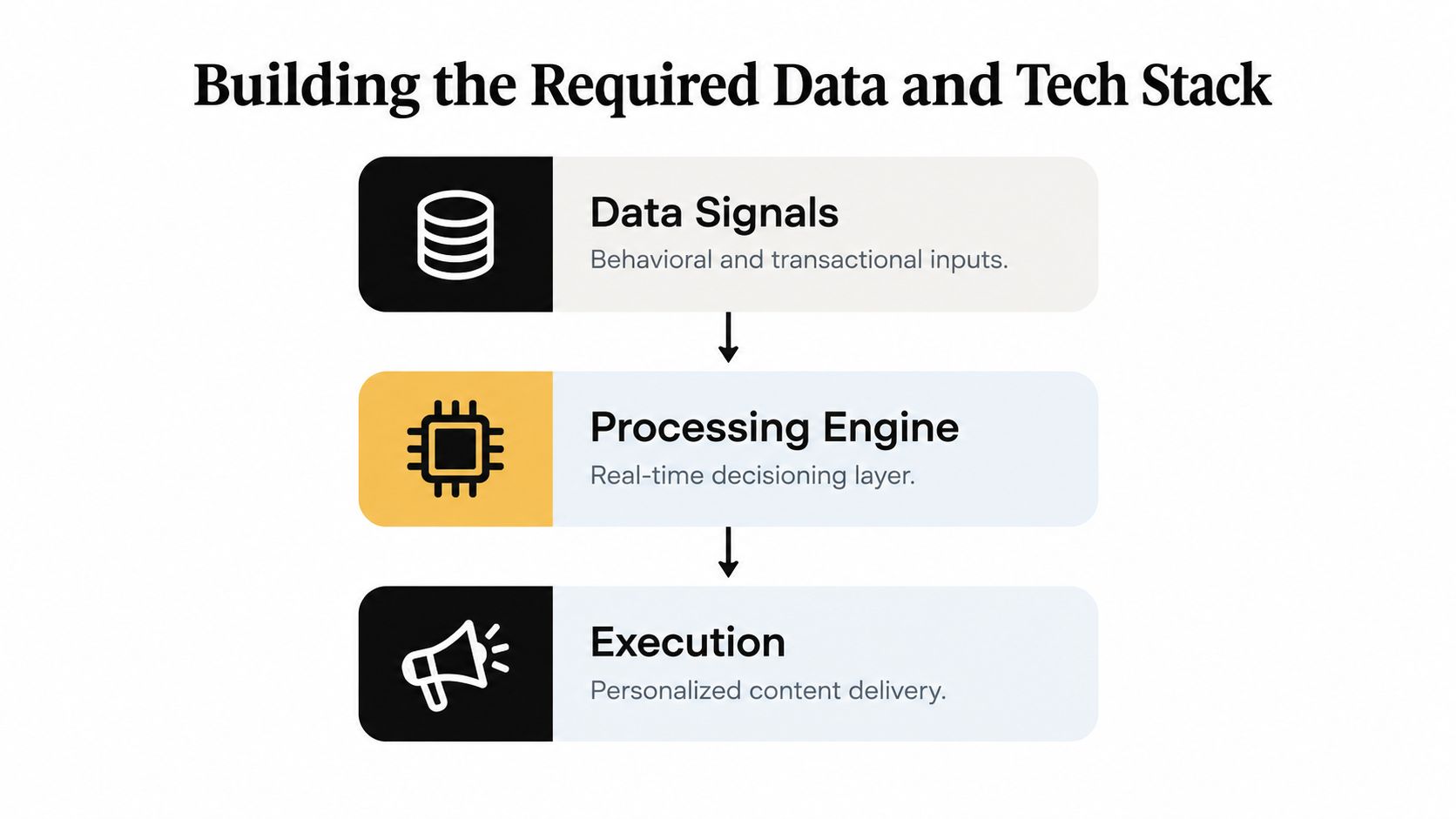
Real-time personalisation depends on infrastructure, but it doesn't require collecting everything. The strongest stack captures a small set of useful, permissioned signals, processes them quickly, and exposes them to an execution layer that can change the page safely.
Start with signals that explain intent
First-party behavioural data should form the foundation. Useful inputs can include the page a visitor viewed, the content they engaged with, the search or campaign context they arrived from, the device they use, and whether they are new or returning. Transactional data can add product ownership, previous purchases, subscription status, or known preferences where the visitor has provided an appropriate basis for use.
Source-aware tracking is particularly valuable because acquisition context often reveals the promise that brought someone to the page. If the landing page ignores that promise, the visitor has to translate the offer again. A system can instead preserve message continuity from ad, email, search result, or referral into the page experience.
Use device information for usability and context, not covert identification. A mobile visitor may need a concise value proposition and a prominent action. A desktop visitor may respond better to comparison content or supporting proof. The goal is to improve relevance without assembling an unnecessary identity profile.
Add a decision layer
The processing engine needs to perform more than audience lookup. It should combine signals, apply eligibility and consent rules, select an experience, and record which decision it made. A useful architecture separates:
- Collection: Capture first-party events and declared preferences.
- Resolution: Normalise those events into a current visit context.
- Decisioning: Choose an eligible message or variant.
- Delivery: Render the experience without creating a slow page.
- Learning: Feed outcome data back into future decisions.
Keep the content system modular. Headlines, subheadings, proof points, objections, and calls to action should be editable independently, with fallback copy available whenever a signal is missing or consent is unavailable. This prevents the system from treating personalisation as an all-or-nothing switch.
Protect the operating layer
The stack also needs governance. Define which signals can influence copy, which require consent, how long they remain usable, and when the system must show the control experience. Log decisions so a marketer can understand why a visitor saw a variant. Set boundaries around claims, pricing, legal language, and brand voice so an agent can't optimise into a misleading promise.
For a practical view of how pages can respond to live visitor context, see this guide to real-time personalization. The technology matters, but the sequence matters more. A fast decision engine with poor signals produces fast irrelevance.
Navigating Privacy and Consumer Trust
The biggest mistake in personalisation is assuming that more data automatically creates more relevance. In practice, data sensitivity determines whether a signal can be used without damaging trust.
A large global consumer study found that 64% of consumers prefer personalised experiences, yet 53% were very or extremely concerned about privacy, and only 33% trusted companies to use personal data responsibly, as reported in the Qualtrics and XM Institute consumer research. Consumers were most comfortable with purchase history, at 45%, and website visits, at 42%. Comfort was lowest for financial information, at 12%, and social media posts.
These figures expose the privacy paradox. People want brands to understand their needs, but they don't want the brand to use every available detail to prove that it understands them. A purchase history can support a useful recommendation. An unexplained inference from sensitive financial information can feel invasive even if the resulting offer is technically relevant.
Use a clear value exchange
Consent shouldn't be a banner that disappears into the interface. It should connect the data request to a visible benefit. Explain what the system uses, why it uses it, and what the visitor can control. If a visitor declines optional tracking, the experience should still work through contextual and session-level signals that don't require a persistent profile.
Good personalisation often uses less data than teams expect. A campaign source, current page, declared goal, and immediate interaction can provide enough context to improve a headline or call to action. The system doesn't need to infer sensitive attributes when the visitor has already provided a clear behavioural signal.
Make the logic explainable
Visitors don't need a technical description of the model. They do need a credible explanation when personalisation affects what they see or receive. Avoid copy that reveals hidden observation, such as referencing a visitor's private activity in a way they couldn't reasonably expect. Use the signal to improve the message, not to announce that the signal was collected.
Growth teams should review personalisation from three perspectives:
- Necessity: Does this signal materially improve the decision?
- Expectation: Would a reasonable visitor expect the brand to use it here?
- Reversibility: Can the visitor change the preference or opt out without losing basic access?
Trust also varies by market and culture. A global personalisation system needs local consent rules, local expectations, and local review rather than a single universal playbook. The right level of personalisation is the point where relevance improves the experience without making the visitor feel watched.
Measuring Conversion Impact and Retention
Personalisation should earn its place through business outcomes. Click-through rate can diagnose interest, but it doesn't prove that the visitor became a better customer. A useful measurement system connects the first experience to downstream behaviour and separates short-term response from durable value.
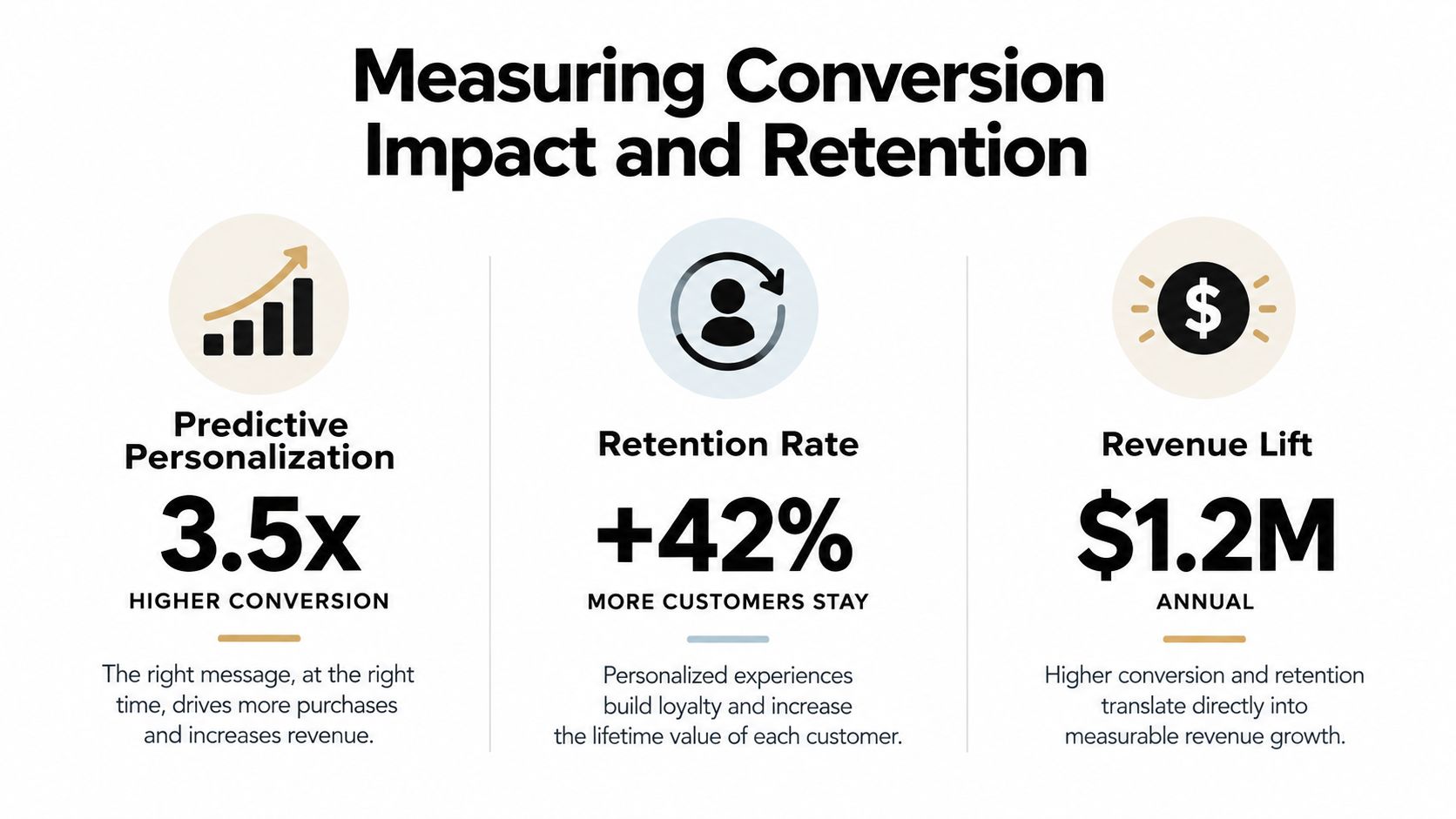
The strongest evidence in the supplied research comes from a 2026 comparative analysis of seven published studies. It reported retention gains of roughly 5 to 15 percentage points and churn reductions of 8 to 14% over periods ranging from 90 days to 12 months, with predictive analytics and recommendation systems producing the strongest effects. These findings support a move away from one-time page winners toward systems that keep learning after the click.
Build a measurement chain
Start with the immediate outcome, but don't stop there. For a landing page, that may be a qualified form completion, checkout initiation, or purchase. For a product journey, it may be activation, a meaningful feature action, or a renewal-related behaviour.
Then connect that outcome to later cohorts:
- Conversion quality: Compare lead quality, purchase completion, or selected plan, not just form submissions.
- Post-click behaviour: Record what visitors do after the personalised page, including activation and return visits.
- Retention: Compare cohorts exposed to dynamic experiences with a suitable control experience.
- Churn: Monitor whether relevance reduces abandonment over the chosen observation window.
- Incrementality: Account for seasonality, traffic mix, channel changes, and returning-customer effects.
A testing framework still matters. Before launching a change, estimate the minimum detectable effect your team needs to make a decision. The guide to minimum detectable effect can help CRO teams avoid declaring a winner from noise or running a test that cannot answer the commercial question.
Let the page learn after conversion
Post-click signals often reveal more than the original conversion. If visitors from one source convert but fail to activate, the headline may be working while the promise is incomplete. If a returning visitor skips introductory proof and moves directly to pricing, the next experience may need a different information order.
Retention work also extends beyond the landing page. Teams refining lifecycle journeys can use these onboarding and engagement methods to retain customers from Receiver as a reference for connecting early experience quality to continued engagement. The principle is consistent across channels: optimise for the customer outcome, not the easiest metric to move.
Autonomous AI Agents in Action
An autonomous personalisation agent changes the role of the landing page from a fixed asset into a responsive interface. Instead of asking a copywriter to create one headline for an entire campaign, the system can read the existing page, generate suitable alternatives, and select the version that fits the visitor's context.
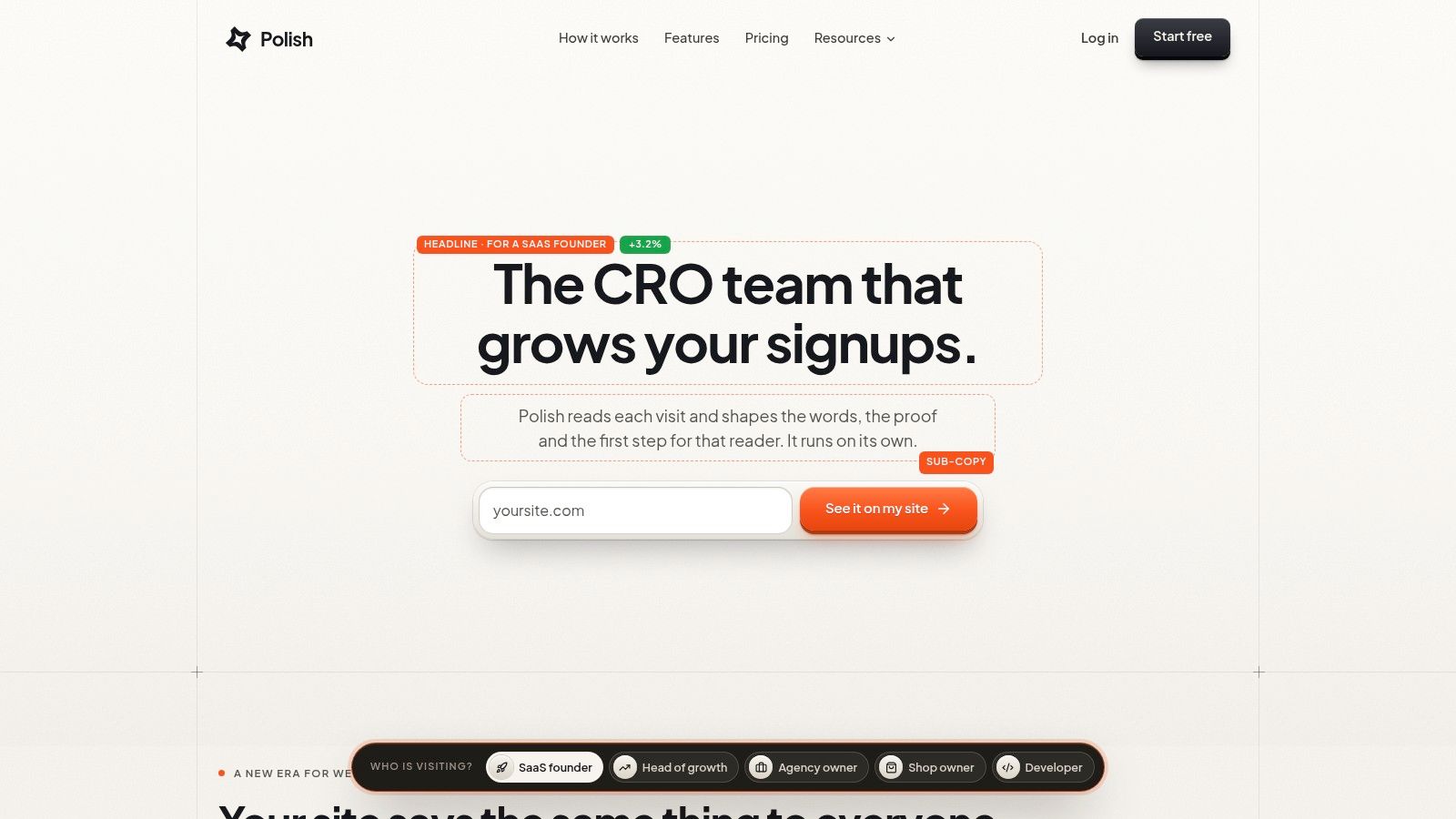
Consider a visitor arriving from a search query focused on implementation speed. The base page may lead with broad product positioning. An agent can adapt the headline toward speed, bring relevant proof closer to the opening, and use a CTA that reflects the visitor's likely next question. A returning visitor who has already seen the category explanation may receive a more direct message focused on evaluation or action.
The agent doesn't need to invent a new brand strategy for every session. It works within a controlled content space. Marketing defines the approved claims, tone, offer boundaries, and components that may change. The decision system uses available first-party context to select or write a variation, then measures what happens.
A useful operating loop
A practical agentic workflow has four parts:
- Read: Inspect the page, campaign context, visit signals, and available consent.
- Write: Produce candidate headlines, subheadings, proof points, or CTAs within brand constraints.
- Choose: Select the experience most likely to fit the current visitor context.
- Learn: Compare downstream outcomes and refine future selections.
The distinction from ordinary dynamic content is important. A conventional system often maps one known segment to one manually prepared block. An autonomous agent can work with combinations of signals and adjust its output as evidence accumulates. It still needs human oversight, especially around regulated claims, sensitive audiences, and changes that could alter the meaning of an offer.
The following video shows the product context behind this type of landing-page optimisation.
The advantage isn't that the agent writes more copy. More copy creates noise if the system can't evaluate it. The advantage is that each visit can contribute evidence about which message, proof point, and CTA fit a specific context, while the page remains governed by the team's constraints.
Implementing Your Personalization Strategy
Start with the page where intent is already visible and the commercial outcome is clear. A high-traffic landing page with a defined conversion event gives the team a better learning environment than a broad site-wide rollout.
Audit the current system before adding an agent:
- Inventory signals: List the first-party behavioural, transactional, and campaign inputs you already collect.
- Check consent: Separate signals that can be used by default from those requiring permission.
- Map page components: Identify which headlines, proof points, objections, and CTAs can change safely.
- Define guardrails: Lock approved claims, tone, legal language, pricing, and fallback experiences.
- Choose the outcome: Measure qualified conversion, activation, revenue quality, retention, or churn.
- Create a control: Preserve a stable experience so dynamic performance has a credible comparison.
- Review decisions: Make the system's inputs, outputs, and learning process visible to the growth team.
Don't begin by personalising every customer attribute. Begin with context that visitors reasonably expect a brand to use, such as acquisition source, current behaviour, device, and declared intent. Expand only when the evidence shows that another signal improves outcomes without increasing perceived intrusiveness.
Adoption pressure is rising. Nielsen reports that 59% of global marketers view AI for campaign personalisation and optimisation as the most impactful trend for 2025. That makes governance a competitive capability, not an administrative afterthought. Teams that move quickly without consent and measurement controls may create experiences that are technically dynamic but commercially fragile.
Use a guide to personalization KPIs for retailers to align reporting with the outcomes your business values. Then run a focused deployment, inspect the decisions, compare downstream cohorts, and expand only after the system proves that it can improve relevance safely.
Polish offers an autonomous AI agent that reads a landing page, creates visitor-specific headlines, subheadings, proof, and calls to action, then selects variants using first-party visit context such as source, device, country, and visit history. Visit Polish to explore how dynamic page optimisation can replace static assumptions with a privacy-aware learning loop.
- data driven personalisation
- conversion rate optimization
- AI landing pages
- growth marketing
- personalization strategy
Your website rewrites itself until it converts.
Polish writes new versions of your headlines and CTAs, tests them on your real visitors and keeps the ones that win.
Start free