Real Time Personalization That Converts Visitors
Learn what real time personalization is, how it works on landing pages, and how to implement it to lift conversions with real time personalization.
Published on 16 min read
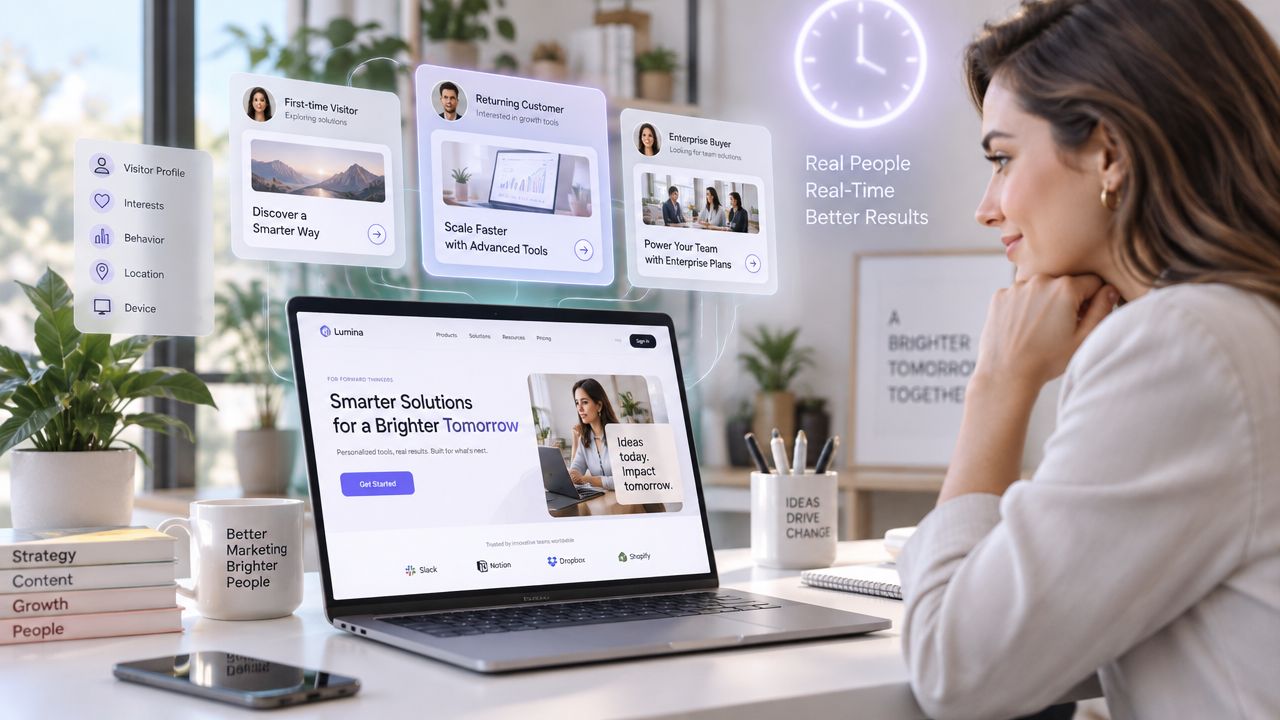
Table of contents
- Introduction Why Timing Beats Targeting Now
- What Real Time Personalization Really Means
- Three kinds of relevance
- A simple mental model
- How Real Time Personalization Works Behind the Scenes
- Event capture creates the live signal
- Decisioning turns behavior into an action
- Delivery makes the change visible
- Real World Use Cases for Landing Pages That Convert
- Match the promise to the traffic source
- Adapt to in-session exploration
- Recognize returning intent without trapping the visitor
- Change proof and calls to action selectively
- What You Need Before You Personalize in Real Time
- Start with the data foundation
- Connect delivery to decisioning
- Make experimentation part of the operating model
- Build measurement before launch
- How to Measure What Actually Works
- Test the decision, not just the copy
- Track system health beside business health
- Putting Real Time Personalization to Work on Your Pages
A visitor arrives on your landing page after clicking a highly relevant ad. The ad promises a solution for their role, industry, or immediate problem. The page greets them with a generic headline, a broad subheading, and a call to action that could belong to almost any campaign. They scan the page, fail to see themselves in it, and leave.
Your team may already use audience segments, customer profiles, and campaign-specific pages. Those tools help, but they can still miss the most important signal: what the visitor is trying to do right now. A returning customer may be researching a new category. A first-time visitor may show strong intent within a few clicks. A buyer who arrived through one campaign may need a different promise from someone who arrived through another.
That's why real time personalization has moved from an interesting digital-commerce tactic to a serious growth priority. In a 2026 consumer study, Amperity found that 74% of consumers are more likely to purchase after receiving a truly personalized offer or recommendation, while 69% say the same when retailers adjust offers instantly as they browse. Yet 57% still feel shopping experiences are generic, and 79% say retailers often get personalization wrong because messages arrive irrelevant or mistimed.
The lesson for landing pages is simple: relevance that arrives late can feel like irrelevance. This guide treats personalization as a landing page decisioning problem, not a reason to buy another martech platform. You'll see how the system reacts to live behavior, which technical constraints matter, what your team needs before implementation, and how to measure whether a changing headline or CTA improves business results. If speed is also shaping your broader go-to-market motion, Captiwate's speed-focused sales guide offers useful context on why fast responses can beat larger but slower systems.
Introduction Why Timing Beats Targeting Now
A growth lead opens the analytics dashboard and sees familiar symptoms. Traffic is healthy, paid campaigns are attracting the right broad audiences, and the landing page has been polished repeatedly. Still, visitors arrive, skim the hero section, and disappear before they reach the form.
The first instinct is usually to improve targeting. Build a new segment. Add more fields to the audience definition. Create another campaign variation. Those actions can help when the audience is clear and stable, but they don't solve a different problem: the visitor's intent can change during the session.
Someone may click an ad about reducing acquisition costs, then spend time reading about experimentation. A visitor who arrives looking for a general product may click into a specific use case. A returning account may already understand the category and need proof, not another introductory explanation. A static page treats all three people alike unless your team has created and routed them to different experiences in advance.
Real time personalization changes the decision point. Instead of asking only, “Which segment does this visitor belong to?”, the page asks, “What does this visitor's current behavior suggest they need next?” The answer can influence the headline, supporting copy, proof point, offer, or CTA while the visit is still happening.
Consumer expectations have moved in that direction. The Amperity research cited above found that more than half of consumers believe brands should personalize during the current interaction instead of days later, while nearly one-third expect relevant offers from their first interaction. That doesn't mean every page should change dramatically for every visitor. It means a generic experience now carries a larger opportunity cost when the page has enough context to respond.
Practical rule: Treat timing as part of relevance. A perfectly matched message shown after intent has passed won't perform like a timely message shown during the decision.
The most useful mindset is to start with the page, not the platform. Identify the decision your visitor is making, the signals that reveal that decision, and the smallest page element that can respond. Then test whether that response creates a better outcome without slowing the experience or damaging trust.
What Real Time Personalization Really Means
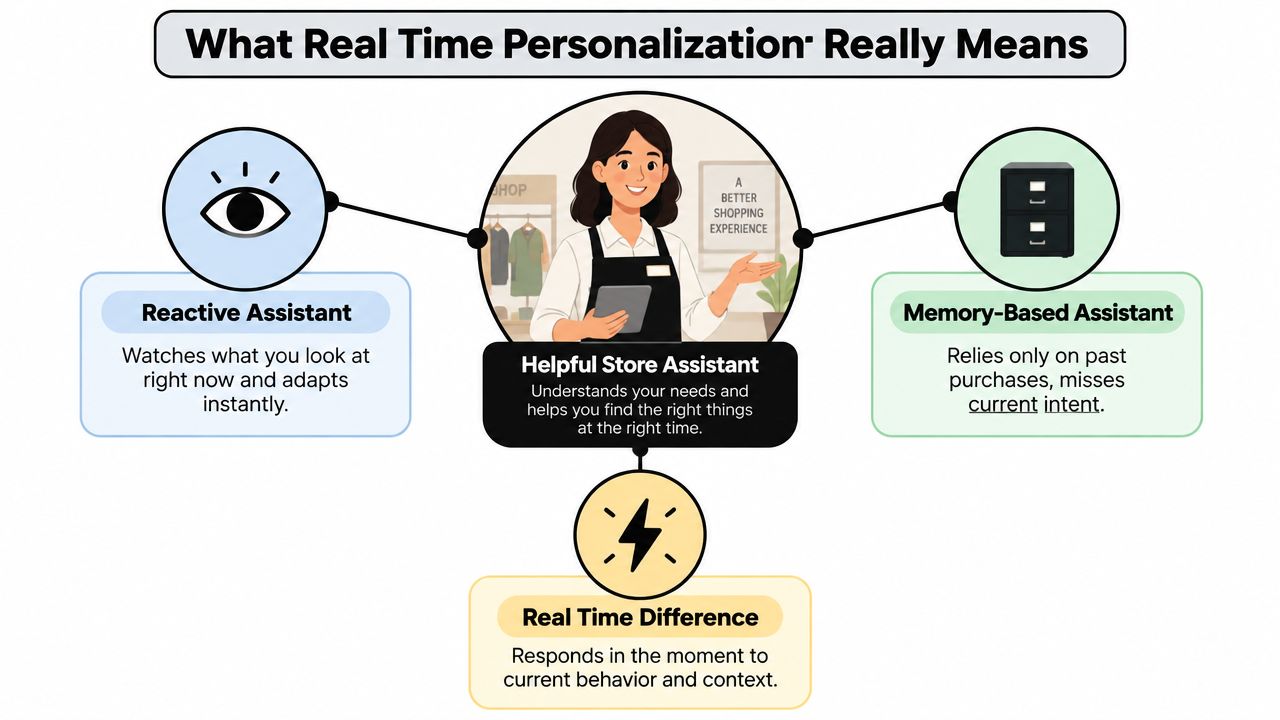
Think of a helpful store assistant. You walk into a shop, look closely at running shoes, compare two pairs, and then move toward the section for trail equipment. A good assistant responds to what you're doing now. They might point out a trail model, ask whether you're training outdoors, or explain the difference between cushioning and grip.
A memory-based assistant behaves differently. They remember that you bought casual shoes last year and show you more casual shoes, even though your current behavior indicates a new purpose. That memory can be useful, but it doesn't explain the whole visit.
A landing page works the same way. Traditional personalization often relies on a profile, segment, past purchase, location, or campaign label. Real time personalization adds current-session behavior and context to the decision, so the experience can adapt as intent develops.
Three kinds of relevance
Static segmentation starts with a prebuilt group. A marketer might create one experience for enterprise visitors and another for small businesses. The page remains mostly fixed once the visitor enters that group.
Triggered personalization reacts to a known event, such as a form submission, email click, or abandoned cart. It can be timely, but the trigger usually comes from a defined workflow rather than a continuous reading of the current session.
Real time personalization sits closer to the live interaction. It can consider signals such as:
- Traffic context: The campaign, ad message, referral path, or search intent that brought someone to the page.
- Session behavior: The pages viewed, products explored, searches performed, scroll depth, and repeated interactions.
- Current context: Device, location, account state, previous relationship, and the content already consumed during the visit.
- Decision signals: Actions that suggest curiosity, comparison, urgency, or readiness to convert.
The important distinction isn't speed. A page that changes quickly for no meaningful reason isn't personalized well. The system must connect a useful signal to a useful response.
A simple mental model
Use this sequence: signal, decision, response.
The signal is what the visitor does. The decision is the page's interpretation of that behavior. The response is the content or action that changes.
For example, a visitor repeatedly reads a page about implementation support. The system interprets that behavior as a need for risk reduction, then changes the hero proof point from a broad product benefit to implementation guidance. The page isn't trying to guess everything about the person. It's answering the question their behavior makes most visible.
How Real Time Personalization Works Behind the Scenes
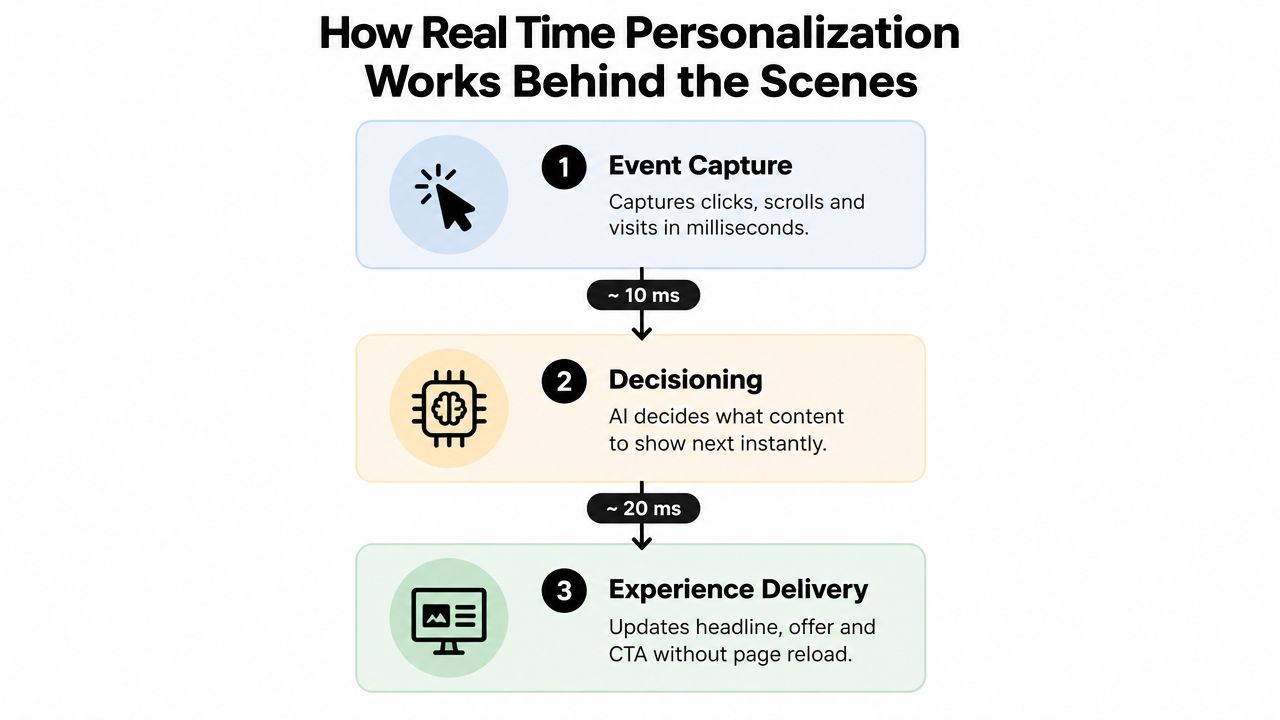
A landing page decision happens through three connected layers: event capture, decisioning, and delivery. The visitor may see only a changed headline, but the system must collect a useful signal, choose an appropriate response, and render it before the moment passes. Slow data or an overloaded decision service leaves the page generic, or changes it after the visitor has already acted.
Event capture creates the live signal
The process starts by recording relevant actions, such as a click, search, product view, form interaction, or visit to a supporting page. That event must reach a usable data layer quickly enough to influence the current session.
A warehouse pipeline may update records in minutes or hours. That timing can support reporting, segmentation, and lifecycle campaigns, but a landing page decision needs a faster route for signals that matter now. First-party behavioral data helps because it comes directly from interactions with your own site, product, or service. It can reflect current intent instead of relying only on an older profile.
Data readiness is the first practical bottleneck. If the event arrives late, lacks context, or cannot be joined to the current visitor, even a fast model has little to work with.
Decisioning turns behavior into an action
The decisioning layer selects what the page should show. It can combine rules, a model, an experimentation system, or several of these methods. The aim is a dependable choice within the page's performance budget, not the largest calculation possible on every request.
Industry guidance commonly targets sub-100ms p99 serving latency, with some architectures aiming for under 50ms by preparing candidates offline and re-ranking them with live session context. Precomputation handles the heavier work before the visitor arrives. The live path then makes a smaller choice, similar to selecting one prepared landing page variation after checking the visitor's current context.
A benchmark in the research reports 340ms average event capture-to-feature-store propagation, 84ms recommendation latency at p50, and 147ms at p95, using a hybrid offline and online architecture. It also describes frequent model updates that reduced update payload size and bandwidth needs by more than 13x, while maintaining serving accuracy comparable to a fully fresh model. These figures come from the large-scale real-time personalization system report. They show why freshness, latency, and infrastructure design must be planned together.
Delivery makes the change visible
The final layer applies the decision to the experience. On a landing page, that could replace the headline, subheading, proof point, offer, or CTA. The implementation should avoid visible flicker, protect page speed, and keep the selected experience consistent during the session.
Measurement belongs beside delivery. A changed page element is only a hypothesis until the team compares its effect against a control and checks whether the result reflects a meaningful action, such as form completion or qualified conversion.
This video gives a visual introduction to the flow from user behavior to personalized experience:
Financial services teams face higher stakes because context and trust must work together. this guide to personalization for fintech teams offers a focused reference for responding to live context without making the page feel intrusive.
Real World Use Cases for Landing Pages That Convert
The easiest way to apply real time personalization is to start with one page decision. Don't begin by trying to personalize the entire site. Choose a visible element, identify the signal that should influence it, and define the response a visitor should receive.
Match the promise to the traffic source
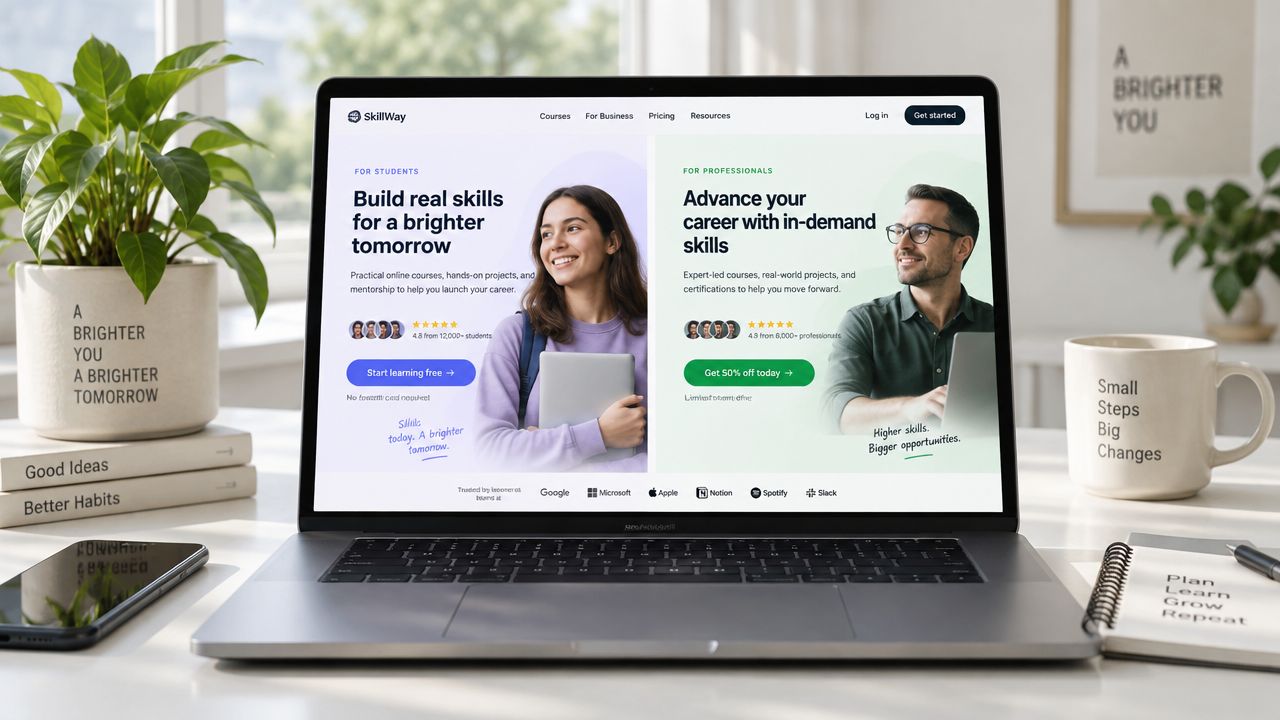
A visitor arriving from a campaign about onboarding shouldn't meet a headline focused on analytics if the page has enough context to understand the campaign promise. The trigger is the referral or campaign context. The change is a matching headline and subheading. The intended outcome is a shorter mental jump between the ad and the page.
This is different from creating a separate page for every campaign. One flexible page can respond to meaningful source context while keeping the underlying offer consistent.
Adapt to in-session exploration
Suppose a visitor starts on a general product page, then reads a page about integrations and returns to the landing page. Their actions suggest that compatibility matters. The page can replace a broad benefit with an integration-focused message, surface a relevant proof point, or change the CTA from “Learn more” to an action that fits a visitor closer to evaluation.
The trigger is not a demographic label. It's a sequence of behaviors. That makes the response useful even when the visitor is anonymous or has little historical data.
Recognize returning intent without trapping the visitor
A returning visitor may already know the basics. Showing the same introductory headline every time wastes valuable space. A page can use prior interaction as one signal, then combine it with current behavior before changing the experience.
If the visitor returns to compare plans, the page might emphasize decision support. If they return to read educational content, it may retain a softer CTA. The key is to avoid treating the past as a permanent identity. History should inform the decision, not override the current session.
Change proof and calls to action selectively
A product page can adjust social proof based on the visitor's apparent concern. Someone exploring security content may need compliance or governance proof. Someone studying an integration may respond better to implementation evidence. Someone returning from a pricing page may need a direct path to a conversation.
Keep the number of changing elements small enough that you can explain the result. A useful landing page test might look like this:
| Live signal | Page response | Decision being supported |
|---|---|---|
| Campaign emphasizes a specific use case | Align the hero message with that use case | “Is this relevant to my problem?” |
| Visitor explores implementation content | Surface integration or setup proof | “Can my team adopt this?” |
| Visitor returns after viewing pricing | Clarify next-step CTA | “What should I do now?” |
| Visitor shows low engagement | Simplify the first message | “Why should I keep reading?” |
Avoid changing copy merely because the technology allows it. A visitor should feel understood, not watched. The strongest experiences make the next step clearer without calling attention to the machinery behind the page.
What You Need Before You Personalize in Real Time
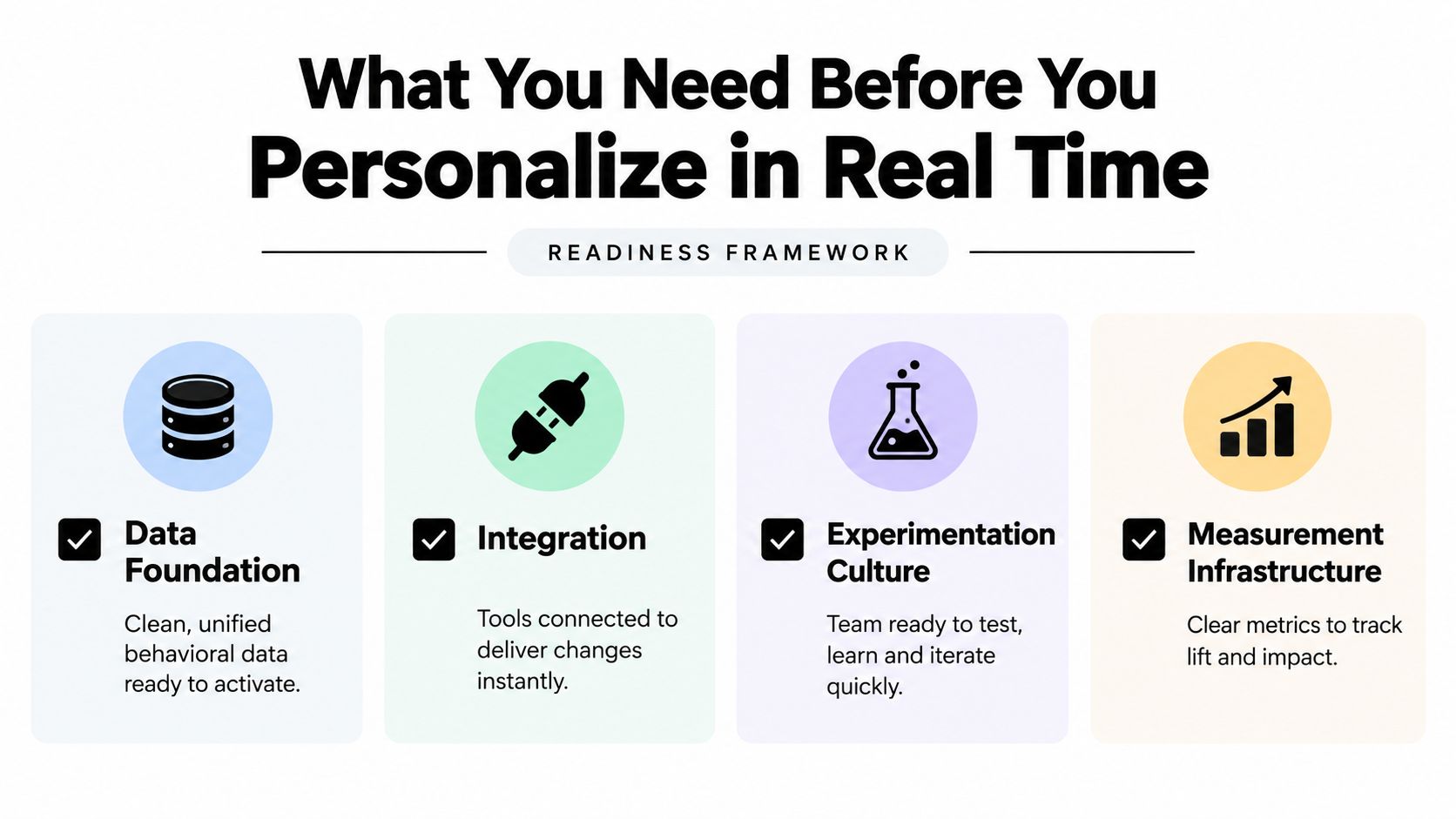
A personalization platform can't repair unclear signals, disconnected systems, or a team that doesn't agree on success. The readiness question isn't “Which vendor has the most features?” It's “Can we make a fast decision from trustworthy data, deliver the response, and learn from the result?”
Start with the data foundation
List the signals your page can access today. Include campaign source, session events, account information, product interactions, and consent status. Then ask whether those signals are named consistently, available to the decisioning system, and trustworthy enough to drive a visible change.
A unified first-party data layer matters because personalization decisions depend on context. If marketing sees one visitor history, the product system sees another, and analytics records a third, the page may deliver conflicting experiences. Clean data doesn't require every system to be replaced. It does require a clear source of truth for the signals used in the decision.
Connect delivery to decisioning
The page must be able to receive a decision without waiting for a slow back-and-forth process. That usually means connecting event collection, audience or feature storage, experimentation, content delivery, and analytics.
Warehouse-centric pipelines remain useful for analysis and longer-term learning, but they can introduce delays when teams use them as the only path for live decisions. Event streaming and low-latency access support the current session. Training-serving consistency also matters, because the information used to create a model must line up with the information available when the page serves it.
Make experimentation part of the operating model
Personalization creates more possible variants, which can make opinion-based optimization even more dangerous. Your team needs a repeatable way to choose a hypothesis, define the audience or signal, launch a controlled experience, and decide what happens next.
That process works best when marketers, analysts, engineers, and leaders agree on responsibilities. Someone must own the experience. Someone must validate the data. Someone must inspect the results and check for unintended effects.
A clear message still matters before the page adapts. Teams can use a customer value proposition guide to clarify the core promise before creating dynamic versions of it.
Build measurement before launch
Decide which outcome the experience is meant to influence. A headline test may aim to improve qualified form submissions. A CTA change may aim to increase completed demos. A recommendation block may aim to move visitors toward a relevant product category.
Your checklist should include:
- Data foundation: Clean, unified behavioral signals are available for activation.
- Integration: The page can receive and display the decision without disruptive delay.
- Experimentation culture: The team can test changes rather than defend preferences.
- Measurement infrastructure: Analytics can connect exposure to meaningful outcomes.
The recent operational discussion around real time personalization frames the challenge as an organizational readiness issue as much as a technical one. The analysis of the real-time personalization readiness gap highlights data readiness, measurement infrastructure, and alignment between executives and practitioners as important gaps teams must close.
How to Measure What Actually Works
A personalized landing page can win more clicks and still hurt business results. Visitors might respond to a stronger CTA, abandon the form, or become leads that sales cannot use. Measurement must follow the journey beyond the first interaction.
Choose one primary outcome and a short set of supporting measures. For a lead-generation page, the primary metric could be qualified submissions or completed sales conversations. Supporting measures might include conversion rate, revenue per visitor, form completion, engagement with the next step, and downstream lead quality.
Test the decision, not just the copy
A useful experiment compares a personalized experience with a suitable control. The control could be the existing page or a stable non-personalized variant. The treatment needs a clear rule, such as showing an implementation-focused hero after a visitor engages with integration content.
Keep the decision logic visible. If the team cannot explain why a visitor entered a variant, the result becomes difficult to trust. Record the signal, the decision, the content displayed, and the outcome that followed. This record turns a landing page test into an inspectable decision system rather than a copy preference.
Do not call a winner from one early movement. Check performance across meaningful traffic contexts, devices, visitor states, and downstream outcomes. A personalization rule may help one audience while confusing another, especially when the page reacts to a weak or incomplete signal.
Track system health beside business health
Latency and freshness belong in the scorecard. Industry guidance commonly points to sub-100ms p99 serving latency, while practical architectures often keep decisions within a few hundred milliseconds, as discussed in earlier technical guidance.
Freshness must match the decision. A recommendation based on current behavior loses value when the signal arrives after the session has moved on. Not every feature needs to update at the same speed. Use the fastest path for signals that affect the live page, and reserve slower processing for analysis and model improvement.
A useful dashboard should help a growth lead answer four questions quickly:
- Exposure: Who saw each experience, and which decision placed them there?
- Behavior: Did visitors take the intended next action?
- Business impact: Did qualified conversion or revenue per visitor improve?
- Reliability: Did latency, missing data, or delivery errors affect the result?
A practical guide on action-driving dashboards can help teams turn reporting into decisions instead of collecting charts without a regular operating rhythm. For adaptive allocation, review this guide to multi-armed bandit experimentation, while keeping guardrails and downstream quality in the evaluation.
The analysis of the readiness gap for real-time personalization highlights data readiness, measurement infrastructure, and alignment between executives and practitioners as areas teams must address. These constraints shape what a landing page can decide, how quickly it can respond, and whether the resulting lift can be trusted.
Putting Real Time Personalization to Work on Your Pages
Start with one landing page and one decision. Choose a headline, subheading, proof point, or CTA that directly answers a question visitors already reveal through their behavior. Avoid changing every element at once, because you'll lose the ability to explain what caused the outcome.
Use this sequence:
- Name the visitor question: What uncertainty is blocking the next action?
- Choose the live signal: Which current behavior or context indicates that uncertainty?
- Write the response: What specific copy or CTA addresses it?
- Set the control: What will visitors see when the signal isn't present?
- Define the outcome: Which business result decides whether the change stays?
- Check the delivery: Does the experience appear quickly and consistently?
This approach keeps the work grounded in conversion rather than novelty. It also gives your engineering team a smaller problem to solve and your marketing team a cleaner experiment to evaluate.
For teams improving the page before introducing live decisioning, this guide to landing page optimization provides a useful foundation. Once the baseline is clear, real time personalization can become a focused extension of conversion work, not a separate transformation program.
The central idea is easy to remember: targeting tells you who a visitor might be, while timing helps you respond to what they need now. The strongest programs combine both, then measure the result with enough discipline to distinguish genuine lift from attractive noise.
Polish helps teams test landing page headlines, subheadings, and CTAs by serving copy variants to real visitors, measuring what converts, and refining the experience based on live performance data. Visit Polish to see how you can start turning landing page decisioning into a focused, measurable growth process.
- real time personalization
- landing page optimization
- conversion rate optimization
- personalization strategy
- growth marketing
Your website rewrites itself until it converts.
Polish writes new versions of your headlines and CTAs, tests them on your real visitors and keeps the ones that win.
Start free