AI Powered Personalization: A Growth Team's Guide
Discover how AI powered personalization transforms customer experiences. This practical guide helps growth teams implement effective strategies that drive
Published on 13 min read

Table of contents
- What AI Powered Personalization Actually Means
- Why finance should care
- What it is not
- How the Learning Loop Works Under the Hood
- Exploration versus exploitation
- What to log and what to optimize
- The Privacy Trust Gap Most Guides Skip
- The low data posture that wins
- The privacy utility trade off is real
- What a Landing Page Agent Does Step by Step
- The workflow on a live page
- Why this scales where manual CRO plateaus
- AI Personalization vs Rules, Segments, and A/B Testing
- My recommendation on layering
- Practical Wins for Growth Teams This Quarter
- The three moves that matter
- Measuring Real Lift Without Fooling Yourself
- Set up the counterfactual first
- Watch for the quiet failure modes
- Answers to Questions Growth Teams Actually Ask
- Should we build or buy
- How long until we have a defensible read
- How much data do we need
- What's the most common failure mode
AI powered personalization is software that picks the landing page variant each visitor sees based on campaign source, device, country and visit status, then updates that choice as results come in. It matters because most consumers now expect personalized interactions and penalize brands that don't deliver them, so every mismatched page is paid traffic you already bought.
You've seen the moment. A visitor clicks a search ad on their phone and lands on copy written for a desktop reader who found you through a webinar. The headline doesn't match the ad, the proof point answers a question they didn't ask, and they're gone. A system that resets the page per visitor fixes that mismatch without your team hand building a test for every combination.
Generating variants is the easy half. Proving the AI caused incremental lift is the hard half, since the system will happily claim credit for conversions that would have happened anyway. Answering that takes persistent holdouts and a low-data posture, both cheaper to run than they sound.
What AI Powered Personalization Actually Means
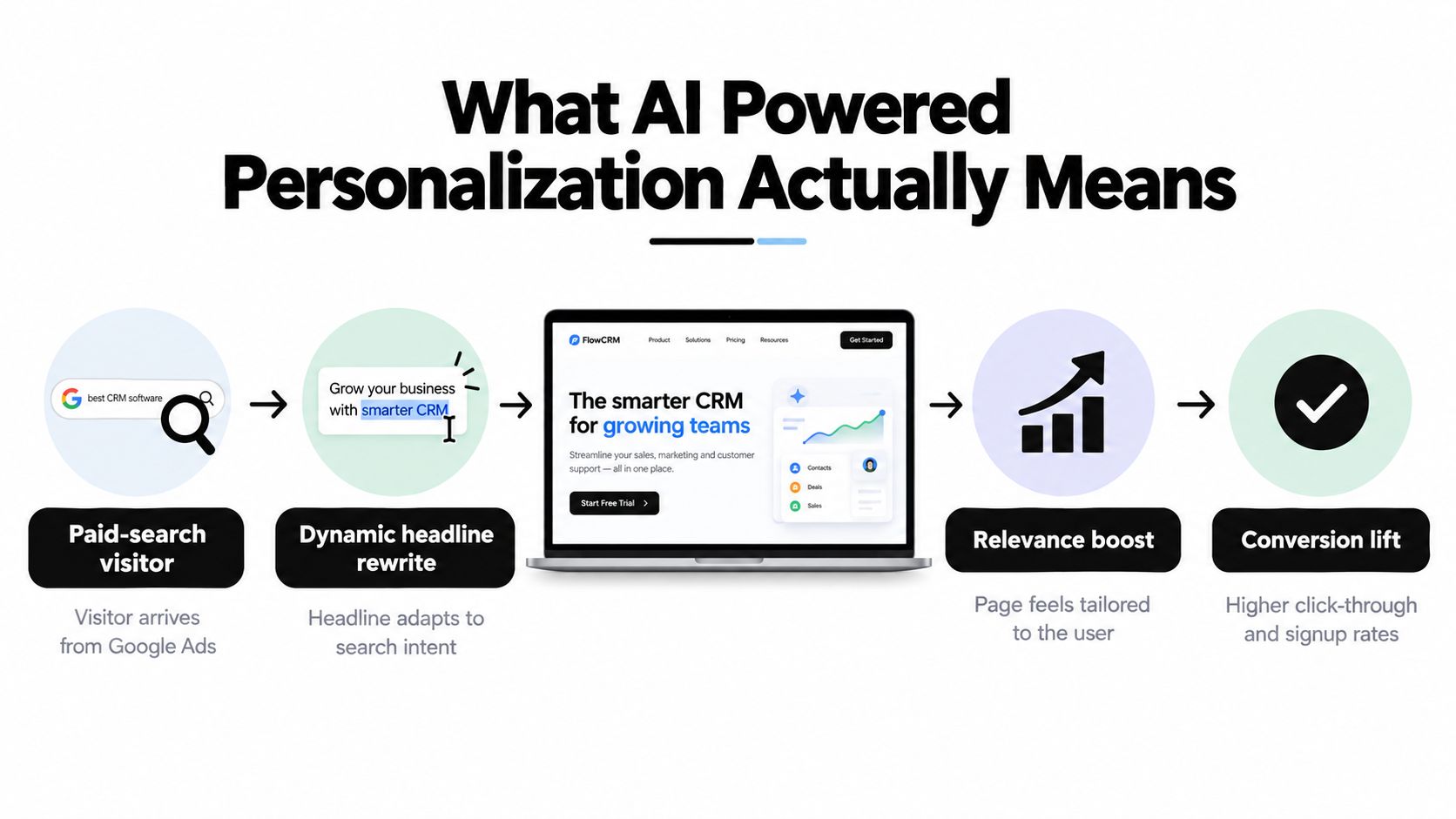
Take a SaaS landing page at 9 a.m. A paid search visitor on mobile sees a short headline that mirrors their search term and a one tap call to action. An hour later, a returning reader from a webinar sees a headline that references the problem from that session and proof from a similar company. Same URL, different page.
That's the working definition you can use in a budget meeting. AI powered personalization is software that selects which version of a headline, subhead, offer or call to action each visitor sees, based on contextual signals like source, device, country and first visit versus returning, using a learning policy that improves with traffic.
The flow from arrival to adapted headline to conversion looks like this.
Why finance should care
This isn't a copywriting upgrade. It's a revenue decision tied to how buyers already behave. In McKinsey's 2021 personalization research, 71% of consumers expected personalized interactions, 76% became frustrated when personalization was absent, and 78% said personalized content made them more likely to repurchase.
Read those three numbers as a funnel. Expectation drives consideration, frustration kills conversion, and relevance after purchase drives repeat revenue. That is why personalization belongs on landing pages, recommendations, offers and follow ups, not just in email subject lines.
What it is not
Don't let a vendor sell you psychoanalysis. You don't need third party data harvesting or a profile that claims to know a visitor's personality. You need a per decision policy that uses signals the visitor just gave you, the ad they clicked, the device they're holding, the country they're in, and whether they've been here before.
If you're mapping this across channels, this breakdown of how to personalize customer experiences is useful context for touchpoints beyond the landing page. My recommendation is narrower. Start where intent is highest and the decision is cleanest, the landing page headline and call to action. Prove lift there before you personalize everything.
If you can't explain which signal changed the page for a specific visitor, you don't have personalization. You have a randomizer with a sales deck.
How the Learning Loop Works Under the Hood
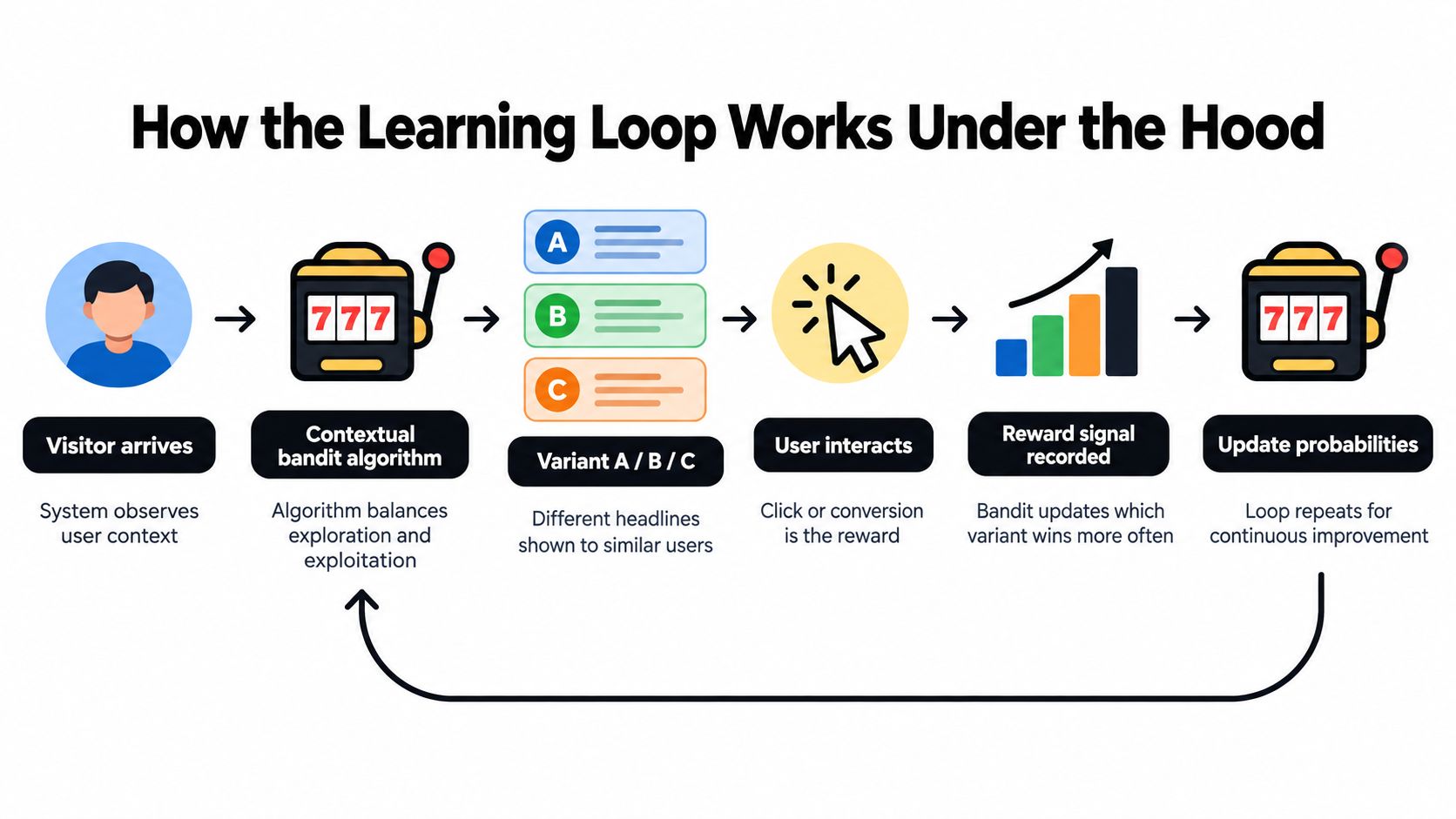
Most modern systems don't run a fixed split. They run a contextual bandit. Each pageview is a decision. The system looks at context, picks a variant, records whether that visitor converted, and updates its estimates before the next visitor arrives.
The loop, from observed context to updated probabilities, works like this.
Exploration versus exploitation
The bandit balances two jobs. Exploitation means showing the variant currently predicted to convert best for that type of visitor. Exploration means sometimes showing a less proven variant so the system can learn. Policies like Thompson sampling, UCB or epsilon greedy make that trade off explicit.
Kill exploration and you lock in early noise. The first variant to get lucky with a few high intent visitors looks like a winner, gets all the traffic, and you never discover that a different headline wins for mobile visitors from a specific campaign. I've shipped this mistake. It looks efficient in week one and costs you for months.
The evidence for using context at all is strong. On a Yahoo! News dataset of more than 33 million events, a contextual bandit produced a 12.5% click lift over a context free bandit, and the advantage grew when training data got scarcer. The mechanism is heterogeneous treatment effects. You're not asking which headline wins on average. You're asking which headline wins for this visitor, in this context.
This walkthrough shows the loop in motion before we get to evaluation.
What to log and what to optimize
Log three things for every impression, the context, the variant shown, and the outcome. Without that, you can't run inverse propensity or doubly strong evaluation later, and adaptive allocation will bias your read. Teams that handle risk decisions run into the same logging discipline, as this guide to Shopify fraud prevention shows for customer risk assessment, where every decision needs an auditable trail.
Optimize incremental revenue per visitor or qualified conversion, not raw click through rate. A headline can win clicks by overpromising and lose you money downstream. Ask any vendor which reward signal they optimize, how exploration is set, and how they correct for allocation bias. Vague answers mean you're buying variant generation, not learning.
The Privacy Trust Gap Most Guides Skip
The standard pitch says more data means better relevance. Buyers don't agree, and if you ignore that, your program will die in a privacy review or a screenshot on social media.
People want the personalized page. They don't want to feel tracked into it.
The low data posture that wins
My position is simple. Personalize on recognizable context, not opaque profiling. Campaign, referral message, device, country and visit status are signals a visitor can understand. If they clicked an ad about pricing and the page leads with pricing, that feels helpful. If the page reveals something they never told you, that feels like surveillance, even if it converts once.
Build the controls before legal asks for them:
- Signal minimization: Hash or aggregate campaign, device, country and lifecycle features instead of retaining raw cross site identities.
- Minimum cohort sizes: Don't make decisions for segments so small that a result could expose an individual.
- Clear disclosure and controls: Say what you use, in plain language, and make deletion and opt out easy to find.
- Sensitive attribute guardrails: Block attributes you should never infer or act on, even if a model finds them predictive.
The privacy utility trade off is real
Differential privacy makes the trade off measurable. It adds calibrated noise so output barely changes whether one person's record is included. The budget, epsilon, quantifies the guarantee. A privacy preserving recommender evaluation kept competitive ranking quality near ε ≈ 5, while performance dropped fast below 1.
You don't need to implement that math yourself. You need the lesson. Stronger privacy costs some accuracy, and that's an acceptable trade. Suppress decisions on thin segments, report estimates with uncertainty, and you'll keep useful adaptation without memorizing individual behavior.
What a Landing Page Agent Does Step by Step
Forget the generic AI tool story. A landing page agent runs a specific workflow on your existing page, and you should be able to map each step to your stack.
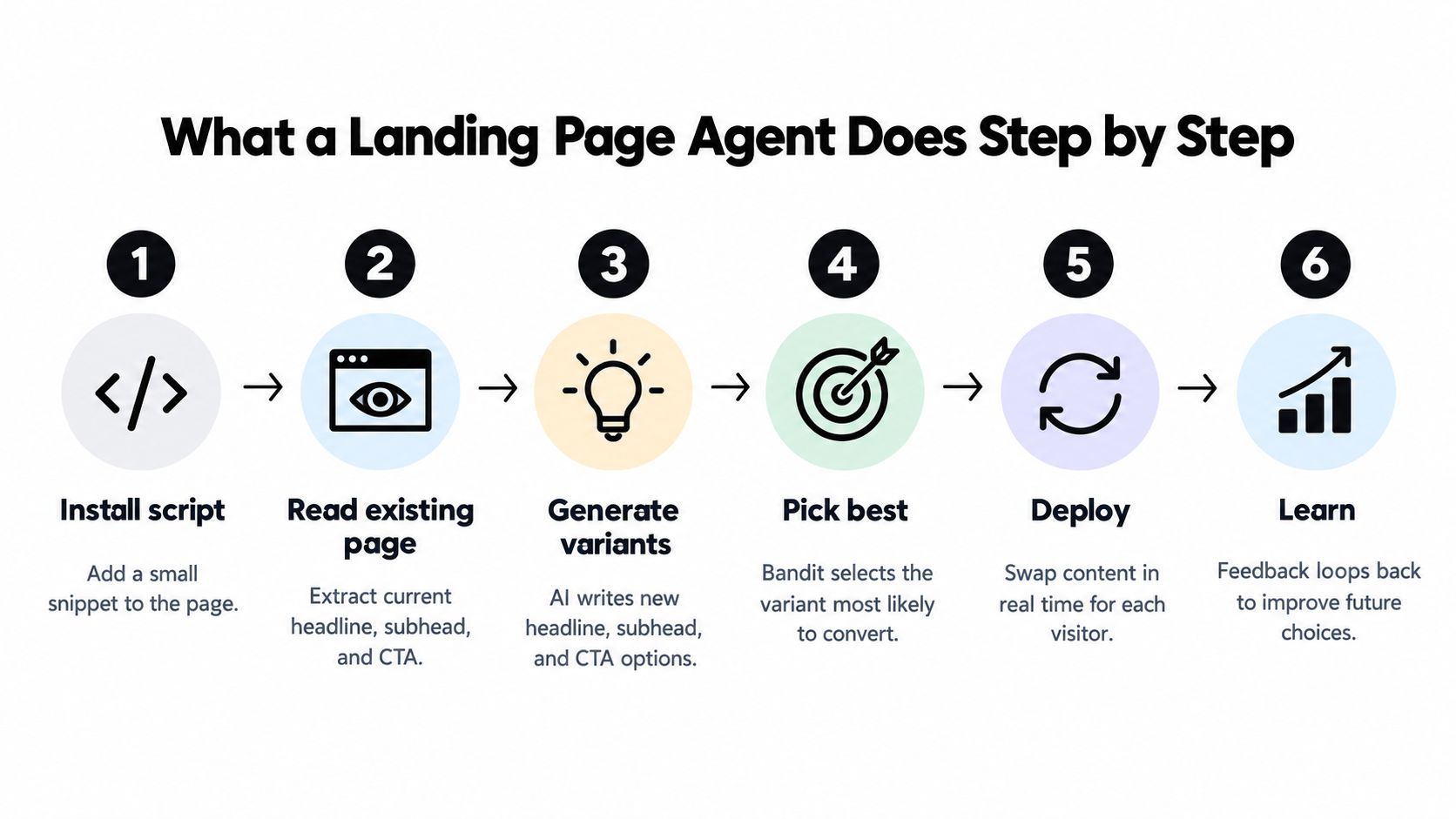
The six steps, from installation to learning, run in this order.
The workflow on a live page
- Install and read: You add a script. The agent reads your current headline, subhead and call to action so it knows what it's replacing and what your page already promises.
- Generate variants: It writes new headline, subhead and call to action options. Your job is to approve the pool and set brand and compliance boundaries, not to write every option yourself.
- Pick per visitor: For each arrival, it checks the ad, post or search that brought them, plus campaign, device, country and new versus returning status, then serves the variant the policy predicts will convert best for people like them.
- Log and update: It records the outcome, updates the policy, and serves a sharper choice on the next visit. Every visit makes the next one better informed.
Polish is one example of this model. It installs via script, reads the page, writes headline, subheading and call to action variants, and picks per visitor using source, campaign, device, country and visit status.
Why this scales where manual CRO plateaus
Manual testing moves one variant at a time and waits. An agent tests combinations across contexts continuously, including contexts your team would never think to isolate. That compounding is the point.
It also creates a measurement obligation. A system that adapts per visitor can't be judged by comparing this month to last month, because traffic mix and campaigns changed too. McKinsey's 2025 coverage of promotion uplift modeling frames the right question as outcomes under promotion versus no promotion, and your landing page needs the same explicit counterfactual. The agent generates and serves. You still own the proof.
AI Personalization vs Rules, Segments, and A/B Testing
You're not choosing between good and bad tools. You're choosing which layer makes which decision. Use this table in your next planning meeting.
Choosing the Right Personalization Approach
| Approach | Time to First Lift | Data Needed | Best Use Case |
|---|---|---|---|
| Rules | Immediate once written | A known condition you can state in advance | Compliance floors, brand safety, eligibility |
| Segments | Slow, depends on manual analysis | Enough visitors per segment to read results | Broad audience planning and campaign structure |
| Traditional A/B testing | Slow, waits for a single winner | Steady traffic on a fixed split | One big question with an average answer |
| AI powered personalization | Learns continuously from live traffic | Context, variant and outcome logged per impression | Picking which message wins per visitor |
My recommendation on layering
Keep rules. They're how you enforce what must never happen, restricted claims, excluded audiences, required disclosures. Rules set the boundary. The model should choose inside it, never outside it.
Keep segments for planning, not for per visitor decisions. Segments help you decide where to spend and what to build, much like product segmentation for Google Shopping helps retailers structure campaigns before any per shopper decision happens. But a segment is a static bucket. It can't adjust when a returning mobile visitor behaves differently from the segment average.
Stop treating A/B testing as the alternative. AI personalization turns the test into a continuously updated policy, and a persistent holdout keeps it honest. If you want the mechanics of that replacement, read this explainer on how multi armed bandits differ from fixed split testing before your vendor conversation. The decision isn't test or personalize. It's whether your testing learns per context or settles for one average winner.
Practical Wins for Growth Teams This Quarter
Ship small, measure carefully, and expand only what survives. That's the whole quarter plan. Teams get burned when they launch personalization everywhere, can't attribute anything, and lose internal trust by month two.
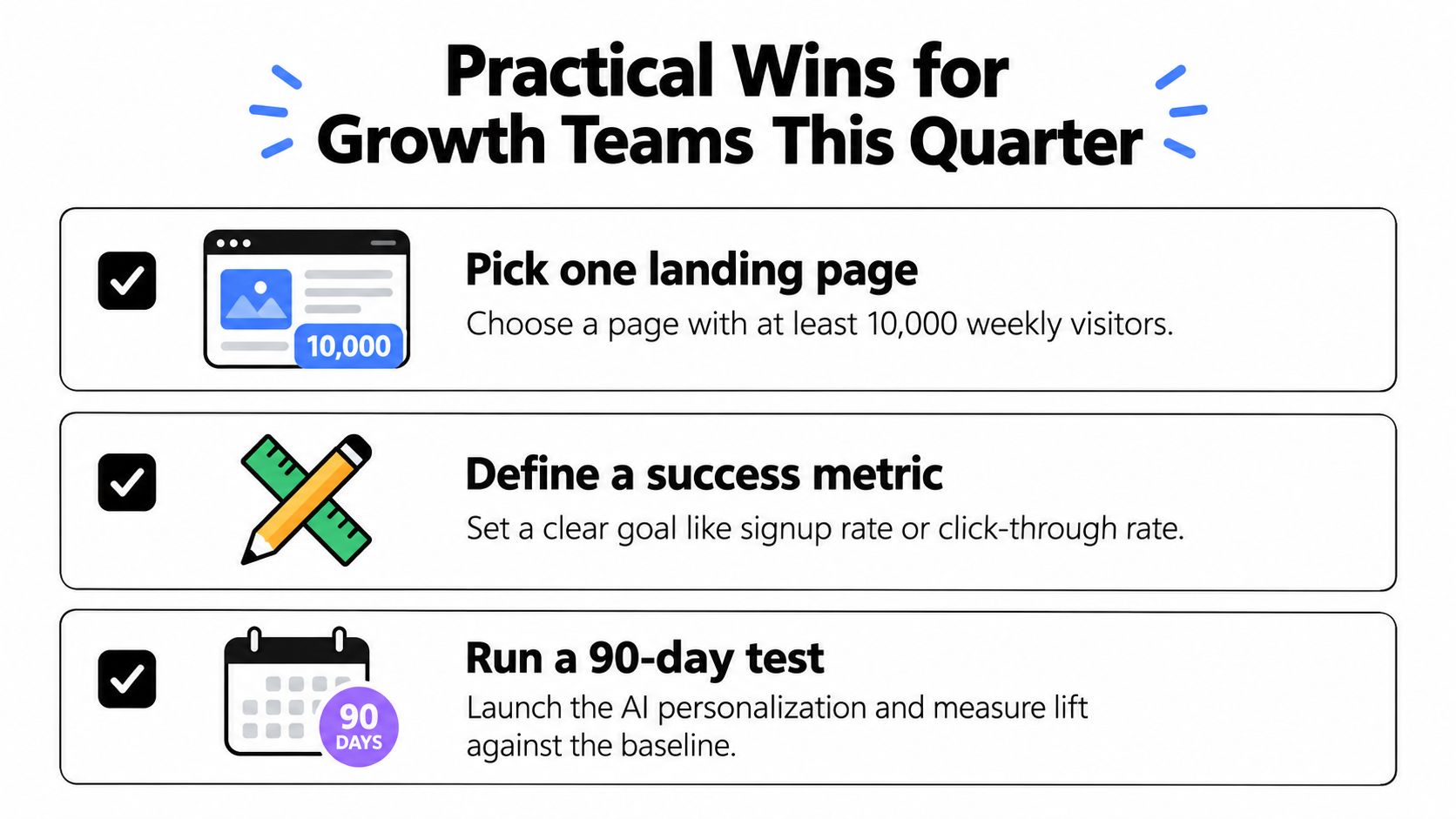
These are the first moves, in order.
The three moves that matter
Pick one landing page with meaningful, steady traffic and a clear conversion event. One page limits blast radius, keeps QA manageable, and gives the policy enough repeated decisions in similar contexts to learn. Don't start on your homepage if its traffic is a mix of every intent you serve.
Define one primary metric before launch. Use qualified conversions or revenue per visitor, something finance recognizes. If you let the system chase clicks, it will find clicky copy. That's not growth, that's a proxy consuming your budget.
Build a small, approved variant pool and reserve a persistent holdout that never sees personalization. The holdout isn't overhead. It's the only reason anyone should believe your lift number. Without it you're reporting a trend and calling it causation.
For concrete patterns of what per visitor adaptation looks like on real pages, these website personalization examples are a useful reference when you're approving your first variant pool. Steal structures, not claims. Your traffic will tell you which structures work for your buyers.
Non negotiable: If leadership won't fund the holdout, don't launch. You're not saving traffic, you're giving up the ability to know anything.
Measuring Real Lift Without Fooling Yourself
Most guides stop at click through rate and declare victory. A continuously adapting system makes that dishonest, because the thing you're measuring changes while you measure it.
Before and after comparisons break for boring reasons. Seasonality shifts demand. Ad changes alter traffic mix. Returning visitors behave differently from new ones. An early spike regresses to the mean. Your dashboard won't warn you about any of this. It'll just show a line going up while the campaign that caused it runs in another tab.
Set up the counterfactual first
The credible question is what would this visitor have done without personalization. Answer it with structure, not opinion:
- Persistent holdout: The same visitors stay in control for the life of the test, so repeated visits don't contaminate the read.
- Randomized eligibility: Assignment happens before the policy sees the visitor, so high intent traffic can't get routed into treatment.
- Pre registered primary metric: Write down the metric, the attribution window and the decision rule before launch. Changing the metric after seeing results is how teams manufacture wins.
- Segment level thresholds: Don't declare a winner for a context cell that hasn't seen enough impressions to distinguish signal from noise.
That last point is where most reads fall apart. Work through how minimum detectable effect sets your sample size requirements before launch, so you know which effects you can even detect with your traffic. If the effect you need is smaller than what you can detect, say so upfront.
Watch for the quiet failure modes
Monitor novelty effects, where new copy wins because it's new, and cannibalization, where one page gains by pulling conversions from another. Track downstream lead quality, refunds and retention alongside conversion rate. An apparent lift that lowers lead quality is a loss with better cosmetics.
And accept the hardest outcome. Sometimes the holdout sits within noise and the right call is to stop adapting and report no lift. Publishing that verdict internally builds more trust than a manufactured win, and it frees traffic for a test that might move revenue.
Answers to Questions Growth Teams Actually Ask
Should we build or buy
Build only if you have engineering capacity to maintain logging, evaluation and policy updates after launch. The model is the easy part. The ongoing measurement discipline is what you'll live with. Most growth teams should buy the agent and spend their own effort on variant approval and holdout design.
How long until we have a defensible read
That depends on your traffic consistency and how many context cells you're trying to learn at once. You'll see directional movement before you have a number worth taking to finance. Don't present the early movement as the result. Wait for the holdout comparison you designed for.
How much data do we need
Think in impressions per context cell, not total volume. A page with strong traffic concentrated in a few campaigns and devices can learn faster than a larger page spread thin across dozens of contexts. Thin cells should fall back to your default page, not guess.
What's the most common failure mode
Optimizing a proxy that doesn't move revenue, followed closely by forgetting the holdout. Both produce impressive dashboards and no money. Fix the metric, protect the control group, and most other mistakes become recoverable.
If you want a landing page that writes and tests a version for every visitor, based on the ad, post or search that brought them, their device, country and visit status, that's what Polish does. Install the script, approve the variants, protect your holdout, and let the policy learn on live traffic. Start with one page and see what it proves at Polish.
- ai personalization
- personalization tools
- landing page conversion
- growth marketing
- contextual bandit
Your website rewrites itself until it converts.
Polish writes new versions of your headlines and CTAs, tests them on your real visitors and keeps the ones that win.
Start free