Multi Armed Bandit Explained for Smarter Experiments
Learn how the multi armed bandit balances exploration and exploitation to optimize conversions faster than A/B tests, with algorithms and real examples.
Published on 15 min read

Table of contents
- Why Traditional Testing Wastes Your Best Traffic
- What the Multi Armed Bandit Problem Really Means
- From slot machines to landing pages
- The goal isn't simply to find a winner
- The Core Trade Off Between Exploration and Exploitation
- Why neither extreme works
- How Popular Bandit Algorithms Make Decisions
- Epsilon greedy
- Upper Confidence Bound
- Thompson Sampling
- Choosing based on the operating context
- Multi Armed Bandits Versus A/B Tests and When to Use Each
- Situations where the standard assumptions fail
- Real World Examples of Adaptive Optimization in Action
- Product recommendations
- Pricing and calls to action
- A failure caused by shared audiences
- Choosing the Right Approach for Your Next Experiment
Your landing page is live, traffic is arriving, and two headlines are competing for attention. One appears to be producing more sign-ups, but your team is still sending a meaningful share of visitors to the weaker version while the test runs. You're waiting for a statistically defensible conclusion, yet every visit creates another opportunity cost.
That tension sits at the heart of conversion optimization. A traditional A/B test is built to help you learn which option performs better under a controlled comparison. A multi armed bandit is built to help you allocate traffic toward the option that currently looks most promising while continuing to learn. The distinction matters because landing-page decisions rarely happen in a vacuum. You need to balance immediate conversions, reliable evidence, changing audiences, and the risk of trusting an algorithm too quickly.
If you manage headlines, calls to action, offers, or product recommendations, the useful question isn't whether bandits are “better” than A/B tests. The better question is: what job do you need the experiment to perform?
Why Traditional Testing Wastes Your Best Traffic
A Head of Growth launches a landing-page experiment with a clear hypothesis. The original headline says, “Make reporting easier.” The challenger says, “See every campaign's performance in one place.” Both versions receive traffic, and the team watches the dashboard each morning.
After the first signals arrive, the challenger looks more convincing. Still, the team keeps the allocation fixed because stopping early could produce a misleading conclusion. Visitors continue seeing both versions, including the version that currently appears less effective. The team gains information, but it may sacrifice conversions while gathering that information.
That isn't a flaw in the purpose of A/B testing. A controlled test protects you from reacting to noise, novelty effects, uneven audiences, and random variation. The problem appears when the business treats every visitor as if their primary value is helping the team reach a later decision. In reality, each visitor is also a chance to generate a lead, purchase, demo request, or activation.
The practical tension: A/B tests prioritize clean comparison. Growth teams often need clean comparison and sensible traffic allocation at the same time.
A useful foundation is the guide to landing pages, because the page itself determines what you're testing. A headline test, CTA test, and pricing test may all use the same experiment framework, but they carry different risks. A headline change might be easy to reverse. A pricing presentation could influence customer expectations, sales conversations, and downstream revenue.
A multi armed bandit changes the traffic question. Instead of assigning visitors to variants according to a fixed split for the entire experiment, the system updates its allocation as new outcomes arrive. A variant that appears stronger can receive more opportunities, while weaker options still receive enough exposure to avoid making a decision from a tiny or unrepresentative sample.
That makes the bandit useful as an adaptive budget allocator. Your traffic is the budget. Each variant is an investment. The algorithm decides where to place the next unit of attention based on what it has learned so far.
This approach doesn't magically remove uncertainty, and it doesn't make experimental design optional. It puts more emphasis on earning value during the learning process. By the end of this guide, you should be able to decide when that trade is appropriate, when a classic A/B test is safer, and how to evaluate the algorithm making the allocations.
What the Multi Armed Bandit Problem Really Means
The phrase comes from a casino problem. A traditional slot machine is sometimes called a one-armed bandit. Now replace that single machine with several machines, each with an unknown chance of paying out. You have limited time and money, so you must choose which machine to play next.
Each machine is an arm. Pulling an arm produces a reward, such as a win or no win. At the beginning, you don't know which machine is best. You learn by trying them, but every try also has an opportunity cost because you could have played another machine.
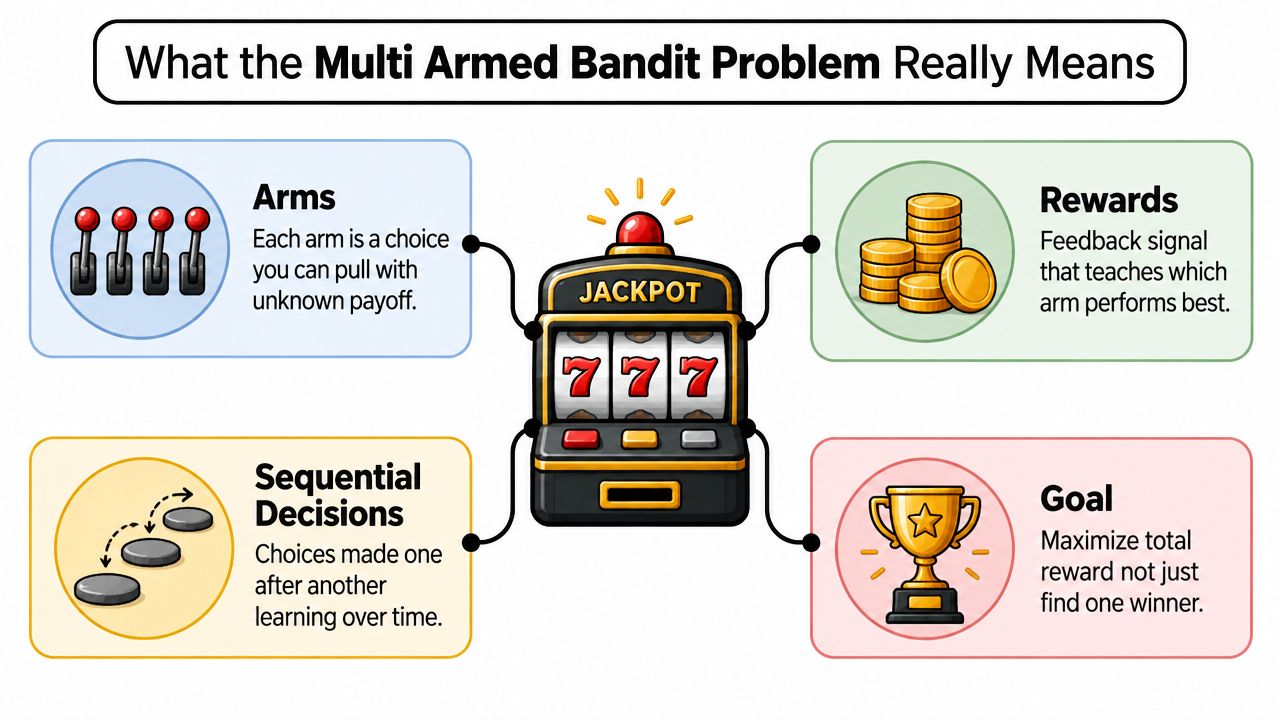
Marketing uses the same structure:
- Arms: Different headlines, CTAs, offers, layouts, or recommendations.
- Rewards: A defined outcome, such as a completed form, purchase, or qualified booking.
- Sequential decisions: The system chooses one experience, observes the outcome, then chooses again.
- Objective: Maximize the total reward accumulated across the run, not merely identify a winner at the end.
That last point creates the biggest conceptual shift. In a standard test, you often ask, “Which version should we choose once the experiment is complete?” In a bandit system, you ask, “Which version should receive the next visitor, given everything we've learned so far?”
From slot machines to landing pages
Suppose a page has three headline variants. A fixed A/B or multivariate design can distribute visitors according to a preselected plan. A bandit treats each headline as an arm and updates its belief about each option after observing conversions.
The algorithm doesn't need to understand the headline as a human copywriter would. It needs a consistent reward signal and a decision rule. If the primary conversion event is a completed demo request, the system uses that event to estimate which arm deserves more traffic.
This is a sequential optimization problem because the page receives visitors one after another. The system isn't making one permanent decision before the experiment begins. It's repeatedly deciding how to spend the next opportunity.
The goal isn't simply to find a winner
A team can discover the strongest-looking variant and still make a poor decision if it ignores timing, audience changes, or the quality of its reward signal. A bandit focuses on cumulative performance, which means an option that earns value early can influence future allocation before the experiment ends.
That makes the method attractive for live pages with ongoing traffic and a clear conversion action. It also means you must define the reward carefully. If you optimize for button clicks while the business cares about qualified pipeline, the algorithm may become very good at producing the wrong behavior.
The Core Trade Off Between Exploration and Exploitation
Every bandit must answer one question repeatedly: should the next visitor see the option we currently believe is strongest, or should we try an uncertain option to learn more?
Exploration means gathering information. Exploitation means using information. If the system explores too much, it keeps spending traffic on options that may not work. If it exploits too aggressively, it can commit to an early apparent winner and fail to discover a better alternative.
| Decision mode | What the system does | Immediate benefit | Main risk |
|---|---|---|---|
| Exploration | Shows uncertain variants to collect evidence | Improves understanding | Sends traffic to options that may underperform |
| Exploitation | Favors the strongest current option | Captures more value now | Can lock onto a misleading early signal |
Consider a headline test with three options. One version receives an early conversion from a visitor who was already highly motivated. If the algorithm treats that small signal as proof, it may favor the headline too quickly. Another version might appeal to a broader audience but need more observations before its advantage becomes visible. Exploration gives that alternative a chance to demonstrate its value.
Every bandit algorithm is an answer to the same allocation question: how much uncertainty should the system tolerate in exchange for the possibility of finding something better?
The balance also depends on the cost of a mistake. A low-risk CTA wording experiment may tolerate more adaptive allocation. A regulated offer, a high-value sales funnel, or a change that affects customer trust may justify a more conservative design.
Why neither extreme works
Pure exploitation sounds efficient, but it can turn a temporary lead into a permanent allocation. The first option that looks good isn't necessarily the option that performs best across traffic sources, devices, intent levels, or time periods.
Pure exploration sounds rigorous, but it ignores the value of what you've already learned. A system that keeps treating every option equally can waste opportunities that a smarter allocator would direct toward stronger experiences.
The right balance changes as evidence accumulates. Early decisions should leave room for learning. Later decisions can lean more heavily toward the options that consistently earn the desired reward, while still guarding against changes in audience behavior.
The same principle appears in orchestrating next best actions, where teams think about selecting the most useful next interaction rather than applying one static rule to everyone. A bandit applies that logic to competing choices and measurable outcomes.
The visual intuition is simple. Exploration buys information. Exploitation collects returns. A useful system pays for enough information to avoid blind spots, then directs more of the available budget toward what the evidence supports.
How Popular Bandit Algorithms Make Decisions
The algorithms differ mainly in how they interpret uncertainty and decide which arm deserves the next opportunity. You don't need heavy mathematics to understand the practical distinction.
Epsilon greedy
Epsilon greedy uses a straightforward rule. Most of the time, it chooses the variant with the best observed performance. Occasionally, it selects another variant at random so the system can continue exploring.
The appeal is simplicity. A team can explain the logic to stakeholders without introducing probability distributions or confidence bounds. The weakness is that random exploration doesn't necessarily focus on the most informative uncertainty. An option that looks almost as strong as the current leader may deserve attention, while a clearly weak option could still receive a random visit.
This method suits teams that value transparency and want a baseline that's easy to implement and audit.
Upper Confidence Bound
Upper Confidence Bound, often called UCB, takes an optimistic view of uncertainty. It scores each option using its observed performance plus an uncertainty allowance. An arm with limited evidence can receive a high score because its true performance might be better than the current estimate.
The method tends to explore options that could plausibly outperform the leader, rather than exploring purely at random. That makes its behavior more targeted, but it also requires careful handling of the assumptions behind the confidence calculation.
UCB can be attractive for stable experiments where the reward signal is reasonably consistent and the team wants a visible rationale for why an uncertain variant received more traffic.
Thompson Sampling
Thompson Sampling treats each variant as having a probability of being the best option. It samples from those beliefs and chooses the arm that wins the simulated draw. An option with strong performance receives frequent selection, while an uncertain option can still be chosen when its possible upside is meaningful.
The Bayesian framing can sound intimidating, but the intuition is practical. The algorithm behaves as if it repeatedly asks, “If my current uncertainty were resolved in one plausible way, which option would win?” It then uses those plausible winners to guide allocation.
Thompson Sampling is often useful when you want uncertainty to influence traffic naturally rather than setting a blunt exploration rule. Its quality still depends on the reward model, event tracking, and assumptions about the environment.
| Algorithm | How It Chooses | Strengths | Best For |
|---|---|---|---|
| Epsilon greedy | Usually selects the current leader, with occasional random exploration | Simple to explain and implement | Straightforward landing-page tests |
| UCB | Combines observed performance with an uncertainty allowance | Focuses exploration on plausible upside | Teams that want an explicit uncertainty signal |
| Thompson Sampling | Samples from the estimated probability that each arm is best | Balances learning and allocation through probabilistic choice | Ongoing optimization with uncertain outcomes |
Choosing based on the operating context
Algorithm selection shouldn't happen before you define the business decision. Ask whether the page changes frequently, whether the reward arrives quickly, and whether a wrong allocation carries a meaningful customer or compliance risk.
You also need to distinguish a simple multi armed bandit from a contextual system. A basic bandit searches for a generally strong option. A contextual approach can use visitor information to make different choices for different situations, but it adds modeling and governance requirements.
The algorithm is one part of a wider decision system. Your tracking, eligibility rules, holdouts, stopping criteria, and review process matter just as much. A selector can't rescue a poorly defined conversion event.
Multi Armed Bandits Versus A/B Tests and When to Use Each
An A/B test and a multi armed bandit answer different questions.
An A/B test asks whether the variants differ under a planned comparison. It generally keeps allocation stable so the team can estimate performance cleanly and assess whether the observed difference is likely to reflect a real effect. A bandit asks how to direct the next opportunity toward the option that appears most valuable while learning continues.
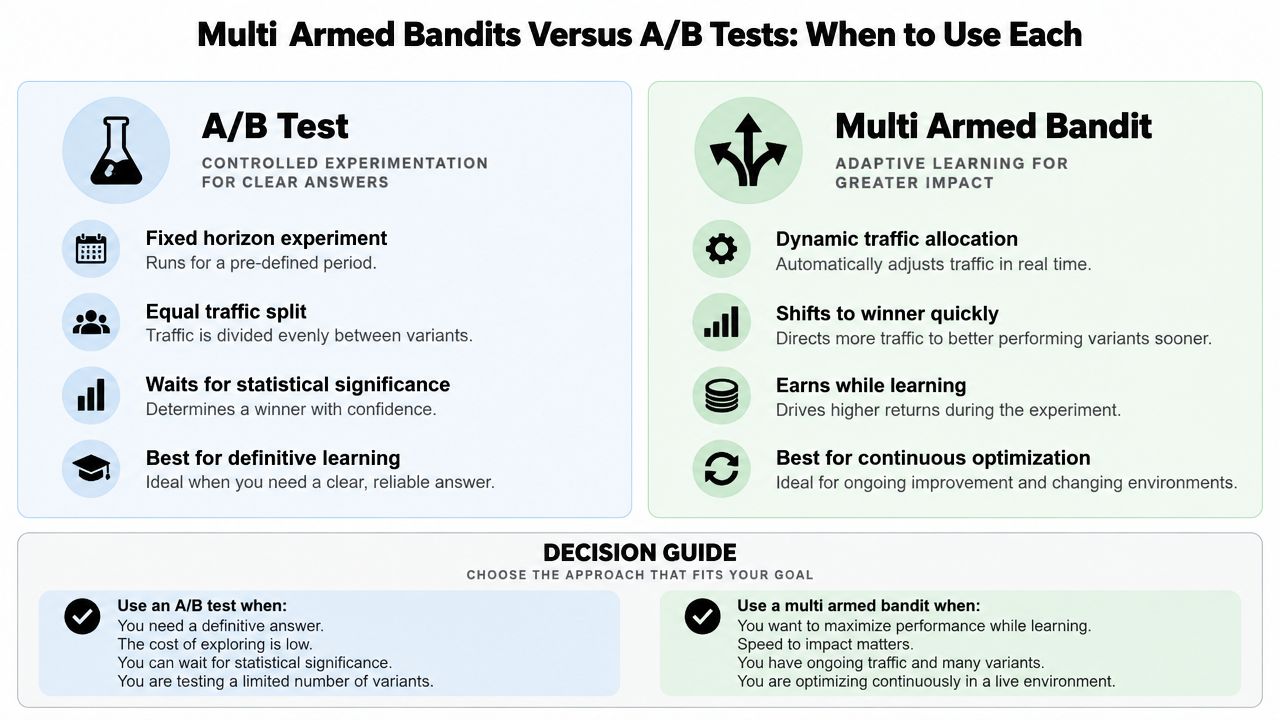
| Decision need | A/B test | Multi armed bandit |
|---|---|---|
| Primary objective | Learn whether variants differ | Allocate traffic toward current expected reward |
| Traffic behavior | Planned, relatively stable allocation | Changes as outcomes arrive |
| Value during the run | Accepts exposure to alternatives to preserve comparison | Seeks to reduce exposure to weaker options |
| Main output | Evidence for a decision | Adaptive allocation plus an evolving estimate |
| Best fit | Definitive learning, sensitive changes, and reusable insight | Continuous optimization with a clear immediate reward |
A classic test is usually the safer choice when your main goal is a defensible conclusion. For example, you may want to know whether a new onboarding message changes activation, or whether a pricing explanation affects qualified demand. In those cases, preserving comparability can matter more than extracting value from every impression.
For a practical overview of experiment tooling and setup considerations, the Web Mage A/B testing guide can help teams evaluate the broader testing workflow before selecting an allocation method. If your goal is to improve an existing page while traffic continues to arrive, a bandit may fit better.
Situations where the standard assumptions fail
Bandits aren't automatically unbiased because they adapt. Real-world interference can break the assumptions behind ordinary reward comparisons. Research on network interference and spillover-aware bandits describes situations where one user's treatment can affect another user's reward, and where fairness constraints may need explicit attention.
That matters for shared audiences, multi-page journeys, referral loops, marketplaces, and networked products. If one visitor's exposure changes what another visitor sees or does, the algorithm may attribute outcomes incorrectly. Pure conversion maximization can also produce an allocation that disadvantages a relevant group if you don't define fairness requirements.
Another overlooked problem is testing the algorithms themselves. A team may want to compare Thompson Sampling, UCB, and epsilon greedy in a production-like setting. A 2026 paper on experiments for comparing bandit algorithms says reliable inference requires many independent restarts, which makes evaluation costly and slows deployment decisions. The paper proposes a replay-based design that nearly halves user-interaction cost while remaining unbiased.
That finding changes the implementation mindset. Don't treat the allocation method as an invisible detail. Document it, monitor it, and test it with a design that respects sequential dependence.
For teams deciding between traditional and adaptive testing, a useful rule is simple:
- Choose an A/B test when you need clear causal learning, stable comparison, or evidence you'll reuse in future decisions.
- Choose a bandit when the reward is immediate, the page runs continuously, and directing traffic toward stronger options has meaningful value.
- Choose a hybrid approach when you want an initial controlled learning phase followed by adaptive allocation, provided your measurement design can support both goals.
Teams comparing the mechanics of experimentation can also review A/B and N/A/B testing guidance when deciding how much control and how much adaptation the next test requires.
Real World Examples of Adaptive Optimization in Action
A landing page gives you a clean way to see adaptive allocation. Start with three headline variants and one primary conversion event, such as a completed form. The bandit initially gives each option opportunities to collect evidence, then updates its allocation as conversions arrive.
If one headline produces stronger observed rewards, the system can direct more impressions toward it. The other variants don't necessarily disappear at once. They remain part of the learning process, which protects the experiment from treating an early signal as permanent truth.

Product recommendations
An online store might choose among several products to feature in a recommendation slot. The reward could be an add-to-cart event, a completed purchase, or another business-defined action.
A bandit can treat each recommendation as an arm and use each response to update future selection. That approach becomes more complex when recommendations influence later browsing, inventory availability, or other visitors' choices. The team must decide whether a click is a sufficient reward or whether the system should optimize for a later commercial outcome.
Pricing and calls to action
A pricing page may test different explanations, package framing, or CTA wording. The algorithm can allocate more traffic toward the presentation that currently produces the chosen action, while the team monitors downstream quality.
The key is to avoid optimizing a convenient proxy that conflicts with the business goal. A CTA click may rise while completed purchases or qualified sales conversations fall. Adaptive allocation accelerates whatever signal you provide, so the signal deserves deliberate review.
For practical page-level experimentation ideas, landing-page optimization guidance can help you identify changes that are specific enough to test and measurable enough to evaluate.
A failure caused by shared audiences
Suppose a company runs a promotion across several pages and users influence one another through referrals. A visitor who sees one offer may share it with another person, changing that second person's exposure and behavior. The bandit may credit the original treatment with outcomes that involve a wider network.
That isn't a reason to reject bandits. It's a reason to identify interference before deployment, define the unit of assignment carefully, and consider whether fairness or spillover constraints belong in the design. A conversion dashboard can look precise while the underlying attribution remains wrong.
Choosing the Right Approach for Your Next Experiment
Treat the multi armed bandit as an adaptive budget allocator, not as a universal replacement for controlled experimentation. It spends traffic where current evidence points, but it still needs a trustworthy reward, clear eligibility rules, and safeguards against interference.
Use this checklist before launching:
- Start with the decision: Do you need a causal conclusion, or do you need the page to optimize while it runs?
- Define the reward: Choose an outcome that reflects business value, not merely the easiest event to track.
- Assess the environment: Look for referrals, shared audiences, multi-page spillovers, and fairness concerns.
- Match the risk: Use more controlled testing when a wrong decision could affect trust, compliance, pricing, or customer quality.
- Plan algorithm evaluation: If you're comparing allocation methods, use a design that accounts for sequential decisions and independent restarts.
- Begin narrowly: A single headline or CTA test is easier to monitor than a large collection of interacting changes.
A hybrid workflow can work well when you first need structured evidence and later want adaptive allocation. The important point is to label each phase appropriately. A system optimized for cumulative reward isn't automatically producing the same kind of evidence as a fixed-horizon A/B test.
For landing-page teams, the most practical starting point is a small, observable experiment with one clear conversion event. Review the allocation behavior, not just the apparent winner, and keep a human decision-maker responsible for interpreting the result.
Polish reads your landing page, generates alternative headlines, subheadings, and CTAs, serves those versions to real visitors, measures what converts, and keeps the stronger-performing copy in circulation. Visit Polish to start with one focused headline test and explore adaptive optimization on your page.
- multi armed bandit
- bandit algorithms
- adaptive experimentation
- conversion optimization
- A/B testing
Your website rewrites itself until it converts.
Polish writes new versions of your headlines and CTAs, tests them on your real visitors and keeps the ones that win.
Start free