Multivariate Testing Marketing: A Practical Guide
Learn how multivariate testing marketing helps you compare multiple page elements at once to boost conversions, reduce guesswork, and make data-driven
Published on 13 min read

Table of contents
- What Multivariate Testing Marketing Means
- The trade-off behind every combination
- When to Choose Multivariate Testing Over A/B Testing
- Designing a Multivariate Test That Can Win
- Count before you launch
- Reading Multivariate Results Without Fooling Yourself
- Decide what counts as a useful result
- Choosing the Right Tooling for Multivariate Experiments
- Adding Audience Variables Without Crossing the Privacy Line
- Make privacy part of the design
- Common Pitfalls That Invalidate Multivariate Tests
- A Pre-Launch Checklist for Your Next Multivariate Test
You've already tested the obvious headline against the control, found a clearer call to action, and improved the page. Now the team wants to test the headline, supporting copy, and button together. That sounds efficient, but it also divides visitors across combinations, and a test can end with a confident-looking winner built on too little evidence.
That's the practical tension in multivariate testing marketing. The method can reveal how page elements work together, but every added variation makes the traffic budget work harder. Strong tests start with a narrow question, realistic expectations about evidence, and audience rules that respect visitor privacy.
What Multivariate Testing Marketing Means
When a page's headline, image, and call to action may affect one another, testing each in isolation can miss the result that matters. Multivariate testing marketing compares combinations of those elements to reveal which pairings perform well and whether their interaction changes the outcome.
A page works like a recipe. The headline, image, and call to action are ingredients, and each combination is a finished dish. A headline that performs well with one image may feel mismatched with another. A multivariate test can surface that interaction, while separate tests may not show how the elements work together.

The trade-off behind every combination
Every distinct combination needs visitor exposure, and conversions take time to accumulate. As you add factors or variations, available traffic gets split across more cells. A design that looks manageable in a planning meeting can become slow or inconclusive once all its combinations are included.
For example, three headlines, two hero images, and two calls to action create 12 combinations. That structure is useful only when the page can attract enough qualified visitors to build evidence for each combination. Otherwise, the added complexity consumes traffic without producing a dependable answer.
MVT fits when the design has a short list of meaningful factors and the team can wait for evidence to accumulate. It is less useful when a quick decision about one change is needed or when qualified traffic is too limited to support several alternatives. Audience rules matter at design time, too: define privacy-safe segments before launch, so useful comparisons do not depend on sensitive personal data.
Use MVT to investigate plausible interactions, not to test every idea at once. More combinations do not guarantee more learning; they divide traffic further and can leave the team with results too uncertain to guide a decision.
When to Choose Multivariate Testing Over A/B Testing
The choice isn't about which method sounds more advanced. It comes down to traffic, scope, and the question you need answered.
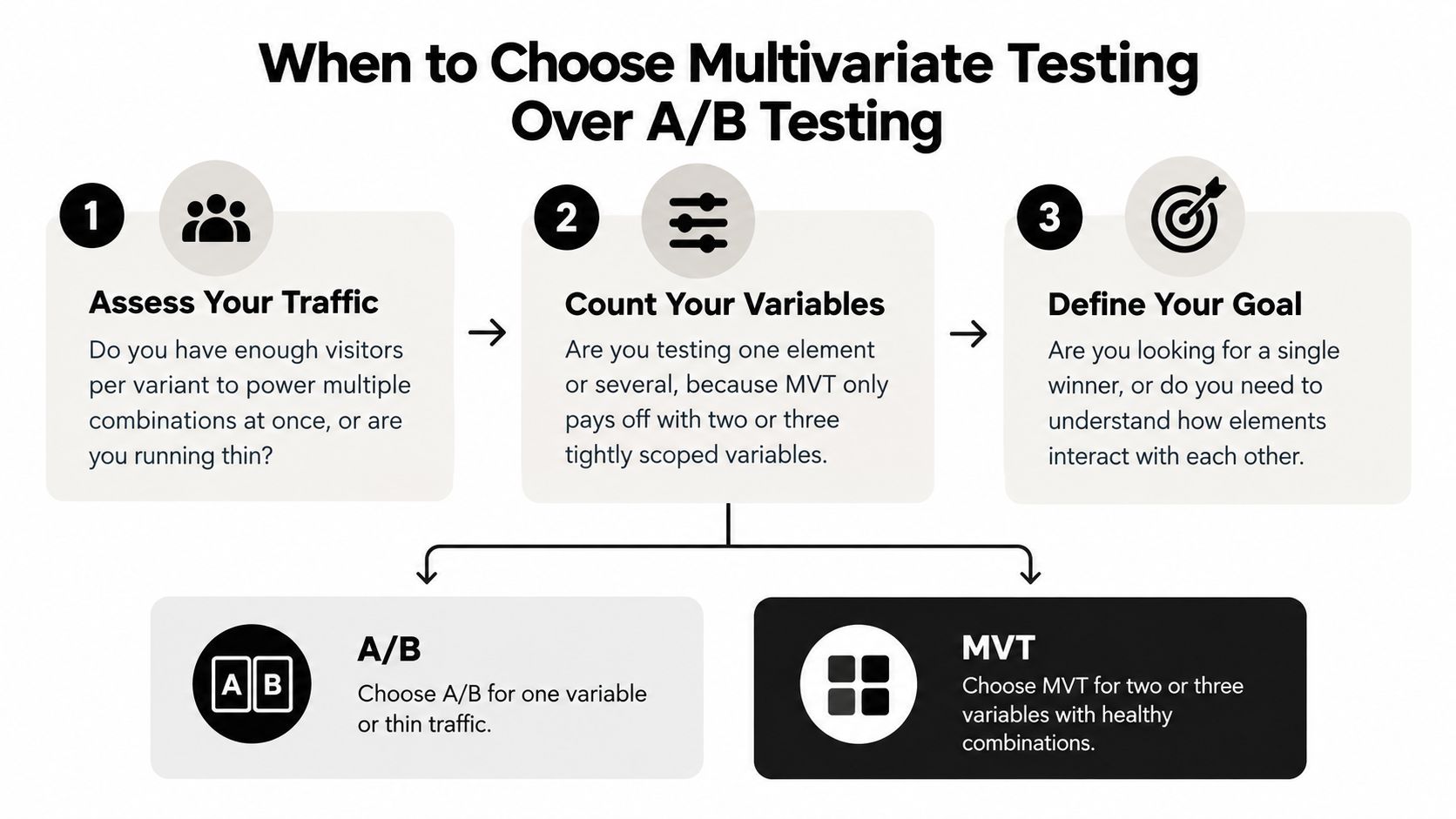
Start with traffic. If a page has limited or inconsistent visits, splitting its audience among many combinations makes it harder to distinguish a meaningful pattern from random variation. An A/B test usually concentrates evidence on a simpler comparison. With healthier traffic, an MVT can be reasonable, provided the combinations remain tightly scoped.
Then count the changes. If you're testing one headline, one form layout, or one call to action, an A/B test is the clearer tool. If you have a sound reason to think two or three elements influence each other, MVT can expose interactions that isolated tests won't answer. If you have a long list of factors, cut it down before launch rather than assuming the platform will solve the traffic problem.
Practical rule: Use A/B testing for one main variable or thin traffic. Consider MVT for a small set of connected elements when each combination can receive enough exposure.
Finally, ask what the decision is meant to do. If you need to choose a winner between two page treatments, an A/B test is easier to interpret. If the question is whether a specific pairing of message and creative works better than either element alone, MVT may justify the extra complexity.
A useful middle path is to test the highest-impact change first, establish a reliable baseline, then run MVT on the remaining elements if there's a meaningful interaction question. This keeps a broad redesign from turning into an unwieldy test.
For help thinking through creative comparisons before they reach a landing page, Evoteam's guide to testing ad creative offers a relevant companion to the page-level decision. Teams that want a refresher on simpler split-test logic can also review A/B testing fundamentals.
Designing a Multivariate Test That Can Win
A test can have a sound hypothesis and still fail if traffic is split too thinly across its combinations. Start with the decision the team needs to make, then connect the tested elements to one primary business outcome. For example: “Pairing a benefit-led headline with a product-focused image will increase completed sign-ups because the image makes the promise more concrete.” This gives the design a clear rationale to assess after launch.
Choose factors that could plausibly affect that outcome. A headline, hero image, and primary call to action belong in the same test only if there's a reason to expect them to work together. Skip decorative changes added for convenience. Each extra factor divides traffic further, without guaranteeing more useful learning. Also decide which audience can be included using privacy-safe criteria, and whether each eligible segment has enough traffic to support the comparisons.
Count before you launch
Set the alternatives for each factor, then count the resulting combinations. For example, two headlines paired with three calls to action create 6 combinations. Estimate whether the available traffic can provide meaningful exposure to each one before launch. If not, reduce the alternatives or test fewer factors.
A full factorial design tests every combination, giving a complete view of the design you specified. With limited traffic, a fractional factorial or Taguchi-style design can test a subset. That reduces the number of combinations, but limits what you can learn about interactions. If interactions are the central question, a design that obscures them may not answer it.
Before implementation, define:
- Primary outcome: The decision metric, such as completed sign-ups or qualified leads.
- Factors and levels: Which elements change and what alternatives each has.
- Traffic allocation: How visitors will be assigned consistently to combinations, within privacy-safe audience rules.
- Analysis plan: Which comparisons and interactions you'll assess, and how you'll handle multiple comparisons.
- Launch threshold: Whether the expected evidence is realistic for the traffic and time available.
Write down the primary metric, guardrails, and analysis plan before results arrive. This limits the temptation to search across combinations and metrics until one looks compelling. Keep audience segmentation tied to a clear test question, and avoid collecting or using sensitive attributes that aren't needed.
Before launch, ask whether the design can produce a decision the team will use. If traffic is too fragmented, remove factors, use a simpler test, or wait until the page can support the experiment.
Reading Multivariate Results Without Fooling Yourself
A dashboard may rank one combination first even when its apparent lead rests on very few visitors. Before choosing a winner, separate main effects, how an element performs on average across other variations, from interaction effects, where its effect changes depending on what it's paired with. The distinction matters: a headline that works well with one image may underperform with another.
Thin cells make results unstable, and each additional combination creates another opportunity to find a winner by chance. Check that the analysis accounts for multiple comparisons instead of treating every combination like a separate, simple A/B test. PlotStudio AI's guide to multiple testing correction explains why this adjustment matters.
Decide what counts as a useful result
Choose a primary metric that matches the decision. Completed sign-ups may suit a landing-page test; a revenue-focused page might use revenue per visitor if tracking is dependable. Use secondary measures, such as lead quality, downstream purchases, opt-outs, or perceived intrusiveness, as guardrails. A short-term conversion lift can be a poor trade if it erodes trust or attracts visitors who do not progress.
Set the stopping rule before launch. A fixed-horizon test ends at a predetermined point; sequential testing allows ongoing checks when the method is designed for them. Repeatedly checking ordinary significance results and stopping as soon as a combination leads can produce a misleading win. Cover the relevant business cycle, too.
Privacy-aware segmentation deserves the same care as the page variations. A 2025 experiment with 360 participants found that highly intrusive, personally identifiable personalization performed worse than moderate, contextual personalization when privacy concerns were activated. Under low privacy concern, stronger personalization increased purchase intention (experiment details). If performance differs across audience groups, check whether those segments were planned, meaningful, privacy-safe, and supported by enough evidence. Fragmented traffic can leave each segment too small to support a dependable decision.
Use a clear decision rule:
- Ship: The result is stable, useful on the primary metric, and acceptable on guardrails.
- Iterate: An interaction looks plausible, but the test has not established which version to deploy.
- Restart: Problems with the design, tracking, or traffic mix make the result unreliable.
Before interpreting a lead as actionable, consider whether the test had enough exposure to detect an effect worth acting on. This guide to minimum detectable effect can help teams frame that decision.
The video explains how to interpret experiment results without mistaking a promising combination for a reliable winner.
Choosing the Right Tooling for Multivariate Experiments
A tool should match your team's experimentation maturity, not just offer the longest feature list. The main choices are a testing module built into an analytics suite, a dedicated experimentation platform, or an AI-driven system that generates and rotates page variants.
Built-in testing modules suit teams that already use an analytics platform and want to run straightforward experiments without adding another workflow. They can be practical for a marketer or small team with limited traffic, but setup and analysis options may not support the level of control needed for a complex MVT. Confirm that the tool can track individual combinations and analyze interactions, rather than only showing a top-performing page.
Dedicated experimentation platforms are a better fit when a growth team has steady traffic, recurring tests, and the people to manage implementation and analysis. They typically provide more control over assignment, experiment setup, and reporting. The trade-off is operational: a platform doesn't replace sound design, clean tracking, or someone who can interpret the output.
AI-driven systems can generate and rotate variants with less manual work. Polish is an AI agent that reads a landing page, writes alternative headlines, subheadings, and CTAs, and serves versions to visitors based on contextual signals such as campaign, device, country, or whether they're returning. That approach can help a team test messaging when it has variety in traffic but limited bandwidth to define combinations by hand. It still needs clear conversion measurement and privacy-aware rules for how audience signals are used.
| Team profile | Monthly visitors | Recommended approach | Main trade-off |
|---|---|---|---|
| Solo marketer with limited traffic | Modest or inconsistent | Built-in testing module, or a focused A/B test | Simple setup, but limited evidence and analytical flexibility |
| Growth team with steady volume | Enough to support scoped combinations | Dedicated experimentation platform | More control, with added implementation and analysis work |
| High-traffic team running experiments at scale | Sustained volume across audiences | Dedicated platform or AI-driven variant system | Faster experimentation, but governance and interpretation matter |
Before committing, verify that the platform can report variant-level performance, preserve visitor assignment, and connect results to your chosen business metric. If it can't support the question you're asking, a simpler method may be more rigorous than a complicated test on inadequate tooling.
Adding Audience Variables Without Crossing the Privacy Line
A visitor arriving from a campaign may need different messaging from someone returning directly, but extra segments split traffic across more combinations. Start with contextual signals such as campaign, device, country, or returning-visitor status. They can make a test more relevant without relying on sensitive personal inferences. Each added audience variable also reduces the evidence available for its combinations, so include it only when it answers a clear question.
Consumers expect both relevance and control. YouGov reported that 56% of Americans were uncomfortable with companies using online behavior to personalize advertising, while 52% said opt-out options would make personalization more acceptable. TransUnion found that 89% of U.S. consumers considered data privacy important in online engagement, while 39% expected personalized shopping experiences. These figures point to a practical test goal: evaluate contextual personalization and measure whether it makes the experience feel intrusive.

Make privacy part of the design
Include a context variable in the test, or define segments before launch and analyze them separately. For example, compare messaging by campaign or device while keeping each visitor's assignment consistent. Country may matter when language or expectations differ. A segment that a tool can create is not automatically useful, especially if it leaves too little traffic to compare results.
Set privacy safeguards before the test begins:
- Disclose personalization: Explain relevant data use in clear, accessible language.
- Track negative responses: Monitor opt-outs, complaints, or a direct measure of perceived intrusiveness alongside conversions.
- Set a guardrail in advance: Decide how much negative response would make a conversion gain unacceptable.
- Avoid sensitive triggers: Don't use personally identifiable information or sensitive inferences to select creative variants.
- Limit the purpose: Collect and use only the contextual information needed to answer the test question.
Judge each combination on both performance and trust. A variant can lift conversions for one context and still be a poor choice if visitors react negatively. For teams serving visitors across countries, check whether the segment has enough traffic to support a useful comparison before adding it.
For context on experimentation within Scéaled's conversion optimisation, see the service overview. The guide to data-driven personalisation also offers ideas for evaluating personalization beyond the immediate conversion metric.
Common Pitfalls That Invalidate Multivariate Tests
Fragmented traffic is the constraint that makes many multivariate tests unreliable. Each added combination gets a smaller share of visitors, so a promising result may reflect a short-lived fluctuation rather than a dependable effect. Use this diagnostic list before acting on a winner:
- Seasonality: A test spanning a holiday or major promotion may capture shifting demand as well as page effects. Guardrail: Set a fixed analysis window spanning the relevant business cycle, and log major campaign changes during the test.
- Sample pollution: Visitors who see different combinations across devices can blur their assigned experience. Guardrail: Use deduplicated visitor identification where appropriate, and check that assignment persists across sessions and devices.
- Selection bias: A paid campaign may bring a different audience mix from other channels. Guardrail: Keep traffic sources visible in the analysis and validate the result with sources beyond the original campaign.
- Revenue-tracking errors: Broken or inconsistent purchase events can distort variant performance. Guardrail: Test revenue events and downstream integrations before the experiment starts.
- Thin cells: A combination with little evidence can rank first after a favorable run. Guardrail: Plan for adequate evidence per combination, and treat the top-ranked cell as a candidate, not a confirmed effect.
- Rapid automatic rotation: An adaptive system may optimize short-term conversions without showing whether the message works for a changed audience mix. Guardrail: Reserve a holdout or later validation period.
- Premature stopping: Ending the test when a dashboard shows a lead can turn ordinary fluctuation into a product decision. Guardrail: Define a fixed-horizon or valid sequential stopping rule before results arrive.
The testing guidance also emphasizes checking whether findings generalize beyond the original test. If the traffic mix changes, validate the result with that audience before making it a permanent rule. This matters when campaign sources shift: an interaction that appeared valuable in one audience may not hold for another, and privacy-safe segments should be defined before comparing those results.
A Pre-Launch Checklist for Your Next Multivariate Test
A multivariate test is easier to defend when the team agrees on the rules before traffic starts flowing. Use this checklist in the launch review:
- Write the hypothesis: Make one prediction about how the selected elements will influence the primary business outcome.
- Justify the design: List each factor and variation, calculate the resulting combinations, and confirm the traffic plan can support them.
- Choose metrics: Name one primary outcome and the guardrails that could reveal harm to lead quality, trust, opt-outs, or revenue measurement.
- Define audience rules: Use relevant contextual signals, such as campaign or device, and state how assignment will stay consistent.
- Review privacy: Confirm disclosures are appropriate, data use is limited to the test purpose, and sensitive personal inferences aren't creative triggers.
- Register the analysis plan: Record the comparisons, interaction questions, segmentation approach, and multiple-comparison method before examining results.
- Reserve validation: Hold back a suitable audience or plan a later period to check whether the finding holds beyond the original mix.
- Set a stop rule: Choose a fixed endpoint or a valid sequential method before you see which combination is ahead.
If the test can't answer an interaction question, it may not need to be multivariate. If it can answer one but relies on invasive targeting, redesign the audience rules before launch. Those checks keep conversion learning connected to the experience visitors receive.
Treat MVT as a learning system, not a one-off optimization. A useful outcome isn't only a winning combination. It's a clearer understanding of which elements work together, for which contexts, and within what privacy boundaries.
Polish generates and rotates landing-page headline, subheading, and CTA variants for different visitor contexts, giving growth teams a practical way to learn from messaging combinations without manually building every version. Visit Polish to see how it could fit your landing-page experimentation workflow.
- multivariate testing marketing
- multivariate testing
- A/B testing
- conversion optimization
- landing page testing
Your website rewrites itself until it converts.
Polish writes new versions of your headlines and CTAs, tests them on your real visitors and keeps the ones that win.
Start free