Fake Door Test: A Practical Guide to Validating Demand
Learn how a fake door test validates demand before you build. Covers metrics, ethics, real examples, and a checklist growth teams can use this week.
Published on 11 min read

Table of contents
Your roadmap is full, sales is asking for another feature, and three customers have described the same idea as “a must-have.” The team is already discussing architecture, edge cases, and delivery dates. Nobody has yet checked whether the people who would supposedly use the feature will take a meaningful action when it appears in front of them.
That's the problem a fake door test can address before engineering commits. You place a realistic entry point in front of relevant users, measure what they do, and use the result to decide whether the idea deserves deeper validation. But a click is only the beginning of the evidence, not the conclusion.
Why Growth Teams Build Features Nobody Wants
A product team can make a feature look inevitable long before anyone has tested demand. A customer request becomes a sales promise. The sales promise becomes a roadmap item. Then design creates screens, engineering estimates the work, and leadership starts measuring progress by how quickly the team can ship.
By launch day, the original question has disappeared. The team no longer asks, “Do users need this badly enough to act?” It asks, “How do we make adoption happen?” That shift is expensive because the largest product decision was made before the team observed real behavior.
A fake door test gives the team a smaller commitment. You add a feature card, navigation item, CTA, pricing option, or landing-page offer that looks plausible in context. When an eligible user engages, you reveal the truth and invite an optional next step, such as joining a waitlist or describing the problem they wanted to solve.
The value isn't that the test produces a magical yes or no. It compresses an uncertain roadmap debate into a small behavioral experiment. A weak result can stop a costly build. A promising result can justify interviews, a prototype, or a more direct willingness-to-pay test.
The useful question isn't “How many people clicked?” It's “What did the click earn us the right to investigate?”
The danger is treating an attractive click rate as proof of product-market fit. Copy, placement, novelty, audience quality, and misunderstanding can all affect the first action. The disciplined approach follows the user from exposure to click, transparent reveal, qualified intent, and, where appropriate, willingness to pay.
What a Fake Door Test Actually Is
A fake door test is a behavioral demand experiment. A company places a functional-looking button, link, pricing tier, advertisement, or feature card in front of real users before the underlying product exists, then measures whether exposed users click, attempt to purchase, join a waitlist, or continue to another defined action. The method is behavioral because it observes what people do in context rather than what they say they might do.
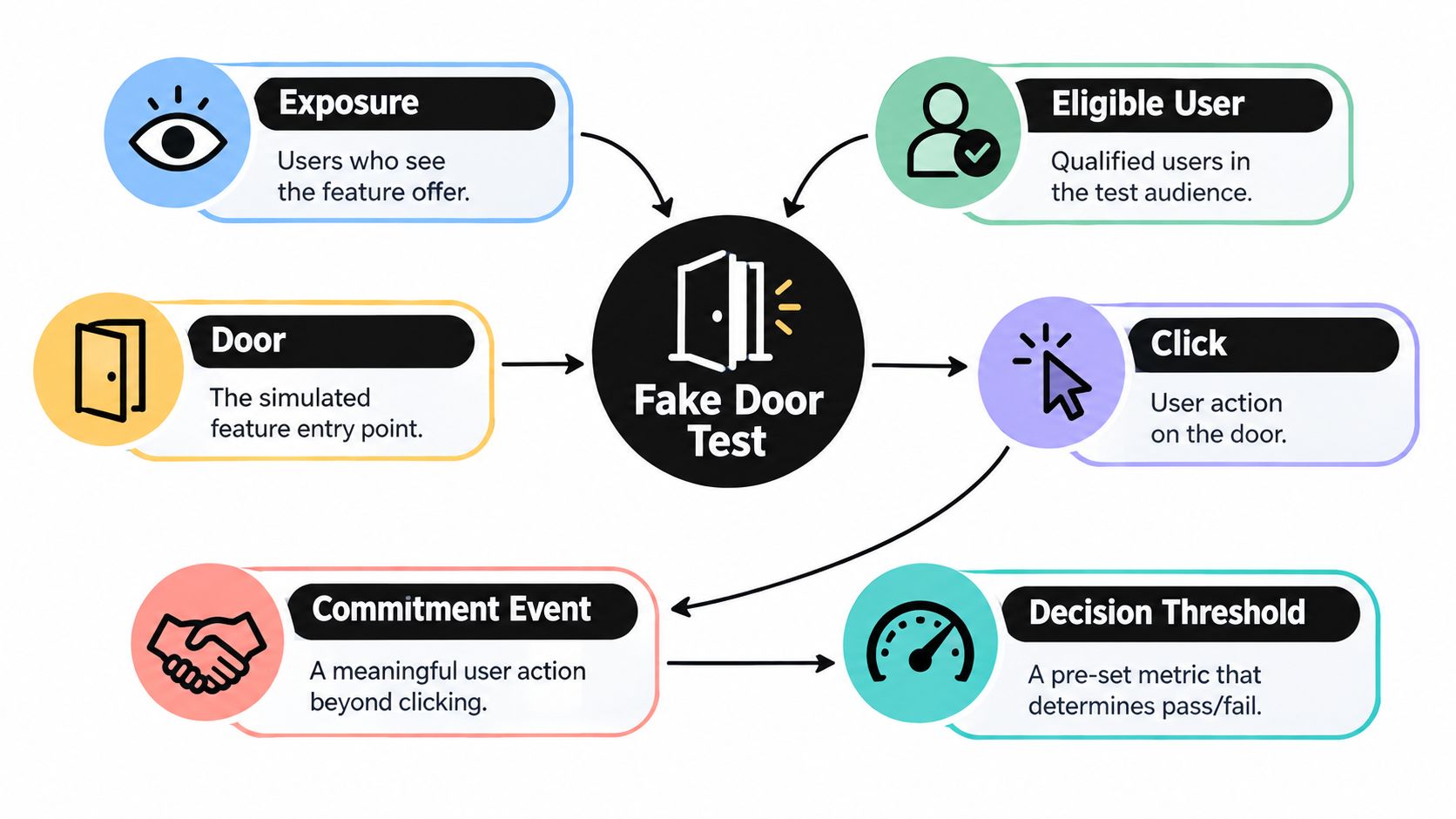
The vocabulary matters:
- Exposure means the interactive offer rendered for a user.
- Eligible user means someone who fits the audience for the proposed feature.
- Door means the plausible entry point, such as "Advanced Reports" or "Join the beta."
- Click means initial interest, not confirmed adoption.
- Commitment event means a stronger action after the click, such as an email request, use-case response, interview opt-in, or refundable deposit.
- Decision threshold means the result you define before launch that determines whether you stop, revise, or investigate further.
A survey asks users to predict future behavior. A focus group reveals reactions and language. A pre-order tests a stronger commercial commitment. A fake door sits earlier in the sequence. It tests whether a relevant user notices and tries to enter an offer before the product has been built.
The approach is associated with customer development and the lean-startup movement, including the influence of Eric Ries's The Lean Startup, published in 2011. It's best understood as a smoke test, not proof that users will retain the feature, pay for it, or find the finished experience valuable.
For more discovery approaches, these product discovery tips from SubmitMySaas can help you choose research methods around the specific uncertainty you're trying to resolve.
A planning-doc definition you can reuse is: “A fake door test exposes eligible users to a realistic entry point for an unbuilt offer and measures the progression from unique exposure to qualified commitment.”
The Funnel Behind the Door
The first implementation mistake is counting the wrong people. Your denominator should be unique eligible users who rendered the interactive door, not every page impression across the site. A reload isn't another vote, and repeated clicks from one user should remain diagnostic rather than inflate the apparent number of interested users.
Before launch, define an event schema that captures the whole path:
- Unique eligible impression: The qualified user saw the door.
- Unique click: The user selected the door.
- Transparent reveal: The user learned that the feature wasn't available.
- Downstream commitment: The user joined a waitlist, explained a use case, accepted a price range, booked a conversation, or completed another meaningful action.
- Business outcome: The team observed a commercial result, such as a refundable deposit or eventual conversion.
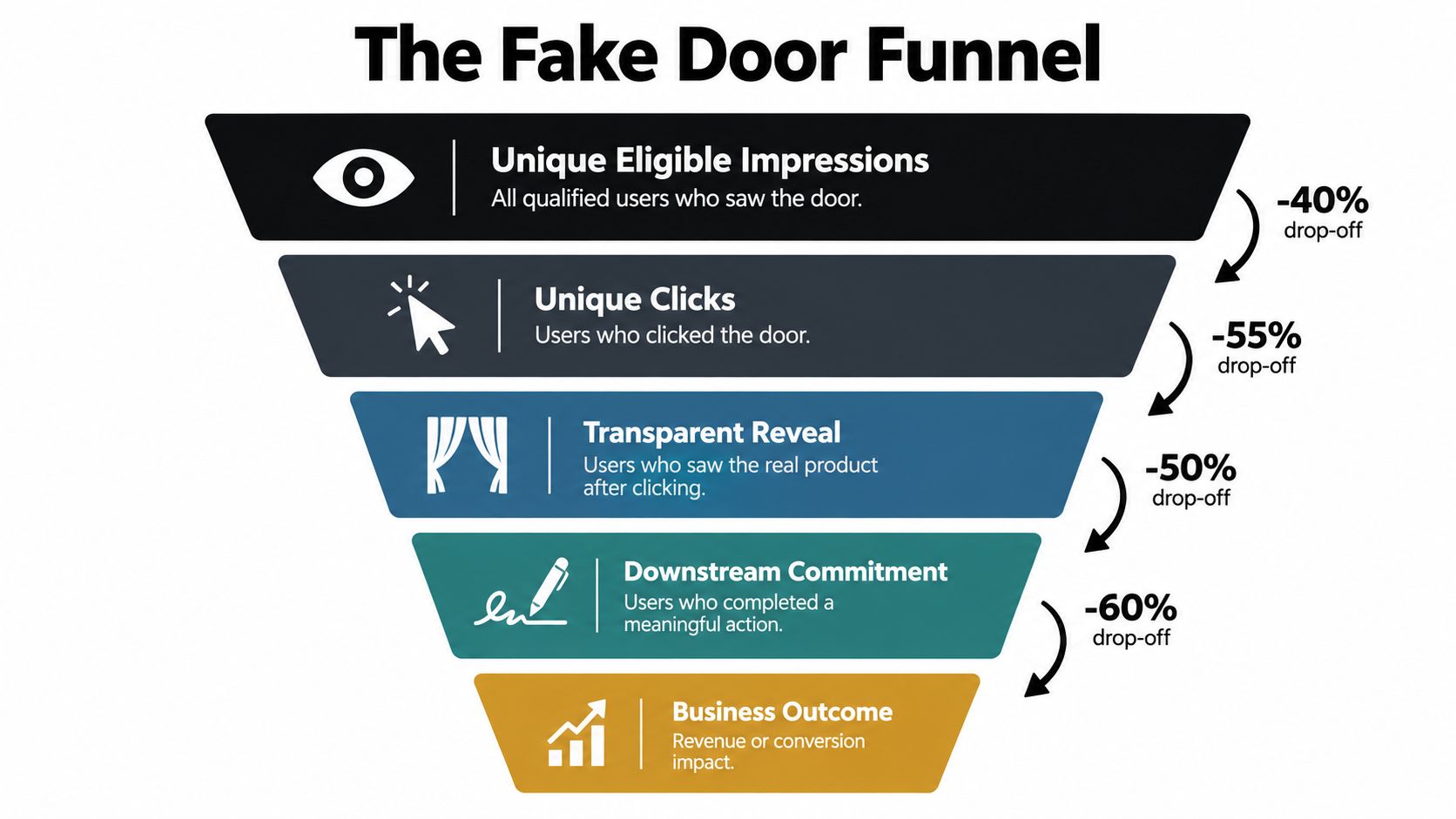
A worked example makes the drop-off visible. Among 412 targeted visitors, 77 clicked through to pricing, which represented 18.7% of visitors. Only 9 people, or 2.2% of all visitors, reached the payment step. 31 left an email after an honesty screen, and 3 prepaid after a founding discount. The example isn't a forecast. It shows why a strong top-of-funnel response can narrow sharply when the user faces a meaningful commitment.
Record the context alongside each event. At minimum, capture audience segment, device, traffic source, experiment window, and the door variant. If the same visitor can encounter the offer repeatedly, store exposure and unique-user identifiers separately so frequency doesn't distort the result.
A click answers “Does this offer attract attention here?” A commitment answers “Does the offer survive explanation and effort?”
The same discipline applies to broader CRM tactics for demand gen. Keep every funnel stage visible in the results document, even when the later numbers are uncomfortable. The sharpest learning often sits between the first click and the final commercial action.
Reading the Numbers Without Fooling Yourself
A fake door test can produce a click rate that looks healthy and still tell you little about real demand. A stronger read comes from comparing like with like, not from chasing one universal pass rate. As a working heuristic, treat 2% to 5% as meaningful for an internal product surface, with above 5% suggesting the idea is worth deeper validation. For paid traffic, compare the result with the channel itself. A useful benchmark for ad traffic puts Facebook at roughly 1% and Google Search at roughly 3% to 5%, but only as reference points for similar traffic, not as fixed targets.
| Surface | Typical strong threshold | Comparison reference | Decision implication |
|---|---|---|---|
| Internal feature card, quiet placement | Above 5% is often treated as strong | Compare with an equivalent in-product surface | Move toward deeper validation if downstream intent is credible |
| Internal CTA or nav item, prominent placement | Around 2% to 5% is often treated as meaningful | Compare with the same audience and placement | Investigate further, then test commitment |
| Facebook advertisement | Use the channel baseline | Roughly 1% in one practitioner benchmark | Judge the offer against comparable Facebook traffic |
| Google Search advertisement | Use the channel baseline | Roughly 3% to 5% in one practitioner benchmark | Judge the offer against comparable search intent |
The surface matters as much as the number. A prominent CTA shown to highly motivated visitors is not the same test as a quiet feature card shown to casual browsers, even if both produce the same click rate.
Sample size shapes how much trust you can place in the result. For planning that question, the minimum detectable effect is the right concept to check, because it ties your threshold to the smallest change you need to see. One guide recommends at least 1,000 unique impressions for a meaningful first read, while also warning that confidence depends on the baseline rate and the size of the difference you want to detect.
Report uncertainty, not just the point estimate. A binomial confidence interval, the full funnel, and pre-set stop or build rules make the decision easier to defend than a single CTR in a dashboard.
Why a Click Is Not the Same as Demand
A click can mean the user wants the feature. It can also mean the wording was attractive, the placement was prominent, the concept was novel, or the user assumed the feature already worked. Someone may click to discover what “Smart Forecasting” means.
That makes the click useful, but incomplete. Treat it as a question about curiosity, message relevance, and perceived value, not as evidence of adoption.
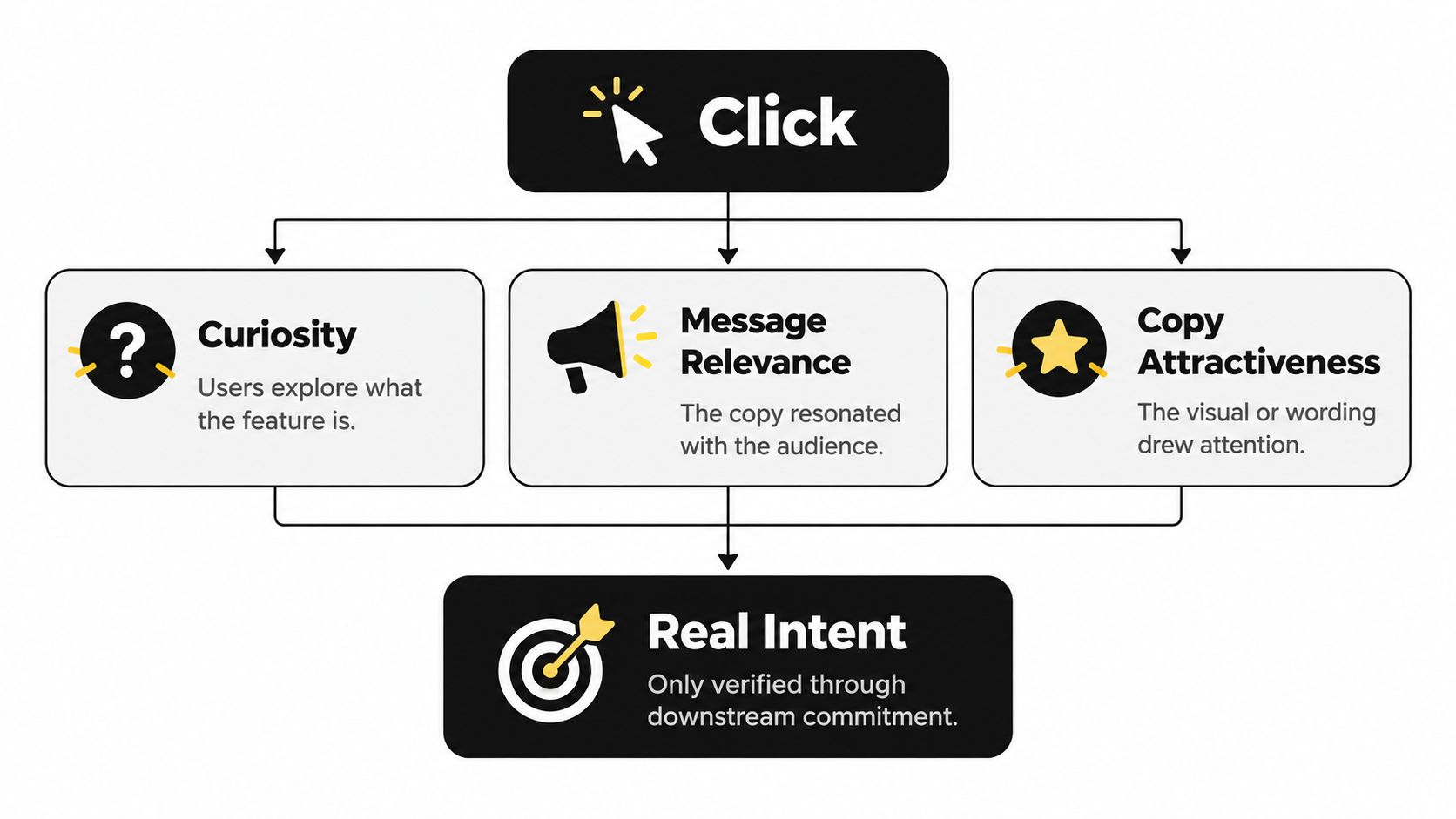
A stronger funnel continues after the transparent reveal:
- Click: The user chose to explore the offer.
- Qualified intent: The user describes the problem, confirms a relevant use case, accepts a price range, or opts into a conversation.
- Willingness to pay: The user takes a commercial action appropriate to the test, such as a refundable deposit or prepayment.
- Business outcome: The behavior connects to the decision your company needs to make.
The post-click action should match the risk. If you're deciding whether to research an internal workflow, a use-case response may be enough. If you're considering a paid add-on, a price-range response or refundable deposit is more informative than another click.
Segment the result before drawing a conclusion. Analyze audience, device, geography, new versus returning status, traffic source, campaign, and intent level separately. Aggregation can hide a valuable niche or make broad curiosity look like commercial demand.
For implementation, this button click tracking guide can help you establish clean interaction events. Your CTA should also match the promise and the next action, which is why CTA optimization belongs inside the experiment rather than outside it.
For automated personalization, the implication is direct. A system that optimizes only for clicks can learn to attract the most curious visitors, not the users most likely to become qualified leads. Feed downstream commitment back into the decision, or the optimization target will be too shallow.
Ethics as an Experiment Variable
Disclosure timing changes the meaning of the result. If users learn immediately that the feature isn't available, the remaining commitment signal is more honest than a click collected under the assumption that the product already works.
You can compare three transparent designs:
- Immediate inline disclosure: The message appears in the same context immediately after the click. This is clear and minimizes surprise.
- Post-click modal: A modal explains the test and offers an optional next step without moving the user away from the workflow.
- Coming-soon page: A dedicated page describes the proposed feature, explains its status, and provides a voluntary waitlist or feedback action.
Don't judge these variants only by sign-ups. Track complaints, abandonment of adjacent tasks, repeat visits, support contacts, and brand-perception feedback. A reveal that produces more email addresses but also disrupts the surrounding workflow may be a poor trade.
Some journeys should be excluded entirely. Don't place a fake door in a payment flow, subscription-cancellation path, account-management task, transactional step, or high-stakes context where the user might think an existing capability has failed.
Ethical guardrails are part of the experiment design, not a paragraph added after the results arrive.
Use a safer operating policy: exclude sensitive journeys, cap exposure, disclose immediately, make follow-up optional, and minimize data collection from people who don't convert. Don't fake a payment or subscription action. Don't collect personal information merely because someone showed curiosity.
The experiment should measure whether interest survives honesty. If the offer only performs when users believe the feature is available, you haven't validated durable demand. You've measured an expectation your team created and then withdrew.
Alternatives Worth Knowing
A fake door is strongest when the main uncertainty is whether relevant users will try to enter an offer. Other methods answer different questions, and choosing the lightest one prevents teams from using a click test for a problem it can't solve.
| Method | Best for | Primary signal | Cost | Pick when |
|---|---|---|---|---|
| Survey or stated-intent poll | Understanding language and perceived problems | What users say they might do | Low research effort | You need motivations, objections, or vocabulary before testing behavior |
| Smoke test advertisement | Testing whether a market responds to an external promise | Ad engagement and landing-page action | Media and creative effort | The concept is new and has no natural in-product surface |
| Concierge MVP | Learning the user's workflow through manual service | Repeated use and qualitative feedback | High team or sales time | You need to discover what the solution should actually do |
| Prototype-pays test | Testing whether users will make a stronger commercial commitment | Payment or deposit behavior | Moderate sales and setup effort | Willingness to pay is the central risk |
| Waitlist landing page | Capturing interest after a clear explanation | Signup and optional qualification | Low build effort | You need a standalone demand page with a transparent value proposition |
| Fake door test | Testing contextual interest before building | Unique click plus downstream commitment | Low implementation effort | The offer is easy to understand and safe to reveal after engagement |
A survey can explain why an idea matters, but stated intent may overestimate action. A smoke test can reach a new audience, while a fake door benefits from existing context. A concierge MVP shows how people use a solution, but requires manual delivery. A prototype-pays test gives stronger commercial evidence, though it asks more from the user and the team.
Use the lightest method that resolves the current risk. If you're comparing traffic allocation across variants after demand is established, a multi-armed bandit approach may be relevant, but it shouldn't replace a clear commitment event or ethical disclosure.
Your One-Week Fake Door Checklist and FAQs
Start with the user, the surface, the event schema, the success threshold, the disclosure, the stop or build rule, and the support and legal briefing. Then segment results by audience and traffic source, because a click from the right context means more than a click in the wrong one. Read the full funnel, from impression to qualified intent, not CTR in isolation.
What is a good CTR? Use the thresholds and channel baselines from the benchmarks section above. Context and downstream intent decide whether the door is worth opening.
How many impressions do I need? Start with at least 1,000 unique impressions for an initial read, then adjust for baseline rate and the size of change you need to detect.
How do I avoid misleading people? Skip sensitive journeys, disclose immediately, make follow-up optional, and collect only what you need.
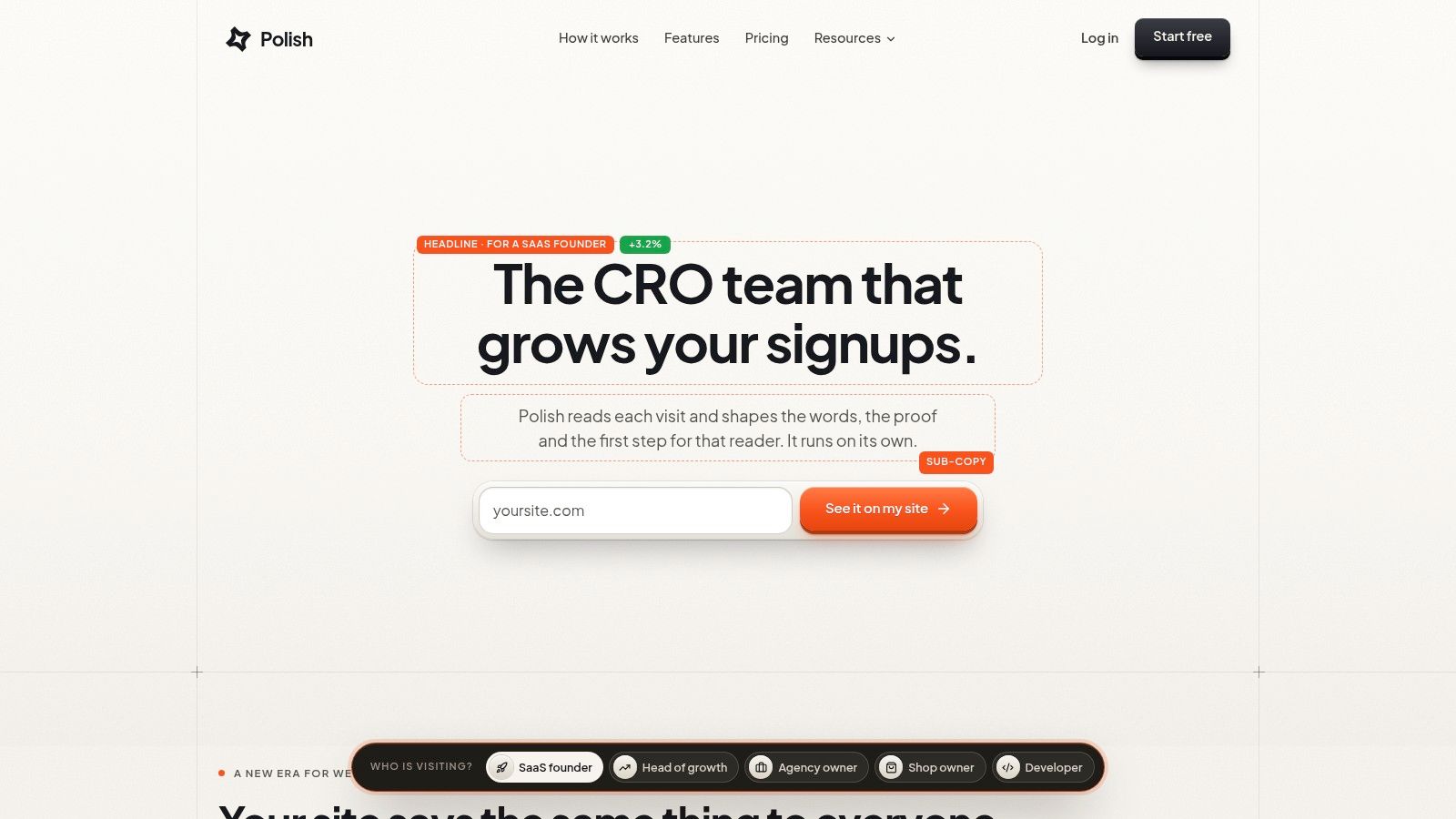
How does Polish fit? Use it to test which headline and CTA fit each visitor, but optimize toward qualified commitment, not clicks alone.
Polish creates an adaptive landing page for each visitor, testing headlines, subheadings, and CTAs against context such as campaign, device, country, and first or returning visit. Visit Polish to see how you can connect that personalization with a transparent fake door funnel and optimize for the actions that matter after the click.
- fake door test
- demand validation
- growth experiments
- conversion optimization
- smoke testing
Your website rewrites itself until it converts.
Polish writes new versions of your headlines and CTAs, tests them on your real visitors and keeps the ones that win.
Start free