10 Best Optimizely Alternatives for CRO Leaders in 2026
Compare 10 Optimizely alternatives for CRO and growth leaders: key features, strengths, limits, pricing signals, migration tips and a verdict for each.
Published on 17 min read

Table of contents
- 1. Polish
- Where Polish fits best
- 2. VWO
- Pricing and migration considerations
- 3. AB Tasty
- The main trade-off
- 4. Kameleoon
- Who should choose it
- 5. SiteSpect
- Implementation is the deciding factor
- 6. Convert Experiences
- What it gives up
- 7. GrowthBook
- The warehouse-native trade-off
- 8. Statsig
- Best fit and common mismatch
- 9. LaunchDarkly
- Where it falls short for CRO
- 10. Adobe Target
- Buying and implementation
- Top 10 Optimizely Alternatives: Feature Comparison
- Choosing the Right Testing Platform for Your Team
Your renewal is approaching, the quote is difficult to justify, and your team still needs to launch tests faster. Or perhaps the opposite problem is blocking you: Optimizely can do far more than your marketing team needs, while engineering time is tied up in implementation and maintenance.
The best Optimizely alternative depends on who runs experiments, how much technical control you need, and what you are replacing. A marketer-led team may need a visual editor for landing-page changes. A product organization may need feature flags, SDKs, and server-side testing. A data-mature company may prefer warehouse-native experimentation, while a smaller growth team may value autonomous copy testing over a broad enterprise suite.
This list judges each platform by its practical fit, not by feature count alone. It considers team ownership, implementation burden, testing depth, integration requirements, pricing visibility, and migration risk. Public pricing is stated where it's available. Where vendors sell through a quote, that limitation is called out directly.
The broader lesson is that experimentation is an operating discipline, not just a software purchase. Research from Harvard Business School, reported in Management Science, followed 35,262 high-technology startups for 208 weeks and found that structured experimentation was associated with stronger performance across several outcomes. The tool matters, but the quality of your hypotheses, metrics, traffic allocation, and decision process matters more.
1. Polish
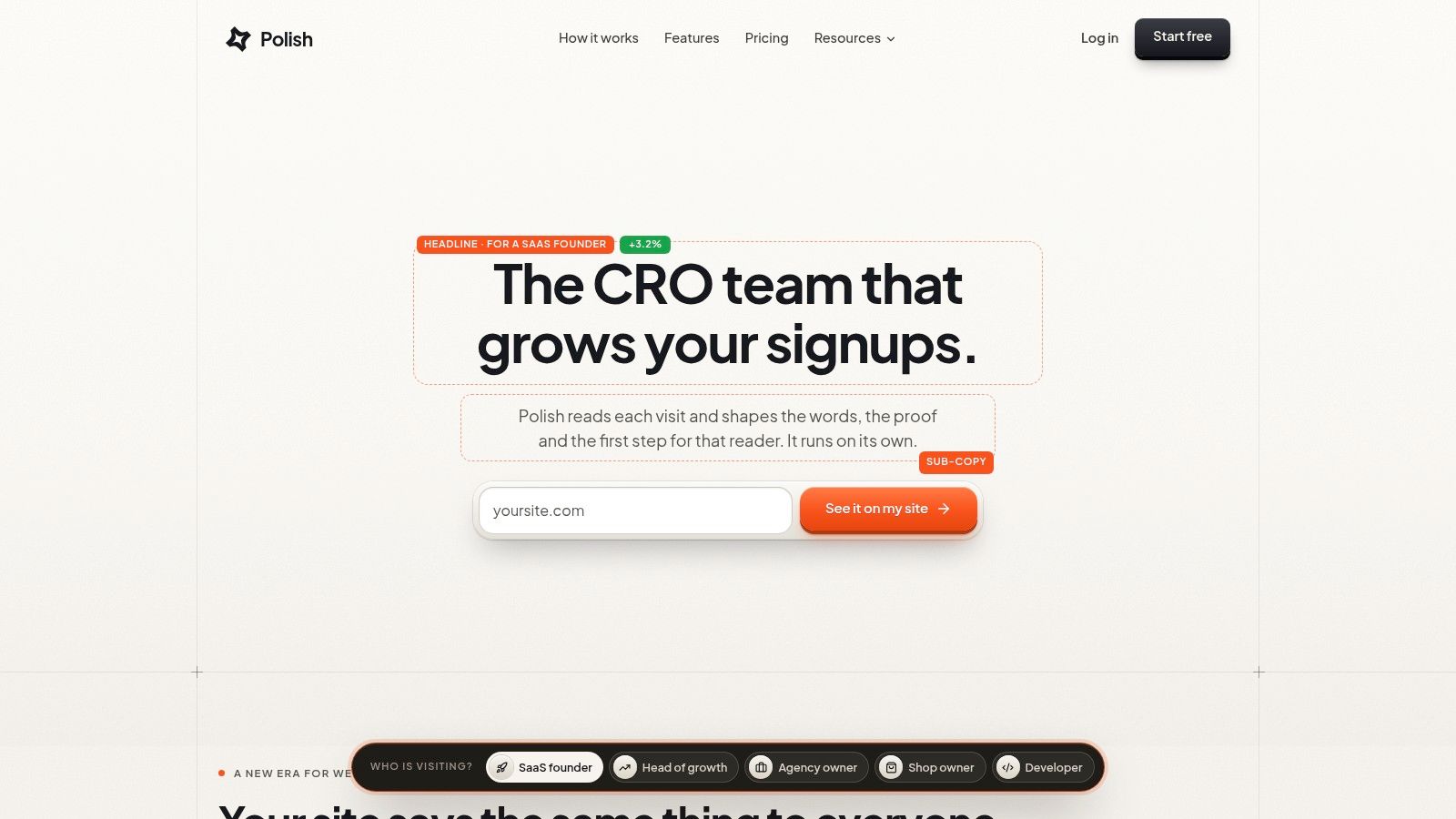
Polish suits a small growth team that wants continuous website copy experimentation without building a full CRO operation. You install one script, and its autonomous AI agent reads contextual signals such as acquisition source, campaign, device, country, and whether someone is visiting for the first time or returning. It then writes and serves custom headlines, subheadings, and calls to action for different visitors on the same page.
The important distinction is operating model. You're not creating every variation manually, setting up every audience, and checking every result before making the next change. Polish continuously tests copy on real traffic, keeps stronger-performing versions live, and uses subsequent visits to sharpen its decisions. Early access currently focuses mainly on headlines and CTAs, while broader changes to proof and section order are being introduced progressively.
Where Polish fits best
Polish is aimed at marketers, founders, and growth leads who need lower setup friction than a conventional experimentation suite. It works with Next.js, Webflow, WordPress, Shopify, and plain HTML, and uses a first-party pixel designed to work without cookies. The product also detects conversions without requiring a complex no-code event configuration.
You still get control. A readable activity feed lets you review changes, approve variations, set tone, and pause the agent. A conversational CRO copilot gives the team a way to inspect or direct optimization without learning a large experimentation interface.
Practical rule: Autonomous copy testing is useful only when the team can inspect what changed, understand why it changed, and stop it quickly when the message no longer fits the brand.
The pricing is unusually simple. Polish offers a 3-day free trial, followed by one plan at $99 per month, billed monthly with cancellation at any time, as stated on the Polish website. That makes it easier to evaluate than a sales-led platform with unknown traffic thresholds or separately priced modules.
The trade-off is scope. Teams needing complex server-side feature rollouts, deep product analytics, or broad governance controls will need another platform. AI-generated copy also deserves review, particularly in regulated categories or brands with strict legal language. For a landing-page team that wants to test message relevance continuously, however, Polish is a focused alternative rather than a smaller imitation of Optimizely.
2. VWO
VWO is the most natural fit for a CRO team that wants a familiar visual testing workflow with more research features around it. Marketers can create A/B/n tests, multivariate tests, and split-URL tests through a visual editor, while developers can use code-based workflows and server-side capabilities through FullStack.
That combination matters when ownership is shared. Marketing can test a promotion or page message without waiting for a release, while product and engineering can use SDK-based experimentation for deeper changes. VWO also brings heatmaps, session recordings, behavioral insights, personalization, and AI text suggestions into the same broader environment.
The platform's strength is breadth, but breadth can become overhead. If you only need to test landing-page headlines, the additional research and personalization modules may be more than your team will use. Visual editors can also require careful validation on heavily customized or JavaScript-dependent pages.
Pricing and migration considerations
VWO's public pricing is limited and generally requires a conversation with sales. Costs can rise as traffic, testing depth, and advanced features increase, so request a quote that separates core testing from behavioral analytics, personalization, and server-side use.
For migration, inventory every Optimizely audience, custom event, variation, and integration before recreating tests. Pay particular attention to how each platform defines exposure and conversion. A superficially similar report can still produce different decisions if assignment, attribution windows, or statistical interpretation changes.
Teams comparing the two can use this Optimizely versus VWO comparison to clarify whether they need a broad CRO suite or a more focused workflow.
3. AB Tasty
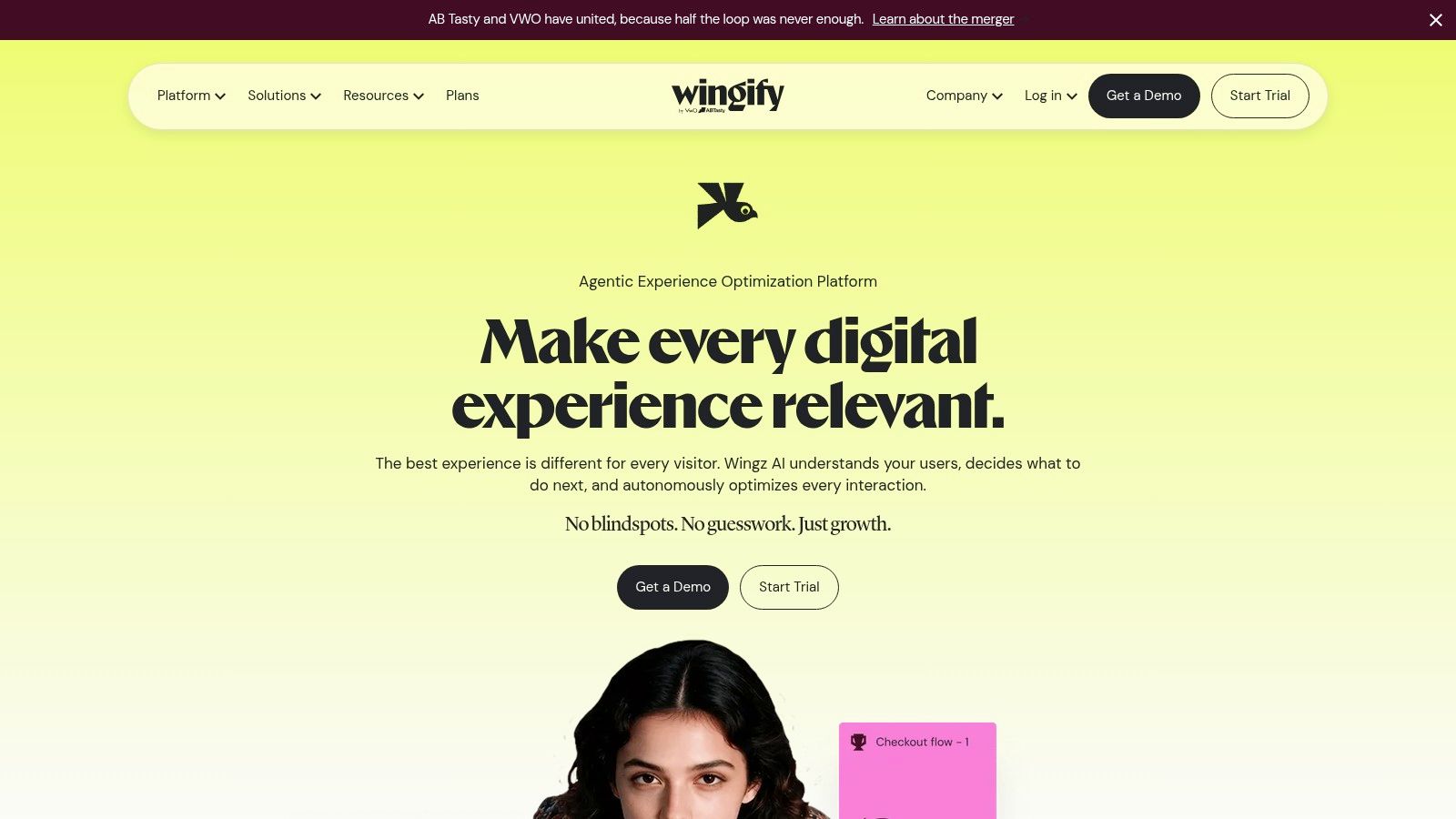
AB Tasty works well for ecommerce and content teams where marketers own campaign experimentation. Its visual editor supports A/B/n, multivariate, and split testing, while developers can use code-based changes when a test goes beyond simple page edits.
The platform also combines experimentation with personalization, feature flags, real-time reporting, goal tracking, and cross-channel templates. That makes it useful when the team wants to connect a promotional campaign with a broader customer journey rather than run isolated page tests.
Its tag-based setup can shorten the path to a first test, especially for a marketing team that doesn't want every change routed through engineering. The cost is that implementation needs performance discipline. Teams should test loading behavior, consent handling, and page stability before scaling a large campaign library.
The main trade-off
AB Tasty is not the obvious choice for a warehouse-native product experimentation program. It's better suited to a marketing-led operating model, where the questions are often about offers, layouts, messages, and audience experiences. Engineering teams looking for deep SDK governance and release workflows may find a feature-management platform more appropriate.
Pricing is sales-led and not fully public. Ask for a proposal based on the traffic and modules you'll use, and clarify whether feature flags, personalization, reporting, and support are included or priced separately.
Before moving from Optimizely, document which audiences are used for personalization versus experimentation. Combining those functions without a clear exposure model can make results difficult to interpret. The practical guidance in this overview of website optimization tools can also help separate a copy-testing need from a broader experience-management requirement.
4. Kameleoon
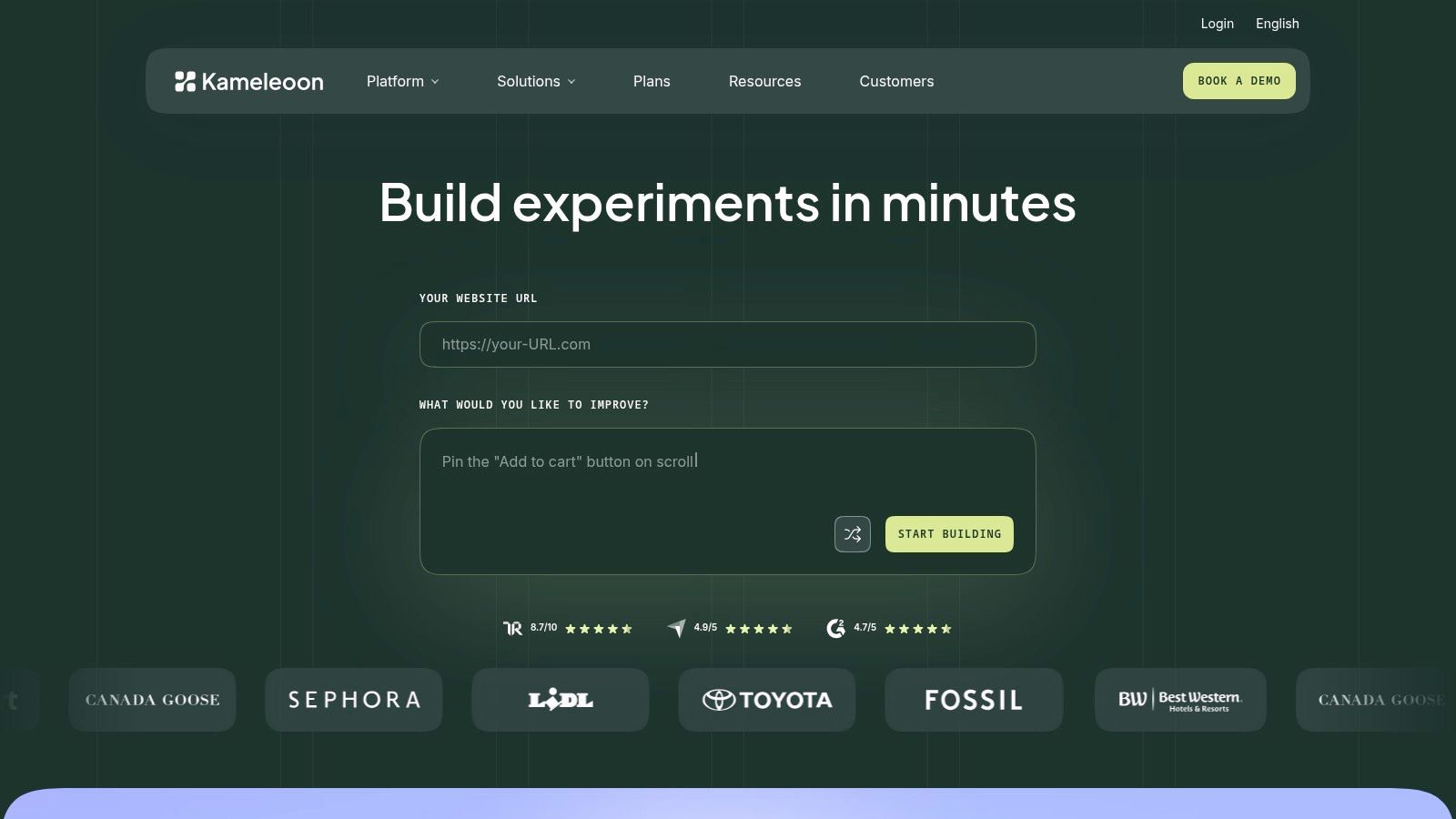
Kameleoon is designed for organizations that want web experimentation, product experimentation, and feature management in one operating model. It supports web, mobile, and server-side experiments, so the same experimentation program can extend beyond a browser page.
Its Prompt-Based Experimentation workflow is aimed at reducing the manual work involved in creating variants. A marketer or product owner can describe an experiment, use AI assistance to generate test material, and then involve technical teams where deployment requires deeper control. That's useful for organizations trying to increase experiment velocity without removing governance.
Kameleoon also offers flexible client-side and server-side deployment options. Teams can choose the implementation pattern that matches the change, rather than forcing every test through a visual editor or every page adjustment through an application release.
Who should choose it
This is a stronger fit for mid-market and enterprise teams than for a very small site that only wants to test a few headlines. Its value comes from joining CRO and product workflows, particularly when the organization has multiple surfaces and needs a consistent approach to targeting and reporting.
Pricing reflects that enterprise orientation and is available by contacting Kameleoon. Plan discussions should include traffic assumptions, web and mobile scope, server-side requirements, and whether AI-assisted test creation is part of the proposed package.
The risk is buying flexibility before the organization has a repeatable process. AI can reduce production effort, but it doesn't replace experiment design. Define one primary metric, meaningful guardrails, and an audience assignment strategy before asking the platform to generate many variants. More variations can create more review work and make it harder to understand which change caused an outcome.
5. SiteSpect
SiteSpect takes a different technical route. Its reverse-proxy and edge-based architecture can apply changes before the page renders, which helps teams reduce client-side flicker and gain deeper control over the experience.
That makes it attractive to performance-sensitive organizations, regulated businesses, and teams testing complex single-page applications. SiteSpect supports client-side and server-side experimentation and offers multiple deployment patterns, including cloud, edge CDN, and Engine API approaches.
The advantage is control at the delivery layer. Teams can test experiences without relying entirely on browser-side manipulation, and they can connect experimentation more closely to server-rendered behavior. This is especially relevant when a flash of the original page would undermine the test or create a poor user experience.
Implementation is the deciding factor
A reverse-proxy platform isn't a lightweight snippet replacement. DNS, CDN, proxy, security, caching, and application behavior all need careful coordination. The initial implementation is heavier than a marketer-led visual editor, so include infrastructure and security owners in the evaluation from the start.
Pricing is generally enterprise-oriented and quote-based. Request a deployment plan alongside the commercial proposal. A lower software quote won't help if your team must absorb unexpected edge configuration work.
SiteSpect makes the most sense when rendering behavior, performance, and deep deployment control justify that effort. It's less appropriate for a small marketing team whose main requirement is changing a headline and measuring form submissions.
6. Convert Experiences
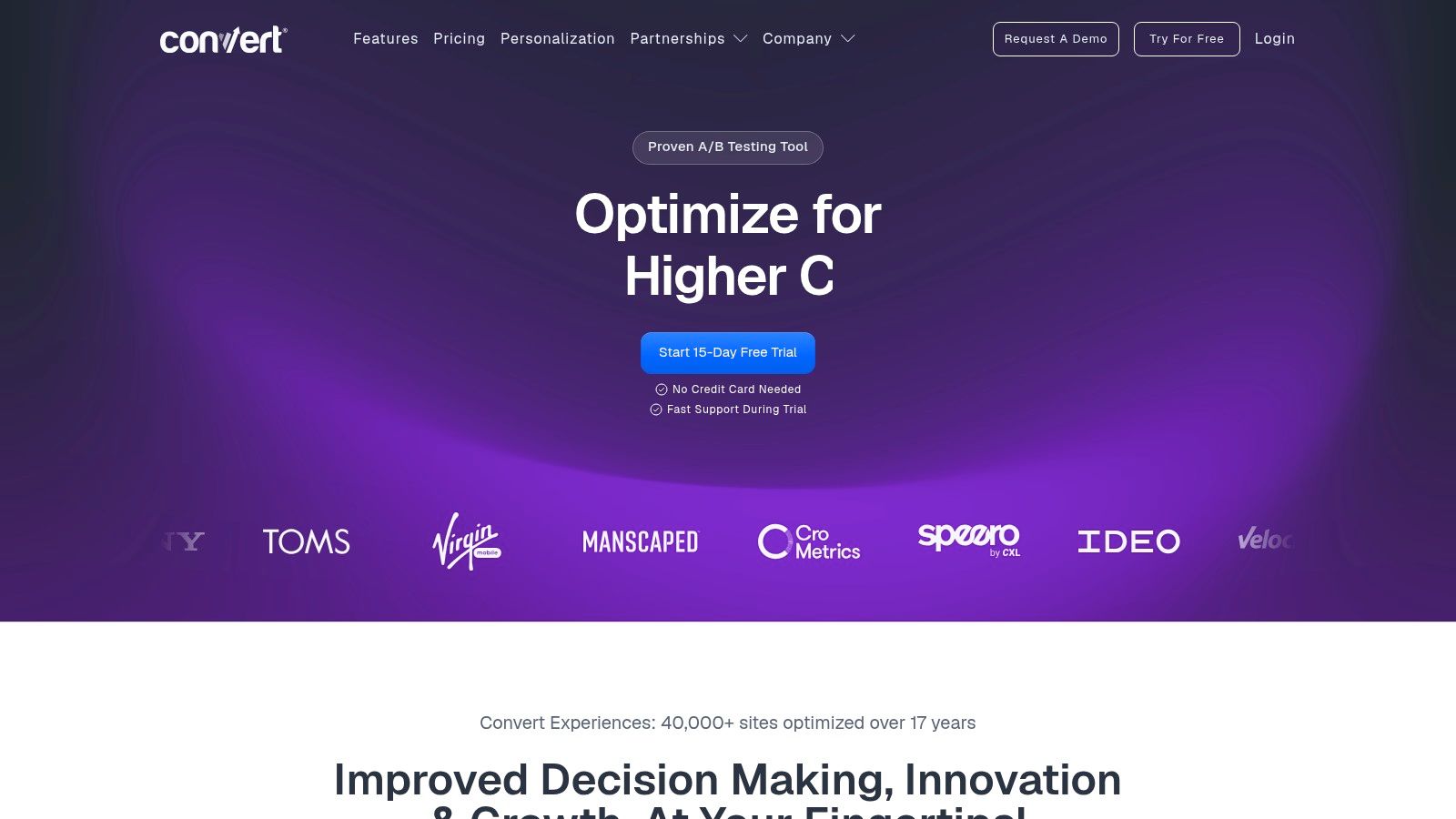
Agencies managing several client sites often need familiar experimentation tools without the cost or scope of a large enterprise suite. Convert Experiences suits that use case, supporting A/B, multivariate, split-URL, and multipage testing through visual and code editors.
Its feature set includes personalization, targeting, goals, migration assistance, and more than 90 integrations, according to Convert's integrations directory. These options give marketer-led teams room to adapt tests across different client setups while keeping implementation understandable. Developers can still take over when a test requires custom code.
Convert publishes plans based on tested users per month, with tiers and volume controls. Public pricing helps agencies forecast spend before contacting sales. Check how Convert defines a tested user, particularly when several properties or broad audience targeting could increase usage.
What it gives up
Convert focuses on experimentation rather than the wider feature-management, orchestration, and governance capabilities found in larger enterprise platforms. That narrower scope works well for marketing teams that want a dedicated testing workflow. Product teams planning feature flags or cross-channel coordination may need additional tools.
The visual editor and templates cover common campaign work, but complex changes can still require development support. Test custom JavaScript with consent management and analytics before migrating a large program, since implementation details can affect both compliance and reporting.
For migration, choose one representative site or client account first. Rebuild an existing test, compare assignment and reporting behavior, and check key integrations. Once the results match expectations, move the remaining experiments. Convert is a practical fit for marketer-led agencies and privacy-conscious teams that value public pricing and a focused testing product.
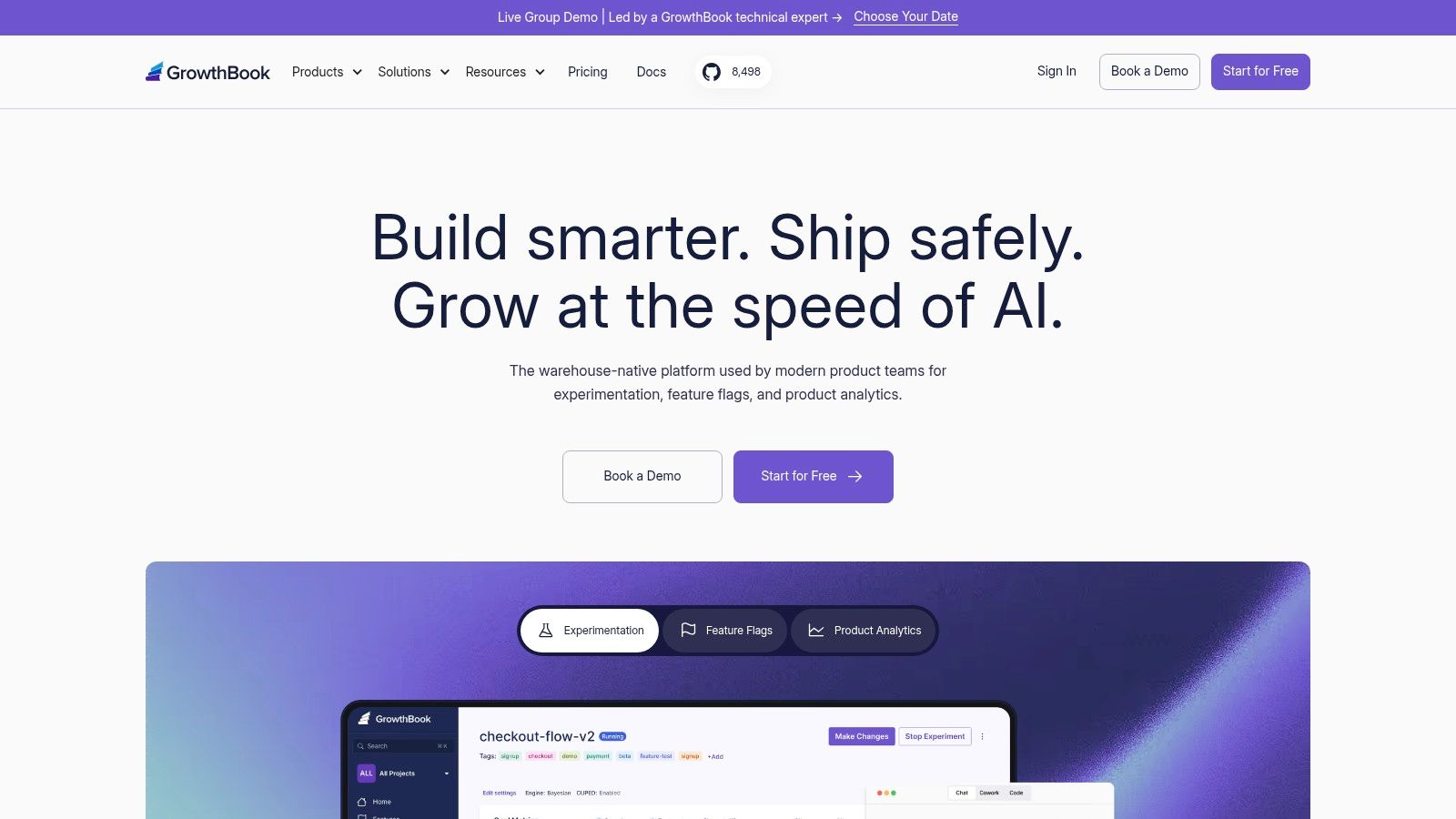
7. GrowthBook
GrowthBook suits engineering-led teams that want control over their experimentation stack. It combines feature flags, A/B testing, holdouts, multi-armed bandits, warehouse-native analytics, and self-hosting in an open-source platform.
The warehouse connection changes the buying decision. Data-mature teams can connect experiments to existing metrics instead of moving every event into a vendor-specific reporting system. Self-hosting can also support strict data, infrastructure, or governance requirements, provided someone owns the operational work.
GrowthBook offers a cloud option with a free starter tier and paid seat-based plans. Self-hosting creates a different cost model, shaped by deployment, maintenance, event pipelines, SDK upgrades, permissions, and statistical workflows. Public pricing gives teams a starting point, but estimate engineering time alongside license costs.
The warehouse-native trade-off
GrowthBook works best when data engineering and product analytics already have a solid foundation. Marketing teams looking for campaign templates, a visual editor, and minimal instrumentation may find the setup demanding.
Fixed-horizon A/B testing remains more common than adaptive allocation in practice, while this overview of multi-armed bandit testing explains why bandits remain relatively uncommon. Bandits still have valid uses. Establish reliable randomization, sample-ratio-mismatch detection, power analysis, and guardrail metrics before adopting adaptive allocation.
A warehouse-native tool gives you control, but control creates work. Don't self-host until someone owns the operational details.
Migration from Optimizely requires mapping audiences, feature states, events, and statistical definitions. Recreate one experiment end to end, then compare raw assignments and outcomes rather than relying on dashboard totals. Review the implementation with both engineering and analytics owners before moving the wider testing program.
8. Statsig
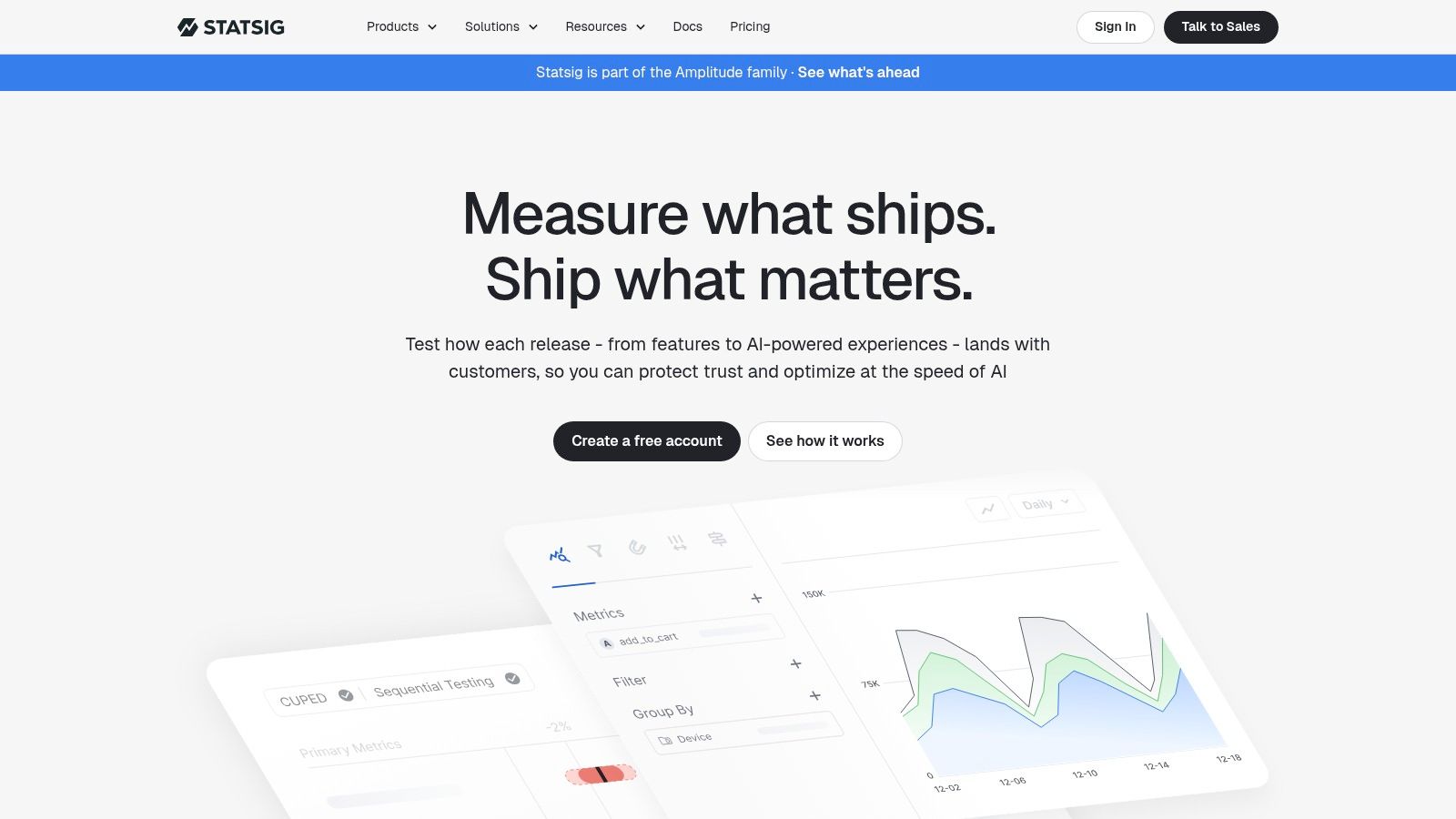
Statsig brings experimentation, feature flags, funnels, metrics, and session replay into a shared event-stream model. It's primarily a product and engineering platform, not a visual CRO tool for marketers who want to edit a landing page without code.
The benefit is speed from implementation to analysis. A product team can create a flag, expose a feature to a defined audience, attach metrics, and inspect results in the same environment. SDKs support full-stack rollout, which makes Statsig useful for web applications, mobile products, and backend experiences.
Statsig offers a free Developer tier and paid plans based on event usage. Those pricing signals are easier to understand than a fully quote-only model, but event volume can become a major cost driver as instrumentation grows. Ask how replay, custom events, historical retention, and high-volume environments affect the estimate.
Best fit and common mismatch
Statsig works best when engineers and product managers own experimentation and already think in terms of event schemas, funnels, guardrails, and release control. It can consolidate tools that would otherwise sit across analytics, feature flags, and experimentation.
It's less suited to a marketing-led team that needs a polished WYSIWYG workflow. A marketer may be able to participate in experiment planning and review, but the platform's center of gravity remains technical.
Before migrating, define metric ownership and event naming conventions. A shared event stream only improves decisions when teams agree on what an exposure, activation, conversion, and negative outcome mean.
9. LaunchDarkly
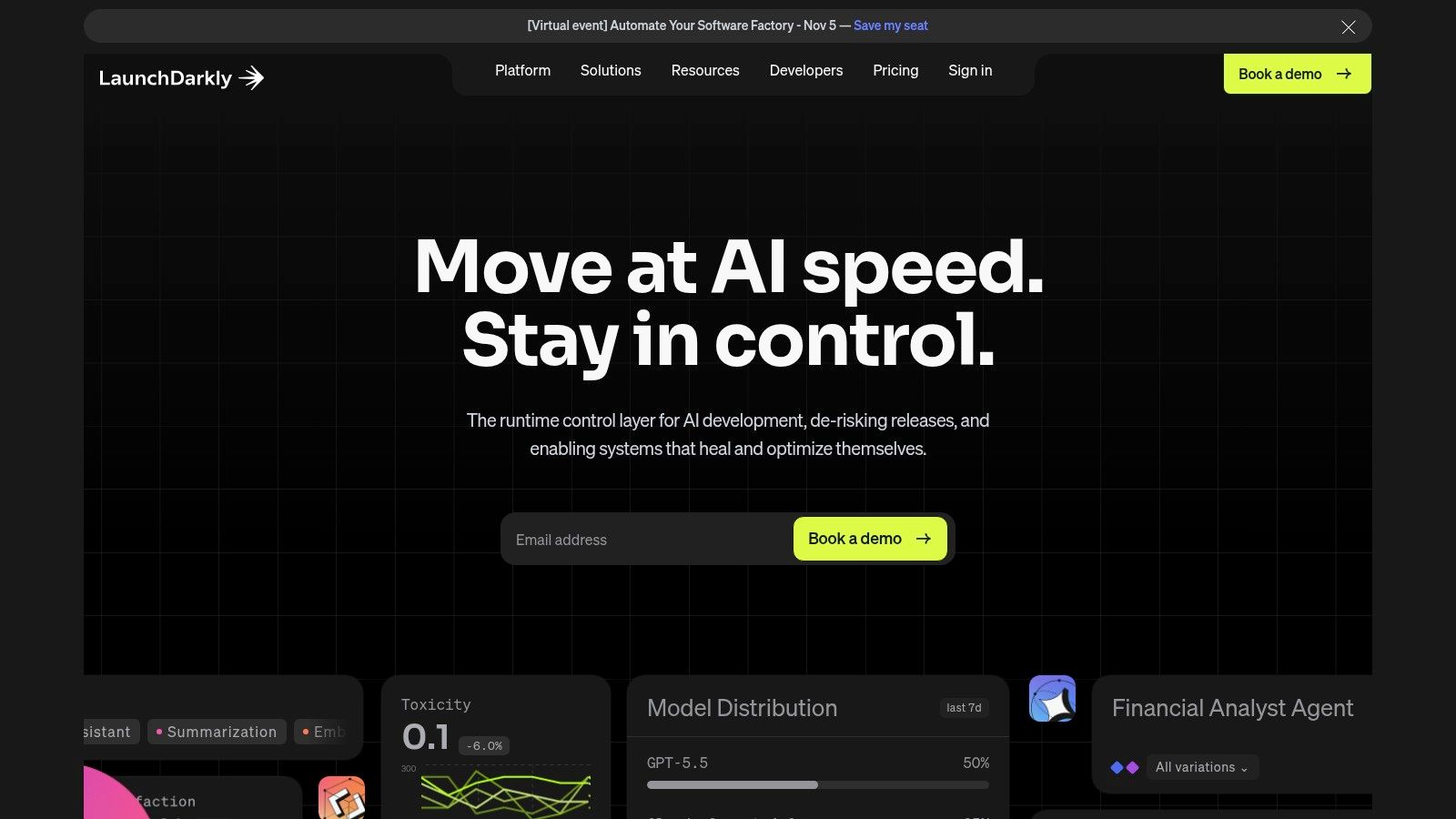
LaunchDarkly is primarily a feature-management platform with experimentation layered into the release process. Choose it when engineering needs gradual rollouts, granular targeting, kill switches, auditability, and operational safety before it needs a marketer-friendly testing canvas.
The core workflow is clear. Engineers release a feature behind a flag, expose it to controlled audiences, monitor guardrails, and expand or stop the rollout based on evidence. Experimentation fits naturally when the team wants to learn before making a feature broadly available.
That makes LaunchDarkly a strong bridge between release safety and learning velocity. It's particularly valuable for teams with multiple services, mobile applications, or high expectations around governance and reliability.
Where it falls short for CRO
LaunchDarkly isn't the best choice for a marketing team that wants to change page copy through a visual editor. Its experimentation capability is connected to flags and engineering workflows, so a simple homepage test may involve more technical coordination than it would in VWO, AB Tasty, or Polish.
Pricing is quote-based, and costs can reach enterprise levels depending on seats, environments, services, event volume, and experimentation requirements. Ask for a scenario-based estimate that reflects both existing feature-flag usage and planned testing.
Migration should begin with flag inventory rather than experiment inventory. Remove stale Optimizely variations, define ownership for each new flag, and establish expiration rules so the replacement doesn't recreate the technical debt you're trying to remove.
10. Adobe Target
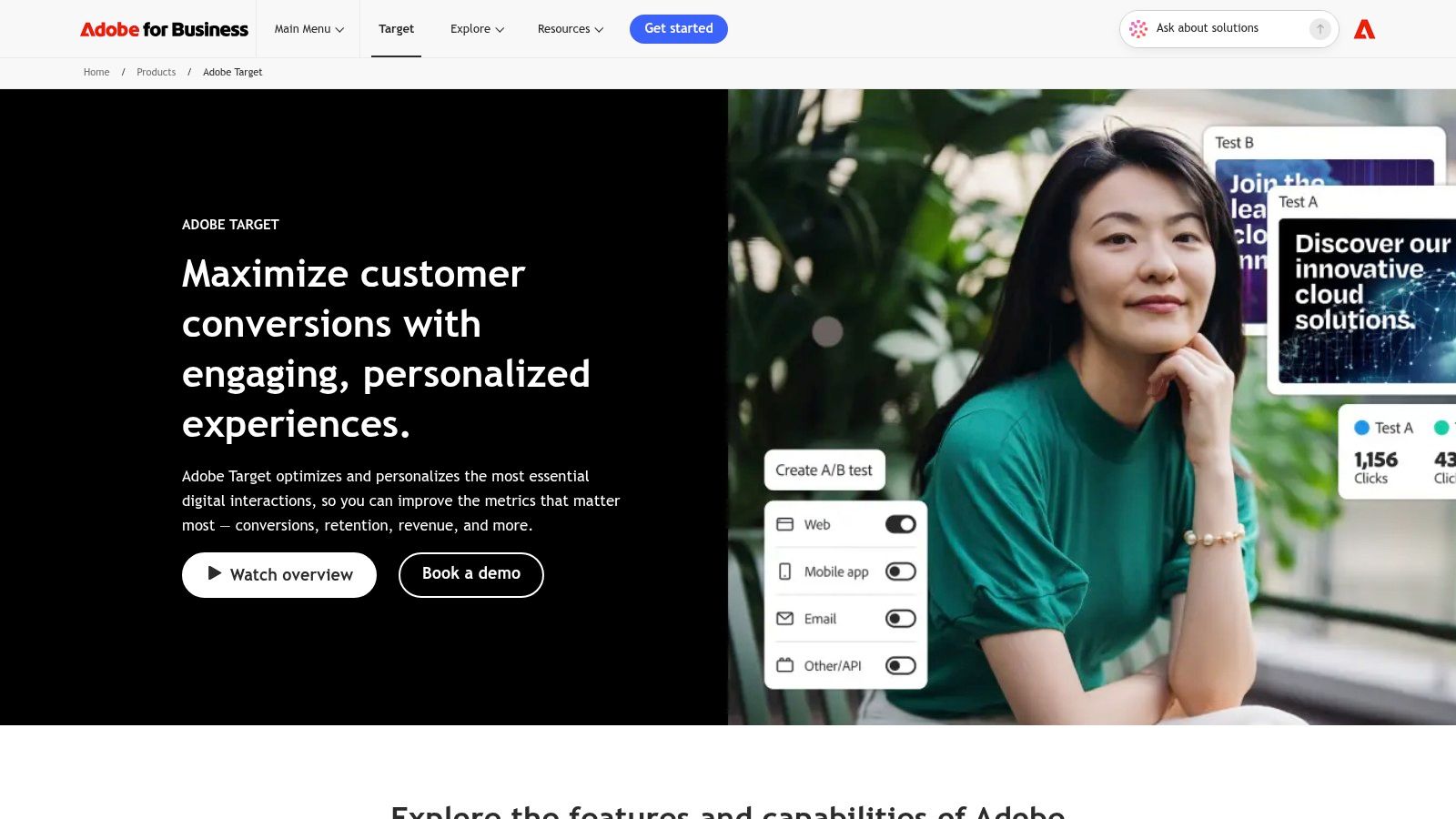
Adobe Target is built for organizations already committed to Adobe Experience Cloud. It combines A/B/n and multivariate testing, automated personalization, recommendations, mobile support, and enterprise integration with Adobe Analytics and Adobe Experience Platform.
Its strongest argument is ecosystem depth. If your analytics, audience management, content, and customer data already live in Adobe products, Target can connect experimentation to broader personalization and orchestration workflows. Adobe Analytics integration through A4T is especially relevant for teams that want a shared measurement environment.
Adobe Target is not a lightweight Optimizely replacement. Its value appears when the organization needs enterprise governance, cross-channel personalization, and the ability to coordinate experiences across a large stack. Smaller teams may pay for capabilities they won't use or take on implementation work that outweighs the testing need.
Buying and implementation
Pricing is sales-led and typically enterprise-grade. Ask Adobe to separate Target licensing from related Experience Cloud products and services. Confirm which integrations are already included in your contract and which require additional implementation.
The platform's AI and machine-learning capabilities can support personalization, but automation needs the same scrutiny as any other optimization system. Independent UX research from Baymard Research covers more than 200,000 hours of testing with 18,000+ users across 90+ leading US and European sites. That doesn't prove that Adobe Target or any other vendor improves conversion, but it shows why discerning buyers should demand explainable, segment-level evidence rather than accept an opaque recommendation.
Top 10 Optimizely Alternatives: Feature Comparison
| Product | Core features (✨) | UX / Quality (★) | Pricing / Value (💰) | Target audience (👥) | Unique selling points (✨) |
|---|---|---|---|---|---|
| 🏆 Polish | ✨ Per-visitor AI copy (headline/sub/CTA); continuous real‑traffic experiments; first‑party pixel; single snippet | ★★★★☆ Transparent feed & conversational CRO copilot; early‑access scope | 💰 $99/mo (3‑day trial), claims payback with 1 extra conversion | 👥 SaaS founders, SMBs, growth teams wanting low‑friction CRO | ✨ Autonomic per‑visitor personalization; privacy‑first; no‑code conversion detection |
| VWO | ✨ Visual A/B/n, MVT, FullStack server‑side, heatmaps & replays | ★★★★☆ Mature UI; broad feature set | 💰 Quote-based; can rise with traffic/features | 👥 CRO & growth teams at mid‑market/enterprise | ✨ All‑in‑one experimentation + behavioral insights |
| AB Tasty | ✨ A/B/n, MVT, split tests, visual & code editors, feature flags | ★★★★☆ Marketer‑friendly; fast time‑to‑first‑test | 💰 Sales‑led pricing; contact for quote | 👥 Ecommerce & marketing teams | ✨ Feature flags + personalization in same UI; cross‑channel templates |
| Kameleoon | ✨ Web/mobile/feature‑flag experiments; AI PBX (prompt‑based test creation) | ★★★★☆ Modern AI workflows; flexible deployment | 💰 Traffic‑based tiers; enterprise pricing (quote) | 👥 Product + CRO teams, mid‑market & enterprise | ✨ PBX AI test generation; client & server deployment options |
| SiteSpect | ✨ Reverse‑proxy / edge testing, pre‑render injection, SPA support | ★★★★☆ Performance‑focused; minimal flicker | 💰 Enterprise quotes; heavier initial setup (DNS/CDN) | 👥 Regulated industries & performance‑sensitive enterprise | ✨ No‑tags edge/CDN injection for zero‑flicker personalization |
| Convert Experiences | ✨ A/B, MVT, split‑URL, personalization; visual & code editors; 90+ integrations | ★★★☆☆ Strong agency support; reliable editor | 💰 Published pricing by tested‑users/month; transparent tiers | 👥 Agencies, SMBs wanting transparent costs | ✨ Privacy‑focused platform with clear pricing & migration help |
| GrowthBook | ✨ Open‑source feature flags, A/B/n, warehouse‑native analytics, free tier | ★★★★☆ Developer/data‑friendly; self‑host option | 💰 Free Starter; affordable Pro; predictable pricing | 👥 Data‑mature teams, self‑hosters, engineers | ✨ Open‑source + warehouse analytics; unlimited traffic on plans |
| Statsig | ✨ Flags, experiments, metrics, funnels & session replay on one event stream | ★★★★☆ Strong stats engine & rapid insights | 💰 Generous free Developer tier; event‑metered paid plans | 👥 Product‑led teams consolidating flags & analytics | ✨ Consolidated event stream + guardrail metrics for safe rollouts |
| LaunchDarkly | ✨ Enterprise feature flags, granular targeting, gradual rollouts, experiments | ★★★★☆ Proven at scale; engineering‑first workflows | 💰 Quote‑based enterprise pricing | 👥 Engineering‑led orgs requiring release safety | ✨ Robust governance, reliability & rich SDK ecosystem |
| Adobe Target | ✨ A/B/n, MVT, AI personalization; deep Adobe Experience Cloud integration | ★★★★☆ Enterprise‑grade; best with Adobe stack | 💰 Enterprise sales‑led pricing | 👥 Large enterprises standardizing on Adobe stack | ✨ Enterprise AI personalization + A4T integration with Adobe Analytics |
Choosing the Right Testing Platform for Your Team
Start by defining the job Optimizely is currently doing. Is it helping marketers test landing-page messages, helping engineers release features safely, giving analysts a place to measure product experiments, or coordinating enterprise personalization? Those are different jobs, and replacing a broad suite with the wrong category can create more work rather than less.
For marketer-led visual testing, shortlist Polish, VWO, AB Tasty, or Convert Experiences. Polish is the most focused option when the immediate need is autonomous headline, subheading, and CTA optimization with minimal setup. VWO adds behavioral research and a broader CRO workflow. AB Tasty fits campaign and ecommerce teams that want personalization alongside testing. Convert is attractive when transparent pricing and privacy-conscious experimentation matter.
For engineering-led feature experimentation, look at Statsig, GrowthBook, or LaunchDarkly. Statsig combines flags, metrics, experiments, and replay around one event stream. GrowthBook gives data-mature teams warehouse-native and self-hosted control. LaunchDarkly is the better fit when release safety, governance, gradual rollout, and kill switches come before visual testing.
For enterprise ecosystem requirements, Kameleoon, SiteSpect, and Adobe Target deserve closer evaluation. Their value depends on implementation depth, deployment patterns, existing analytics, security needs, and the number of digital surfaces you need to coordinate. Don't choose them only because their feature lists look closest to Optimizely.
Traffic and decision quality matter more than a long feature checklist. Technology-tracking data cited by Convert's experimentation overview estimates that roughly 2.2 million websites use A/B-testing or experimentation platforms, equivalent to approximately 0.2% of an estimated 1.1 to 1.2 billion active websites. The practical implication is that implementation friction remains a major barrier. A platform that lets your team launch valid tests, protect performance, and make decisions promptly can be more valuable than one with unused enterprise modules.
Shortlist two or three platforms that match your team's skills and traffic. Run each serious candidate on one high-traffic page or one representative product flow. Compare assignment, exposure, conversion tracking, reporting, page performance, accessibility, and operational effort against your current baseline.
Request quotes where pricing isn't public, and ask vendors to model the same usage assumptions. Check integrations with your analytics, consent system, warehouse, CMS, tag manager, CRM, and deployment pipeline before committing. Migration is also a chance to clean up stale audiences, unused variation code, unclear metric definitions, and experiments that never produced a decision.
For ecommerce teams, connect the platform choice to the broader operating process described in this guide to CRO tactics for ecommerce founders. The right tool won't rescue an unclear hypothesis or an unowned metric. It should make good experimentation easier for the people who already need to do the work.
If your team mainly needs continuous landing-page copy optimization, Polish offers a lightweight alternative that writes, tests, measures, and keeps stronger headline, subheading, and CTA variants live for different visitors. Start with the Polish trial on one important page, review the changes in its control feed, and compare the results with your current conversion baseline before replacing a broader experimentation suite.
- optimizely alternatives
- CRO tools
- A/B testing platforms
- experimentation software
- conversion optimization
Your website rewrites itself until it converts.
Polish writes new versions of your headlines and CTAs, tests them on your real visitors and keeps the ones that win.
Start free