10 Conversion Rate Optimization Tools for 2026
Compare 10 conversion rate optimization tools for testing, analytics, personalization, and heatmaps, with practical stacks for different teams.
Published on 19 min read
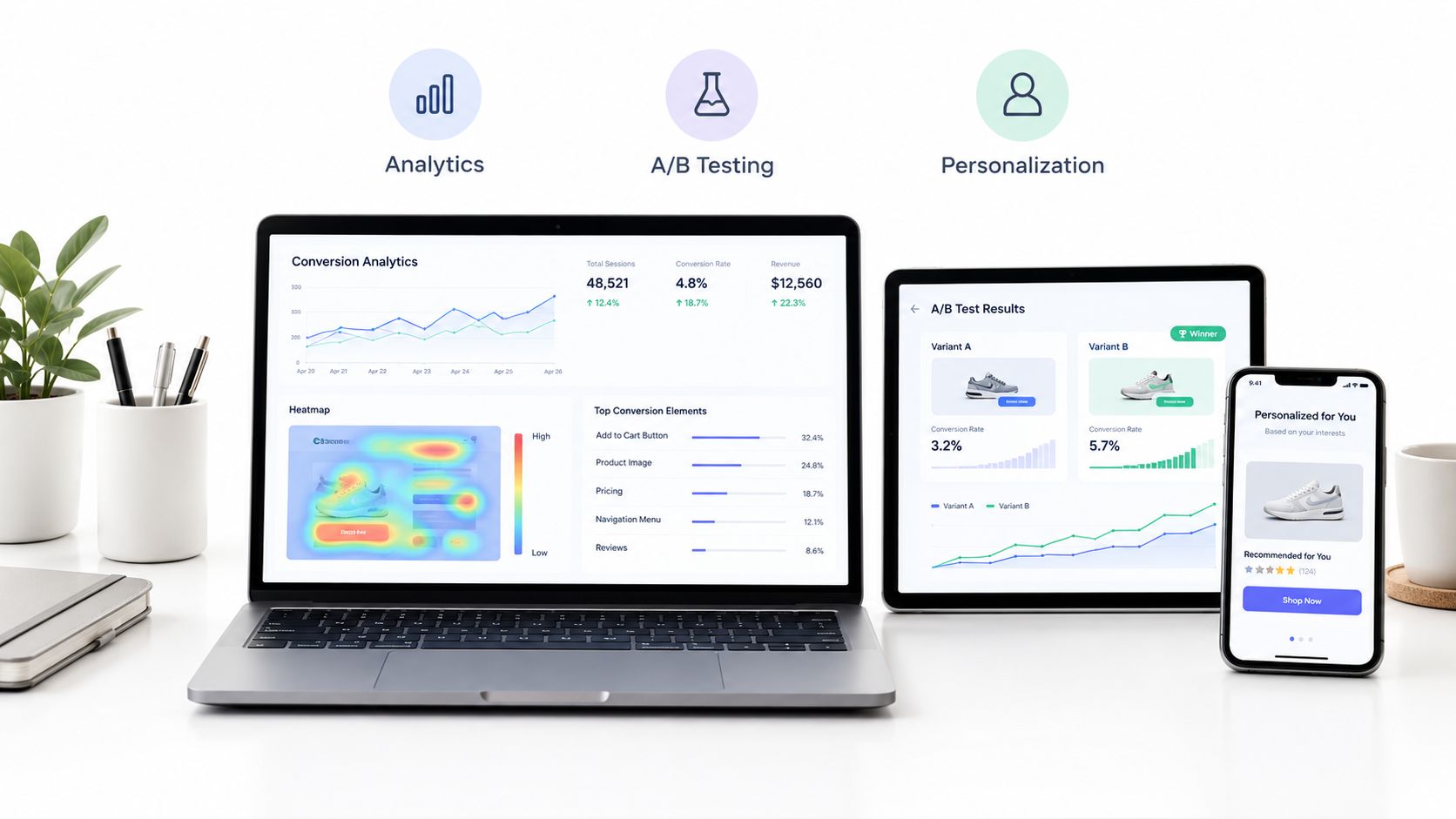
Table of contents
- 1. Polish
- Where Polish fits best
- 2. Optimizely Experimentation
- The enterprise trade-off
- 3. VWO Testing
- What the visual workflow solves
- 4. AB Tasty
- The implementation question
- 5. Adobe Target
- When the ecosystem justifies the complexity
- 6. Dynamic Yield
- Personalization needs an operating model
- 7. Kameleoon
- A privacy-first evaluation
- 8. Convert Experiences
- A focused alternative to an all-in-one suite
- 9. Intellimize
- Best for teams that can feed the system
- 10. Omniconvert Explore
- A pragmatic ecommerce stack
- Top 10 CRO Tools Feature Comparison
- Build the Smallest Stack That Answers the Next Question
- Match the tool to the bottleneck
- Validate the operating cost, not just the license
The most capable CRO platform isn't automatically the right one. A large experimentation suite can add governance, SDKs, and statistical controls, yet still fail if your real bottleneck is unclear visitor behavior, weak landing-page messaging, or a team that can't ship tests consistently. The right choice starts with the job you need done, not the longest feature list.
Some teams need behavioral insight before they can form a credible hypothesis. Others need controlled A/B testing, server-side rollouts, privacy-safe measurement, ecommerce experimentation, or continuous personalization that adapts without a test manager setting up every variation. The comparison below organizes conversion rate optimization tools by those jobs and by the team context they suit.
I'll compare each platform on its practical use case, implementation effort, traffic fit, limitations, pricing visibility, and likely owner. The list covers ten distinct tools, including Polish as an autonomous personalization option for teams with real traffic. That distinction matters as experimentation programs mature, as discussed in these growth experimentation 2026 insights.
1. Polish
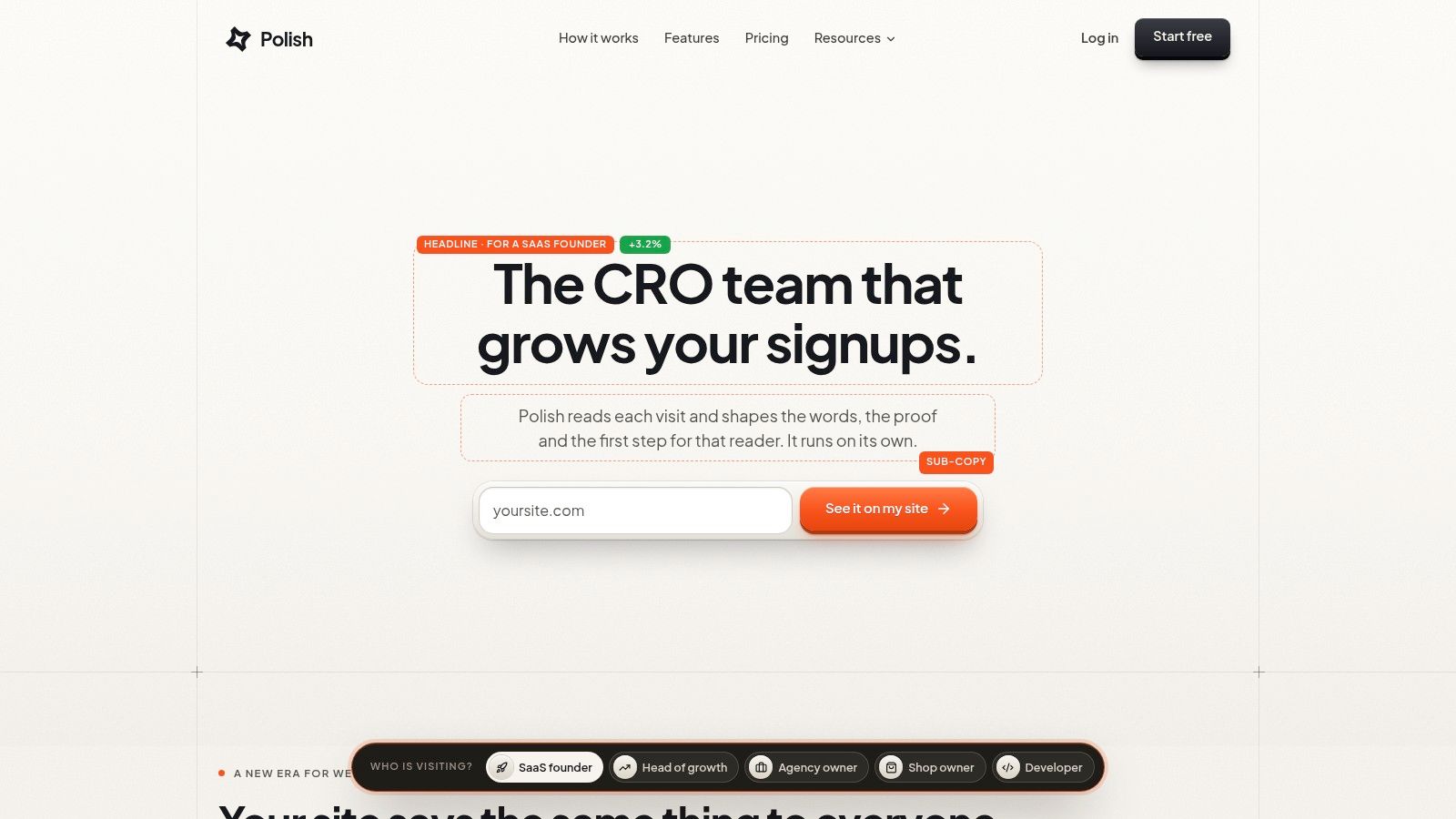
Polish targets a specific CRO problem: keeping landing-page messaging relevant without turning every hypothesis into a manually configured A/B test. After a small snippet is installed and a URL is provided, its autonomous AI CRO agent evaluates each visit's context, including source, campaign, device, language, and whether the visitor is new or returning. It can adjust headlines, supporting copy, CTAs, proof, and page structure while retaining the existing visual design.
That workflow puts Polish in a different category from a conventional experimentation platform. Marketers do not need to build two variants and wait to promote a winner. Polish generates variants for live visitors, observes conversion behavior, and keeps stronger messaging in circulation. It uses a cookieless, first-party pixel and is intended to work with Next.js, Webflow, Shopify, WordPress, and plain HTML.
Where Polish fits best
Polish suits a Head of Growth, CRO lead, marketing manager, or founder who has steady traffic but limited testing capacity. It is a practical option when campaigns and audiences arrive with different expectations, yet the landing page presents one generic message to everyone. Paid search visitors may need different proof from readers arriving through a partner article. Returning visitors may need less introductory explanation than first-time visitors.
The main operational benefit is lower testing overhead. Your team does not have to write every copy variation, arrange a design sprint for each hypothesis, or replace a winning headline by hand. Polish manages the ongoing copy cycle while leaving the team with voice rules, approvals, pause controls, and a readable feed of rewrites and results.
Practical rule: Autonomous optimization needs enough real traffic to learn from. A low-traffic site may take longer to produce useful evidence, making a simpler research and testing stack a better starting point.
The plan is $99 per month with a three-day free trial, as described in the Polish pricing overview. The company says one additional conversion can cover the cost, but that result depends on traffic, the offer, baseline conversion behavior, and average customer value. The pricing is easier to evaluate than quote-only enterprise platforms. Its current scope remains focused mainly on headlines, CTAs, copy, and proof, while complete page-per-visitor rollout is being introduced to early members first.
Polish does not replace a product experimentation system for feature flags, backend logic tests, or complex release governance. Choose it when the immediate bottleneck is landing-page relevance and continuous messaging optimization. Choose a broader suite when engineering-led experimentation is the primary requirement.
2. Optimizely Experimentation
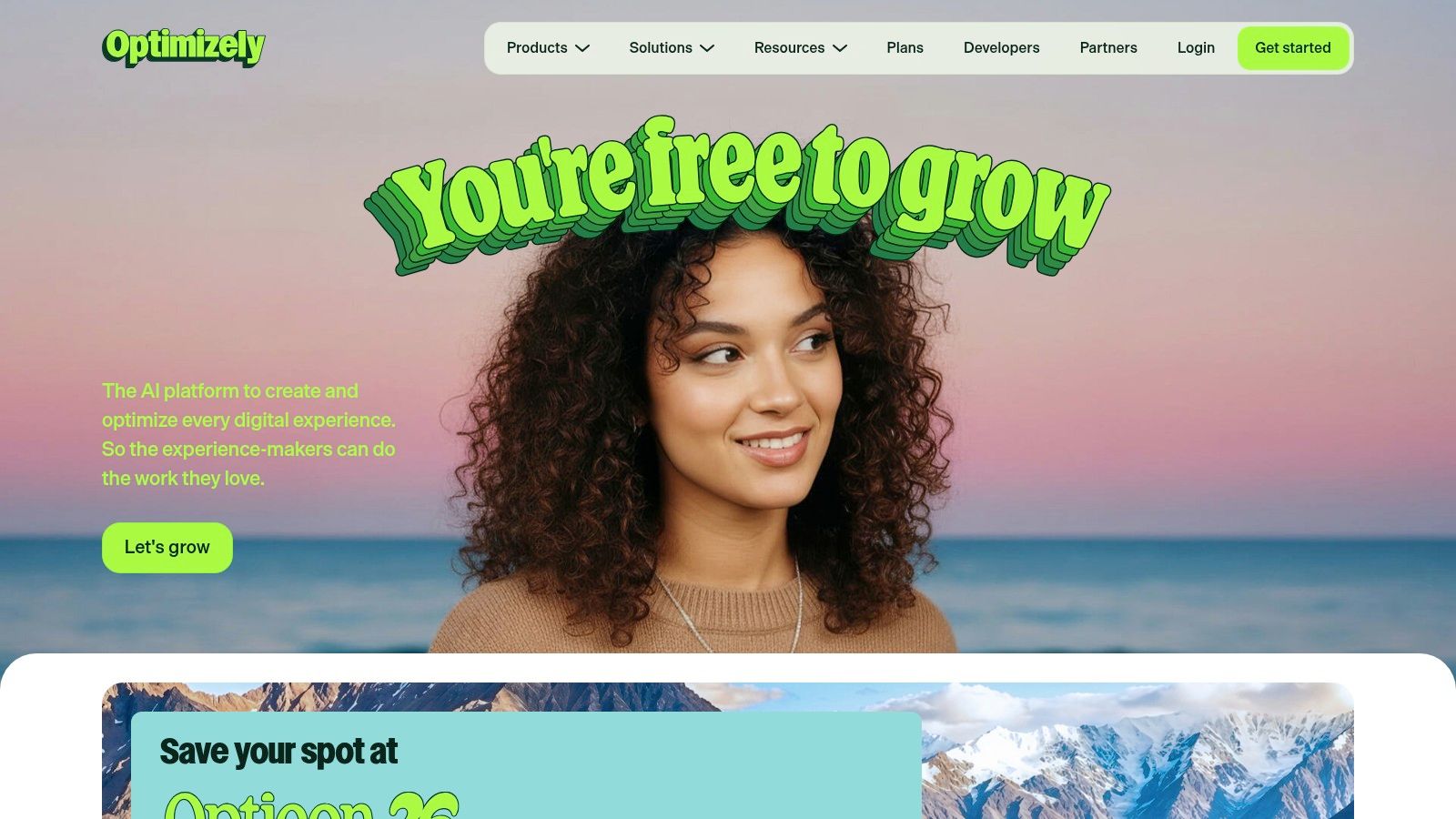
Optimizely Experimentation is built for organizations that need a governed experimentation program across marketing surfaces and product infrastructure. It supports web A/B testing, multivariate testing, redirects, and full-stack experiments through SDKs for web, mobile, server, and edge environments. That breadth makes it useful when a CRO team needs to test more than page copy, such as feature behavior, product flows, or release exposure.
The platform also includes feature management, gradual rollouts, and kill switches. Those controls let product and engineering teams separate experimentation from permanent deployment, reduce exposure when a release behaves badly, and document decisions across a larger organization. AI assistance can support ideation, planning, analysis, and scaling, but it doesn't remove the need for a clear hypothesis or an agreed primary metric.
The enterprise trade-off
Optimizely's strength is control. Approval workflows, hypothesis tracking, broad SDK coverage, and documentation help multiple teams run experiments without turning the site or product into an unmanaged collection of scripts. The same structure creates a learning curve for teams that have only run occasional visual-editor tests.
Traffic isn't the only consideration. A team needs enough experiment volume, technical ownership, and organizational discipline to justify full-stack capability. If the marketing team only wants to test landing-page headlines, Optimizely may be excessive. If engineering needs feature flags and product managers need controlled exposure, its scope becomes more defensible.
Before committing, define the minimum detectable effect and decision rules in your test plan. This minimum detectable effect guide explains why a team should decide what change matters before interpreting a result.
Optimizely doesn't publish a simple public price for the core enterprise offering. Pricing is custom and can be difficult for smaller teams to evaluate without a sales process. Choose it when governance, server-side experimentation, and cross-functional scale matter more than quick self-serve setup.
3. VWO Testing
VWO Testing works well when marketers need to move from behavioral evidence to a live experiment without handing every change to engineering. Its visual editor supports A/B, split URL, and multivariate testing, while heatmaps and session recordings help teams investigate why visitors may be hesitating or abandoning a page.
That combination makes VWO more than a test launcher. A CRO manager can inspect a page, identify a confusing interaction, turn the observation into a hypothesis, and build a test within the same broader platform. The workflow is attractive for mid-market teams that want fewer disconnected tools and don't have a large experimentation engineering function.
What the visual workflow solves
The visual editor lowers the barrier to simple page changes. Marketers can test copy, layout adjustments, calls to action, and other front-end changes without waiting for a full development cycle. Behavioral analytics then give the team context that conversion reports alone can't provide.
The limitation is that a visual editor doesn't make a weak experiment strong. Teams still need clean targeting, an appropriate primary goal, collision management, QA across devices, and a plan for interpreting inconclusive results. Multivariate tests can also become difficult to interpret when traffic and experiment volume don't support the number of combinations being evaluated.
VWO doesn't provide simple public pricing, so budget planning requires a quote. Confirm what's included in the package, whether behavioral tools are bundled, and how pricing changes with traffic, domains, seats, and support requirements. Its mature marketer workflow makes sense for teams running recurring website experiments, but a smaller site may get more value from a lighter insight and testing combination.
4. AB Tasty
AB Tasty brings web experimentation, personalization, feature experimentation, and ecommerce merchandising into one platform. Marketing teams can use a visual editor for A/B, multivariate, and multipage tests, while product teams can use server-side experimentation and rollout controls for features that shouldn't be changed through browser-side code.
Its commerce capabilities are important for retailers with a large catalog or merchandising team. Recommendations, prioritization controls, and ecommerce experiences sit alongside classic tests, so the platform can support both campaign optimization and product-oriented experimentation. That unified approach can reduce handoffs when marketing and product teams share a CRO roadmap.
The implementation question
AB Tasty is strongest when a business has enough use cases to justify one shared experimentation console. A team can coordinate personalization campaigns, set priorities, and use server-side controls instead of maintaining separate systems for every channel or department. Documented onboarding and help content can shorten the initial ramp-up, but the platform still requires ownership from people who understand experiment design and deployment risk.
The commercial model is enterprise-leaning. Exact pricing isn't fully public, and sales involvement is required. Ask for a clear breakdown of traffic limits, environments, feature access, implementation support, and any separate charges for advanced exports or services.
AB Tasty may be more platform than a small marketing team needs. It doesn't make sense to buy broad personalization and feature rollout capability when the organization hasn't yet established a repeatable process for writing hypotheses, launching tests, and applying learnings. Choose it when marketing and product need a common system and ecommerce complexity is part of the business case.
5. Adobe Target
Adobe Target is the natural shortlist candidate for organizations already invested in Adobe Experience Cloud. It supports A/B and multivariate testing, automated personalization, recommendations, and data sharing within Adobe's broader marketing ecosystem. That integration can reduce friction when audience data, campaign management, analytics, and experience delivery already sit inside Adobe.
For large, multi-brand organizations, centralized governance and deployment models matter as much as the test editor. Adobe Target can support teams managing multiple properties, regions, and audience strategies where a standalone testing tool would create additional integration and administration work.
When the ecosystem justifies the complexity
Adobe Target's main benefit isn't that it offers a test type other platforms lack. Its value comes from connecting experimentation and personalization to an existing enterprise customer-data and marketing environment. A team can use shared audience definitions and coordinate targeting across a wider experience stack, subject to its internal data and governance setup.
That benefit disappears when the rest of the organization doesn't use Adobe. Smaller teams may face unnecessary complexity, specialist implementation requirements, and a sales-led buying process. Pricing is quote-based and typically enterprise-level, so the evaluation should include implementation ownership, administrator capacity, data architecture, and the cost of maintaining the broader stack.
Adobe Target also isn't a shortcut around weak experimentation practice. Automated personalization can distribute traffic intelligently, but the team still needs to define business outcomes, monitor segment quality, and check that personalization isn't creating inconsistent or inaccessible experiences. Select it when Adobe is already strategic and the organization needs personalization at portfolio scale. For a standalone landing-page program, a focused tool is usually easier to operate.
6. Dynamic Yield
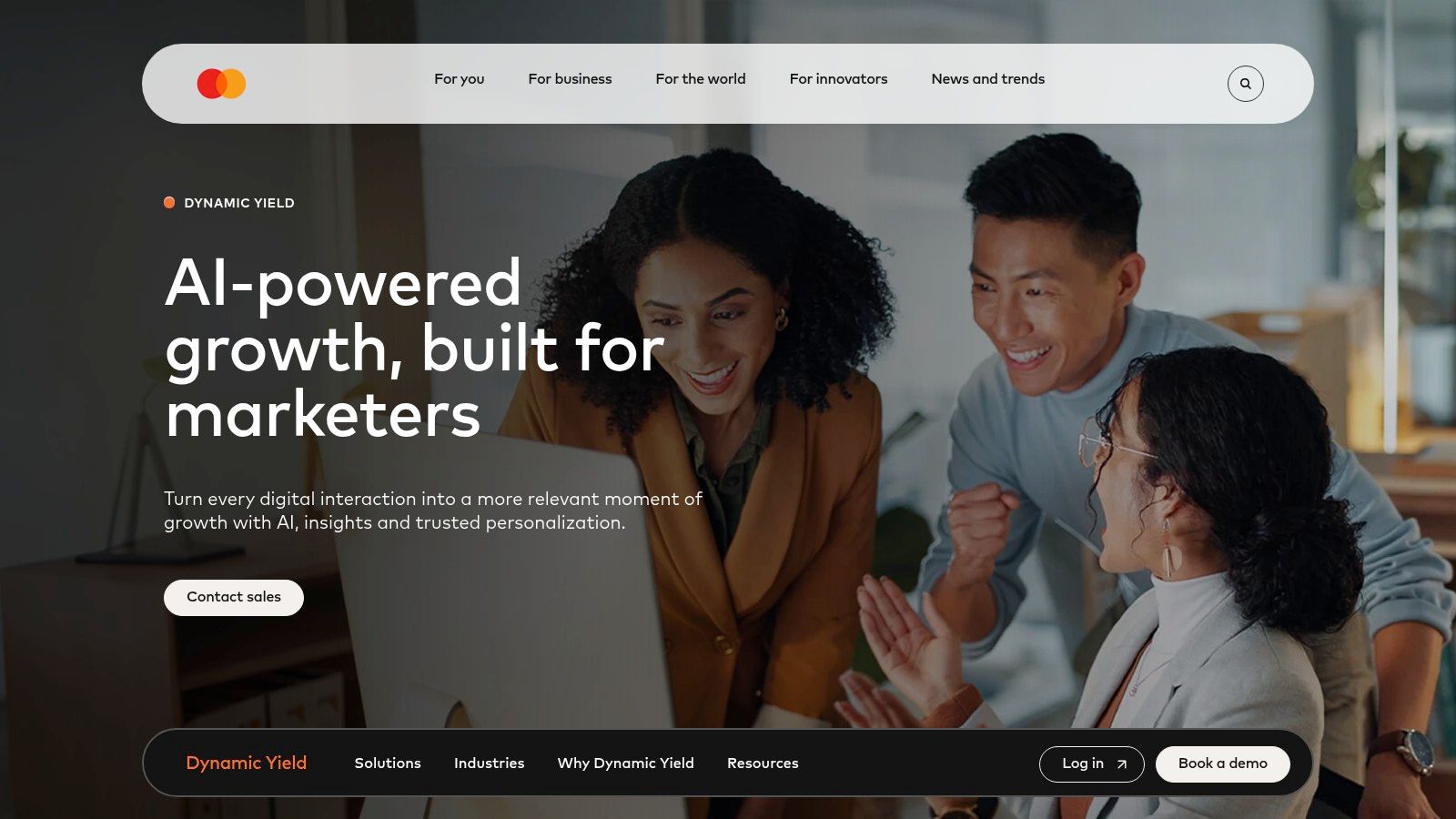
Dynamic Yield is a decisioning and personalization platform for businesses that need audience intelligence across more than one digital touchpoint. It supports client-side delivery, server-side A/B testing, feature rollouts through Experience APIs, affinity profiling, and API-based integrations for advanced decisioning.
This makes it a strong fit for retailers and large digital businesses that want to coordinate recommendations, content, offers, and experiences across channels. Its server-side and API options also give technical teams more control than a browser-only testing system, particularly when personalization needs to influence application logic or downstream systems.
Personalization needs an operating model
Dynamic Yield works best when the organization has people who can define audiences, maintain data quality, and govern decision rules. A strong decisioning engine can create more relevant experiences, but it can also create overlapping campaigns, unclear ownership, and hard-to-diagnose outcomes if teams don't establish priorities.
The platform is sales-led and contract terms are bespoke. Treat the commercial evaluation as a technical discovery process, not just a feature demonstration. Ask how the proposed setup handles identity, consent, server-side latency, API failure, fallback experiences, reporting, and campaign conflicts.
Real-time personalization is useful when audience context changes the appropriate experience, not merely because personalization is available. This real-time personalization guide provides useful context for deciding whether your problem needs dynamic audience-level decisioning or a narrower landing-page solution.
Dynamic Yield is typically an enterprise investment. It can be the right choice for a retailer with many audiences and channels, but it's a poor fit for a small team that primarily needs to improve a handful of acquisition pages.
7. Kameleoon
Kameleoon combines client-side web experimentation, server-side feature flags, personalization, and AI-assisted experimentation. Its positioning is especially relevant to organizations that want flexible deployment while keeping privacy and performance visible in the implementation decision.
The platform can support both marketing and product teams. Marketers can run website experiments, while developers can manage feature rollouts and server-side tests. Self-hosting options for the script and performance-focused tooling give technical teams more influence over how experimentation affects the delivery layer.
A privacy-first evaluation
Kameleoon deserves attention from companies operating in regulated markets or with strict internal data requirements. Privacy isn't a compliance checkbox that can be delegated entirely to a vendor. Your team still needs to verify consent behavior, data collection, retention, regional controls, and the roles of the platform and your own analytics systems.
Kameleoon also offers real-time data capabilities, more than 80 integrations, and a free trial for prompt-based or AI-assisted experimentation, according to the product information supplied for this comparison. Confirm current availability and limits during evaluation, because entry tiers and advanced features can change.
Public pricing is limited, and advanced tiers are quote-based. Ask Sales to separate the cost of client-side testing, server-side experimentation, feature management, integrations, and support. Kameleoon is a sensible candidate when privacy and deployment flexibility are central buying requirements. It may be unnecessary for a team that only needs a straightforward copy test and has no regulated data workflow.
8. Convert Experiences
Convert Experiences is a testing platform for teams that care about experiment quality, privacy controls, and transparent governance. It supports A/B, split, and multipage testing, with features such as sample-ratio-mismatch detection, collision prevention, approval workflows, and audit trails.
Those details matter because a test can look successful while the underlying assignment or implementation is flawed. SRM checks can flag traffic allocation problems, while collision prevention reduces the risk that concurrent campaigns contaminate each other's results. Governance features help teams record who approved a change and why it went live.
A focused alternative to an all-in-one suite
Convert also includes heatmaps and session recordings with privacy controls, but it isn't trying to be a full customer data platform or broad personalization engine. That narrow scope is an advantage for organizations that want a dedicated testing layer without buying a large decisioning suite.
Compliance-aware workflows reference GDPR, CCPA, and HIPAA considerations, but the vendor's controls don't replace your legal review or consent architecture. Confirm how the platform behaves in your jurisdictions and how it connects to your existing analytics and consent systems.
Convert provides public pricing tiers and transparent overage pricing, which makes early budget screening easier than with quote-only enterprise platforms. Still, validate the current plan against your traffic and test volume. A team running occasional low-complexity tests may not need every governance feature, while a regulated organization may value those controls more than advanced personalization.
For landing-page testing, define the page, audience, primary conversion, and stopping rule before launch. This landing-page split test guide covers the practical distinction between changing one page experience and building a broader optimization program.
9. Intellimize
Intellimize uses AI-driven website optimization to generate and evaluate many page variations, then direct more exposure toward better-performing experiences. It's designed for teams that want to increase test throughput without manually setting up every possible combination of copy, layout, or audience message.
The platform's approach differs from a fixed A/B test. A traditional test often gives variants a planned allocation for a defined period, while an optimization system can prioritize traffic toward stronger performers as evidence develops. That can reduce wasted exposure, but it also changes how the team should interpret results and govern decisions.
Best for teams that can feed the system
Intellimize is a good fit for growth teams with enough page traffic, a clear conversion event, and a willingness to let an algorithm manage variation exposure. AI Landing Pages can help teams create and test on-brand experiences faster, particularly when paid campaigns need multiple message-to-page combinations.
The trade-off is transparency and commercial predictability. Pricing is sales-led with no public list price. The platform was acquired by Webflow in April 2024, and pricing remains bespoke according to the supplied product information. Confirm the current product roadmap, ownership model, data access, reporting depth, and migration terms before signing.
AI optimization doesn't eliminate the need for human review. Teams should approve brand language, exclude claims that need legal review, monitor page performance, and decide whether a short-term conversion gain harms downstream lead quality. Intellimize suits companies prioritizing automated variation and traffic allocation. It's less suitable when the organization needs a simple, fully manual testing workflow or strict control over every visitor assignment.
10. Omniconvert Explore
Omniconvert Explore is aimed at ecommerce and SaaS teams that want testing, personalization, surveys, overlays, and server-side experimentation in a practical package. It can support A/B and multivariate testing, qualitative feedback collection, and experiments involving pricing or algorithmic logic.
That combination is useful when the team doesn't just need to know which page converts better. Surveys and on-site messages can reveal why shoppers hesitate, while server-side testing can evaluate changes that a browser editor can't safely handle. For ecommerce teams, the ability to connect behavioral feedback with offer and experience testing is often more valuable than adding another advanced visual editor.
A pragmatic ecommerce stack
Explore's SEO-friendly messaging approach keeps original content visible to Google while delivering test experiences to visitors, according to the supplied product notes. Teams should still validate implementation details with their technical and SEO owners, especially when testing substantial page changes or dynamic content.
The platform has lower entry price points than many enterprise suites, but exact pricing depends on site complexity and should be verified with Sales. Advanced CDP-level personalization may require additional tools, so don't treat Explore as a replacement for every customer-data or merchandising system.
Choose Omniconvert when ecommerce operators need testing plus qualitative input and want to keep the stack practical. It's less compelling for a global enterprise that needs extensive feature management, portfolio governance, or cross-channel identity resolution. Start with one commercial question, such as checkout friction, offer presentation, or product-page clarity, and add complexity only when the evidence requires it.
Top 10 CRO Tools Feature Comparison
| Product | Core features | UX / Quality (★) | Price / Value (💰) | Target audience (👥) | Unique selling points (✨) |
|---|---|---|---|---|---|
| 🏆 Polish | Per-visitor headlines, CTAs & copy; cookieless 1st‑party pixel; one‑snippet install; live auto‑testing | ★★★★☆ autonomous, transparent feed | 💰 $99/mo (3‑day trial), ROI‑focused | 👥 Heads of Growth, CROs, Marketing Managers, founders with real traffic | ✨ True 1:1 landing pages, brand‑safe rewrites, approve/pause control |
| Optimizely Experimentation | Full‑stack A/B, MVT, feature flags, SDKs, ML assistance | ★★★★☆ enterprise-grade control | 💰 Quote (enterprise) | 👥 Product & engineering teams at scale | ✨ Broad SDK coverage + governance/workflow |
| VWO Testing | Visual editor A/B/MVT, heatmaps, session replay, integrations | ★★★☆☆ marketer‑friendly UX | 💰 Quote only | 👥 Growth/CRO teams and marketers | ✨ Visual editor + behavioral insights |
| AB Tasty | Web & server experiments, personalization, e‑merchandising | ★★★☆☆ unified marketing/product console | 💰 Quote based (enterprise) | 👥 Marketing & product teams, e‑commerce | ✨ Commerce features + campaign prioritization |
| Adobe Target | A/B/n, automated personalization, recommendations, Adobe integrations | ★★★★☆ scalable enterprise personalization | 💰 Quote (Adobe stack pricing) | 👥 Enterprises using Adobe Experience Cloud | ✨ Deep Adobe ecosystem integration |
| Dynamic Yield | Server/client personalization, affinity profiling, APIs, decisioning | ★★★★☆ strong decisioning & cross‑channel | 💰 Quote only (enterprise) | 👥 Enterprises needing cross‑channel personalization | ✨ Robust decisioning engine & API flexibility |
| Kameleoon | Web & server experiments, self‑host option, real‑time performance | ★★★★☆ privacy & performance focused | 💰 Quote‑based; free trial available | 👥 Privacy‑conscious product & marketing teams | ✨ Self‑hosting + performance optimizations |
| Convert Experiences | A/B/split/multipage, SRM checks, governance, privacy controls | ★★★☆☆ testing quality & compliance | 💰 Public tiers + transparent overage | 👥 CRO teams, ecommerce with privacy needs | ✨ Built‑in SRM, audit trails, compliance workflows |
| Intellimize | AI‑driven variant generation, predictive personalization, traffic prioritization | ★★★★☆ AI-first optimization | 💰 Sales‑led pricing (contact) | 👥 Teams wanting AI to scale personalization | ✨ Shifts traffic toward winners to reduce waste |
| Omniconvert Explore | A/B, MVT, personalization, surveys/overlays, server‑side tests | ★★★☆☆ practical, cost‑sensitive UX | 💰 Lower entry points; varies by complexity | 👥 Ecommerce & SaaS teams seeking value | ✨ Server‑side testing + SEO‑friendly messaging |
Build the Smallest Stack That Answers the Next Question
The right CRO stack starts with the question your team can't answer today. If you don't know where visitors struggle, add an insight layer first. If you know the friction but need controlled validation, add an experimentation platform. If different audiences need different messages, choose personalization. If the team wants continuous landing-page adaptation without managing every test manually, consider autonomous optimization.
This sequence prevents a common buying mistake. Teams purchase a broad platform because it has more features, then discover that nobody owns implementation, the traffic isn't sufficient for the planned experiments, or the reporting doesn't match the business decision. A smaller stack often creates more learning because people can operate it consistently.
Market demand supports the idea that CRO tooling has become a substantial software category. The global A/B testing software market was projected to reach about USD 1.08 billion by 2025, rising from roughly USD 516.5 million in 2020 and reaching about USD 1.25 billion by 2028, according to Sci-Tech Today's A/B testing statistics. A separate market summary valued the broader CRO software market at USD 3.8 billion in 2025 and projected USD 10.2 billion by 2034, with North America representing 38.2% of global revenue in 2025, as reported by CROBenchmark.
That growth doesn't mean every team needs an enterprise suite. Usage remains relatively underpenetrated, with a BuiltWith-based estimate placing A/B testing or experimentation platforms on about 2.2 million websites, around 0.2% of an estimated 1.1 to 1.2 billion active websites, according to Convert's A/B testing statistics roundup. The same source says A/B tests account for 67.6% of experiments, split URL tests for 16.9%, and multivariate testing for less than 1%. Most organizations still rely on straightforward test designs, so buying advanced capability before building a repeatable process can create cost without creating insight.
Match the tool to the bottleneck
Use Polish when the main problem is generic landing-page messaging and the team wants autonomous, per-visitor optimization. Its $99 per month plan and short trial make the commercial decision more visible than a custom enterprise quote, but the product needs meaningful live traffic to produce useful learning.
Use Optimizely Experimentation when product, engineering, and marketing need governed full-stack experimentation, SDK coverage, feature flags, and rollout controls. Use VWO when marketers need a visual testing workflow connected to heatmaps and session recordings. Use AB Tasty when marketing and product teams want experimentation, personalization, and commerce capabilities in one enterprise-leaning console.
Use Adobe Target when Adobe Experience Cloud already anchors your marketing and data stack. Use Dynamic Yield when cross-channel decisioning, audience profiles, server-side delivery, and advanced APIs are central to the business case. Use Kameleoon when privacy, performance, and flexible client-side and server-side deployment deserve priority.
Use Convert Experiences when privacy-conscious testing and experiment governance matter more than a full personalization suite. Use Omniconvert Explore when an ecommerce team wants testing, surveys, overlays, and practical server-side scenarios without starting with the broadest enterprise platform. Use Intellimize when the team wants AI to generate and prioritize page variations and is comfortable with sales-led pricing and algorithmic allocation.
Validate the operating cost, not just the license
A CRO platform's real cost includes implementation, QA, analytics, consent management, engineering time, training, experiment design, and the work required to act on results. Ask who owns the snippet or SDK, who approves copy, who checks mobile rendering, who monitors experiment collisions, and who decides whether a result is ready for rollout.
Traffic fit matters just as much. An advanced tool can't manufacture evidence from thin traffic. The supplied Ascend2 research reports that marketers use web analytics at 55%, built-in tools from CMS, email, and advertising platforms at 50%, landing-page tools at 40%, dedicated platforms at 38%, and custom-built tools at 34%. That mix supports a practical conclusion: a lightweight combination can outperform an all-in-one platform when the team's constraint is process and experiment volume rather than software capability.
The same research reports that 92% of respondents said AI-driven tools improved A/B testing, while 46% described the improvement as significant. Treat that as a reason to test AI-assisted workflows, not as permission to remove human review. The team still needs to protect brand voice, validate attribution, monitor lead quality, and document decisions.
Finally, include mobile and privacy in the buying brief. Market research supplied for this comparison says mobile-first optimization influences 67% of campaigns, mobile traffic exceeds 58% globally, cloud deployment accounts for 83% of installations, and privacy-centric testing frameworks are adopted by 52% of regulated industries, according to Market Growth Reports. The same source says personalization engines affect 71% of CTA placements. These figures point to the practical direction of the category, but your own traffic mix, consent requirements, and customer journey should decide the purchase.
Build the smallest stack that answers the next question. Start with insight when the problem is unclear, add controlled experimentation when the team needs validation, and choose personalization or autonomous optimization when audience context and continuous adaptation are central. Validate current pricing, traffic limits, implementation ownership, data requirements, integrations, privacy behavior, and rollout controls before signing.
Polish offers autonomous landing-page personalization that adapts headlines, proof, CTAs, and supporting copy to each visitor, then keeps stronger experiences live on real traffic. If your CRO bottleneck is generic landing-page messaging rather than complex product experimentation, visit Polish and see whether its focused approach fits your stack.
- conversion rate optimization tools
- CRO tools
- A/B testing tools
- website personalization
- conversion optimization
Your website rewrites itself until it converts.
Polish writes new versions of your headlines and CTAs, tests them on your real visitors and keeps the ones that win.
Start free