Landing Page Split Test That Converts: A Practical Guide
Run a landing page split test that actually converts. Learn hypotheses, variants, traffic allocation, and stats in this practical, no-fluff guide
Published on 14 min read
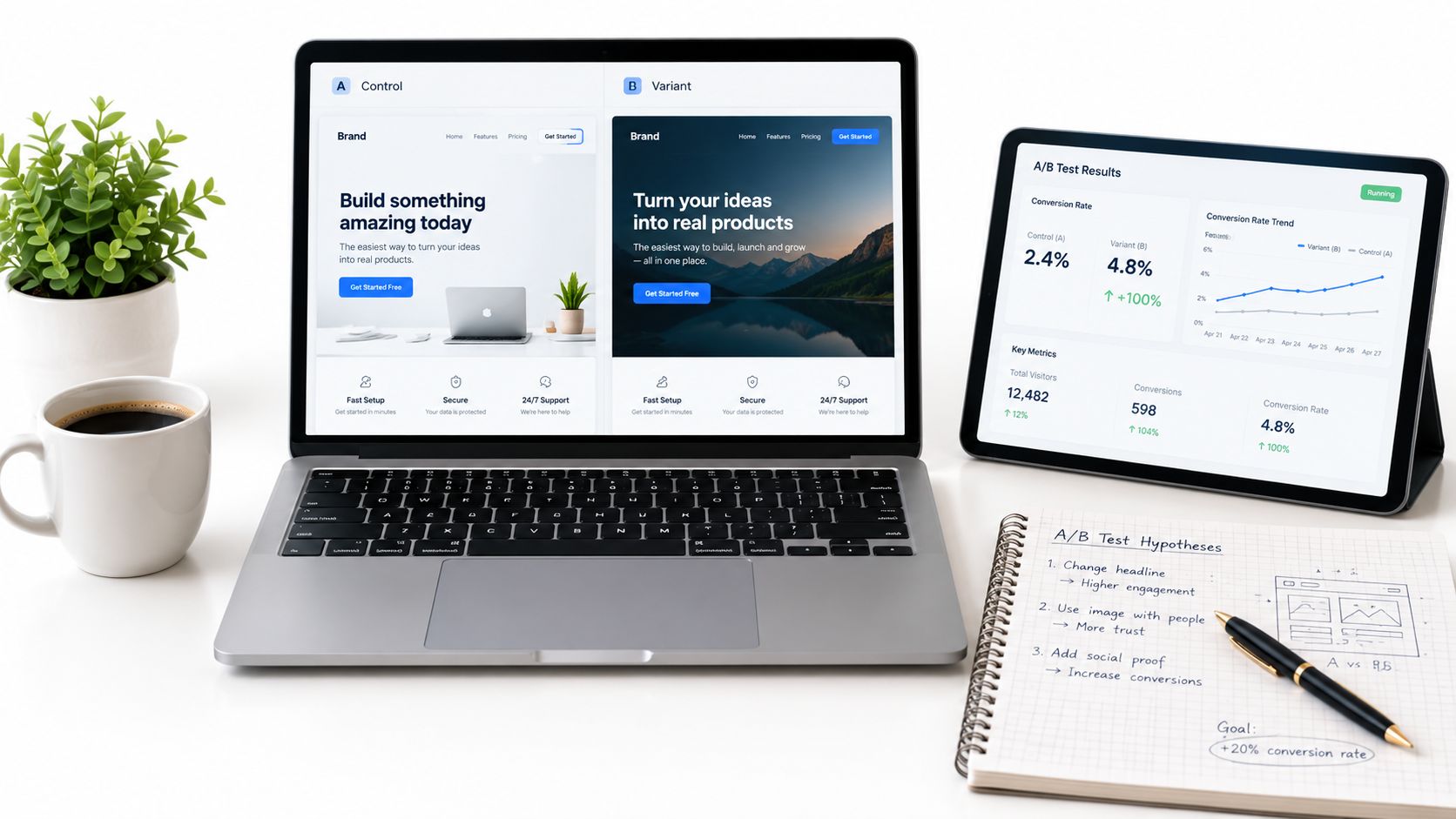
Table of contents
- The Moment Every Growth Lead Recognizes
- The real problem starts before launch
- What growth leads actually need on launch morning
- What a Landing Page Split Test Actually Is
- The terms teams mix up
- When each format fits
- Choosing a Hypothesis Worth Testing
- The four parts of a usable hypothesis
- What deserves traffic first
- A simple scoring filter
- Planning the Test End to End
- Start with baseline and minimum detectable effect
- Allocate traffic and lock the rules
- Build the launch checklist before the variant
- Reading Results Without Fooling Yourself
- Don't reward early movement
- Segment carefully or you'll invent a story
- Use decision rules instead of interpretation theater
- Running the Test With an AI Copy Agent
- What the workflow looks like in practice
- Where AI helps and where it doesn't
- What happens after a winner appears
- Your Landing Page Split Test Checklist
- Before launch
- After the result
Monday morning. The test is built, traffic is about to split, and everyone is acting as if the hard part is over.
It usually isn't.
Most bad landing page split tests fail before launch. They fail when a team picks the wrong page, tests a weak idea, accepts a stakeholder request as a hypothesis, or rushes a cosmetic change because it's easy to ship. By the time the experiment goes live, the result is mostly baked in.
That's the part most guides skip. They tell you how to run a test. They don't tell you when the test isn't worth running, what deserves traffic, or how to avoid lying to yourself when the dashboard starts moving.
The Moment Every Growth Lead Recognizes
You know the setup. A launch ticket is approved. Design handed over a variant on Friday. Paid traffic is already booked. Someone from sales wants stronger claims above the fold. Someone from brand wants softer wording. Someone from product wants to “just test” a new CTA because last quarter a CTA test won on a different page.
By 9 a.m., the test is ready. You still have a quiet suspicion it shouldn't go live.
The real problem starts before launch
A landing page split test looks clean in the tool. Control on one side, challenger on the other, conversion event selected, traffic split set. But the result is shaped by decisions made earlier:
- Which page got selected: High-intent pages behave differently from top-of-funnel campaign pages.
- What change made the cut: Offer framing and form friction matter more than decorative tweaks.
- How much traffic you're committing: Too little traffic turns the test into a story generator, not a decision tool.
- What success means: If the team can't agree on the primary conversion, the test is already compromised.
The pressure to launch usually comes from four directions.
- A roadmap deadline. The team needs visible output this sprint.
- A forceful stakeholder. Someone senior insists on a specific change and wants “data to validate it.”
- A recycled win. A test that worked for another audience gets copied onto a page with different intent.
- A fast cosmetic idea. Button color, icon style, or spacing ships faster than fixing the offer.
Practical rule: If a test exists mainly to satisfy a calendar or a stakeholder, treat it as guilty until proven worthy.
What growth leads actually need on launch morning
On test day, abstract CRO advice is useless. You need a short list of decisions that hold up under pressure:
- Hypothesis selection: Is the change tied to a real friction point?
- Sample planning: Can this page produce a trustworthy answer?
- Traffic allocation: Are you spreading visitors too thin?
- Result criteria: Have you defined the winner before looking at the dashboard?
This is how you get to fewer tests run and more tests trusted. That's a better operating model than celebrating activity. The win is having a clear answer the next time someone asks what to do with the landing page.
What a Landing Page Split Test Actually Is
A landing page split test compares two or more page versions against one defined conversion goal. The job is simple. Send comparable traffic to each version, hold the context as steady as possible, and measure which version produces more of the action that matters, such as a demo request, signup, form completion, or purchase.
That definition sounds basic, but teams blur three different test types and then read the result with more confidence than the setup deserves.
The terms teams mix up
Teams often say “A/B test” when they mean any experiment on a landing page. That shorthand causes problems once the page build, tracking plan, and analysis start. Optimizely's testing guide separates these formats for a reason. They answer different questions and demand different traffic levels.
Here's the practical distinction.
| Format | Best For | Minimum Traffic | Common Mistake |
|---|---|---|---|
| Split URL | Big page-level changes across separate URLs | Higher than a simple A/B test | Calling it an A/B test and overlooking that the pages differ in multiple ways |
| A/B | One focused change inside the same template, such as headline, CTA, proof block, or form copy | Moderate | Changing several elements at once and claiming the result proves one idea |
| Multivariate | Combinations of multiple elements on a high-traffic page | Very high | Running it on a page that cannot support all combinations |
When each format fits
Use split URL testing when the concept changes at the page level. Different offer, different structure, different story. If one version asks visitors to book a demo and the other pushes a free trial, the team is comparing strategies, not polishing a single component.
Use A/B testing when the page framework stays intact and one decision is under review. Headline, hero copy, CTA wording, trust section placement, or form intro. This is the default for a good reason. It usually gives the clearest read with the least interpretive mess.
Use multivariate testing only when traffic is strong enough to support every combination and someone on the team knows how to interpret interaction effects. Many landing pages do not meet that bar. In those cases, tighter A/B tests produce faster decisions and cleaner learning.
If you want a broader playbook on how teams boost conversions with AI support, treat split testing as one input into the conversion system, not the whole system.
Many tests labeled “A/B” are split URL tests running inside A/B testing software.
That distinction matters on day one, not after results come in. A test brief should name the format correctly before design starts. If the build requires separate URLs, separate QA, and separate analytics validation, call it a split URL test. That one naming choice usually improves sample planning, implementation discipline, and post-test analysis.
Choosing a Hypothesis Worth Testing
Most landing page split tests aren't weak because the copy is bad. They're weak because the hypothesis is vague.
“Let's try a stronger headline” is not a hypothesis. It's a direction. A testable hypothesis names what will change, who will see it, what behavior should move, and what outcome matters enough to count as useful.
The four parts of a usable hypothesis
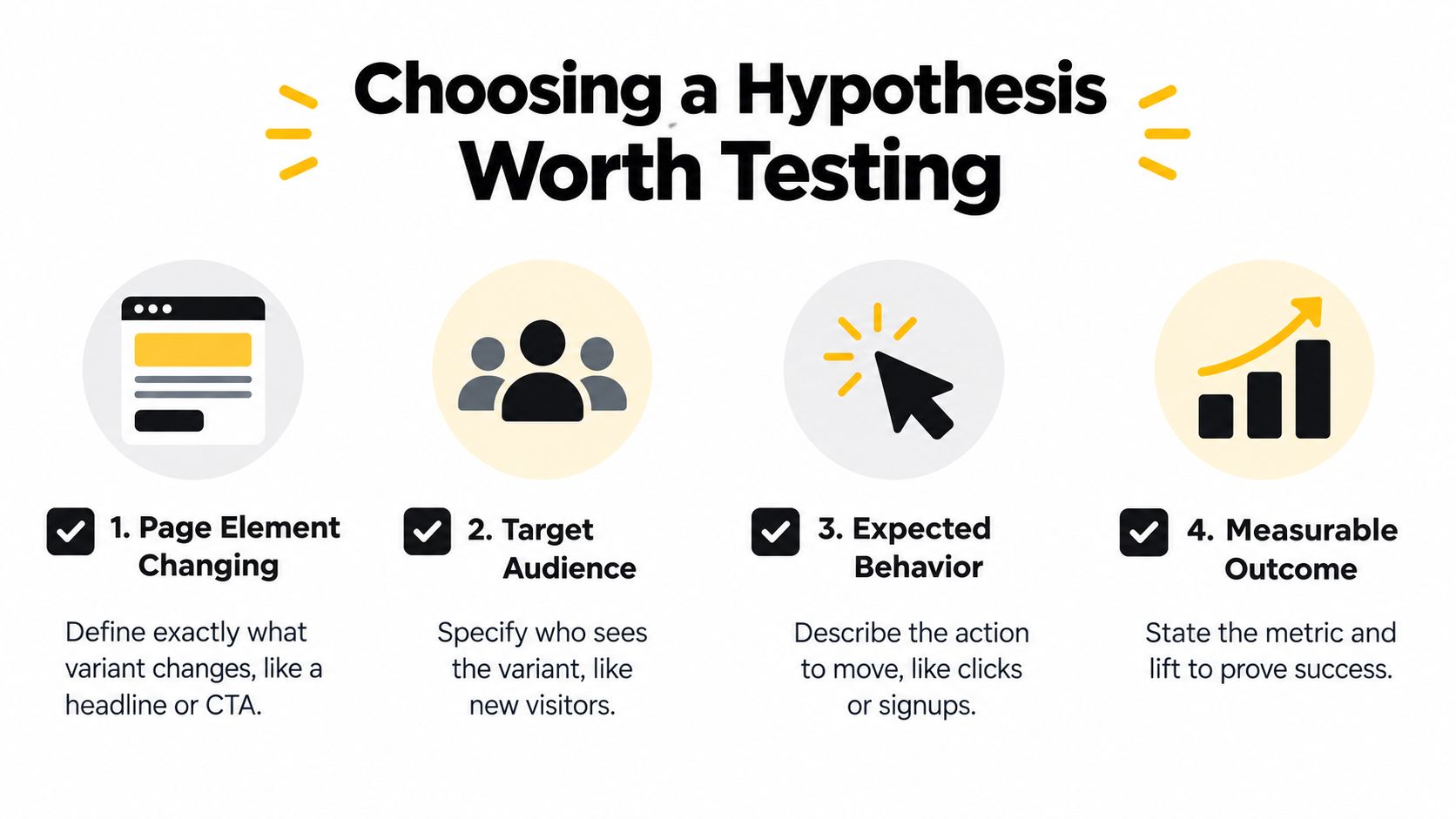
A practical hypothesis should answer four questions in one sentence:
- What element is changing
- Which audience sees it
- What behavior should move
- What outcome would make the change worth shipping
A decent version sounds like this: changing the hero headline for first-time paid visitors will increase demo requests because the current message explains the product but not the problem it solves.
A bad version sounds like this: test new messaging and see if engagement improves.
The second one gives everyone room to reinterpret the outcome later. That's how weak tests survive approval.
What deserves traffic first
The strongest landing page split test ideas usually sit high in the decision path. They affect what visitors understand, trust, or fear in the first moments.
Prioritize these first:
- Hero headline and subhead: Clarify problem, outcome, or audience fit.
- Primary CTA: Change the action framing, not just the visual style.
- Offer framing: Trial, demo, audit, quote, consultation, or immediate purchase.
- Social proof placement: Move proof closer to the decision point.
- Form length and field logic: Remove friction where commitment becomes real.
Lower-value ideas still exist, but they go later.
- Button color
- Minor icon swaps
- Footer text
- Spacing-only edits without a user-friction thesis
If the team is still refining the page's positioning, revisit the underlying message before testing micro-variants. A useful prompt is to sharpen the actual promise first. This guide on customer value proposition is a good reference when the page sounds polished but still doesn't land.
The biggest gains usually come from offer, form fields, and messaging. Trivial visual tweaks rarely rescue a weak page strategy. That aligns with current landing-page testing guidance summarized by Design Elite's 2026 playbook.
A simple scoring filter
Before adding any idea to the queue, score it on three dimensions:
| Idea filter | What to ask |
|---|---|
| Impact | If this works, does it change a real decision point? |
| Ease | Can the team build and QA it without introducing noise? |
| Confidence | Do you have evidence from behavior, calls, funnel drop-off, or objections? |
Keep only the top one or two ideas per cycle. Not because the others are bad, but because crowded queues create sloppy tests.
If you can't write the hypothesis in one sentence and name the metric in one word, it isn't ready.
Planning the Test End to End
Planning is where most of the quality sits. A clean landing page split test starts with arithmetic and discipline, not creativity.
Independent guidance on A/B testing for landing pages recommends setting the sample size before launch, using baseline conversion rate, minimum detectable effect, desired power, and significance level to calculate what the test needs. A common benchmark is 80% power at a 5% significance threshold, and the same guidance warns that peeking before the planned sample is reached inflates false positives (Apte AI guidance on sample-size pitfalls).
Start with baseline and minimum detectable effect
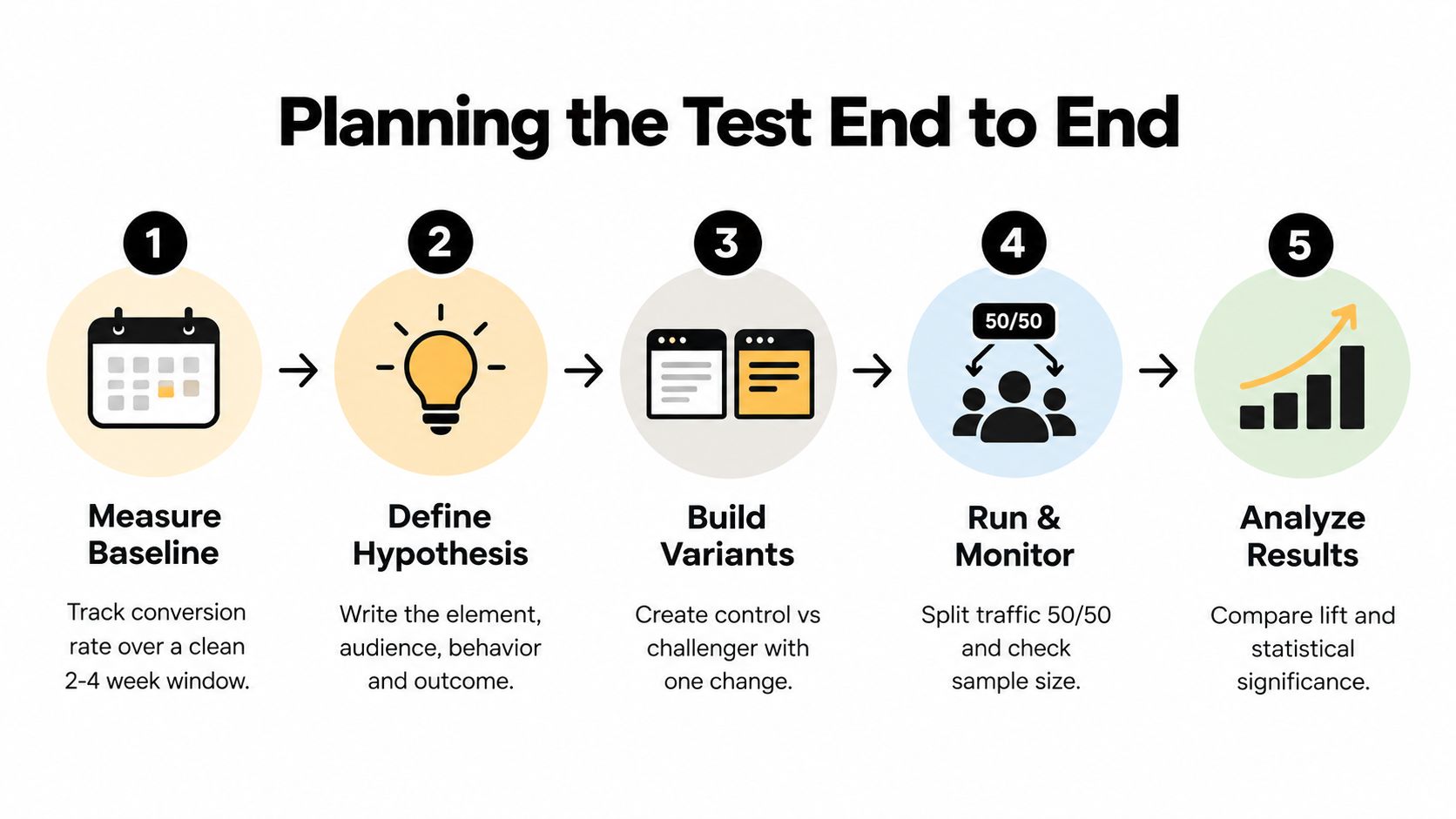
Pull a clean baseline from at least two weeks of historical data. If seasonality or campaign swings are common, use a longer clean window. The baseline should reflect the page in normal operating conditions, not a one-off promotion or a broken tracking week.
Then define the minimum detectable effect, or MDE. This is the smallest lift that would justify the work and rollout. It's the most important pre-test decision because it controls how much traffic and time the experiment will need.
If the business only cares about a meaningful change, don't pretend you're testing for a tiny movement. Set the MDE.
Allocate traffic and lock the rules
For a standard two-variant A/B test, split traffic evenly. Keep it simple unless you have a strong operational reason not to.
Before launch, lock these items:
- Primary conversion event: one winner metric only
- Secondary diagnostics: behavior data, not winner criteria
- Audience inclusion rules: which channels, devices, or geographies are in
- Exclusions: internal traffic, obvious bots, broken sessions
- Run condition: full weeks, not arbitrary stop dates
A practical walkthrough helps here:
If your test touches forms, review the mechanics before you touch the copy. This breakdown of lead capture forms AgentStack is useful because form friction can overpower message improvements.
Build the launch checklist before the variant
Spending more time discussing copy than checking instrumentation is backwards.
Use a launch checklist that covers:
- Variant QA: mobile, desktop, browser rendering, broken links, CTA behavior.
- Tracking validation: every form submit, click, or purchase event fires correctly.
- Traffic split check: make sure allocation behaves as planned.
- Hypothesis doc: include the exact change, dates, sample assumptions, and success rule.
- Analysis rule: define in advance what counts as ship, iterate, or no decision.
For broader experimentation setups with more than two variants, the logic changes. This overview of A/B/n testing is helpful when the team is tempted to expand the variant count before confirming the page can support it.
Launch note: the day-one job is not to admire the dashboard. It's to verify that the experiment is technically clean and that no one changes the page, audience mix, or success metric midstream.
Reading Results Without Fooling Yourself
A weak readout can undo a good test. Teams talk themselves into wins that don't exist.
A 2026 synthesis of A/B testing data reports that 36.3% of tests produce a statistically significant winner at the 95% confidence level, while the raw win rate was 50.5%. The same source says 60% of A/B tests are stopped too early before reaching that significance threshold (Conversion Team statistics roundup). That pattern should sound familiar to anyone who has watched stakeholders ask for updates three days into a test.
Don't reward early movement
If you keep checking and hoping the graph stays green, you increase the chance of calling noise a result. Early lifts are seductive because they create momentum inside the team. They also disappear all the time.
Read the test only when the planned conditions are met:
- Planned sample reached
- Full business cycle covered
- Primary metric evaluated first
- No mid-test audience or page changes
When those conditions aren't met, the honest answer is “not enough evidence yet.”
Segment carefully or you'll invent a story
Segmentation helps when it was planned. It misleads when it's used to rescue a losing test.
If the variant wins on mobile and loses on desktop, that isn't a clean winner. It's evidence that device context matters. Treat that as a follow-up design question, not a retroactive justification.
The same goes for traffic source, geography, and returning versus new visitors. These cuts are valuable when the team had reason to expect interaction effects before launch.
A winner on a secondary slice is not the winner if the main audience loses.
Use decision rules instead of interpretation theater
| Observed Result | Decision | Action |
|---|---|---|
| Primary metric improves and pre-set conditions are met | Ship | Roll out carefully and monitor after launch |
| Primary metric is flat but behavior data shows clear friction signal | Iterate | Write a sharper follow-up hypothesis |
| Primary metric declines | Reject | Roll back and document why the idea failed |
| Result is noisy and the page lacks enough volume | Stop testing this change | Move to qualitative diagnosis or broader redesign |
Statistical significance and practical significance are not the same thing. A small movement can be statistically reliable and still not matter enough to justify engineering, design, or rollout complexity. On the flip side, a promising directional result on a low-traffic page may still be too weak to trust.
If you're considering adaptive allocation methods, read about multi-armed bandit carefully before swapping it in as a default. Faster allocation sounds attractive, but it doesn't remove the need for clean hypotheses and disciplined interpretation.
The right conclusion after many tests is often boring: ship, refine, redesign, or stop. Boring is good. Boring means the team is making decisions instead of writing mythology around a dashboard.
Running the Test With an AI Copy Agent
AI changes the speed of the workflow. It doesn't remove the need for discipline.
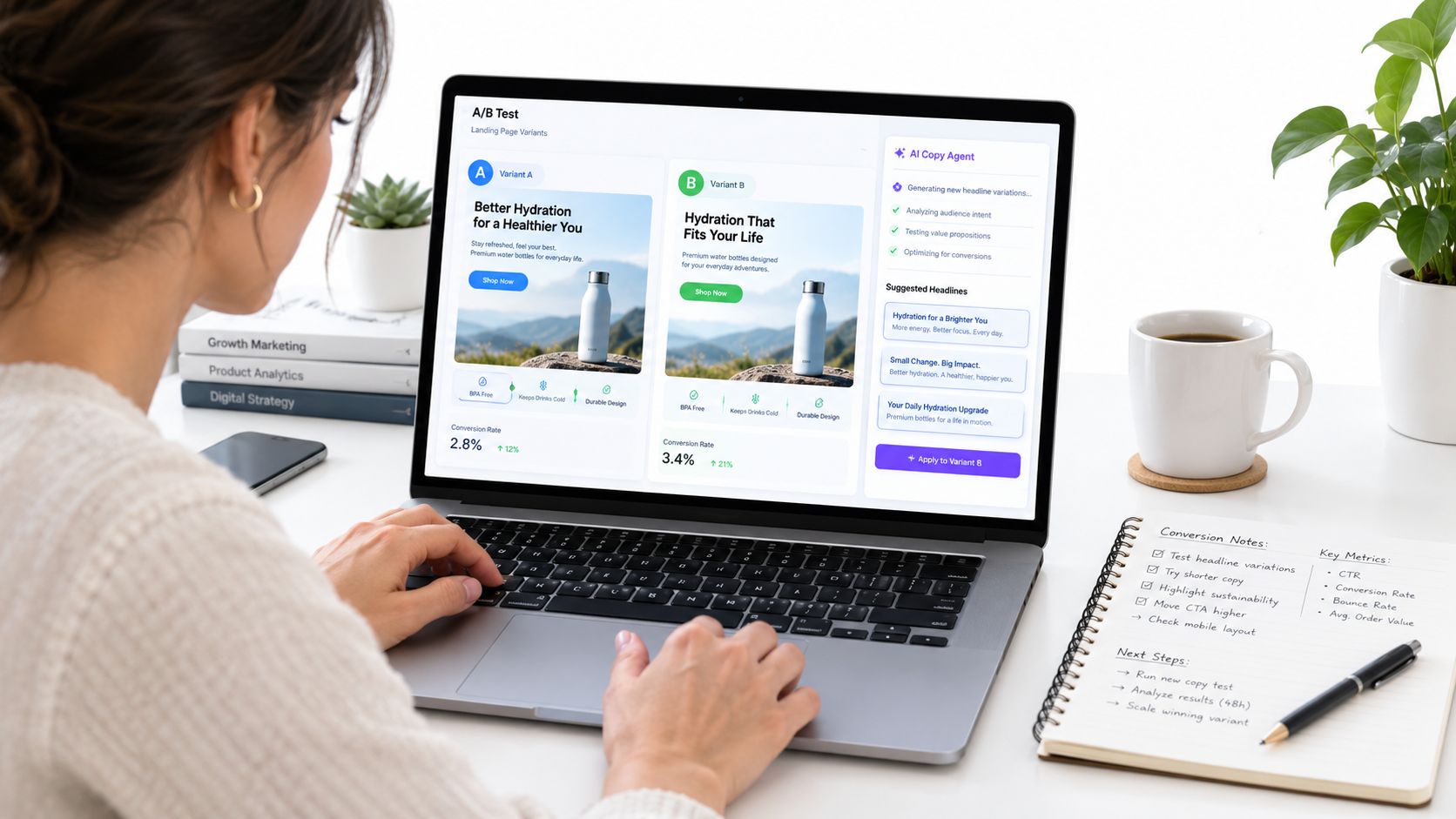
A practical setup starts with the current landing page. The growth lead pulls the existing hero headline, subhead, and primary CTA into the system, along with the brief for the page. The useful input isn't “make it better.” It's “new paid visitors don't understand the offer,” or “the current CTA asks for commitment too early.”
What the workflow looks like in practice
Instead of drafting one challenger by hand, the team generates a small set of copy variants tied to distinct hypotheses. One variant may sharpen the problem statement. Another may reframe the offer. Another may reduce perceived effort in the CTA.
That creates a better queue because each version maps to a reason, not just a different wording style.
Where AI helps and where it doesn't
The useful part of AI is throughput. It can produce alternate headlines, subheads, and CTA combinations quickly enough that the team can explore more message angles in less time. In that sense, a tool like Polish fits neatly into this workflow. It reads the landing page, generates new headline, subheading, and CTA variants, serves them to visitors, and measures which version converts better.
But the guardrails still matter:
- Brand voice settings: stop the model from drifting into generic SaaS language.
- Banned phrases: block claims legal or brand won't approve.
- Human review: no variant should go live uninspected.
- Hypothesis tagging: every variant needs a stated reason to exist.
Recent landing-page guidance also stresses that stronger experimentation comes from pre-set sample size, full business-cycle coverage, and post-launch validation, not from generating more variants faster. Teams should use automation to scale hypothesis generation and production, while keeping statistical rigor intact, as emphasized in Contentsquare's landing page testing guidance.
What happens after a winner appears
The system can flag an apparent winner. That doesn't make the test terminal.
A strong operating model asks a second question: what did the winning version reveal? Did users respond to clearer pain language? Lower commitment? Better proof sequencing? The follow-up test should isolate that lesson rather than produce another batch of random alternatives.
That's where AI becomes useful in a real CRO workflow. Not because it replaces judgment, but because it reduces the production burden between one clean hypothesis and the next.
Your Landing Page Split Test Checklist
The best checklist is short enough to live next to the launch ticket and strict enough to stop weak tests before they start.
Before launch
- Document the hypothesis: Name the page element, audience, expected behavior, and primary metric.
- Verify the baseline: Use a clean historical window, not a distorted campaign spike.
- Set the sample rule: Precompute the sample size and commit to it.
- Check tracking: Confirm the winner metric fires correctly on every variant.
- QA the page: Test links, layout, form behavior, and mobile rendering.
- Lock the decision rule: Decide in advance what counts as ship, iterate, reject, or redesign.
After the result
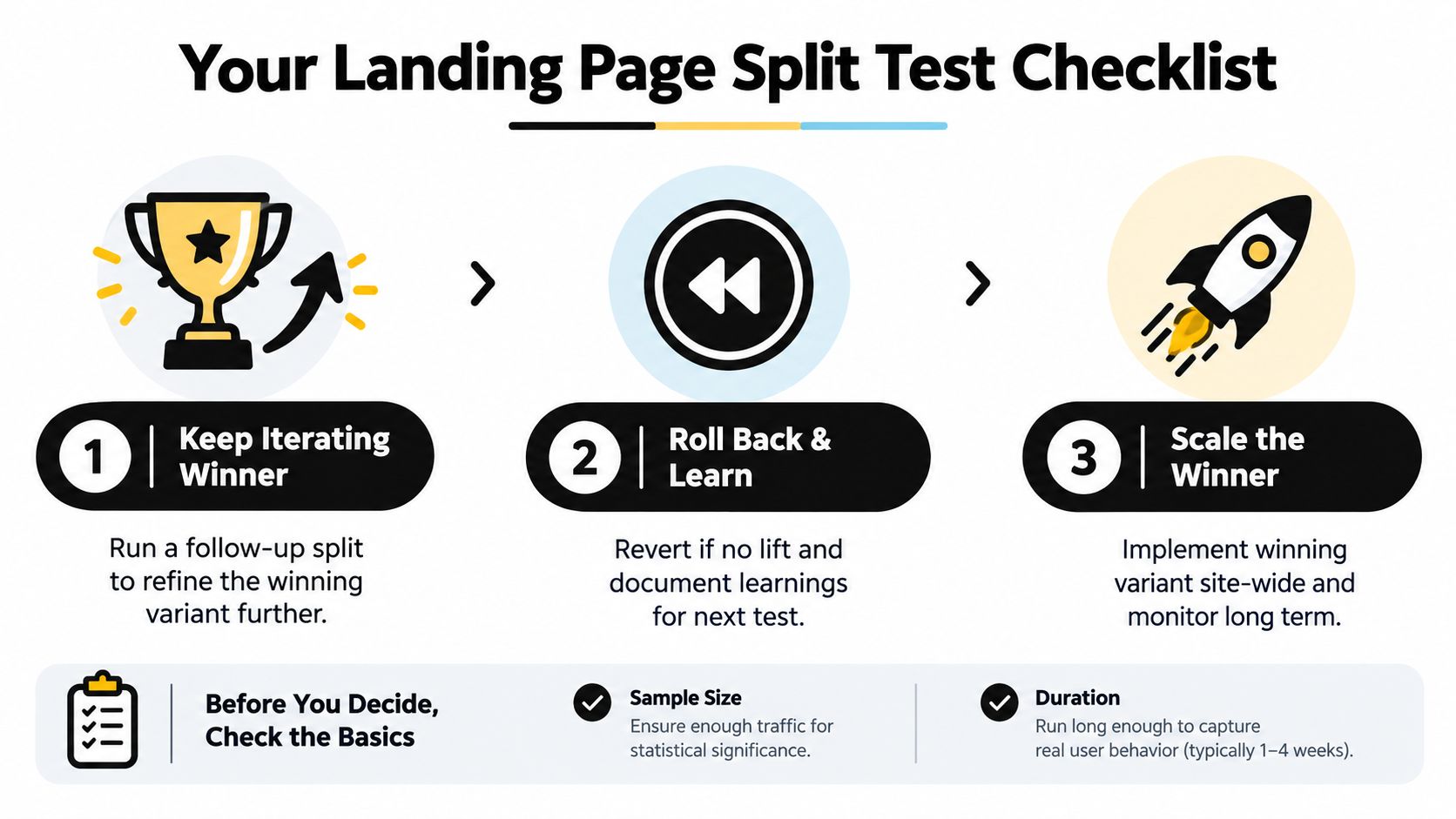
Use three branches.
- Keep iterating the winner: Do this when the result is trustworthy and the page still has obvious message or friction headroom.
- Redesign the page: Do this when the hypothesis was too local and the issue is structural, such as weak offer framing or poor page flow.
- Skip testing for now: Do this when the page lacks enough conversion volume to support a clean read, or when the current baseline is already healthy enough that minor experiments are lower priority than channel or offer work.
A realistic benchmark matters here. One 2026 industry analysis reported a median landing page conversion rate of about 6.6%, with median conversion uplift from winning tests at 1.88% and median revenue per visitor uplift at 2.77%. The same source also found that only 17% of marketers say they use landing page A/B tests, and fewer than 0.2% of websites experiment at all (Foundry CRO benchmarks). The message is simple. Testing can produce measurable gains, but most wins are modest, and still don't run the discipline well.
A good landing page split test program doesn't chase dramatic stories. It builds a habit of making fewer, better decisions.
If you want to operationalize this without turning every copy change into a design sprint, Polish is built for exactly that layer of the workflow. It reads your landing page, writes and serves headline, subheading, and CTA variants to real visitors, then keeps the winner so your team can focus on choosing better hypotheses and reading results.
- split testing
- A/B testing
- conversion rate
- landing page
- CRO
Your website rewrites itself until it converts.
Polish writes new versions of your headlines and CTAs, tests them on your real visitors and keeps the ones that win.
Start free