Examples of Type 1 and 2 Errors in Landing Page Tests
Real examples of type 1 and 2 errors in landing page testing, with plain-English explanations and fixes for false winners and missed wins.
Published on 12 min read

Table of contents
- 1. Type I Error from Calling a Headline Winner Too Early
- Separate monitoring from decision-making
- 2. Type II Error from Segment Traffic That's Too Small
- Design around the traffic you have
- 3. Type I Error from Multiple Comparisons and Segment Fishing
- Keep discovery separate from confirmation
- 4. Type I Error from Novelty and Primacy Effects in Returning Visitors
- Measure repeated exposure, not just launch response
- 5. Type II Error from Testing Personalization Without a Proper Holdout
- Compare policies on concurrent traffic
- 6. Type I and Type II Trade-offs When Setting Decision Thresholds
- Price the mistakes before choosing the rule
- How each error type shows up in landing page testing and how to guard against it
- Set Up Your Tests So Errors Stay Visible
- Write the decision before launching the page
You check your headline test every morning. The new version turns green early, the team celebrates, and you replace the old headline across the site. Later, conversions look much the same. You shipped a winner that was never real.
The dashboard wasn't necessarily broken. Your stopping rule may have turned a lucky run into a launch decision. Or your AI page builder may have found an apparent winner inside an audience too small to judge reliably.
The opposite mistake costs money too. You can reject a useful message because you split your traffic into tiny groups or let personalized copy leak into the control.
These are practical examples of type 1 and 2 errors: shipping an improvement that doesn't exist, or missing an improvement that does. In statistical terms, a Type I error is a false positive. A Type II error is a false negative.
Your job isn't to eliminate uncertainty. It's to make decisions with rules that keep uncertainty visible, especially when AI can generate new headlines, subheadings, and calls to action faster than your traffic can evaluate them.
1. Type I Error from Calling a Headline Winner Too Early
Your paid-search landing page has a clear control headline. An AI-generated challenger takes an early lead, so the campaign manager stops the experiment and sends everyone to it.
If the challenger has no real advantage, that decision is a Type I error. You've rejected the default assumption of no difference when it was true.

Separate monitoring from decision-making
Checking tracking daily is sensible. Repeatedly checking an ordinary fixed-sample significance test and stopping whenever it looks favorable isn't. That stopping rule creates extra opportunities to mistake random variation for evidence.
AI makes the temptation stronger. A highly relevant headline can sound right for a campaign before you have enough conversions to assess it. Once the system favors that headline, you may also collect less evidence about the alternatives.
- Set the finish line: Calculate the required sample before launch using your baseline conversion rate and smallest worthwhile lift.
- Choose the right method: Use a sequential testing method if the team needs valid early stopping. A live dashboard alone doesn't provide that protection.
- Keep operational checks separate: Monitor broken forms, missing events, and severe harm without treating every performance fluctuation as a winner.
Practical rule: A result becomes actionable when it meets the planned decision rule, not when someone first notices green.
A fixed review schedule helps team discipline, but it doesn't repair an invalid stopping rule. Match the analysis method to how you plan to stop.
For a promising AI-selected headline, use fresh randomized traffic for confirmation. Keep the copy fixed during that confirmation so you're evaluating a specific message, not a moving target.
2. Type II Error from Segment Traffic That's Too Small
A German mobile visitor arriving from LinkedIn may need a different message from a returning desktop visitor arriving through search. That doesn't mean you have enough traffic to test each audience independently.
Say your AI writes a stronger value proposition for German mobile visitors. It really helps, but the audience produces too few conversions for the experiment to distinguish the improvement from noise. You retire it as ineffective.
That's a Type II error if a real effect exists and your test fails to detect it.

Design around the traffic you have
Start with the improvement worth acting on. Use a minimum detectable effect calculation to check whether your available traffic can support that decision. Don't choose an implausibly large improvement just to make the required sample look manageable.
Personalization creates more possible audiences, not more evidence. Splitting by campaign, country, device, and visit history can leave each decision resting on very little information.
- Pool where appropriate: Use a shared model with audience features rather than isolated tests for every combination.
- Limit independent decisions: Reserve segment-specific rollout decisions for audiences with enough evidence.
- Show uncertainty: Report confidence intervals alongside the estimated lift, not just a pass-or-fail label.
A wide interval that includes both worthwhile benefit and meaningful harm means the result is inconclusive. It doesn't establish that the messages perform equally.
Keep a randomized comparison of the overall personalization policy against a static page. That lets you assess whether personalization helps the business while smaller audience-level estimates remain uncertain.
3. Type I Error from Multiple Comparisons and Segment Fishing
The overall test shows no clear improvement. Someone opens the audience filters and finds that the urgency headline performs well for returning mobile visitors from paid social.
That finding could be useful. It could also be the lucky result you'd expect to find after searching enough combinations.
With AI-generated copy, the search space grows quickly. You can compare headlines, subheadings, CTAs, and audience definitions until a dashboard produces something worth celebrating.
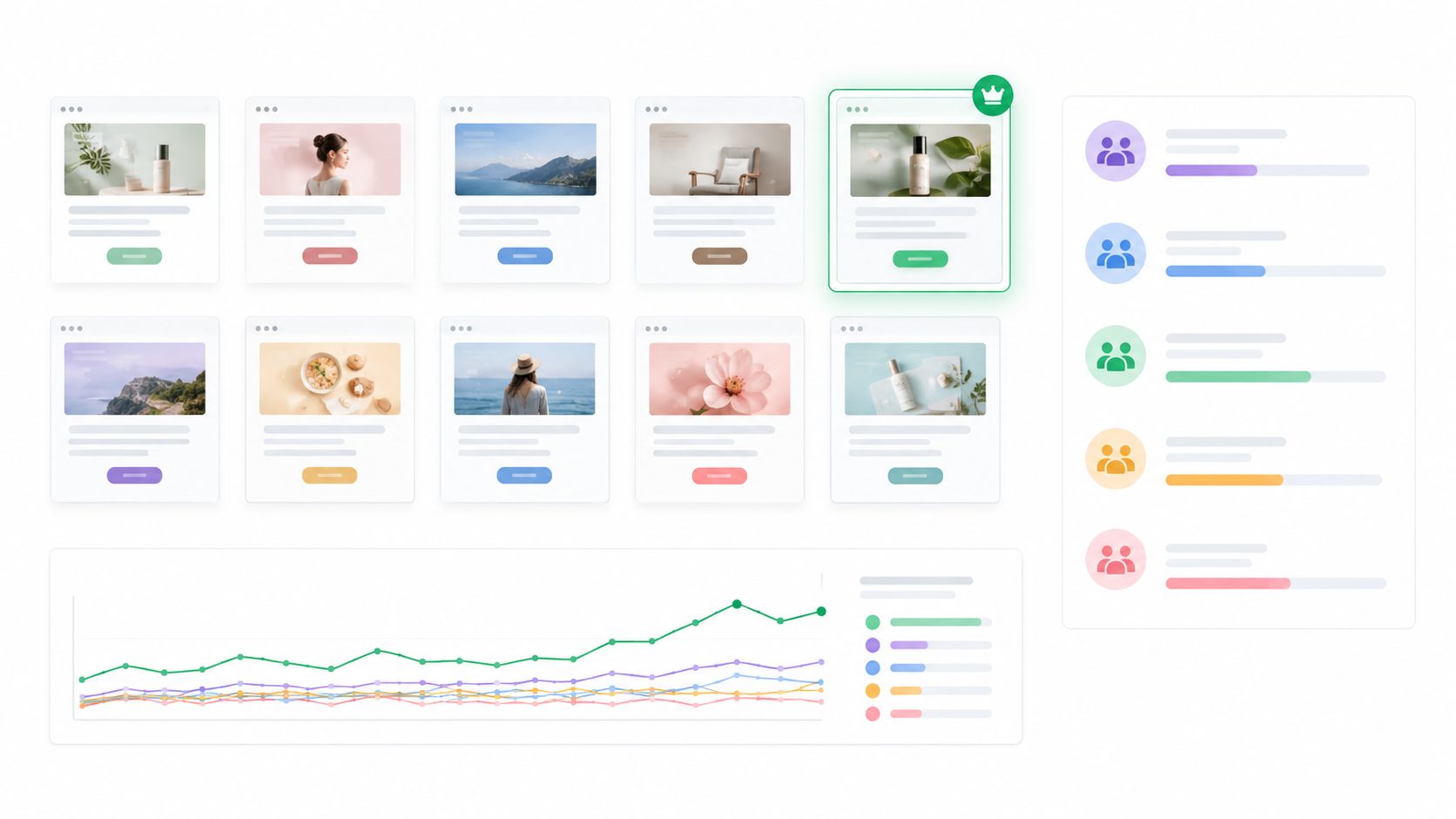
Finding an audience after inspecting the results is useful for generating a hypothesis. It isn't the same as confirming one.
Keep discovery separate from confirmation
Suppose a discount-led CTA appears strongest among returning visitors. Before making it permanent, state the audience rule precisely, freeze the copy, and test that claim on fresh traffic.
Your A/B/n testing plan should account for the comparisons you'll use to make decisions. Counting only the variants while ignoring audience searches leaves part of the problem untreated.
- Declare primary comparisons: Specify the main conversion metric and decision-driving audiences before launch.
- Adjust for the search: Use Holm correction for a defined family of confirmatory comparisons, or an appropriate false-discovery-rate procedure for exploratory screening.
- Test differences directly: A significant result in an audience and a nonsignificant result elsewhere don't, by themselves, prove that the audiences respond differently.
A model with treatment-by-segment interaction terms can help assess those differences without treating every slice as an unrelated experiment. It still needs sensible modeling assumptions and validation.
AI can help propose audiences worth investigating. Don't let it turn every discovered pattern into an automatic personalization rule.
4. Type I Error from Novelty and Primacy Effects in Returning Visitors
A returning visitor notices your new CTA because it looks unfamiliar. They click to investigate, and the test reports a promising lift. After repeated exposure, they stop noticing it.
If you ship the CTA expecting a lasting improvement, you've made the wrong business decision. There may have been a real short-term effect, but not the durable effect you intended to measure.
That distinction matters. Novelty isn't automatically a statistical Type I error; it becomes a false-positive claim when you infer lasting benefit that the evidence doesn't support.
Measure repeated exposure, not just launch response
Say an AI-personalized page replaces a familiar product explanation with a curiosity-led headline. Returning visitors initially explore it more, but they don't submit more qualified enquiries after becoming familiar with the message.
The reverse can happen too. Visitors may initially resist a clearer layout because they've learned where everything used to be. An early decline doesn't necessarily establish lasting harm.
- Keep assignment stable: Returning visitors should remain in their assigned experience rather than bounce between treatments.
- Inspect exposure patterns: Compare effects by visit number and elapsed time since first exposure.
- Use business outcomes: Check qualified enquiries or purchases, not merely clicks on the newly conspicuous button.
Watch the duration: If you want a durable improvement, your measurement window must include behavior after the first impression.
Don't impose the same runtime on an impulse purchase page and a considered B2B purchase. Allow enough time for the relevant return visits and conversion delay.
For AI-personalized pages, record which message visitors saw. If the system keeps changing the copy, you can't reliably separate response to novelty from response to a stable proposition.
5. Type II Error from Testing Personalization Without a Proper Holdout
A static control is a valid way to evaluate an AI personalization system. The problem starts when that control isn't fully protected from personalization, or when you replace concurrent randomization with a before-and-after comparison.
Say visitors assigned to your static page later return and receive AI-generated copy. Both groups now experience some personalization, so the measured difference can shrink. You may miss a real benefit.
Control contamination is a design bias, not itself a Type II error. But it can lead you to the same costly conclusion: rejecting a system that genuinely helps.
Compare policies on concurrent traffic
For inspiration, website personalization examples can help you identify useful message changes. To measure their value, compare an eligible visitor assigned to personalization with an eligible visitor assigned to a protected static experience during the same period.
Use visitor-level assignment and persist it with a first-party identifier. Where users authenticate, account-level assignment may better prevent people from crossing groups across devices.
- Protect the holdout: Exclude control visitors from personalized rendering and, where feasible, the engine's learning feedback.
- Choose a credible baseline: Compare against a maintained, competitive static page, not neglected copy.
- Check delivery: Log assignment, actual exposure, conversion events, and unexpected differences between assigned group sizes.
An adapting model doesn't automatically invalidate the experiment. You're measuring the policy of running that adapting system, provided randomization and outcome measurement remain sound.
The distinction is important: an engine-level result doesn't prove every generated headline works. Report the overall incremental effect, then investigate audience patterns with suitable uncertainty and multiple-comparison controls.
If exposure logs show that the groups mixed, fix delivery before extending the test. More traffic won't remove contamination bias.
6. Type I and Type II Trade-offs When Setting Decision Thresholds
A reversible CTA wording change and pricing-related copy shouldn't necessarily face the same rollout rule. The consequences differ, even if the dashboard presents identical significance labels.
Holding sample size and the true effect constant, a stricter significance threshold reduces false-positive risk but makes genuine improvements harder to detect. A looser threshold does the reverse.
The authors of Optimising the Trade-Off Between Type I and Type II Errors state that a typical two-sided clinical hypothesis test uses a 5% Type I error rate and designs for a Type II error rate of either 10% or 20%. Those clinical conventions aren't a ready-made decision policy for your landing page.
Price the mistakes before choosing the rule
Say an AI-generated CTA is easy to reverse and affects a limited campaign. You might permit controlled exploration while continuing to collect evidence.
Pricing-related copy deserves more caution. Misstating what a buyer receives can create complaints, refunds, and trust problems beyond the conversion metric.
- Estimate false-positive costs: Include exposure, lost revenue, implementation work, and customer consequences.
- Estimate false-negative costs: Consider the value of delaying or abandoning a worthwhile improvement.
- Separate exploration from rollout: Permission to gather evidence isn't permission to declare a permanent winner.
A cautious threshold isn't enough if your test is too small to detect an improvement worth having.
Use a larger sample, cleaner outcome measurement, or fewer competing variants when the decision needs stronger evidence. Don't loosen the threshold after seeing disappointing results.
Track reversals and inconclusive tests as diagnostic signals. A reversal doesn't prove the original decision was a Type I error because audiences, offers, and traffic can change. It does justify reviewing the original evidence and stopping rule.
How each error type shows up in landing page testing and how to guard against it
The six failure modes below account for most bad landing page decisions. Match the trigger you recognize to the safeguard that blocks it.
| Item | Error Type | Main Trigger | Primary Safeguard |
|---|---|---|---|
| Calling a Headline Winner Too Early | Type I: false positive | Repeatedly checking results and stopping when significance appears | Predefine the sample size or use valid sequential testing |
| Missing a Real Winner Because Segment Traffic Is Too Small | Type II: false negative | Underpowered segments with too little traffic | Run segment-level power analyses and ensure adequate sample sizes |
| Multiple Comparisons and Segment Fishing | Type I: false positive | Testing many variants or searching across segments | Predefine comparisons and apply multiple-testing corrections |
| Novelty and Primacy Effects in Returning Visitors | Type I: false positive | Short-term novelty or adjustment effects mistaken for lasting impact | Measure results over time and analyze new and returning visitors separately |
| Testing Personalization Without a Proper Holdout | Design bias that can lead to a Type II false negative | Contaminated control groups or a shifting baseline | Use a randomized, persistent holdout group |
| Decision Thresholds for AI-Generated Variants | Type I and Type II trade-off | Thresholds that do not reflect the costs of false positives and false negatives | Set and document thresholds based on business risk |
The holdout row works differently from the rest. Contaminated controls are a design flaw, not a statistical error in themselves, but they produce the same outcome as a false negative: a working personalization engine looks flat against a baseline it already leaked into. AI-personalized pages spread traffic across more audiences, which makes contamination easier and the persistent holdout more important.
Set Up Your Tests So Errors Stay Visible
A false winner looks like progress. A missed winner looks like a sensible decision to stop wasting time. Neither comes with a warning label, and an AI system can repeat either mistake across many audiences before anyone questions the setup.
Before your next test, pre-register the sample size and stopping rule, check each decision-driving segment's power, keep a persistent holdout, and review results on a fixed schedule. Match that schedule to your statistical method. Scheduled peeking with an unsuitable stopping rule is still peeking.
Write the decision before launching the page
Describe what you're testing in plain language. A fixed headline test asks whether that message improves an outcome. An engine-level test asks whether letting the personalization system choose messages improves that outcome compared with the static experience.
Those aren't interchangeable claims. If the engine wins, you haven't established that every headline or audience rule deserves permanent deployment.
- Define success: Choose a primary business outcome and the smallest improvement worth acting on.
- Define protection: Set guardrails for lead quality, purchase completion, refunds, or other relevant customer outcomes.
- Define uncertainty: Decide what you'll do when the interval still includes both meaningful benefit and harm.
When you analyze A/B testing results, start with experiment integrity before interpreting lift. Confirm that assignment worked, visitors saw the intended experience, and conversions had time to mature.
Then review the effect size, uncertainty, and cost of the available actions. A statistically detectable improvement can still be too small to justify operational work. An inconclusive result can still justify further testing when the potential benefit is valuable.
AI makes producing alternatives easier. It doesn't make evidence arrive faster. Give the system room to explore, but keep a protected comparison and a clear boundary between a promising idea and a result you're prepared to ship.
Polish is an autonomous AI agent that writes landing-page headlines, subheadings, and CTAs, then chooses versions using each visitor's context. If you're exploring personalized pages, visit Polish and pair your rollout with a protected holdout and clear decision rules so you can measure what the personalization adds.
- type 1 errors
- type 2 errors
- false positives
- false negatives
- A/B testing
Your website rewrites itself until it converts.
Polish writes new versions of your headlines and CTAs, tests them on your real visitors and keeps the ones that win.
Start free