VWO vs Optimizely: Choosing by Team Operating Model
Compare VWO and Optimizely to see which experimentation platform fits your team's workflow, feature requirements, and budget based on real contract medians.
Published on 13 min read
Table of contents
- VWO vs Optimizely at a Glance
- What Are VWO and Optimizely Built For?
- Marketing-led CRO versus engineering-led experimentation
- Is VWO or Optimizely better for marketing teams?
- Is Optimizely better for engineering-led experimentation?
- How Do Their Features Compare?
- Web experimentation and A/B testing
- Feature flags and server-side testing
- Heatmaps, recordings and behavior analytics
- Statistical approaches and reading results
- Governance, permissions and workflow
- How Much Do VWO and Optimizely Cost?
- Does VWO publish its prices?
- What the estimates and medians say
- What to ask for in a written quote
- Which Tool Is Easier to Use?
- Who builds and launches tests in each tool
- Trial the real workflow before signing
- Who Should Choose VWO
- Who Should Choose Optimizely
- Which One Should You Pick for Your Situation?
- A method for checking plan-level capabilities
- Worked example
- Decision table by team, budget and need
- Do You Need a Testing Platform or Automated Personalization?
- Your Next Steps for Choosing
Most teams settle the vwo vs optimizely question by lining up feature lists and picking the tool that looks bigger or cheaper. That falls short because both platforms run web experiments, and the real differences are who runs the tests, which modules a plan includes, and what the contract costs. Should you choose VWO or Optimizely? Which one fits your team and budget? And what does neither tool do for your signup goal?
The comparison pages we reviewed position VWO as a conversion-optimization platform for marketing and CRO teams, with some stressing heatmaps and recordings. They position Optimizely as an enterprise experimentation platform, strongest for engineering-led feature and server-side work. Pricing is the murkiest part: Optimizely is described as quote-based, and sources disagree about VWO. The short answer is to choose by operating model first (marketing-led or engineering-led), then confirm in writing that your must-have capabilities are in the specific plan you are quoted.
VWO vs Optimizely at a Glance
The table summarizes how comparison sources describe each platform. Treat it as a starting hypothesis to verify, not a spec sheet, because plan details vary and sources conflict.
| 📋 Criterion | 🧪 VWO | 🚀 Optimizely |
|---|---|---|
| What it does best | Conversion optimization and experimentation, with behavior analytics emphasized in some comparisons | Enterprise experimentation, including feature and server-side work |
| Who it suits | Marketing and CRO teams | Engineering-led teams and larger organizations |
| Testing types | Web experimentation; confirm server-side and feature flags per plan | Web, feature and server-side experimentation emphasized |
| Behavior analytics | Heatmaps and recordings highlighted by some sources | Less emphasized in the comparisons reviewed; verify what is included |
| Pricing model | Conflicting reports: estimates and starting prices on some pages, quote-only on others | Custom, quote-based |
| Set-up effort | Positioned for marketing-led workflows; confirm in a trial | Engineering involvement likely for feature and server-side work |
Pricing and plan details conflict across sources, so the cost section below separates estimates from contract medians. If neither tool matches your team, our guide to Optimizely alternatives covers other options.
What Are VWO and Optimizely Built For?
VWO is a conversion-optimization and experimentation platform that comparison sources most often position for marketing and CRO teams. Optimizely is an enterprise-oriented experimentation platform that sources position for engineering-led work, including feature and server-side experimentation. The split between them is the operating model: who designs, builds, launches and reads experiments.
Marketing-led CRO versus engineering-led experimentation
Feature count isn't what separates these tools. It's the operating model.
- Marketing-led CRO: A marketer or CRO specialist forms a hypothesis, changes a page, launches the test and reads the result. The tool must make that loop fast without a developer ticket.
- Engineering-led experimentation: Developers ship variations behind feature flags or on the server, and product teams measure impact across the product. The tool must fit code, release processes and review.
- Mixed models: Many teams do both. Decide which loop produces most of your tests, and weight the tool toward that one.
Raw Studio and Solid Growth both frame the choice around this fit. That is a stronger method than the usual "VWO for smaller budgets, Optimizely for enterprise" shortcut.
Is VWO or Optimizely better for marketing teams?
VWO is the better-positioned option for marketing teams in the sources reviewed. Comparisons describe VWO as a conversion-optimization platform for marketing and CRO work, and some highlight its heatmaps and recordings, which help marketers decide what to test. Optimizely can serve marketers, but sources emphasize its engineering-led depth.
Is Optimizely better for engineering-led experimentation?
Optimizely is the better-positioned option for engineering-led experimentation. Sources including Fibr and CustomFit describe it as enterprise-oriented and strong on feature and server-side experimentation. If developers own experiments and release flags, Optimizely's positioning matches that workflow.
How Do Their Features Compare?
Both platforms cover experimentation, but they emphasize different layers. The subsections below follow the dimensions comparison pages discuss most: web testing, flags and server-side testing, behavior analytics, statistics and governance. Where the sources do not give a dependable detail, the advice is to verify it, not to assume it.
Web experimentation and A/B testing
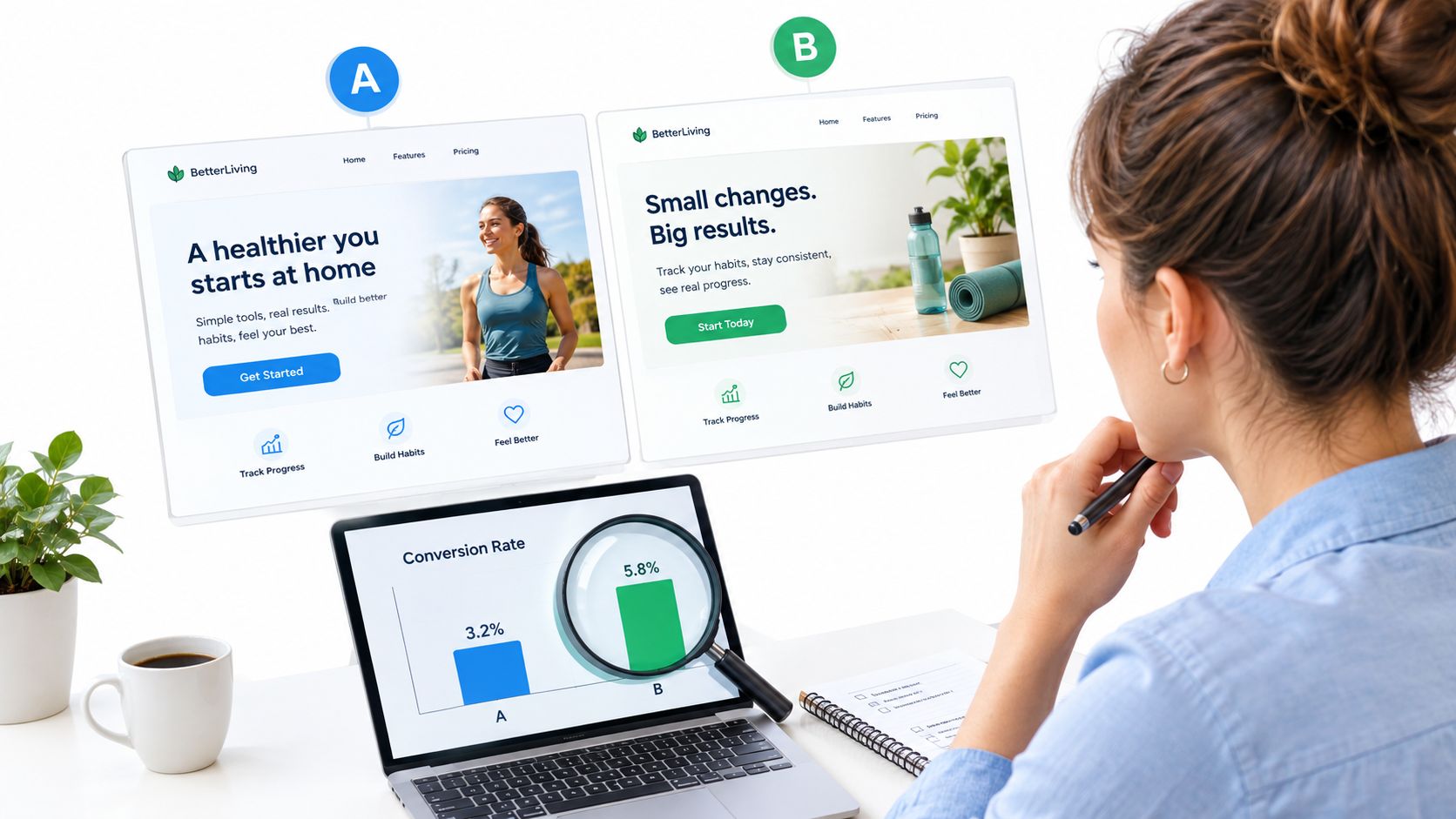
Web experimentation means changing what visitors see in the browser (headlines, layouts, calls to action) and measuring which version converts. Both tools are positioned for it. The difference is who does the work: VWO is framed around marketer-run tests, Optimizely around teams with developer support.
- Test types: Confirm whether A/B, split URL and multivariate tests are all included in your plan. Our explainer on A/B testing examples shows what typical tests look like.
- Editing method: Check whether you can build a variation visually or need code.
- Traffic needs: Any web test needs enough visitors to reach a readable result, whichever tool you choose.
Feature flags and server-side testing
Feature flags and server-side testing let developers run experiments in application code, not in the browser. Sources position Optimizely as the stronger fit here, and this is the clearest capability difference in the comparisons reviewed.
- If you need it: Ask each vendor whether flags and server-side testing are part of the quoted product or a separate module.
- If you don't: Do not pay for it. A marketing team testing signup pages rarely needs server-side depth.
- Check the SDKs: If you do need it, confirm your languages and frameworks are supported before you trial.
Heatmaps, recordings and behavior analytics
Behavior analytics shows how visitors interact with a page: where they click, how far they scroll, what session recordings reveal. Some sources emphasize heatmaps and recordings as part of VWO's appeal (Fibr is one). Comparisons give Optimizely's equivalent less attention.
- Why it matters: Analytics tells you what to test. Experiments tell you whether the change worked.
- What to verify: Confirm whether heatmaps and recordings are included in your plan or sold separately, and whether they have session limits.
- If missing: You will need a separate analytics tool, which adds cost and a second place to look.
Statistical approaches and reading results
Statistical approach determines when a result counts as trustworthy. Raw Studio and ABTestly both compare it, but the surfaced results do not give a dependable summary we can restate. Verify each vendor's method yourself.
- Ask for the method: Is it frequentist, sequential or Bayesian, and is it documented?
- Ask about peeking: Can your team check results mid-test without inflating false positives?
- Set the effect size first: Decide your minimum detectable effect before launching, so the tool's output is read against a plan.
- Check the reporting: Look for confidence intervals, segment views and exportable raw data.
Governance, permissions and workflow
Governance covers who can build, approve and launch tests, and how changes are recorded. Optimizely's enterprise positioning suggests more attention to this, and Raw Studio lists governance among its comparison criteria. Small teams may not need it. Larger teams with several contributors usually do.
- Roles: Check whether you can separate builders, reviewers and publishers.
- Review: See whether a test can require approval before going live.
- Audit trail: Confirm changes are logged and who can see the log.
- Plan level: Governance features are often tied to higher plans, so ask which one you need.
How Much Do VWO and Optimizely Cost?
Neither VWO nor Optimizely has a single verified list price in the sources reviewed. Optimizely is described as custom, quote-based. VWO pricing is reported inconsistently: some pages give estimates or starting prices, others say prices are not publicly listed. Any number below is an estimate or a contract median, not a price you can rely on.
Does VWO publish its prices?
Sources disagree on whether VWO publishes its prices. Pages from Brillmark, Fibr and CustomFit give estimates or starting prices. Roundups such as Intempt and Convert describe pricing as not publicly listed and available by quote. No source reviewed establishes a current official price or plan limit, so confirm on VWO's own site and in a written quote.
What the estimates and medians say
Two figures circulate, and they measure different things.
- Brillmark estimates: About $200–$400/month for a VWO Growth tier and $700–$1,200/month for a Pro tier, with estimated monthly tested-user allowances of 10,000–50,000 and 50,000–100,000, according to Brillmark. These are not verified official prices, and no underlying source or date is given.
- Vendr contract medians: $16,330/year for VWO and $81,447/year for Optimizely, according to ABTestly, which reports Vendr data updated in February 2026 from 102 VWO purchases and 126 Optimizely purchases. These are what buyers reportedly paid, not list prices.
Use them as reference points, never as budgets. The Optimizely median is roughly five times the VWO median, which fits the "enterprise versus marketing team" framing. But the VWO median sits above the annualized Pro estimate (about $14,400 a year at the top of Brillmark's range). That gap is why a written quote matters: add-ons, traffic volume and negotiation can all move the final figure, and the sources do not say which.
What to ask for in a written quote
- Users: The monthly tested-user or visitor allowance, and what happens when you exceed it.
- Tests: Any cap on concurrent experiments, or on the number of tests per plan.
- Modules: Whether web testing, feature flags, server-side testing and behavior analytics are included or priced separately.
- Support: What level of support and onboarding comes with the plan.
- Term: Contract length, renewal terms and price changes at renewal.
Practical rule: Treat every public price comparison as an estimate and make the vendor put your exact scope and price in writing.
Which Tool Is Easier to Use?
Neither source set shows a clear ease-of-use winner. Ease of use depends on who builds the tests. VWO is positioned for marketing-led workflows where non-developers launch experiments. Optimizely's feature and server-side strengths suggest developer involvement for much of its work, so marketers may depend on engineers more.
Who builds and launches tests in each tool
Ask a concrete question: who on your team will create the next five tests? If the answer is a marketer, test that person in the trial, not a developer. If the answer is an engineer, test the code path instead.
- Marketing-led: Can a marketer build a headline or call-to-action variation, preview it and launch it alone?
- Engineering-led: Can a developer wire up a flag, define the metric and ship the experiment through your normal release process?
- Handoffs: Count how many times a test waits on someone outside the owner's team.
Trial the real workflow before signing
The comparison sources recommend trialing the actual workflow with your team, including how tests are created, reviewed and analyzed. Use that as your trial checklist:
- Create: Build one real test from your backlog, such as a signup page headline, from hypothesis to variation.
- Review: Have a second person approve it. Note whether the tool supports that step or you do it outside the tool.
- Launch: Push it live on a small share of traffic and confirm tracking fires for your signup event.
- Analyze: Read the result as a teammate who did not build the test. Check whether the statistics are clear and exportable.
- Record: Write down every time someone needed help, and from whom.
Who Should Choose VWO
VWO fits a team where marketers or CRO specialists run most experiments and want testing and behavior analytics in one place.
- Team: A marketing-led or CRO-led team with limited developer time.
- Need: Web testing for pages and signup flows, plus heatmaps and recordings to find what to test.
- Budget: Smaller budgets, if the quoted scope fits. Estimates and medians point lower than Optimizely's, but confirm in writing.
- Verify: Whether server-side testing, flags or advanced governance are included, if you expect to need them later.
Who Should Choose Optimizely
Optimizely fits a team where engineers own experimentation, or where an enterprise needs feature and server-side depth and governance.
- Team: Engineering-led or product-led, with developers building and shipping experiments.
- Need: Feature flags, server-side testing, and workflow controls across several contributors.
- Budget: A larger, quote-based commitment. The reported median is about $81,447/year, according to ABTestly, as a reference point only.
- Verify: That the modules you want are in the quote, and that marketing users can work without constant developer help.
Which One Should You Pick for Your Situation?
Pick by operating model, then by plan scope, then by price. This ordering protects you from buying features your team will never use. The method below also guards against assuming a capability is bundled when it is not.
A method for checking plan-level capabilities
- List must-haves: Web testing, feature flags, server-side testing, behavior analytics and governance, each marked required or nice to have.
- Map to products: For each, ask the vendor which product and plan includes it.
- Get it in writing: Have the quote name every module and limit.
- Prove it in a trial: Use each must-have once on a real test.
- Compare totals: Add up the whole package for both tools, not the headline price.
Worked example
A seven-person SaaS team wants more signups. The marketing lead owns the website, and there is one part-time developer. Before, the team compared feature lists, assumed the more established tool covered everything, and planned to buy on reputation.
After applying the method, they first named their operating model: marketing-led, with the developer handling only tracking. They listed web testing and heatmaps as required, and server-side testing as unnecessary. They asked both vendors for written quotes naming each module, since several sources describe offerings priced as separate packages. They trialed one headline test on their signup page in each tool, with the marketing lead building it alone. The shortlist was set by who could launch and read that test without a developer ticket, not by feature count. The choice rested on workflow and written scope, not reputation.
Decision table by team, budget and need
| Situation | Lean toward | What to verify |
|---|---|---|
| Marketing-led, wants tests plus heatmaps | VWO | Which analytics and testing modules are in your plan |
| Engineering-led, needs flags and server-side testing | Optimizely | That those modules are quoted, and how marketers will use the tool |
| Smaller budget, web tests only | VWO | The written quote against the estimates and the Vendr median |
| Large organization, many contributors, governance needs | Optimizely | Roles, approvals and audit trail at your plan level |
| Mixed team, unclear needs | Trial both | Who builds, reviews and analyzes tests in each |
Do You Need a Testing Platform or Automated Personalization?
VWO and Optimizely are experimentation platforms: a team designs each test, builds the variations, runs them and analyzes the result. That is a different category from an AI agent that reads visit signals, rewrites headlines, copy and calls to action for each visitor, and tests variations on live traffic, keeping the versions that convert. The two are not substitutes for each other.
- You need a testing platform when: You have a test program, a backlog of hypotheses and people to design and read experiments. Our guide to A/B testing examples shows how that work looks in practice.
- You need automated copy personalization when: Page copy is your bottleneck for signups, and nobody has time to write, schedule and analyze variants for each audience. Read more on AI-powered personalization.
- You may need both when: Engineers run product and feature experiments while copy for each visitor is handled automatically.
A testing suite asks your team to supply the ideas and the analysis. Automated personalization shifts part of that work to an agent. Neither claims to replace the other, so decide which bottleneck you actually have. If you want to compare wider options, see our roundup of Optimizely competitors, or the Intempt and Convert lists.
Your Next Steps for Choosing
Run this sequence over a week or two. It turns a price-and-feature argument into an evidence-based decision.
- Name your operating model: Marketing-led, engineering-led or mixed. Write down who will build the next five tests.
- List must-have capabilities: Web testing, feature flags, server-side testing, behavior analytics, governance. Mark each required or optional.
- Request written quotes: Ask both vendors for users, test limits, modules, support and renewal terms in writing.
- Compare against reference points: Check the quotes against the Brillmark estimates and the Vendr medians, and question any large gap.
- Trial one real test in each tool: Create, review, launch and analyze it with the people who will do the work.
- Check the statistics: Confirm the method, how peeking is handled and whether results are exportable.
- Decide and document: Record why you chose, which modules you bought and what you will revisit at renewal.
The decision comes down to a chain of checks. Operating model tells you which tool is likely to fit. Feature comparisons tell you where each tool is strongest. Estimates and medians tell you the rough cost, and written quotes tell you the real one. A trial tells you whether your team can actually use the tool. And if copy is what limits your signups, a testing suite may not be the missing piece at all.
Polish is an AI agent for founders and website owners who want more signups: it reads visit signals to rewrite headlines, copy and calls to action for each visitor, and keeps testing variations on live traffic to retain the versions that convert. If copy for each visitor is the gap in your stack, Polish covers that part of the work alongside a testing platform.
- vwo vs optimizely
- ab testing
Your website rewrites itself until it converts.
Polish writes new versions of your headlines and CTAs, tests them on your real visitors and keeps the ones that win.
Start free