10 Optimizely Competitors Compared: Features and Pricing
Compare the top Optimizely Competitors with pricing ranges, key features, pros and cons, and migration tips for CRO and growth teams.
Published on 18 min read

Table of contents
- 1. VWO
- What VWO does well
- Pricing and technical effort
- 2. AB Tasty
- Why commerce teams shortlist it
- Pricing and technical effort
- 3. Kameleoon
- Where the AI helps
- Pricing and technical effort
- 4. Adobe Target
- Best fit for the Adobe stack
- Pricing and technical effort
- 5. SiteSpect
- Why technical teams choose it
- Pricing and technical effort
- 6. Dynamic Yield
- Personalization before experimentation
- Pricing and technical effort
- 7. Intellimize
- The useful difference
- Pricing and technical effort
- 8. Webtrends Optimize
- A clearer commercial model
- Pricing and technical effort
- 9. GrowthBook
- When ownership matters
- Pricing and technical effort
- 10. Polish
- What Polish automates
- Where it fits, and where it doesn't
- Optimizely Competitors: 10-Tool Feature Comparison
- Building a Shortlist You Can Test With
- Run a controlled pilot
Is a full enterprise experimentation suite still the right fit for your team's size, skills, traffic, and budget? That's the question behind most searches for Optimizely competitors. A renewal conversation may expose a pricing problem. An engineering team may need server-side control. A marketing team may want a visual editor without a long implementation queue. Or the gap may be narrower, such as testing landing-page copy by campaign, device, country, or visit history.
This shortlist organizes alternatives by buying context, not by a generic feature checklist. You'll find enterprise suites, engineering-led platforms, personalization-first tools, an open-core option, and a specialized landing-page copy platform. Each entry covers the practical feature set, pricing transparency, technical effort, best fit, and the limitation most likely to matter after purchase.
The market is broad because experimentation itself has become an operating discipline. A 2023 VWO experimentation report analyzed more than 1,000,000 concluded tests across approximately 100,000 websites during 2022. The right platform is therefore less about owning the longest feature list and more about helping your team run trustworthy decisions repeatedly. For a useful primer on split testing in a commerce context, see SMS recovery tests explained by CartBoss.
1. VWO
VWO is the closest all-rounder on this list for teams that want a familiar visual workflow without giving up deeper experimentation. Its visual web editor supports client-side tests, while code-based options extend into server-side testing, feature rollouts, and programmatic experimentation. That range makes it a practical candidate when marketers and developers need to work in the same system.
What VWO does well
The platform combines A/B/n and multivariate testing, personalization, feature flags, segmentation, integrations, and ROI reporting. A marketer can launch a straightforward page variation in the editor, while an engineering team can use more controlled delivery for product or application changes. That flexibility is useful when a testing program grows beyond landing-page tweaks.
VWO's strongest selling point is operational balance. The editor is approachable, documentation is established, and the platform can support both research-oriented CRO work and formal experimentation programs. Teams comparing workflow options should also review Polish versus Optimizely and VWO, especially if the main need is automated landing-page copy adaptation rather than a broad testing suite.
Practical rule: Choose VWO when you want one platform to serve visual-editor users and developers, but confirm which capabilities are included at your expected traffic and account volume.
Pricing and technical effort
Pricing is reasonably accessible at entry level, but higher-volume and enterprise pricing isn't fully transparent. Advanced modules, support, governance, and implementation can raise total cost of ownership beyond the initial quote. Technical effort is moderate. Simple visual tests are approachable, while server-side work, complex targeting, and application testing need engineering ownership.
VWO is a strong default for mixed teams, but it can feel oversized if you only need continuous headline and CTA optimization.
2. AB Tasty
AB Tasty fits marketing-led organizations that want experimentation and personalization under one commercial relationship. It supports web and feature experimentation, visual and code-based editing, predictive targeting, and reporting designed for teams that need to launch campaigns without putting every change into an engineering backlog.
Why commerce teams shortlist it
The platform is particularly relevant to retail and ecommerce teams. Its visual editor, templates, Shopify support, personalization capabilities, and EmotionsAI features help marketers connect testing with merchandising and campaign work. The platform can handle more than isolated A/B tests, including targeted experiences and feature management across web properties.
AB Tasty also puts real weight behind onboarding and customer success. That matters for teams that don't have an internal experimentation architect and want help with implementation, governance, and program design. Its Bayesian reporting can be useful, although non-analysts may need training to understand what the reporting does and doesn't establish.
For teams building a broader operating process, conversion rate optimization tools can provide useful context before choosing between a full suite and a narrower landing-page workflow.
Pricing and technical effort
AB Tasty uses quote-only pricing, so budget comparison takes more effort than with transparent self-serve tools. It can land in the mid-to-high range for smaller organizations, particularly when services and advanced capabilities are included. Technical effort is moderate for visual campaigns and higher for server-side testing, feature management, and complex integrations.
Choose AB Tasty when customer success and enterprise campaign support matter as much as raw testing depth. Don't choose it expecting a simple public price page or a purely developer-owned workflow.
3. Kameleoon
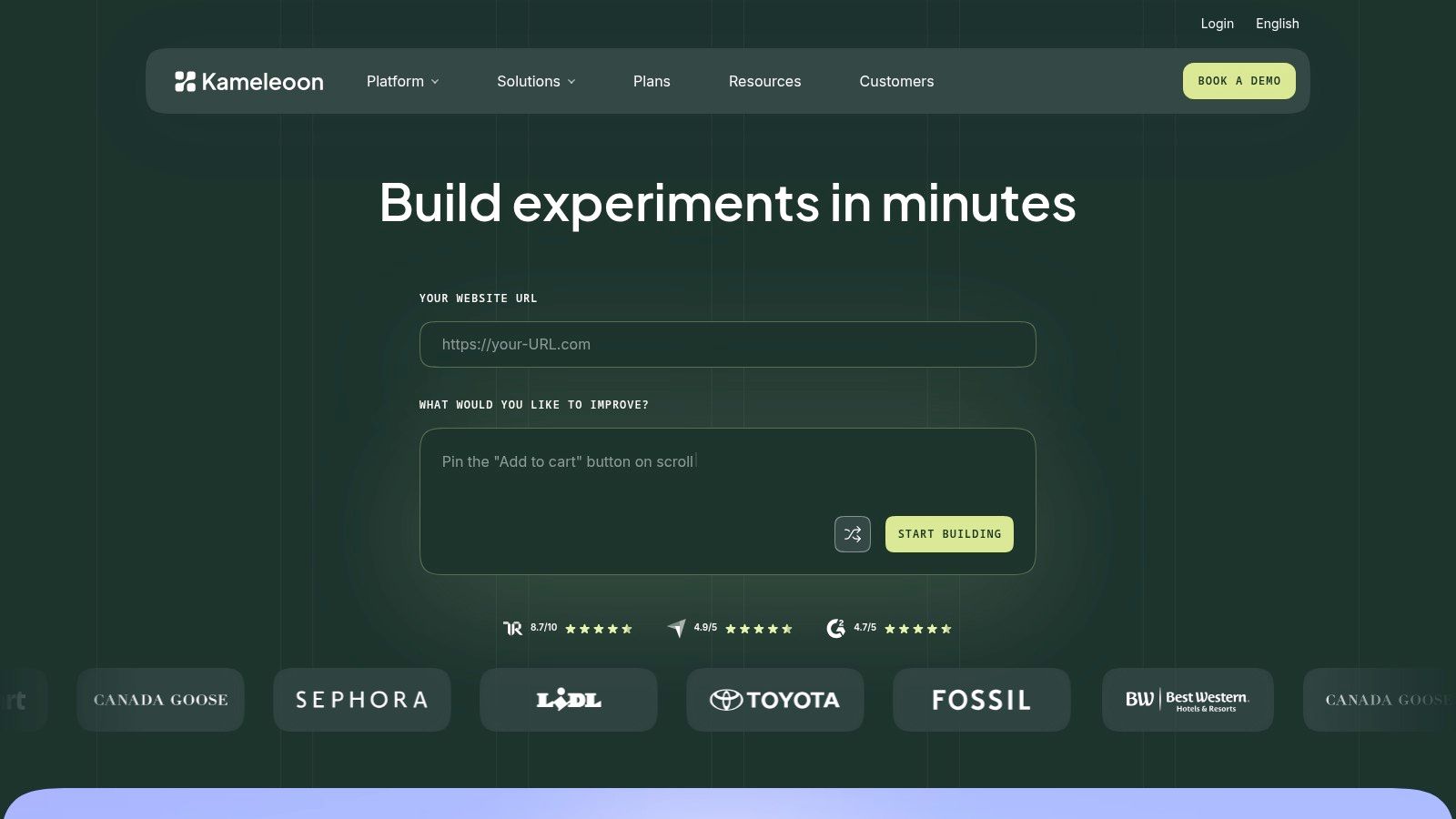
Kameleoon is a good fit for teams that need experimentation across websites, applications, and dynamic single-page experiences. Its offer combines client-side and server-side A/B and multivariate testing with personalization, feature experimentation, and AI-assisted workflows.
The practical distinction is delivery quality on modern sites. Kameleoon emphasizes SPA-friendly implementation and flicker control, which matters when a page renders dynamically or when a visible content swap could affect perceived quality. The platform also supports integrations with analytics and customer data platforms, allowing teams to connect experiment decisions to existing measurement systems.
Where the AI helps
Kameleoon's AI Copilot and prompt-based experimentation can reduce the time needed to turn an idea into a test. That's useful for marketers who know the hypothesis but don't want to write every variation or depend on a developer for the first draft. It doesn't eliminate review, QA, or measurement design. AI can accelerate production, but it can't rescue a weak success metric or a poorly defined audience.
Kameleoon is strongest when a mixed team wants marketer-friendly creation with a credible path to technical experimentation. Advanced setups still benefit from developers who understand routing, application states, analytics events, and release controls.
Pricing and technical effort
Pricing is sales-led and not transparent, and the investment can become significant as usage and complexity grow. Technical effort is moderate for standard web work and high for advanced server-side, application, and integration projects.
The trade-off is straightforward. Kameleoon offers a polished route into AI-assisted experimentation and dynamic delivery, but teams should budget for implementation expertise rather than treating it as a no-code product.
4. Adobe Target
Adobe Target makes the most sense when your company already operates inside Adobe Experience Cloud. The platform's value comes less from being an isolated A/B testing tool and more from its connections to Adobe Analytics, Adobe Real-Time CDP, enterprise permissions, and broader governance processes.
Best fit for the Adobe stack
Target supports visual and form-based activities, A/B and multivariate testing, rules-based targeting, automated targeting, and server-call-based measurement. Teams with complex properties can manage multiple deployments and apply enterprise administration standards that smaller tools may not match.
That depth comes with a cost in implementation. Adobe Target can be difficult to configure well, especially on single-page applications where page views, route changes, content delivery, and event tracking need careful coordination. The visual editor can help marketers, but it won't remove the need for technical architecture.
The platform is only as valuable as the Adobe data and governance around it. Buying Target without assigning ownership for implementation and measurement creates an expensive testing backlog.
Pricing and technical effort
Pricing is opaque and generally difficult for smaller teams to assess. Server calls, properties, support, implementation, and the rest of the Adobe stack can all affect the commercial picture. Technical effort is high, particularly when the organization wants reliable personalization across several properties.
Adobe Target is a rational choice for an Adobe-centered enterprise with existing specialists and governance. It's a poor fit for a small marketing team that mainly wants to test landing-page headlines quickly.
5. SiteSpect
SiteSpect belongs in the engineering-led category because its strongest use cases go beyond changing visible page elements. Its tagless, performance-focused approach supports origin experiments, redirects, API and content transformation, client-side editing, feature flags, and testing closer to the server.
Why technical teams choose it
SiteSpect is well suited to complex checkout, pricing, product logic, and application flows where browser-side manipulation may be fragile or too late. Origin-level experiments can reduce flicker and help teams test experiences before the browser paints the final page. Its SPA-oriented analytics and preview tooling also address problems that appear when conventional page-based tracking breaks down on dynamic applications.
This is not the easiest platform for a marketer who wants to open a visual editor and publish a campaign independently. The visual editor exists, but the full value comes from engineering involvement, integration planning, and careful QA across application states.
A strong implementation can make SiteSpect a better match than a marketer-first tool for tests that affect response content, routing, or core product behavior. A weak implementation will leave the organization paying enterprise pricing for capabilities it rarely uses.
Pricing and technical effort
SiteSpect has no public pricing and is primarily positioned for enterprise buyers. Technical effort is high. You'll need developers, analytics owners, and a release process that can handle server-side and origin-level variation safely.
Choose it when performance, flicker control, and product-level experimentation matter more than visual simplicity.
6. Dynamic Yield
Dynamic Yield, now part of Mastercard, is a personalization-first platform with experimentation inside a broader commerce optimization system. It fits organizations that need to recommend products, target audiences, and adapt experiences across channels, rather than manage isolated tests alone.
Personalization before experimentation
Dynamic Yield supports A/B testing, predictive targeting, commerce templates, widgets, banners, popups, email experiences, and AI-driven insights. Its operating model reduces the need to define every audience rule manually, while still leaving teams responsible for deciding which opportunities deserve investment.
That makes it a practical option for ecommerce and media organizations managing many product, content, and merchandising decisions. It can support goals related to website personalization examples and how personalization boosts average order value, though the right success metric depends on margin, retention, and customer quality.
The trade-off is complexity. New personalization teams may need time to learn the interface, and flexible targeting can produce overlapping experiences that are difficult to govern. Assign clear ownership for audiences, templates, business rules, and measurement before launching widely.
Dynamic Yield works best when personalization is the primary buying requirement. Teams seeking occasional page tests may find its broader system harder to justify.
Pricing and technical effort
Pricing is enterprise and traffic-based, with no simple public package for early budgeting. Technical effort is moderate for standard commerce integrations and higher when identity, catalogs, analytics, and multiple channels must connect.
Choose it when the business can support ongoing personalization operations and needs more than a lightweight experimentation tool. Expect coordination between marketing, engineering, analytics, and merchandising.
7. Intellimize
Intellimize is built around continuous conversion optimization rather than a sequence of manually configured experiments. It combines A/B/n and multivariate testing with automated personalization, selecting experiences for individual visitors based on audience and contextual signals.
The useful difference
The platform can help marketers move beyond one headline test at a time. It supports full-page personalization, audience targeting, dynamic bundles, product recommendations, and integrations with common analytics and marketing tools. Its Shopify app makes it relevant to ecommerce teams that want a faster path from campaign idea to personalized experience.
The main benefit is reduced orchestration work. Marketers don't need to manually create every audience-to-variant rule, monitor every possible combination, and repeatedly rebuild campaigns as traffic changes. That doesn't remove the need for clear conversion definitions, quality checks, or analysis of downstream outcomes.
Intellimize is most useful when the team has enough traffic and campaign variation to benefit from automated selection. If a site has limited activity or a small number of meaningful pages, a simpler test process may be easier to validate.
Pricing and technical effort
Pricing is not public and tends toward mid-market or enterprise packaging. Technical effort is moderate. Marketing teams can operate the workflow, but analytics support becomes valuable for advanced segmentation, ecommerce events, and interpreting personalized outcomes.
Choose Intellimize when automation and visitor-level experience selection are central. Choose another tool if your priority is self-hosting, public pricing, or deep developer control.

8. Webtrends Optimize
Webtrends Optimize is one of the more approachable options for smaller organizations that want broad functionality without feature paywalls across every plan. It supports A/B and multivariate testing, personalization, recommendations, social proof widgets, server-side experiments, and split-URL testing.
A clearer commercial model
Its main distinction is session-based licensing with more visible packaging. The platform also offers a free trial and a free plan for very small sites, giving teams a way to validate the workflow before negotiating an enterprise contract. That transparency makes it easier to compare against tools whose pricing only appears after a sales process.
Webtrends Optimize includes a widget library that can help teams launch common tests quickly. It's useful for marketers who need practical campaign and conversion work rather than a large product experimentation infrastructure. Support options and its European presence can also appeal to organizations that want closer regional coverage.
The limitation is ecosystem scale. Compared with Adobe, Optimizely, or larger global CRO platforms, Webtrends Optimize may offer fewer integrations, partners, and implementation resources. That may not matter for a focused website program, but it can matter when the tool must connect to a complex enterprise stack.
Pricing and technical effort
Pricing is more transparent than most enterprise alternatives, and technical effort is low to moderate for standard website work. Server-side testing and advanced integrations still need technical involvement.
It's a sensible shortlist candidate for SMB and mid-market teams that value predictable packaging over maximum ecosystem depth.
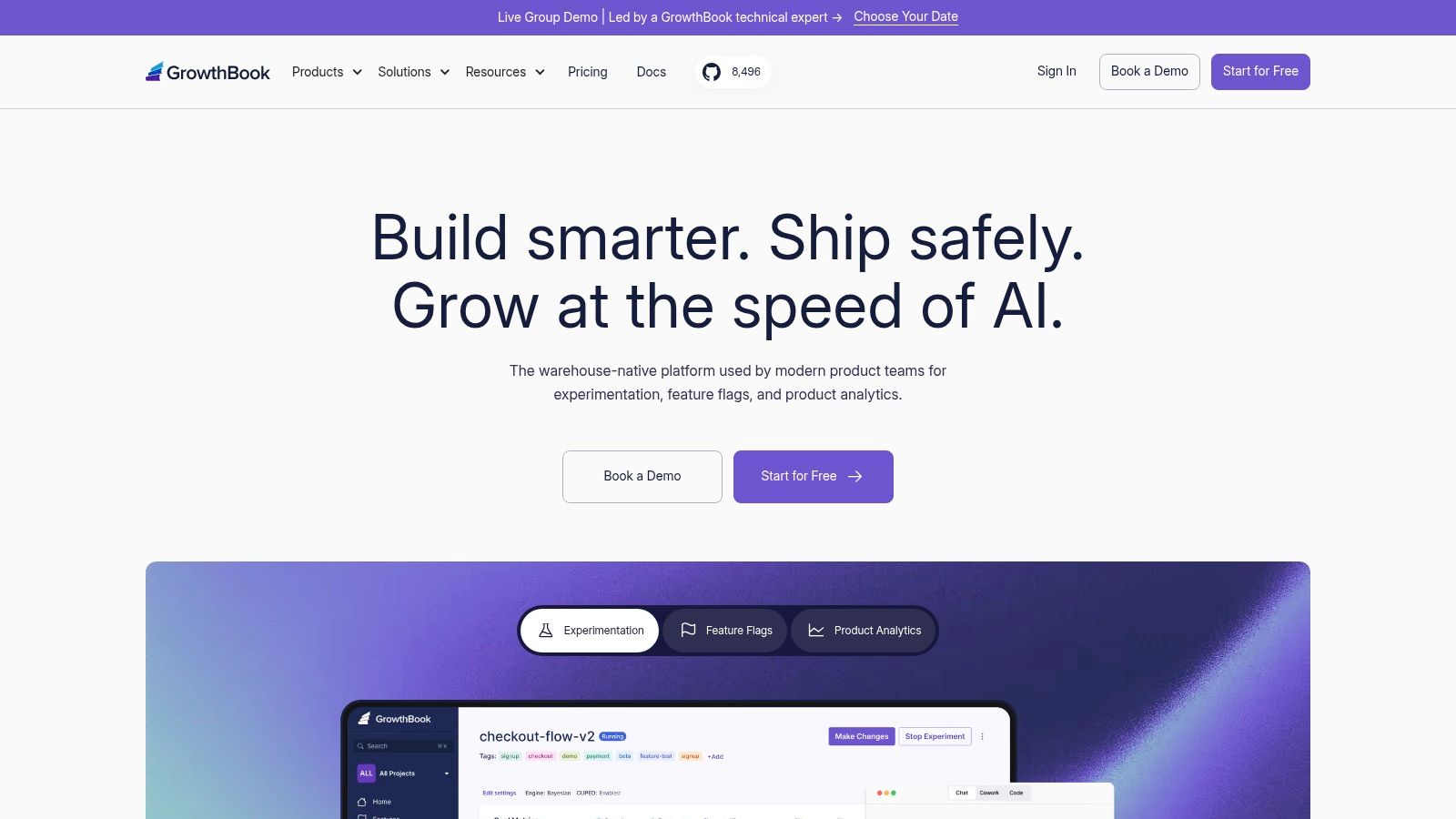
9. GrowthBook
GrowthBook is the clearest open-core choice for teams that want control over their data, deployment, and experimentation stack. It provides open-source SDKs, feature flags, gates, rollouts, and an experimentation engine that can work with existing analytics events and data warehouses.
When ownership matters
Self-hosting gives engineering and privacy teams more control over infrastructure and data flows. It can also reduce dependence on a vendor's visual workflow, proprietary data model, or reporting interface. The hosted cloud option offers a faster route to adoption for teams that don't want to operate every component themselves.
GrowthBook works best when developers and data engineers already own experimentation. They can connect feature delivery to application code, use warehouse events, and build a workflow that fits existing release and measurement practices. The downside is equally clear. Visual and no-code web editing is limited compared with VWO, AB Tasty, or other CRO suites.
A team may save on platform licensing and still spend heavily on implementation, maintenance, QA, analytics modeling, and internal support. Open source doesn't mean zero cost. It changes where the cost appears.
Pricing and technical effort
Pricing is the most flexible in this group because self-hosting and hosted options support different budgets. Technical effort is high for self-hosting and moderate for the managed cloud workflow, depending on the integration model.
Choose GrowthBook when data ownership and engineering extensibility outrank marketer convenience. Don't choose it for a visual, campaign-led program that has no developer capacity.
10. Polish
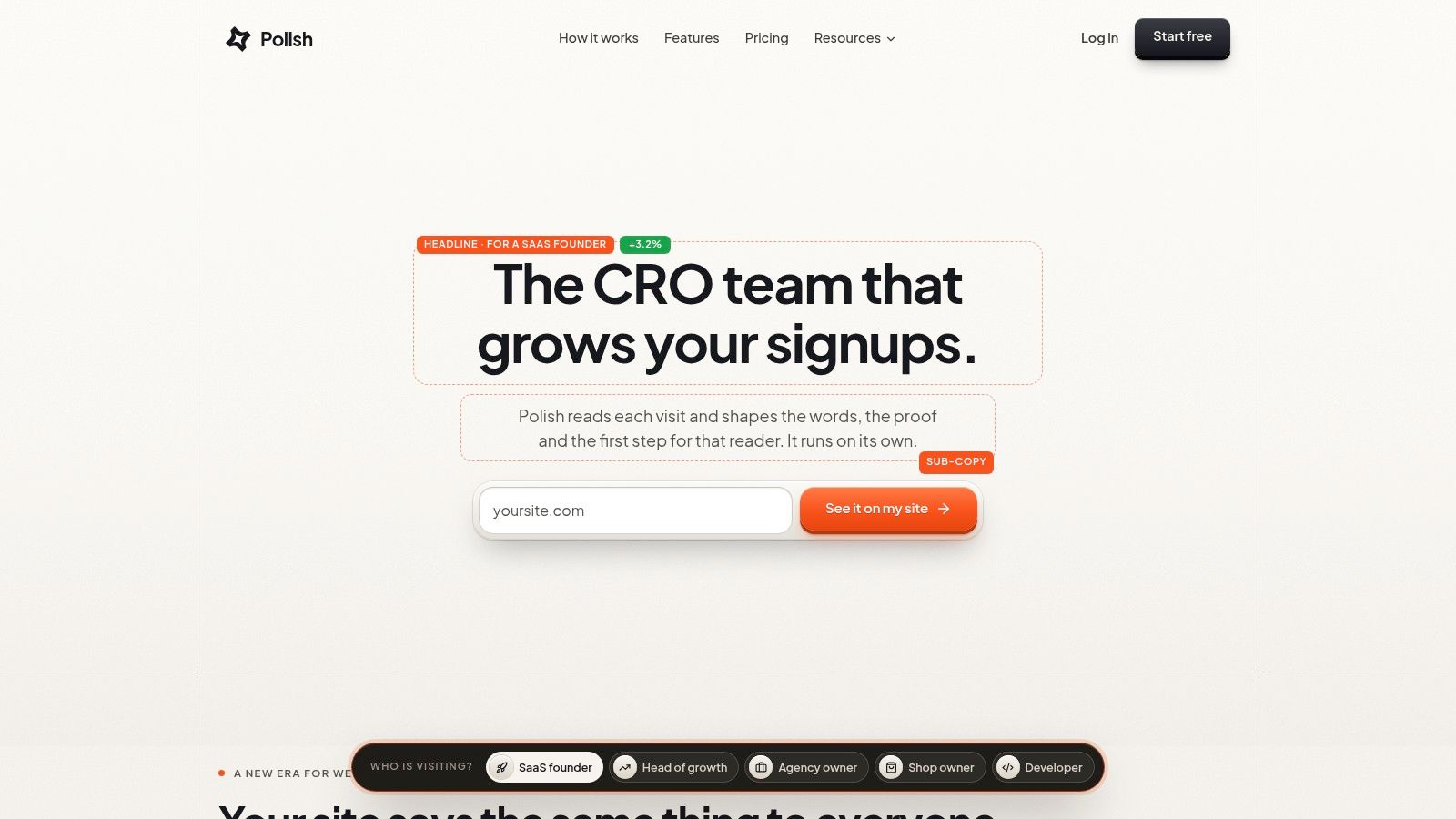
Polish is a specialized alternative for teams whose main problem is not feature rollout or enterprise governance. It focuses on landing-page copy optimization, using an autonomous agent to create and test personalized messaging for each visitor while preserving the existing page design and brand.
What Polish automates
After a small first-party pixel is installed, Polish reads visit context such as referral source, campaign, device, language, country, and whether someone is visiting for the first time or returning. It then writes headlines, subheadings, proof points, and CTAs in the brand's voice and serves the version that performs best for people with similar context.
The approach is different from a conventional A/B test backlog. Every real conversion feeds the system, so the team doesn't have to create a separate experiment for every campaign or audience. Polish positions the workflow as a living website that continuously adapts while keeping a human-readable feed of pages, results, and changes for review.
It works with Next.js, Webflow, Shopify, WordPress, and plain HTML. The installation is designed to be low friction, and the product emphasizes cookieless, first-party measurement rather than building invasive identity profiles. Conversion detection and attribution are intended to keep the workflow useful without requiring a large analytics implementation.
Where it fits, and where it doesn't
Polish offers one all-plan package with a three-day free trial followed by $99 per month, including unlimited pageviews, autonomous testing, AI-written copy, and a conversational CRO copilot, as described in the product brief. That makes pricing more transparent than most enterprise platforms, though the recurring cost still needs to make sense for a low-traffic or low-conversion site.
The current scope focuses on headlines, CTAs, copy order, and proof, rather than full layout redesigns or complex product-interface changes. A full experimentation suite remains the better fit for feature flags, server-side logic, multivariate product tests, and deep governance. Polish can stand alone for landing-page optimization or complement a broader platform by handling high-volume copy adaptation while the main suite manages product and funnel experiments.
Best use case: Use Polish when the opportunity is in the message, the page already has a sound design, and your team wants continuous visitor-context optimization without maintaining a manual test queue.
Optimizely Competitors: 10-Tool Feature Comparison
| Product | Core features ✨ | UX / Quality ★ | Price / Value 💰 | Target audience 👥 | Key differentiator ✨ |
|---|---|---|---|---|---|
| VWO (Wingify) | Visual editor, client/server A/B, feature flags, ROI dashboards | ★★★★☆ | 💰 Quote/enterprise | 👥 Growth & CRO teams, mid→enterprise | ✨ End-to-end experimentation + program tooling |
| AB Tasty | A/B/MVT, personalization, EmotionsAI, Shopify support | ★★★★☆ | 💰 Quote, mid/high | 👥 Retail/commerce & enterprise teams | ✨ Strong onboarding & commerce templates |
| Kameleoon | Client/server experiments, AI Copilot, SPA-friendly delivery | ★★★★☆ | 💰 Sales-led / enterprise | 👥 Marketers + engineering for dynamic sites | ✨ Prompt-based experiment creation; SPA perf |
| Adobe Target | A/B, MVT, automated targeting, enterprise governance | ★★★★☆ | 💰 High / opaque | 👥 Adobe-stack enterprises | ✨ Deep Adobe Analytics & Experience Cloud integration |
| SiteSpect | Tagless origin experiments, server/client testing, SPA analytics | ★★★★☆ | 💰 Enterprise / no public pricing | 👥 Engineering/product-led enterprises | ✨ Origin-level experiments; minimal flicker |
| Dynamic Yield (Mastercard) | Testing + predictive targeting, commerce templates, AI insights | ★★★★☆ | 💰 Enterprise, traffic-based | 👥 Ecommerce & media companies | ✨ Commerce playbooks + recommendation templates |
| Intellimize | AI-driven experience selection, A/B/n, ecommerce features | ★★★★☆ | 💰 Mid→enterprise (private) | 👥 Marketers focused on automation, ecommerce | ✨ Continuous Conversion, automated personalization |
| Webtrends Optimize | A/B/MVT, personalization, server-side, free tier (<10k) | ★★★★☆ | 💰 Transparent; free & session-based plans | 👥 SMBs & European customers | ✨ Simple packaging, generous free on-ramp |
| GrowthBook (open-core) | Open-source SDKs, feature flags, self-host option | ★★★★☆ | 💰 Cost-effective; self-host or hosted | 👥 Dev-led teams needing data ownership | ✨ Open-source + extensible enterprise add-ons |
| Polish 🏆 | Per-visitor copy + variant serving, cookieless pixel, works on any stack | ★★★★☆ | 💰 💰 $99/mo after 3-day trial (all-in) | 👥 Growth teams, SMBs, agencies wanting autonomous CRO | ✨ Autonomous per-visitor landing pages; continuous learning & human-readable activity feed 🏆 |
Building a Shortlist You Can Test With
Start with the team, not the vendor logo. If marketers need to launch visual tests independently, VWO, AB Tasty, Webtrends Optimize, and a specialized tool such as Polish deserve attention. If engineers own feature delivery and experimentation, SiteSpect and GrowthBook are more natural fits. Adobe Target belongs on the shortlist when Adobe Analytics and Experience Cloud already shape your data and governance. Dynamic Yield and Intellimize make more sense when personalization is the primary operating model.
Traffic and stack narrow the list further. Shopify teams may value AB Tasty, Dynamic Yield, Intellimize, or Webtrends Optimize. Custom applications should examine server-side delivery, SDK quality, flicker control, and feature-flag integration before they compare visual editors. Organizations with strict data ownership requirements should ask where events are stored, how consent affects measurement, and whether the reporting remains interpretable when visitors opt out.
The market evidence supports this architecture-first approach. Datanyze detects approximately 114,349 companies using A/B-testing technologies across 57 tracked vendors, with detected installation shares for Optimizely, Adobe Target, VWO, and Zoho PageSense varying substantially across the category Datanyze market-share data. Those figures describe detected installations, not revenue, active usage, or customer satisfaction. A recognizable vendor is not automatically the right operating model.
Classic testing also creates a capacity problem. The CXL analysis of 28,304 experiments found that 97.5% were A/B tests, with 2.45 variants per test on average, while personalization represented 0.57% of experiments CXL's experimentation analysis. The practical lesson is not that traditional A/B testing is wrong. It's that many teams still configure small, discrete tests manually, even when their commercial opportunity may depend on continuous adaptation.
Run a controlled pilot
Shortlist three or four vendors, then run a pilot on one high-value page. Pick one primary success metric, such as qualified form completion or completed purchase, and define the guardrails before launch. Don't let every vendor report a different success definition.
Check four things during the pilot:
- Flicker and page stability: Confirm that visitors don't see the original content flash before the assigned experience appears, especially on dynamic pages.
- Analytics continuity: Compare exposure, conversion, revenue, and downstream-quality events in the new platform and your existing analytics system.
- Test history: Export experiment names, audiences, variants, decisions, and raw or summarized results before the old contract ends.
- Goal continuity: Recreate conversion definitions and attribution rules, then document any differences in statistical methodology or reporting.
Privacy deserves a place in the pilot rather than a legal review at the end. Evidence from Ascend2's A/B testing research reports that nearly 8 in 10 marketers say GDPR and CCPA have affected their testing strategies, while 27% report significant adjustments. The same research also raises a practical concern: teams may collect more individual-level data than the experiment requires. Ask whether a platform can adapt by campaign, device, country, or returning status without demanding an invasive identity profile.
Migration needs its own plan. Freeze new launches early enough to finish active experiments, export test history, record audience definitions, remove obsolete variation code, and validate the new snippet against your consent and performance requirements. Test history won't automatically become comparable just because two platforms use the phrase “conversion rate.”
A landing-page copy tool can complement a full suite when the responsibilities are clear. Let the enterprise platform handle product releases, feature flags, server-side logic, and governance. Let Polish handle continuous headline, proof, and CTA adaptation on selected landing pages. If you're also evaluating the shift away from Google Optimize, Shopify CRO experts at ECORN explain Google Optimize alternatives in a broader migration context.
The best next step is not another vendor demo. Choose one important page, write down the success metric and guardrails, test the implementation with your analytics owner and developer, and compare the operational workload as carefully as the feature list.
Polish gives landing pages an autonomous copy-testing layer that adapts headlines, proof, and CTAs to visitor context without replacing your existing design or stack. If that's the gap behind your search for Optimizely competitors, visit Polish and test the workflow on one high-value page.
- Optimizely Competitors
- Optimizely Alternatives
- A/B Testing Tools
- CRO Software
- Feature Flags
Your website rewrites itself until it converts.
Polish writes new versions of your headlines and CTAs, tests them on your real visitors and keeps the ones that win.
Start free