Innovation in Customer Experience: What Works in 2026
Innovation in customer experience explained: personalization, AI agents and real-time testing, with evidence, risks and a first step for growth teams.
Published on 13 min read

Table of contents
- The CX Innovations Worth Tracking in 2026
- Five CX Innovations Compared
- Read Adoption as a Starting Point
- How Personalization Turns Visits Into Revenue
- Match the Message to the Visit
- Personalize the Answer, Not the Identity
- Real-Time Experimentation as the Engine
- Run the Test Before Declaring the Winner
- Reject Wins You Can't Explain
- Where AI Agents Help and Where Humans Must Stay
- AI Agent Task Risk and Handling
- Keep Accountability With People
- Judge the Outcome Beyond Deflection
- Protecting Trust While You Personalize
- Give Customers a Meaningful Choice
- Set Guardrails Before Scaling
- Choose Your First Test and Sequence the Rest
- Write a Decision Brief Before Building
- Expand in Order of Uncertainty
- Review Conversion and Perception Together
Twilio's 2025 global survey reports that 88% of consumers are more likely to buy when brands personalize engagement in real time. Treat that as stated purchase intent, not proof of incremental revenue. Personalization can improve relevance, yet opaque signals or a poorly matched message can make customers feel misunderstood.
For a CEO, fund innovation in customer experience only when it improves commercial results and customer perception. Measure conversion alongside how customers experience the interaction. Faster service, more message variants and lower support costs matter, but they do not prove customers received a better experience. Judge each test on both outcomes before expanding it.
The CX Innovations Worth Tracking in 2026
90% of companies offered some real-time personalization, yet it covered an average of only 44% of customer engagement. That gap, reported in Twilio's personalization findings, is separate from the finding that only 44% of brands reported delivering real-time personalization. The figures measure different things: company adoption and the share of engagement covered are not the same as brand delivery.
In 2026, CX innovation means changing a message, channel or decision to address a customer's need at a commercially important moment. Evaluate every change on two measures: does it improve conversion, and does the customer experience feel more useful and trustworthy? A new tool is not a result.
Five CX Innovations Compared
The comparison moves from established personalization evidence toward less-proven claims about customer outcomes. It is not a formal ranking. Experimentation measures performance, while consent-aware design should safeguard every approach.
| Innovation | What It Changes | Evidence | Main Risk | Good First Test |
|---|---|---|---|---|
| Personalization | Tailors messages to traffic source, device and country | Evidence supports testing commercial impact, with revenue findings discussed below | Opaque signals can feel intrusive | Test headline and CTA variants by traffic source |
| Real-time personalization | Adjusts the experience during the interaction | Twilio's findings show that adoption does not guarantee broad execution | Teams mistake having the capability for delivering relevance | Adapt an offer for returning visitors |
| AI agents | Answer questions and handle routine service tasks | Digital-channel preference supports testing, not an assumption of AI acceptance | Customers can get trapped during sensitive tasks | Start with order-status questions |
| Closed-loop experimentation | Compares alternatives against an unchanged experience | Measures whether a change produces incremental improvement | Teams optimize clicks instead of qualified conversions | Keep a control group on a commercially important page |
| Consent-aware personalization | Limits adaptation to permitted signals and preserves user control | Trust concerns make safeguards part of the decision | Less available data can constrain targeting | Test a short explanation beside adapted content |
Twilio also found that businesses rated their real-time personalization efforts 4.1 out of 5, while only 16% of customers called the experience excellent. Those figures point to a perception gap, not proof that personalization improves revenue. Treat revenue impact as a hypothesis to test, rather than a claim established by this comparison.
Read Adoption as a Starting Point
Digital access matters: 73% of consumers preferred digital customer-service channels over phone support, according to Verint's survey of 5,000 U.S. consumers. That preference supports testing digital service, but it does not establish acceptance of autonomous agents. Customers may choose messaging, self-service or a web interface and still expect a person to resolve a difficult issue.
Start with the innovation tied to your largest conversion gap. If visitors do not understand the offer, test whether more relevant messaging helps. If customers cannot get an order update, improve access to that information. Judge the result by conversion and customer perception, then fund what works. An agent will not fix a messaging problem.
How Personalization Turns Visits Into Revenue
A good shop assistant remembers your last visit and answers the question you came in with. A generic sign pinned to the wall gives everyone the same message. Useful personalization should resemble the assistant's attention, not an announcement of everything the business knows about you.
Customers already expect recognition. McKinsey's 2021 personalization research found that 71% expected personalized interactions, while 76% became frustrated when those expectations weren't met. The same research reported a typical 10%–15% revenue lift, with company and sector outcomes ranging from 5% to 25%, and found that the strongest performers generated 40% more revenue from personalization activities than average performers.
Those findings justify investment, but they don't establish what your next landing-page change will earn. The executive decision is to test whether a specific adaptation removes a specific obstacle to purchase.
Match the Message to the Visit
Start with behavior and context rather than broad demographic labels. Acquisition source, device, location, browsing behavior and previous interactions can help a team form a useful hypothesis about the visitor's immediate need.
Consider a hypothetical software landing page. A visitor clicks an advertisement about simplifying campaign reporting, but the destination opens with a broad statement about business growth. The visitor now has to work out whether the advertised promise still applies.
A better test would connect the page elements:
- Headline: Continue the reporting promise that attracted the visitor.
- Subheading: Explain what the visitor can do and what the product really provides.
- Call to action: Offer an appropriate next step, such as “See how it works” for someone exploring or “Pick up where you left off” for someone returning.
The hypothesis isn't that customized words are persuasive by nature. It's that continuity reduces the work required to understand the offer. Keep the product, pricing and eligibility rules accurate across every version.
Personalize the Answer, Not the Identity
Use website personalization examples to identify possible message changes, then write down why each change should help the visitor. Reject variants whose only purpose is to demonstrate that you recognize someone.
Practical rule: If your team can't explain the customer benefit of a personalized element, don't ship it.
Keep the initial change narrow enough to interpret. A page with a different headline, navigation, offer and checkout path may perform differently, but your team will struggle to know which change mattered.
My recommendation is to personalize the promise before redesigning the journey. Revenue lift varies by sector and implementation, and the historical range isn't a guarantee. Your own controlled result should determine what you scale.
Real-Time Experimentation as the Engine
A restaurant tests a new menu by serving some guests the old one, rather than judging the new dishes by their appearance. Growth teams should apply the same discipline to personalized experiences. A compelling variant is a hypothesis until customers respond to it.
Use a controlled learning loop, not a growing collection of audience rules. Otherwise, your team can keep adding variants without establishing whether any of them improve the business.
Run the Test Before Declaring the Winner
The process below connects the experience change to a decision your team can defend.
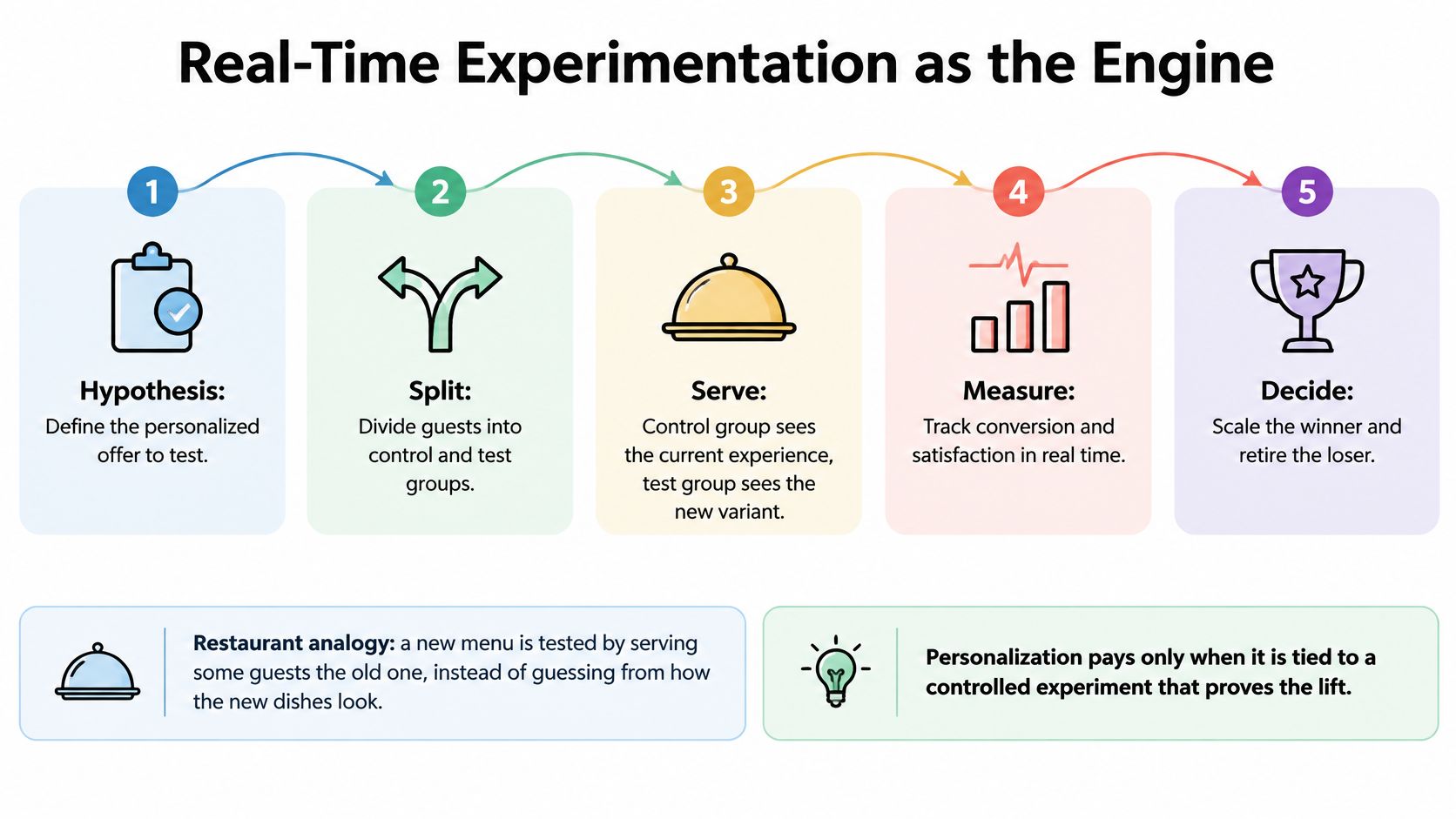
- Define the conversion event. Choose a qualified sign-up, purchase or revenue per visitor. Specify what qualifies before launching, so a larger volume of weak leads can't masquerade as progress.
- Expose visitors to an alternative. Change the headline, subheading or CTA around a clear customer need. Record the hypothesis and the signals used to select the experience.
- Retain a control group. Keep an unchanged experience running alongside the alternative. That comparison helps your team distinguish a page improvement from changes affecting all visitors.
- Measure incremental lift. Compare the chosen business outcome, not just activity on the page. Add a customer-perception check so an aggressive message doesn't win solely by pushing people forward.
- Update targeting only when the result holds. Review major segments before promotion. If the overall result hides a poor experience for a meaningful group, investigate rather than automatically expanding the rollout.
McKinsey's guidance on personalization measurement recommends watching upstream signals such as clicks and opens, alongside downstream measures including conversions, unsubscribes and return on investment. Use the former to diagnose behavior and the latter to judge commercial value.
Reject Wins You Can't Explain
Watch for a novelty effect. A conspicuous new message may attract attention without sustaining useful behavior, so don't assume the first favorable reading will persist.
Also watch for a traffic-mix change. If a higher-intent campaign contributes more visitors during the test, an apparent improvement may reflect who arrived rather than what they saw.
Adaptive allocation adds another decision. A multi-armed bandit approach is worth evaluating when your team wants to adjust exposure as evidence accumulates, but adaptive delivery doesn't remove the need for a credible comparison or clear success criteria.
A variant that earns more clicks but fewer qualified customers hasn't won.
My recommendation is to make the control group a release requirement. Real-time delivery can change quickly, but your decision to scale should wait for evidence that the improvement is commercially useful and acceptable to customers.
Where AI Agents Help and Where Humans Must Stay
82% of business leaders believed they understood their customers well, but only 45% of consumers agreed, according to Twilio's 2025 customer-engagement study. That gap should make executives cautious about judging an agent by internal demonstrations. A fluent answer isn't evidence that the customer's problem was resolved.
My recommendation is to automate the lookup and escalate the decision. Let software retrieve information and explain routine steps. Keep people readily available when the customer needs judgment, reassurance or an exception.
AI Agent Task Risk and Handling
The table is a deployment recommendation, not a claim that consumers have validated every use case. Without directly linked task-specific evidence, don't assign numerical comfort scores or assume willingness transfers from one task to another.
| Task | Consumer Comfort With AI | Recommended Handling |
|---|---|---|
| Delivery tracking | Validate acceptance in your own service flow | Automate routine status retrieval, with a clear route to a person |
| Payments | Don't infer comfort from low-risk tasks | Automate account lookup, escalate decisions and exceptions |
| Product questions | No task-specific comfort figure established here | Automate documented answers, with an easy human handoff |
| Complaints | No task-specific comfort figure established here | Route to a person early |
| Service recovery after a failure | No task-specific comfort figure established here | Keep a human in charge, with AI supplying case history |
For delivery tracking, the agent should retrieve the actual status and explain it plainly. If the order is missing, the status conflicts with the customer's account, or the customer disputes delivery, the interaction has moved beyond a routine lookup.
Product questions need similar boundaries. An agent can answer from approved documentation, but it shouldn't improvise contractual commitments, eligibility rules or unsupported product capabilities.
Keep Accountability With People
Payments involve consequences that a simple information request doesn't. An agent might explain an invoice or retrieve a transaction record, while a person handles disputed charges, unusual requests and decisions outside approved rules.
Complaints and service recovery deserve early human involvement. My judgment is that these are poor places to make customers prove that automation has failed before they can reach someone accountable. A customer reporting a broken promise needs a resolution path, not repeated variations of the same answer.
For teams designing those boundaries, SupportGPT's guide to AI human collaboration is a useful resource to consider alongside your own escalation policy. Document the handoff conditions, then test whether customers can easily use them.
A workable handoff should preserve context. The person taking over should receive the customer's stated problem, the information already checked and any action the agent attempted, without treating the AI summary as unquestionable.
Judge the Outcome Beyond Deflection
Measure resolution quality, repeat purchase and customer-perceived usefulness, not only automation rate or cost saved. Ask whether the customer accomplished the task, whether they had to contact you again, and whether the answer was accurate.
An internal efficiency gain can be valuable without being a CX improvement. Report those outcomes separately. If the agent reduces handling work but customers describe the service as less helpful, call it an efficiency result with an unresolved customer cost.
Protecting Trust While You Personalize
Personalization can lift conversions and still weaken customer trust. Verizon's 2025 CX research found that 30% of consumers said personalization had worsened their experience over the prior two years, while 26% said it had improved it. 54% reported that their trust in companies' handling of personal data had declined. The report also found that privacy rules limited AI-driven personalization for 65% of executives surveyed across seven countries.
Those findings do not identify which personalization choices caused distrust. They do show why teams should judge each change by both conversion and customer perception, rather than assume more targeting is better.
Consider a banner that says, “Welcome back from Leeds.” A visitor might value the recognition, or wonder why their location is being shown. A plain headline focused on their task may convert just as well without making the signal behind the message feel intrusive.
Give Customers a Meaningful Choice
Nielsen Norman Group distinguishes personalization from customization: personalization predicts what a user may need, while customization lets the user choose. Its usability research produced 46 design guidelines after testing seven websites. That distinction should shape the experience: a prediction is not a substitute for customer control.
Build control into the experience, rather than treating it as a compliance detail to add later. Let visitors understand why content changed and return to a standard experience. Measure whether those controls affect conversion as well as whether customers find the adaptation acceptable.
Set Guardrails Before Scaling
Use this checklist to keep personalization useful and accountable:
- Choose observable signals. Start with campaign, referrer, device, country or returning status, when their use is permitted. Do not infer personal traits that those signals cannot support.
- Set an evidence threshold. Agree with your analytics lead on traffic and uncertainty requirements before promoting a variant.
- Inspect meaningful segments. Compare responses from new and returning visitors instead of relying only on the combined result.
- Monitor adverse outcomes. Track bounce, unsubscribe and complaint rates where they fit the journey.
- Preserve a holdout. Keep a stable comparison available as targeting changes.
- Provide fallback content. Show a clear standard message when confidence is low or permitted signals are unavailable.
- Explain and allow refusal. Test a visible “why you see this” note and an accessible off switch.
A data-driven personalisation approach should make each decision auditable. Record the signal that triggered a change, the expected benefit and the result. A conversion gain with an unresolved trust penalty is not ready for unrestricted rollout.
The available findings do not establish a universal way to weigh trust against conversion. Test which signals customers accept, whether an explanation helps, and when a less personalized experience performs better. Use those results to set deployment limits, rather than treating AI efficiency or conversion lift alone as proof of a better customer experience.
Choose Your First Test and Sequence the Rest
Test the page that earns the most revenue, not the page that's easiest to change. The purpose is to resolve an important commercial uncertainty. A convenient experiment on an inconsequential page can keep a team busy without informing an investment decision.
Choose a page where you can identify a specific mismatch between visitor intent and the experience. Confirm that it has enough eligible traffic for a useful comparison and that the team can measure the downstream outcome.
Write a Decision Brief Before Building
Keep the brief short enough that the growth lead, analyst and customer-experience owner can agree on it together. It should make the decision explicit before anyone starts generating copy.
| Decision | What to Write Down |
|---|---|
| Customer problem | The question or obstacle the current page fails to address |
| Primary outcome | A qualified conversion metric tied to business value |
| Downstream check | A relevant measure such as refunds, unsubscribes or customer-rated clarity |
| Permitted context | The visitor signal you'll use and why it's appropriate |
| Release condition | The evidence required to expand, revise or stop the test |
| Accountability | Who owns measurement and who approves data use |
Write a small set of headline, subheading and CTA combinations around that hypothesis. Use the experimentation process already described rather than creating a separate standard for an AI-generated variant.
Don't let creative preference replace the release condition. A message can sound more polished to your team and still make the offer harder for customers to understand.
Expand in Order of Uncertainty
Address the largest conversion gap first. If customers rate the experience less favorably than your own team does, investigate their objections before expanding the personalization program.
Add service automation where the task boundaries are clear and the consequences are limited. Keep the sensitive decisions with people, and make the handoff operational before increasing exposure.
Expand real-time adaptation only after the result survives segment review. If one audience benefits while another struggles, narrow the deployment rather than averaging away the problem.
Assign an owner to protect measurement integrity and another to approve consent and data use. They should have authority to pause a rollout, not merely document concerns after launch.
Review Conversion and Perception Together
Bring commercial outcomes and customer feedback into the same quarterly review. Ask what improved, who benefited, who had a worse experience and what remains uncertain.
The trap is calling a winner on clicks alone. The stronger decision is to scale an experience because customers understand it, complete a valuable task and remain comfortable with how you delivered it.
Make that your standard for innovation in customer experience: a demonstrated business improvement with an acceptable customer experience, not a technology deployment presented as progress.
Polish offers an autonomous AI agent that reads your landing page, generates headline, subheading and CTA variants, and selects messaging using visitor context such as campaign, device and returning status. Visit Polish to explore it as an option for your next landing-page test, with qualified conversion and customer perception defined before you launch.
- customer experience innovation
- CX personalization
- AI customer agents
- real-time experimentation
- CRO strategy
Your website rewrites itself until it converts.
Polish writes new versions of your headlines and CTAs, tests them on your real visitors and keeps the ones that win.
Start free