10 AI in Marketing Examples to Learn From
Explore 10 AI in marketing examples covering personalization, copy, testing, analytics, targeting, and practical strategies you can apply.
Published on 17 min read
Table of contents
- 1. Dynamic Landing Page Personalization
- 2. Predictive Lead Scoring and Prioritization
- What marketers should control
- 3. AI-Powered Copywriting and Content Generation
- 4. Behavioral Email Personalization and Automation
- Where automation fails
- 5. Conversion Rate Optimization Through Multivariate Testing
- 6. AI-Powered Content Recommendation and Personalization
- Relevance without a filter bubble
- 7. Predictive Analytics for Customer Churn Prevention
- 8. AI-Powered Ad Targeting and Audience Segmentation
- The trade-off between scale and transparency
- 9. Customer Journey Mapping and Attribution Modeling
- Turn reporting into a budget decision
- 10. Predictive Customer Lifetime Value and Segmentation
- AI Marketing: 10 Use Cases Comparison
- Turn the Examples Into a Practical AI Marketing Roadmap
AI in marketing works best as a system, not a shortcut. Adding a model to a weak offer, incomplete tracking, or unclear customer journey won't fix the underlying problem. The useful applications are narrower and more practical: adapting a landing-page message, prioritizing leads, generating copy variations, timing lifecycle emails, detecting churn risk, and helping teams decide where to place budget.
The examples below treat AI as a decision layer inside an existing marketing process. For each application, the analysis focuses on the marketing job, the inputs required, the decision AI makes, the control marketers retain, the main trade-off, and the first implementation step. That perspective matters because the same technology can improve relevance in one context and create noise in another. A broader view of machine learning in marketing workflows is available in this AutoSEO marketing workflow guide.
1. Dynamic Landing Page Personalization
A landing page normally gives every visitor the same headline, subheading, and call to action. AI personalization changes that decision. It reads contextual signals such as traffic source, device, geography, campaign, and returning or first-time status, then selects or writes a version suited to that visitor.
Polish applies this model directly. Its autonomous agent reads a landing page, creates new headline, subheading, and CTA variants, and serves them to real visitors based on context. Teams exploring the method can also study real-time personalization for landing pages, while tools such as Unbounce and Optimizely provide related experimentation and personalization capabilities.
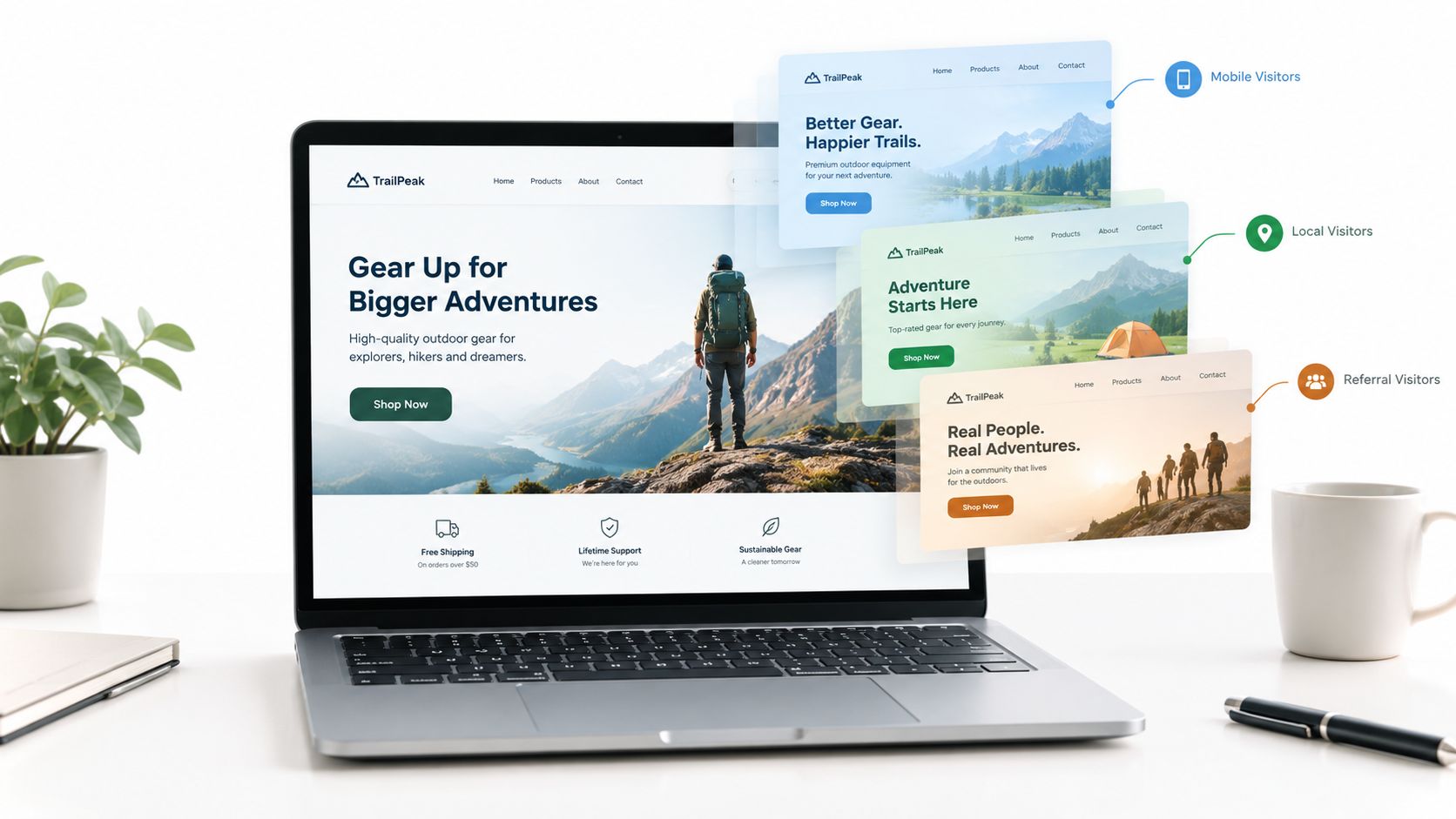
The tactic works when the visitor's context genuinely changes the best argument. Someone arriving from a product comparison article may need proof and differentiation. Someone arriving from a branded search may need reassurance and a direct next step. AI's role isn't to invent strategy from nothing. It chooses among plausible messages and learns from conversion outcomes.
Practical rule: Track the conversion event before asking AI to optimize it. Otherwise, the system may learn from clicks, scrolls, or form starts that don't represent business value.
The main risk is over-segmentation. Too many audiences create thin evidence and unstable decisions. Start with one high-value page, define a small number of meaningful contexts, and compare the adaptive experience with a static control. Polish's approach is most useful when marketers keep ownership of the offer, claims, privacy boundaries, and approval standards.
2. Predictive Lead Scoring and Prioritization
Sales teams rarely need more leads in the abstract. They need a clearer answer to which lead deserves attention now. Predictive scoring uses historical customer and prospect data to estimate which current leads resemble previously successful or unsuccessful opportunities.
A useful model combines firmographic information with behavior. Company size, industry, role, page visits, content downloads, email engagement, and sales activity can all help describe intent. The AI makes a ranking decision, while marketing and sales decide what the ranking should trigger, such as immediate outreach, a nurture sequence, or a request for more qualification.
The data requirement is more demanding than many teams expect. A model needs outcome labels, including converted opportunities and lost deals, not just a list of contacts. If sales representatives use “qualified” inconsistently, the model may reproduce that inconsistency rather than identify genuine purchase likelihood.
What marketers should control
Salesforce Einstein Lead Scoring, HubSpot Predictive Lead Scoring, Marketo Predictive Audiences, and 6sense illustrate different versions of the same operating pattern. They don't remove the need for an agreed definition of quality. They make that definition executable against a larger volume of signals.
Use the score in marketing as well as sales. A high-intent account may receive a case-led comparison page, while a low-intent contact may need educational content instead of a sales call. Review predictions against actual pipeline outcomes regularly, and retrain when products, markets, or buying behavior change.
The trade-off is false confidence. A numerical score can look precise even when the underlying data is incomplete or biased toward past customers. The first step should be a joint sales and marketing workshop that defines the target outcome, lists the available signals, and chooses one downstream action to test.
3. AI-Powered Copywriting and Content Generation
AI copywriting is most valuable when the team has many small decisions to make. Headlines, subject lines, ad variations, product descriptions, and calls to action can all be generated faster than a human team can draft them one by one. The model supplies breadth. Marketers still decide which claims are accurate, which ideas fit the brand, and which versions deserve exposure.
Copy.ai, Jasper, and general-purpose assistants such as ChatGPT can produce initial drafts, but output quality depends on the inputs. Brand voice guidance, audience objections, approved proof points, banned claims, and examples of successful copy give the system a usable boundary. Without those constraints, speed produces more review work rather than better marketing.
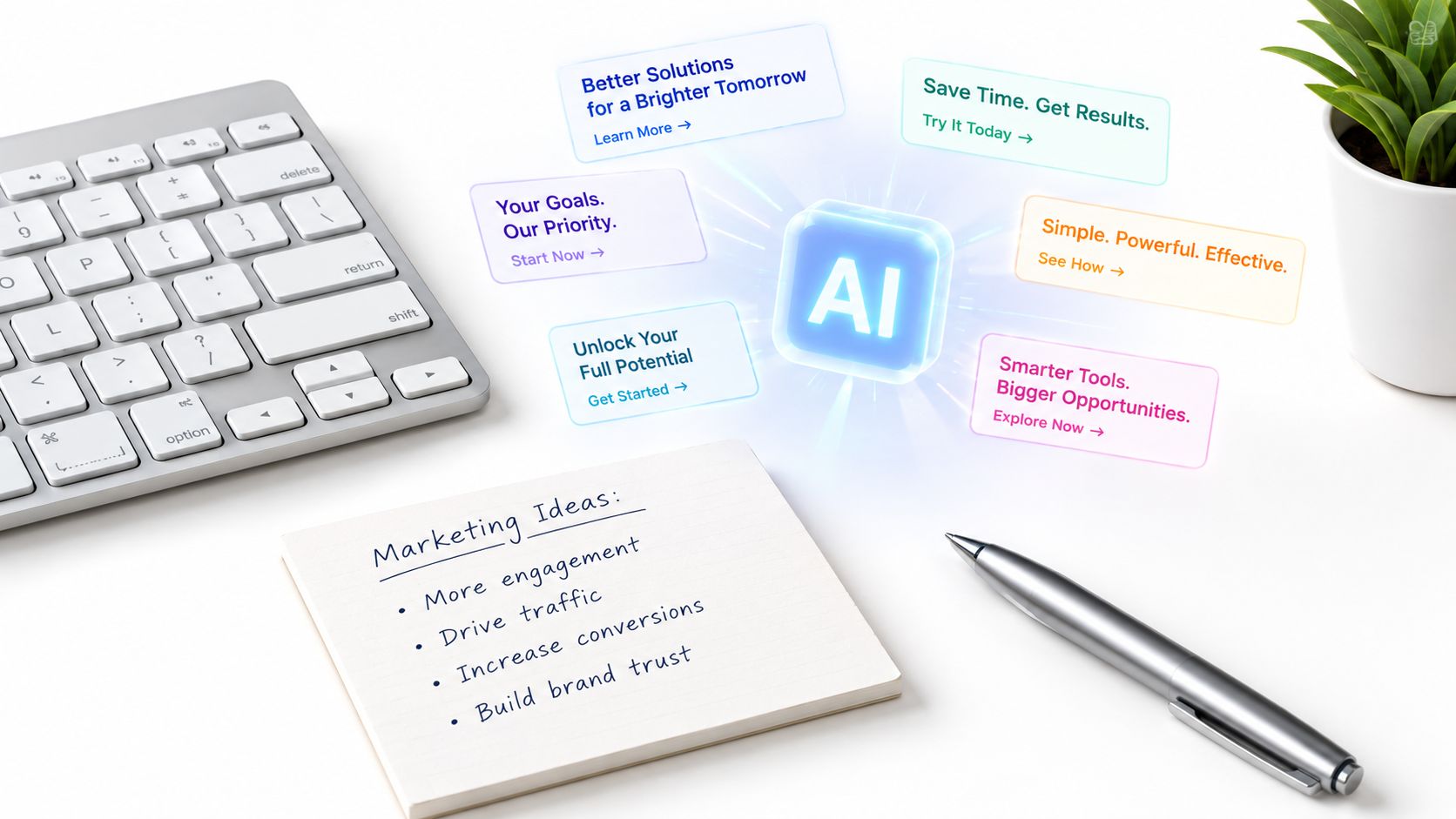
Polish's headline generator represents a focused version of this use case. Instead of asking AI to create an entire brand campaign, a growth team can use it to explore landing-page language that a controlled test can evaluate.
Human control matters most at the claim level. AI can vary wording, but it shouldn't decide whether an unverified promise is safe to publish.
The operating mechanism is a loop: generate, review, publish, measure, and feed useful performance signals back into the next round. A team might ask for alternatives aimed at different objections, then compare them with a human-written control. The limitation is that conversion data can reward familiar, short-term language while weakening distinctive brand positioning. Keep AI on repetitive variation work unless a senior marketer has reviewed the strategic narrative. For a broader workflow perspective, see these AI tools for content marketing.
4. Behavioral Email Personalization and Automation
Email automation becomes more useful when it responds to behavior instead of relying only on elapsed time. A visitor who views a pricing page, downloads a guide, abandons a signup flow, or returns after a dormant period has given the system a different signal. AI can use those signals to alter the message, sequence, timing, and frequency.
Klaviyo, ActiveCampaign, Drip, ConvertKit, and Intercom support variations of this approach. The AI decision might be simple, such as choosing a product category, or more complex, such as selecting the next message in a lifecycle sequence. Marketers define the customer journey and the acceptable frequency. The model helps choose the most relevant path for each contact.
The strongest implementation starts with a journey map rather than a tool configuration. Identify the event that changes intent, the message that responds to it, and the condition that ends the sequence. A product-page visit may justify education, while repeated engagement with a high-intent resource may justify a sales invitation.
Where automation fails
Over-automation creates a relevance problem of its own. A subscriber can receive technically personalized messages that still feel intrusive, repetitive, or badly timed. Monitor engagement and unsubscribes by audience group, give subscribers control over topics and frequency, and suppress contacts who show sustained inactivity.
The trade-off is between responsiveness and pressure. Real-time triggers can capture a moment of intent, but they can also overreact to accidental browsing. Start with one behavior that has a clear commercial meaning, then compare the automated path with the existing sequence. The marketer's job remains editorial and ethical: decide what the brand should say, how often it should speak, and when it should stop.
5. Conversion Rate Optimization Through Multivariate Testing
Traditional A/B testing compares a limited set of page versions. AI-assisted experimentation expands the number of combinations considered and can shift traffic toward variants that appear more promising. The marketing job is still conversion improvement, but the operating mechanism changes from a fixed comparison to a more adaptive allocation of attention.
Optimizely, VWO, Unbounce, Instapage, and Convert all support testing approaches that help teams evaluate headlines, forms, layouts, and calls to action. A multi-armed bandit framework, explained in this guide to multi-armed bandit testing, is especially relevant when a team wants to reduce exposure to weaker variants while a test is running.
The input is clean event data and a hypothesis. The AI chooses which experience to serve more often. The marketer controls the primary metric, audience definition, test duration, and decision threshold. That division prevents a common mistake, treating an optimization engine as if it could define success without business context.
A faster test isn't automatically a better test. If the hypothesis is vague or the conversion event is noisy, adaptive allocation can make a weak conclusion arrive sooner.
Begin with a high-impact element and a clearly stated reason for changing it. Keep a record of the audience, versions, outcome, and decision so future experiments build organizational knowledge. Watch segment-level results, because an aggregate winner may perform poorly for an important audience. The limitation is traffic dependency. If a page receives little qualified activity, the system has less evidence to distinguish a durable improvement from random movement.
6. AI-Powered Content Recommendation and Personalization
Recommendation systems solve a discovery problem. A visitor may have several relevant articles, products, or resources available, but a static page can't know which one should appear next. AI uses behavior, content attributes, prior interactions, and contextual signals to select a recommendation.
Netflix's content suggestions, Amazon's product recommendations, Spotify's playlists, Medium's article suggestions, and YouTube's video feed all demonstrate the general pattern. In marketing, the same logic can guide a reader from an introductory article to a comparison page, or from a product page to a related use case. The AI makes the next-content decision. Editors decide what inventory is eligible and what the customer experience should protect.
The data requirement begins with disciplined tagging. If articles have no reliable topics, stages, audiences, or product relationships, the model has weak material to organize. A hybrid system often works better than relying on a single signal. Combine behavior with editorial rules, popularity, recency, and explicit preferences.

Relevance without a filter bubble
Pure personalization can narrow discovery. New visitors have little history, and returning visitors can be trapped inside past interests. Use popular or editorially selected content for the cold-start experience, introduce diversity into recommendations, and offer explicit controls such as “not interested.”
The practical test is not whether visitors click more recommendations. It is whether the recommended path supports a meaningful business or customer outcome. Compare personalized suggestions with a control set, and inspect whether recommendations move people toward useful next actions or merely extend browsing.
7. Predictive Analytics for Customer Churn Prevention
Churn prevention begins before cancellation. AI models examine usage, engagement, support activity, and account signals to identify customers whose behavior resembles earlier departures. The model's output is a risk classification. The retention team then decides whether to intervene and what intervention makes sense.
Mixpanel and Amplitude can surface behavioral patterns, while Gainsight, Totango, and Intercom connect customer intelligence with success workflows. A login decline may mean low value, but it may also reflect seasonal use, a completed project, or an unresolved support issue. The model can flag the account. It can't replace the context held by customer success or the product team.
A useful operating design combines product and business signals:
- Usage context: Look at feature adoption, depth of use, and changes over time rather than treating one visit as proof of health.
- Relationship context: Include support conversations, renewal milestones, unresolved problems, and account communication.
- Intervention testing: Compare check-ins, education, product guidance, and commercial offers instead of assuming a discount is the best response.
The main trade-off is false positives. If the system alerts a retention team about every uncertain account, staff stop trusting the alerts. Segment models where customer behavior differs, set an intervention threshold, and measure contacted at-risk customers against a comparable group that wasn't contacted.
The first implementation step is a working session between marketing, customer success, support, and product. Agree on what “at risk” means, choose a small set of signals, and connect the prediction to a human action that can happen quickly. Retention improves only when the company changes the customer's experience, not when it labels the customer more accurately.
8. AI-Powered Ad Targeting and Audience Segmentation
Paid media platforms use machine learning to connect audience signals, creative, placements, and bids. The marketing job is to find people likely to respond to a message, while the AI handles a large part of audience expansion and delivery optimization. Meta Lookalike Audiences, Google's Smart Bidding, Amazon Ads, LinkedIn lookalikes, and The Trade Desk offer different implementations of this principle.
The strongest input isn't a generic visitor pool. It's a carefully defined first-party audience with a meaningful business outcome, such as valuable customers or qualified opportunities. That seed tells the platform what “good” looks like. Conversion data sent back from offline systems can improve the connection between an ad interaction and the result the business wants.
Marketers still control the value definition, exclusions, creative strategy, consent rules, and budget boundaries. AI can find a pattern, but it may also exploit an easy-to-convert audience that doesn't support long-term growth. Review results by cohort rather than treating blended return as sufficient evidence.
The trade-off between scale and transparency
Automated targeting can hide why a person received an ad and which signal influenced delivery. That makes privacy governance and brand safety part of the marketing workflow, not a later legal review. Limit data use to an approved purpose, document audience sources, and refresh high-value seeds as the customer base changes.
A practical first test uses one business outcome, one well-defined seed audience, and a clear control or comparison audience. Keep the message aligned with intent. A prospect researching a problem needs a different promise from an existing customer eligible for expansion. AI improves delivery only when the team supplies a meaningful destination.
9. Customer Journey Mapping and Attribution Modeling
Attribution is a decision problem disguised as a reporting problem. Marketers want to know which combinations of ads, content, emails, sales interactions, and product experiences contribute to a conversion. AI systems connect events across channels and devices, then estimate how much value to assign to each interaction.
Google Analytics 4, Marketo, Salesforce Measure Cloud, AdRoll, and HubSpot provide different forms of journey and attribution reporting. The input is detailed event tracking. If paid campaigns, organic visits, email clicks, and offline sales aren't connected consistently, an advanced model can only produce an advanced version of an incomplete story.
The AI decision is an allocation estimate. The marketer decides whether that estimate is strong enough to change budget, creative, or channel strategy. Compare multiple attribution approaches, segment by customer type and cohort, and use incrementality tests where possible. A channel that frequently appears before conversion may assist demand without causing the sale on its own.
Turn reporting into a budget decision
A journey map becomes useful when it answers a specific question. Should the team fund more educational content, change the retargeting message, or improve the handoff from marketing to sales? Build dashboards around decisions rather than displaying every available touchpoint.
The limitation is false precision. Attribution models distribute credit according to assumptions, and customer journeys are rarely uniform. Start by standardizing event names and campaign metadata. Then choose one budget decision to validate against observed outcomes. Update the model as the marketing mix changes, and use its findings to inform messaging as well as media allocation.
10. Predictive Customer Lifetime Value and Segmentation
A conversion tells you what happened now. Customer lifetime value asks what the relationship may be worth over time. Predictive CLV models combine purchase history, engagement, product mix, retention behavior, and account characteristics to estimate future value and group customers by strategic importance.
Salesforce's Einstein CLV predictions, HubSpot value-based segmentation, Klaviyo customer tiers, Zendesk customer scoring, and Amplitude cohort analysis represent tools that can support this work. The AI makes a value estimate. Marketers use it to decide where to invest acquisition budget, retention effort, sales attention, and service resources.
CLV becomes more useful when paired with churn risk. A customer with high potential value and declining engagement deserves a different intervention from a low-value account with the same activity pattern. That distinction helps teams avoid spending equally across customers whose economics and needs differ.
The risk is creating a two-tier experience that alienates customers outside the highest-value group. Efficient service doesn't need to mean careless service. Design scalable education and support for lower-value segments, and test whether premium treatment improves retention or expansion among high-value customers.
Start with one product line or customer cohort. Define the outcome, document which historical signals are available, and separate observed value from predicted value. Review scores as behavior changes rather than treating them as permanent labels. Share the result with marketing, sales, customer success, and finance so the company makes consistent choices about customer investment.
AI Marketing: 10 Use Cases Comparison
| Solution | Implementation Complexity 🔄 | Resource Requirements ⚡ | Expected Outcomes 📊 | Ideal Use Cases 💡 | Key Advantages ⭐ |
|---|---|---|---|---|---|
| Dynamic Landing Page Personalization | Medium 🔄, script install; CMS integration possible | Low–Medium ⚡, visitor data & traffic volume | 📊 ⭐⭐⭐, higher conversions via contextual messaging | High-traffic landing pages, paid campaigns | Real-time adaptation, continuous learning, fast rollout |
| Predictive Lead Scoring and Prioritization | Medium 🔄, data cleaning & sales alignment | Medium ⚡, CRM history, firmographics, analytics | 📊 ⭐⭐⭐⭐, improved sales efficiency & conversion rates | B2B sales, lead-heavy funnels, ABM | Prioritizes high-probability leads; reduces wasted effort |
| AI-Powered Copywriting and Content Generation | Low–Medium 🔄, API/SaaS + editorial workflow | Low ⚡, training examples, editorial oversight | 📊 ⭐⭐⭐, faster scale; variable creativity quality | High-volume copy, ads, headline/CTA generation | Scales content creation; speeds launches; brand consistency with review |
| Behavioral Email Personalization and Automation | Medium–High 🔄, tracking, triggers, privacy setup | Medium ⚡, email platform, behavioral data, sequencing | 📊 ⭐⭐⭐⭐, higher opens/CTRs and improved retention | E‑commerce lifecycle, nurture flows, cart recovery | Timely individualized messaging; automates nurturing at scale |
| Conversion Rate Optimization (Multivariate Testing) | High 🔄, experiment design, statistical rigor | High ⚡, large traffic, analytics integration | 📊 ⭐⭐⭐, rigorous lifts and validated winners | Mature sites with volume seeking systematic CRO | Finds optimal element combinations quickly; bandit efficiency |
| AI-Powered Content Recommendation & Personalization | Medium–High 🔄, recommender models & tagging | High ⚡, content metadata, user behavior data | 📊 ⭐⭐⭐, increased engagement, session depth, AOV | Media platforms, ecommerce catalogs, content discovery | Improves engagement and cross-sell; personalization at scale |
| Predictive Analytics for Customer Churn Prevention | Medium–High 🔄, modeling, real-time scoring | Medium ⚡, usage/engagement data, CS integration | 📊 ⭐⭐⭐, reduced churn when interventions executed | SaaS/subscription, high-retention businesses | Targets at-risk customers; informs timely retention actions |
| AI-Powered Ad Targeting & Audience Segmentation | Medium 🔄, pixel/setup, platform integration | High ⚡, first‑party data, ad spend, tracking | 📊 ⭐⭐⭐⭐, lower CPA and improved ROAS | Paid acquisition, scaling ads, lookalike strategies | Precise targeting, automated bidding, scalable creative testing |
| Customer Journey Mapping & Attribution Modeling | High 🔄, cross-channel tracking & data stitching | High ⚡, comprehensive data infra & analytics | 📊 ⭐⭐⭐, clearer channel ROI and budget guidance | Enterprises with multi-channel spend and complex funnels | Reveals touchpoint value; enables data-driven budget allocation |
| Predictive Customer Lifetime Value & Segmentation | Medium 🔄, CLV models and tiering | Medium ⚡, transaction history, analytics pipelines | 📊 ⭐⭐⭐, better resource allocation and profitability | Retail, subscription, lifecycle-driven marketing | Focuses resources on high-value customers; optimizes spend |
Turn the Examples Into a Practical AI Marketing Roadmap
These ten examples fall into three implementation levels. Copy and creative variation includes landing-page personalization, AI copywriting, email content, and recommendation labels. These applications usually let a team begin with existing content and a visible customer action. The risk is manageable when humans review claims and the team compares generated variations with a control.
Behavioral optimization includes email automation, multivariate testing, recommendations, churn interventions, and ad delivery. These systems respond to user behavior and therefore need cleaner event tracking. They also need guardrails, because the fastest automated response isn't always the most helpful customer experience. A marketer should define when the system may act, when it must ask for approval, and when it should remain silent.
Predictive analytics includes lead scoring, attribution, and lifetime value. These use cases demand stronger historical data and clearer outcome definitions. They can influence sales capacity, budget, and customer treatment, so a score shouldn't become a hidden policy. Teams need to inspect errors, compare predictions with real outcomes, and give commercial owners a way to challenge the model.
A practical roadmap starts with one bottleneck, not an inventory of AI tools. Choose a page with a conversion problem, a lead queue sales can't prioritize, a lifecycle stage with weak engagement, or a retention process that reacts too late. Define the business event before deployment. If the team can't explain what success means, the model has no reliable target.
Set privacy boundaries at the beginning. Document which data can be used, why it is relevant, how long it is retained, and who can access the output. Then establish a human-controlled baseline. The comparison might be a static landing page, the existing email sequence, the current lead-routing rule, or a budget allocation made without predictive assistance.
Useful AI marketing depends on four conditions: relevant data, a clear decision to automate, disciplined testing, and ongoing human oversight.
The most credible programs also create a review rhythm. Examine performance by audience, not only in aggregate. Look for false positives, accidental exclusions, message fatigue, and changes in customer behavior. Keep a record of experiments and decisions so the organization learns which signals matter and which apparent improvements don't survive closer inspection.
AI can support faster iteration, but it can't supply a missing value proposition or repair broken measurement. Marketers who connect each model to a specific decision will get more useful evidence than teams that deploy AI as a general layer over every channel. For another perspective on applying AI to marketing workflows, see this analysis of how RemotionAI enhances marketing.
Polish fits the first implementation level because it focuses on landing-page variation and conversion feedback. It can map a page, write headline, subheading, and CTA alternatives, and keep selected versions in front of real traffic while evidence accumulates. That makes it a practical starting point for a growth team that wants to test contextual personalization without redesigning its entire marketing stack.
Polish reads your landing page, writes personalized headline, subheading, and CTA variants, and serves the version most suited to each visitor's context. Visit Polish to connect an autonomous conversion optimization workflow to your website and start with one measurable page experiment.
- ai in marketing examples
- AI marketing
- marketing personalization
- conversion optimization
- predictive analytics
Your website rewrites itself until it converts.
Polish writes new versions of your headlines and CTAs, tests them on your real visitors and keeps the ones that win.
Start free