How to Write a Value Proposition That Converts Visitors
Learn how to write a value proposition that converts. Framework, templates, examples and testing tips to craft clear landing page messaging.
Published on 14 min read

Table of contents
- Why Most Value Propositions Fail to Convert
- The cost of broad language
- Treat the message as a hypothesis
- What Makes a Strong Value Proposition
- A fast audit for any headline
- Clarity beats cleverness
- How to Craft Your Value Proposition From Research to Draft
- Start with one ICP and one job
- Quantify the pain and the gain
- Map every alternative
- Choose a trade, then add proof
- Draft the landing-page block
- Proven Templates and Real World Examples That Work
- Three practical formats
- Compare the options
- Adapt without becoming generic
- Testing and Improving Your Value Proposition on Landing Pages
- Place the proposition before the explanation
- Test the message and the page
- Refresh the claim as conditions change
- Your Next Steps to a Clearer More Compelling Message
Your landing page is getting traffic, but visitors still hesitate. The headline sounds polished, the design looks credible, and the call to action is easy to find. Yet people arrive, scan the page, and leave because they can't quickly tell what you offer, who it's for, what problem it solves, or why they should choose it over another option.
That's a messaging problem before it's a design or traffic problem. Learning how to write a value proposition means treating the headline as a conversion asset, not a clever slogan. The strongest propositions focus on one ideal customer profile, one important job, and one meaningful alternative, then use evidence and testing to improve the claim.
Why Most Value Propositions Fail to Convert
A common landing page failure looks like this: a company has invested in paid traffic, search content, and a careful visual refresh, but the conversion rate remains disappointing. The hero section says something like “Transform your business with solutions.” It sounds professional, but it gives the visitor no useful reason to continue.
The visitor still has to decode the offer. Is it software, consulting, training, or an agency service? Is it for a founder, a sales leader, or an operations team? Does it replace an existing tool, a manual process, or doing nothing? Every unanswered question creates friction at the exact moment when attention is scarce.
The cost of broad language
Generic copy fails because it describes the company from the inside out. Teams write about capabilities, platforms, partnerships, and transformation. Buyers are trying to decide whether the offer can help them complete a job with less risk and effort.
Words such as solutions, synergy, next-generation, and seamless rarely distinguish one business from another. They also force visitors to translate abstract claims into a practical outcome. If your competitor can paste the same sentence onto its homepage without changing a word, your proposition isn't doing competitive work.
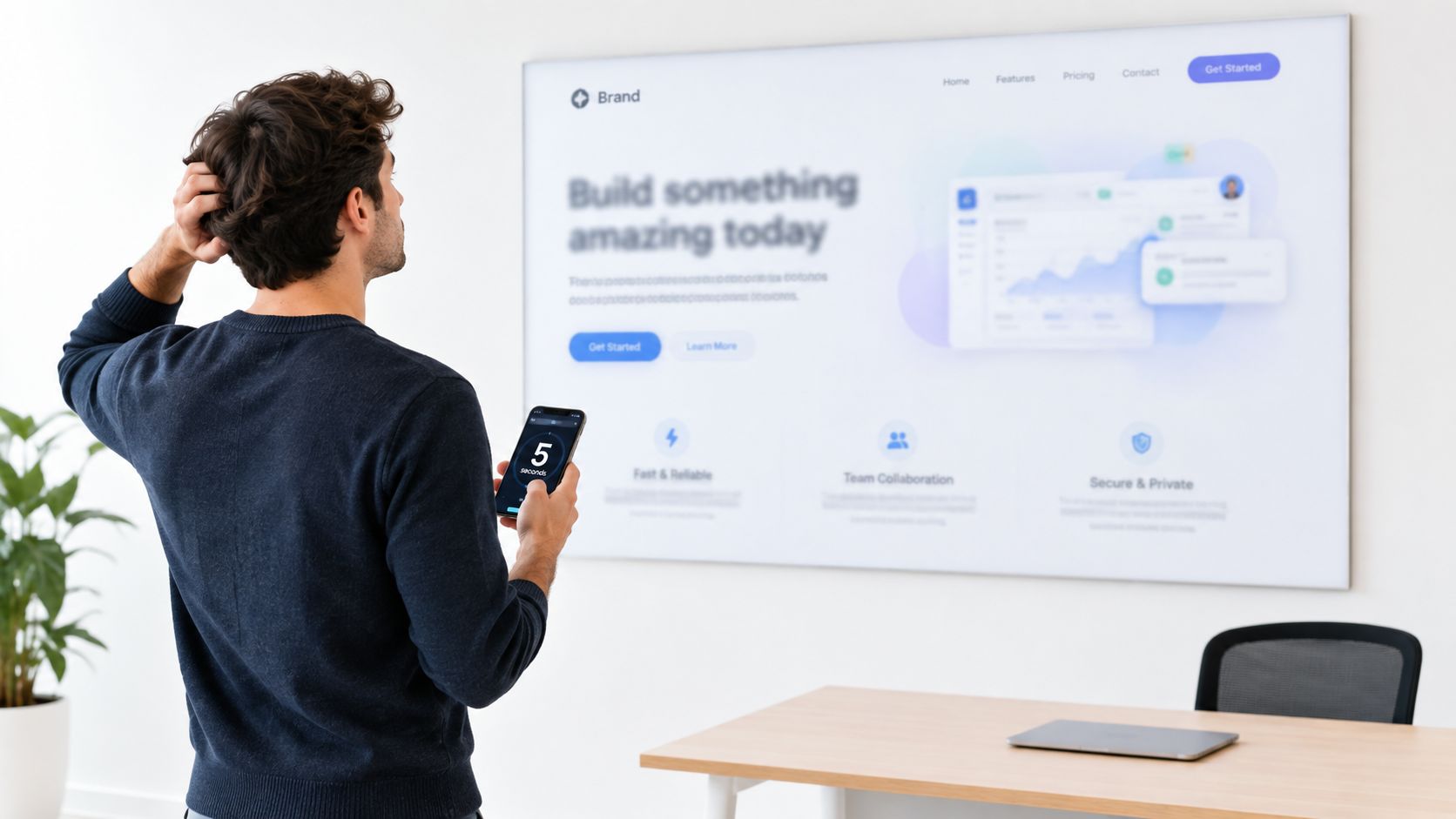
Placement creates another avoidable problem. If the clearest explanation sits below the first screen, many visitors won't see it before deciding whether the page is relevant. Your headline and supporting line need to carry the basic message immediately, then the rest of the page can add depth, proof, and objection handling.
Practical rule: If a qualified visitor can't explain what you sell and why it matters after a quick scan, rewrite the hero before changing the button color.
Treat the message as a hypothesis
A value proposition isn't a permanent declaration of brand identity. It's a claim about relevance, benefit, and difference that can be challenged by customer feedback and landing-page behavior.
Conversion research supports this testing mindset. In one published optimization case, all 10 tested landing-page treatments that added value statements and shortened the copy outperformed the original control, showing why clearer communication should be tested rather than approved by internal preference. You can review the published landing-page value proposition experiment for the original context.
The practical implication is narrow your first claim. Don't try to promise something to every possible buyer. Choose the segment with the clearest pain, identify the alternative they're considering, and write a proposition that makes a specific trade. If you want to strengthen the rest of the page, a useful guide to writing ad copy that converts can help you connect the promise in the headline to the message that brought the visitor there.
What Makes a Strong Value Proposition
A value proposition is a concise explanation of the value a customer should expect and the reason your offer deserves consideration. It isn't the same as a mission statement, which describes the organization's purpose. It isn't a tagline, which may build brand memory. It isn't a feature list, which describes what the product contains.
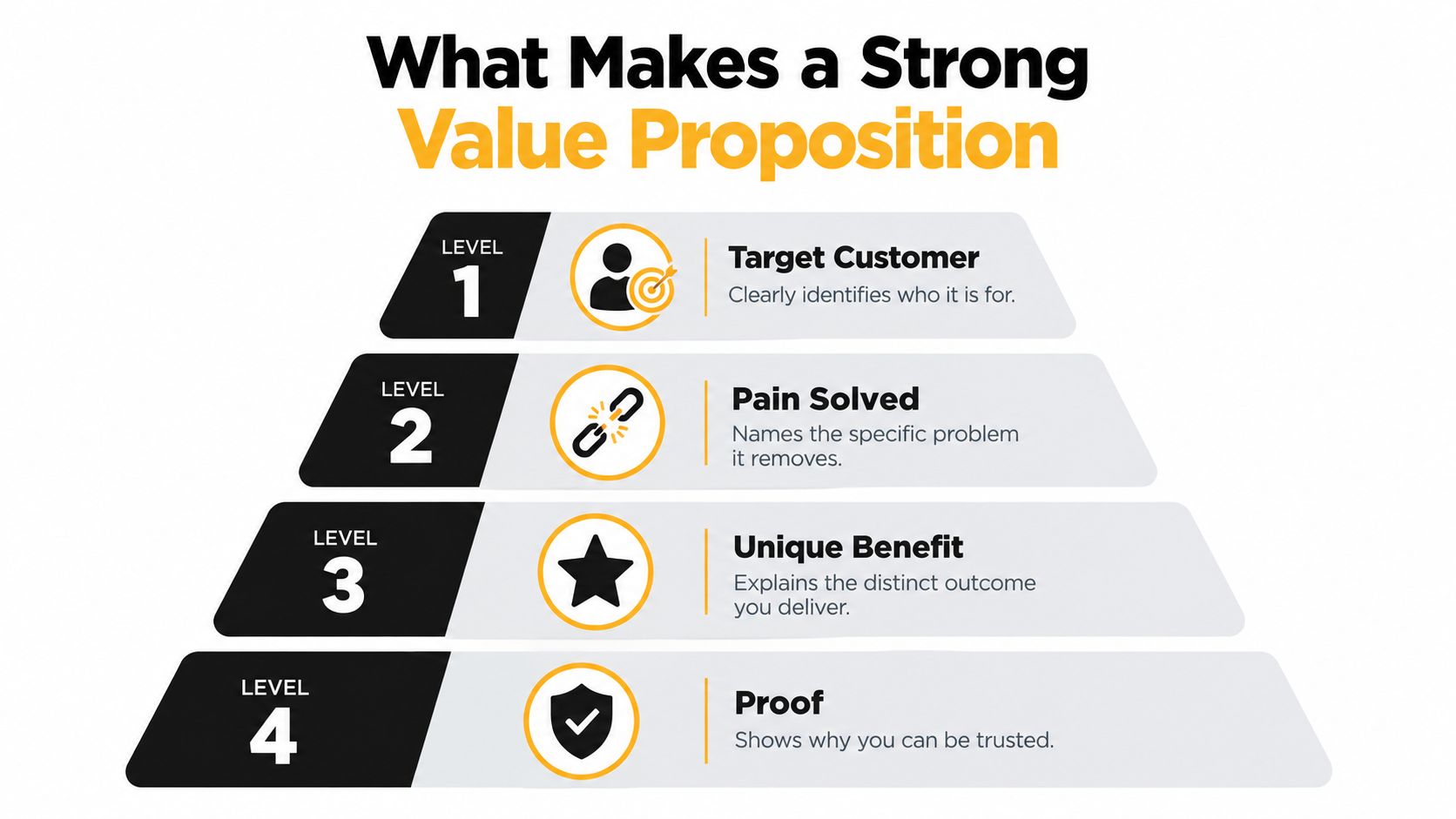
A strong proposition performs four jobs at once:
- Identifies the target customer. The reader should recognize that the offer was designed for people like them.
- Names the job or pain. It should connect to a problem the customer is actively trying to solve.
- Promises a distinct benefit. The message needs to describe an outcome, not merely an internal capability.
- Signals credible difference. The visitor should understand why this option is preferable to a competitor, workaround, or status quo.
A fast audit for any headline
Take a headline such as “The smarter way to grow.” It might work as a campaign line once the audience already knows the brand, but it's weak as a landing-page proposition. It doesn't identify the buyer, name the job, explain the benefit, or establish a difference.
A more useful version might be: “For boutique agencies that need faster client reporting, create branded performance dashboards without rebuilding spreadsheets each month.” The second message isn't automatically better because it's longer. It's better because it gives the reader something concrete to confirm or reject.
Use this five-question audit:
- Who is it for? Could a specific customer segment see themselves in the wording?
- What does it help them do? Is the job expressed in customer language?
- What outcome matters? Does the benefit go beyond a feature name?
- What alternative does it challenge? Does the message imply a meaningful choice?
- Why believe it? Is there evidence, a mechanism, or a credible reason to trust the promise?
Expert guidance recommends assessing propositions across appeal, exclusivity, clarity, and credibility, then averaging feedback from multiple reviewers to limit individual bias. The MECLABS value proposition assessment framework makes that review process practical for CRO teams.
Clarity beats cleverness
Clever copy creates a private joke between the brand and its creative team. Clear copy helps a buyer make a decision. Avoid hiding the main proposition beneath decorative language, a large product screenshot, or a paragraph that begins with company history.
The best first draft often sounds almost plain. That's useful. Once the proposition is accurate and specific, you can refine rhythm and tone without sacrificing meaning. For broader guidance on how to write persuasive web copy, focus on connecting each claim to the reader's decision rather than polishing language in isolation.
How to Craft Your Value Proposition From Research to Draft
The most reliable approach is to treat your proposition as a research-backed hypothesis, not a slogan. Start with a customer segment and job, investigate the pain and desired gain, map the alternatives, select a defensible difference, and then test the wording with people who resemble the market.
Start with one ICP and one job
An ideal customer profile should be narrow enough to make the message uncomfortable for everyone else. “Businesses that want better marketing” is too broad. “Demand-generation managers at growing B2B software companies who need to turn product data into sales-ready campaigns” gives the writer a usable audience and a meaningful job.
Ask:
- What task is the buyer trying to complete?
- Why does the task matter now?
- What happens if it stays unsolved?
- Which part creates the most frustration or risk?
- What language does the buyer use without your prompting?
Customer interviews, sales calls, support tickets, review sites, and lost-deal notes can all expose the words buyers already use. If you need a more deliberate process for audience discovery by Narrareach, use it to narrow the segment before drafting copy.
Quantify the pain and the gain
“Save time” is a direction, not a proposition. Find out what time is being lost, what work creates it, and what the buyer wants to do instead. You don't need to publish every internal measurement, but your research should make the benefit specific enough to guide the copy.
For a service business, the gain might be fewer approval delays, clearer ownership, or more predictable delivery. For SaaS, it might be a workflow that replaces manual reconciliation. For an ecommerce offer, it might be confidence in choosing the right product without comparing dozens of options.
Separate the customer's desired outcome from the feature that produces it:
- A shared workspace is a feature.
- Fewer handoff mistakes between teams is a benefit.
- Confidence that every stakeholder is working from the same brief is a deeper gain.
That distinction is central to personalization and customization, because a message becomes more relevant when it reflects the customer's context instead of presenting the same generic benefit to every visitor.
Map every alternative
Your competitor isn't always another company. The buyer may be comparing your offer with an incumbent platform, an internal hire, a spreadsheet, a familiar agency, or postponing the decision.
Create a simple alternative map:
| Alternative | Why the buyer considers it | Where it falls short |
|---|---|---|
| Existing tool | Familiar and already approved | Doesn't fit the new workflow |
| Manual process | Flexible and inexpensive to start | Consumes attention and creates inconsistency |
| Specialist provider | Brings outside expertise | May be slow to adapt or difficult to scale |
| Status quo | Avoids immediate change | Leaves the underlying pain in place |
This step prevents empty differentiation. You can't claim to be “easier” until you know what feels difficult about the current option. You can't claim to be “faster” until you understand where the existing process loses time.
Choose a trade, then add proof
A differentiated proposition usually makes a trade statement. It says, in effect, for this segment, we help achieve this outcome without the limitation associated with the alternative.
Useful draft formats include:
- “We help [specific customer] achieve [important outcome] without [painful compromise].”
- “[Product] gives [specific segment] a simpler way to [job] by [distinct mechanism].”
- “For [customer] replacing [alternative], [offer] delivers [benefit] through [credible difference].”
Don't add a claim merely because it sounds persuasive. Pair the promise with proof you can support, such as a product mechanism, transparent process, relevant customer evidence, or a clear demonstration. A modest claim that the business can deliver consistently is stronger than a dramatic promise that sales and customer success can't sustain.
A structured research method should evaluate candidate concepts quantitatively across multiple dimensions with a representative sample, rather than relying only on internal opinions. That approach is described in value proposition research guidance.
Draft the landing-page block
Write the proposition as a small message system, not a single sentence:
- Headline: Lead with the most important customer outcome.
- Subheading: Clarify the audience, offer, mechanism, or alternative.
- Supporting bullets: Add the benefits that help the reader believe the headline.
- Proof: Place relevant evidence close to the claim.
- CTA: Ask for the next step in language that matches the buyer's level of commitment.
Use plain words first. Edit later for personality. If the headline needs a paragraph of explanation before it makes sense, the headline is carrying the wrong job.
Proven Templates and Real World Examples That Work
Templates help when they force a decision. They hurt when teams fill in the blanks with generic nouns and call the result finished. Choose the structure based on buyer awareness, offer complexity, and the amount of differentiation you can prove.
The narrow-first approach matters here. Recent guidance increasingly recommends naming one segment, identifying the alternative, and writing a trade statement instead of listing features. That's more useful than trying to make one sentence appeal equally to every audience, as discussed in this specific ICP value proposition guide.
Three practical formats
Headline, subheading, and proof works well for most landing pages. The headline names the outcome, the subheading explains who gets it and how, and nearby proof answers the first credibility objection.
Example:
- Weak headline: “Powerful analytics for modern teams.”
- Stronger headline: “Give subscription finance teams a clearer view of renewal risk.”
- Supporting line: “Combine account signals and renewal workflows in one workspace, so managers can act before a quiet account becomes a surprise.”
The Steve Blank format is useful when the audience and job need to be immediately explicit:
“We help [customer] do [job] by [mechanism].”
Example: “We help independent clinics reduce appointment gaps by filling cancellations through automated patient reminders.” It's direct, but it may need proof below the fold if the mechanism isn't familiar.
The Value Proposition Canvas format works when the offer has several connected benefits. Map the customer jobs, pains, and gains first, then choose the pain reliever and gain creator that matter most. Don't force every canvas detail into the headline. Use the page to reveal the supporting logic in the order the buyer needs it.
Compare the options
| Template | Structure | Best For | Watch Out |
|---|---|---|---|
| Outcome-led block | Headline, subheading, proof | Most product and service landing pages | Don't let proof overpower the main benefit |
| Steve Blank | We help X do Y by doing Z | Clear ICP and job-to-be-done | Can sound mechanical without customer language |
| Canvas-led | Jobs, pains, gains, fit | Complex offers with several stakeholders | The internal map isn't the public headline |
| Trade statement | Outcome without the alternative's drawback | Competitive categories | The contrast must be meaningful and honest |
A good template still needs a real point of view. “For teams that want efficiency, our platform helps improve productivity” follows a structure but says almost nothing. Replace the abstract benefit with a job and a trade: “For support teams replacing scattered inboxes, route every request into one queue without forcing agents to learn a complex helpdesk.”
For more fill-in-the-blank starting points, use this value proposition template resource, then rewrite the result using language from interviews and sales conversations.
Adapt without becoming generic
A company serving several segments shouldn't average their needs into one bland statement. Keep the underlying offer consistent, but change the lead benefit, proof, and alternative for each landing-page context.
A founder may care about speed to first result. An operations leader may care about control and consistency. A specialist buyer may care about integration with an established workflow. The proposition should reflect the decision each person is making.
Testing and Improving Your Value Proposition on Landing Pages
A draft becomes useful when it enters a feedback loop. Put the core message where visitors can see it quickly, support it with evidence, test meaningful alternatives, and review what you learn before the market moves on.
Place the proposition before the explanation
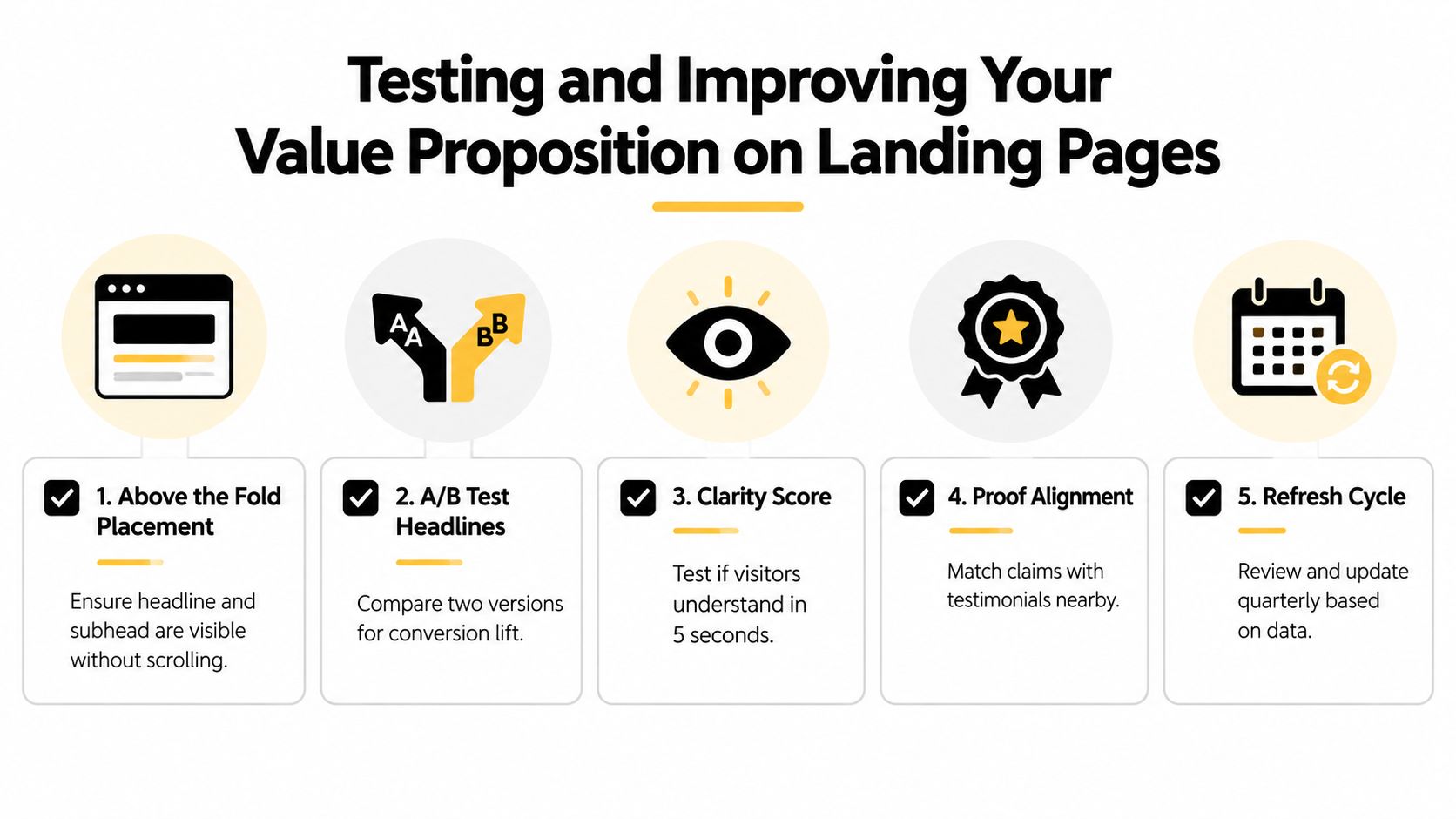
The first screen should communicate the core promise without requiring a scroll. That doesn't mean cramming every detail into the hero. It means making the audience, outcome, and offer understandable before the visitor commits more attention.
Pair the headline with a visual that reinforces the claim. A product interface can show the mechanism. A process illustration can make a service tangible. A customer-facing result can make an abstract benefit easier to grasp. Don't use an attractive image that contradicts or distracts from the message.
Use proof near the promise, not in a distant testimonial section. A relevant customer quote, recognizable context, product demonstration, or transparent explanation can address credibility at the moment the claim is evaluated.
Test the message and the page
A/B testing can tell you whether one version produces stronger behavior than another, but it won't explain why the losing version failed. Qualitative message testing, customer interviews, and sales feedback help diagnose confusion before you spend traffic on weak candidates.
Test one strategic difference at a time where possible:
- Lead with the outcome versus the category.
- Name the customer segment versus use a broad audience label.
- Contrast your offer with the current workaround.
- Emphasize the mechanism versus the final benefit.
- Use a direct CTA versus a lower-commitment next step.
Measure the action that matters to the business, not only engagement with the headline. A click can show interest, but a completed signup, qualified inquiry, or successful handoff gives you stronger evidence that the proposition is attracting the right visitor.
A focused landing page optimization process can help connect message decisions with page structure and conversion behavior.
Refresh the claim as conditions change
A proposition can go stale when competitors copy the category language, customer priorities shift, or the product evolves. Fast-moving teams may need to revisit messaging weekly, especially when new objections or alternatives appear. The important point is not to change wording randomly. Keep a record of the hypothesis, audience, alternative, proof, and result.
The guidance on value proposition development and ongoing review emphasizes evidence, status-quo comparison, and continuous refresh rather than treating the proposition as a finished brand asset.
A practical review asks:
- Do target buyers understand the offer without assistance?
- Does the promise address a current job?
- Does it beat the status quo in a way buyers care about?
- Can the business prove and deliver the claim?
- Does the page support the headline with relevant evidence?
Polish can be one option for this workflow. It reads a landing page, generates alternative headlines, subheadings, and CTAs, serves variants to visitors, measures conversion behavior, and continues serving the stronger version as results develop.
Your Next Steps to a Clearer More Compelling Message
Don't begin by asking, “What should our brand say?” Ask, “Which customer are we trying to win, what job are they hiring us to do, and what alternative are we asking them to leave?”
Write the first proposition for one ICP. Pull language from customer conversations, identify the painful compromise in the current option, and turn your strongest benefit into a testable claim. Then make the landing-page hero earn its space:
- Audit the current headline: Confirm that it names the offer, audience, outcome, and difference.
- Remove internal language: Replace “solutions,” “synergy,” and broad claims with customer vocabulary.
- Choose a structure: Use an outcome-led block, a direct job formula, or a trade statement.
- Add credible proof: Support the promise with evidence or a clear delivery mechanism.
- Run a focused test: Compare meaningful message alternatives and track the conversion action that matters.
- Record the learning: Keep the winning claim, objection patterns, and new customer language together.
If results are flat, don't immediately conclude that testing failed. Check whether the audience was right, the alternative was understood, the proof matched the promise, and the page delivered what the headline implied. A narrow proposition that loses can still teach you more than a broad slogan that produces no clear insight.
Win one segment first. Once the message is clear, credible, and repeatable for that audience, you can expand the framework without diluting the reason to choose you.
Polish helps growth teams test landing-page headlines, subheadings, and CTAs with live visitors instead of relying on internal copy opinions. Visit Polish to put your next value proposition into an iteration loop and learn which message converts.
- how to write a value proposition
- value proposition examples
- landing page copy
- conversion optimization
- messaging framework
Your website rewrites itself until it converts.
Polish writes new versions of your headlines and CTAs, tests them on your real visitors and keeps the ones that win.
Start free