Understanding What Is Zero Party Data in 2026
Learn what is zero party data: its definition, how it differs from first-party data, and how marketers collect and use it safely in 2026.
 Sacha Kleynjans

Table of contents
- What Zero-Party Data Means in Plain Terms
- Zero-Party Versus First, Second and Third-Party Data
- The one-sentence difference
- Why Declared Data Improves Personalization
- Practical Use Cases and When to Ask
- When to ask and when to infer
- Ways to Ask Visitors and What They Prefer
- Accuracy and Privacy Limits to Plan For
- Start with One Clear Question on Your Landing Page
The traffic dashboard shows page views, clicks and exits, but it cannot explain why a visitor left. Someone may have arrived from an ad about team workflows and found a page aimed at solo freelancers. Their behavior hints at a mismatch; it does not confirm what they wanted.
Zero-party data can help fill that gap when visitors choose to share preferences, purchase intentions, personal context or how they want to be recognized. A short question about what they are looking for can give a marketing team an answer that browsing patterns alone cannot. Many UK consumers prefer interactive surveys as a way for brands to collect information.
An answer is still a claim, not a guarantee. A visitor may misunderstand a question, change their mind or give an answer that does not match their later choices. Treat declared data as a useful starting point to test, not unquestionable truth. Ask only when the answer can improve the experience, explain how it will be used, and respect consent and privacy obligations.
What Zero-Party Data Means in Plain Terms
Picture a barista who asks how you take your coffee. Two seconds, one answer, and the next cup comes out right. Now picture the barista who says nothing and guesses from what you ordered last Tuesday. The first one collected zero-party data. The second one inferred your taste from behavior, and probably got the milk wrong.
That single exchange is the whole concept. Someone tells you something about themselves on purpose, and you use it to serve them better. Forrester Research coined the term in 2018 to separate volunteered information from behavioral information collected by observing page views, clicks and purchases, as this Morning Brew explanation of zero-party data sets out.
The answers usually arrive in three shapes:
- Preferences: the likes and dislikes people state outright, such as which email topics they want, which roast they drink or which skincare type they buy for.
- Intentions: plans rather than history, like the laptop they're buying next quarter or the plan they're comparing this month.
- Context: the background that changes which advice is useful, such as their role, team size, dietary needs or the country they buy from.
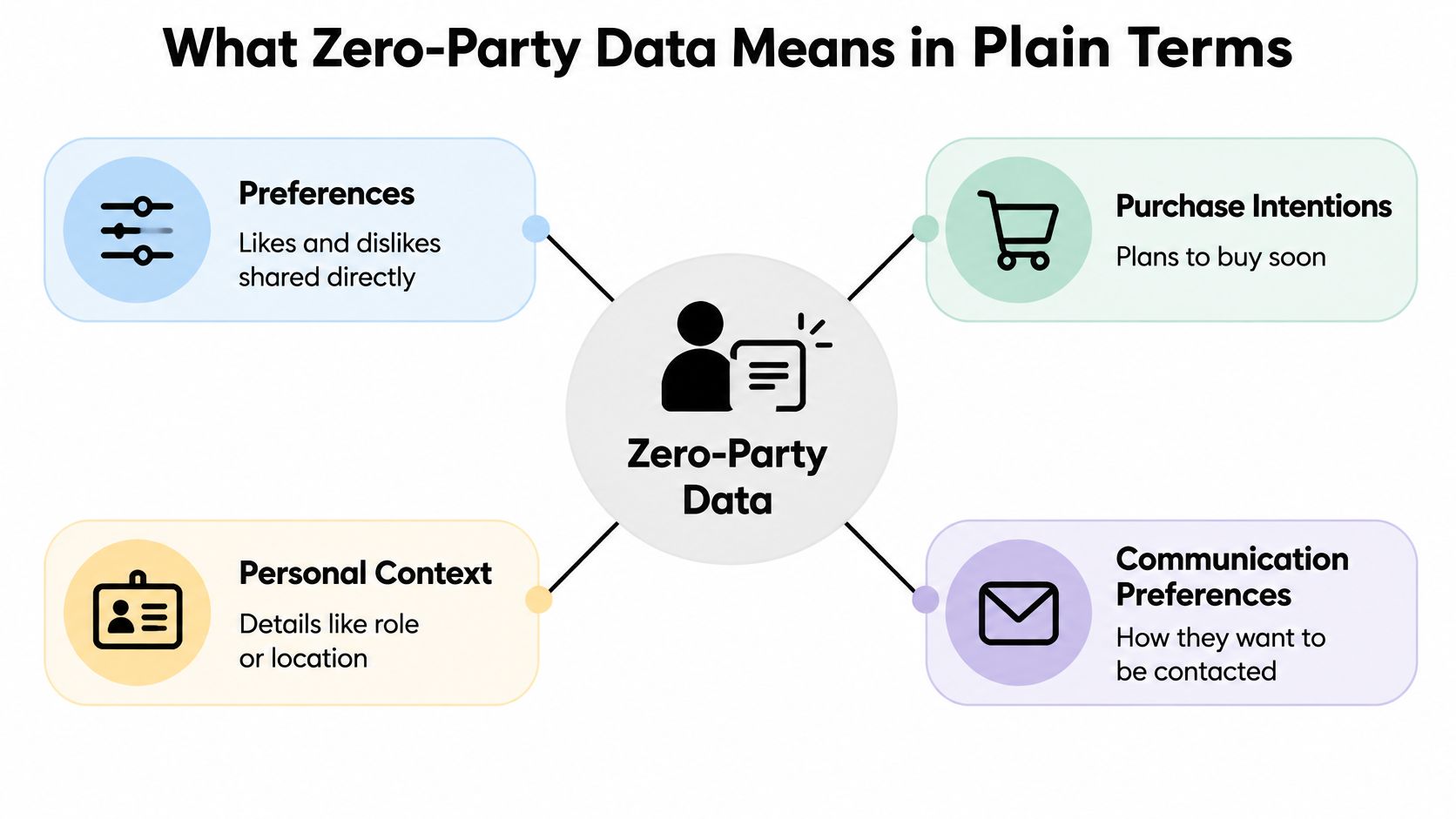
There's a fourth category that sits alongside those three: how someone wants to be recognized. A first name, a preferred language, a request for monthly emails instead of weekly ones. It sounds small. It's the difference between a message written for a person and a message written for a database row.
Here's the test I'd hand anyone sorting through a pile of signals. Ask one question of every data point.
Practical test: did the customer tell us this, or did we observe or infer it? A quiz answer is declared. A pricing-page visit is observed. A modeled "likely buyer" score is inferred.
That question sorts most cases in seconds. If you want the collection mechanics in one place, this walkthrough of how to gather shopper preferences covers the formats that work in practice.
Zero-Party Versus First, Second and Third-Party Data
| Data type | Who provides it | How it is gathered | Example | Main limitation |
|---|---|---|---|---|
| Zero-party data | The customer | Shared on purpose through quizzes, forms and preference centers | Stated skincare type or purchase plan | Can be inaccurate or out of date |
| First-party data | The customer, observed by the brand | Recorded from the brand's own site, app and emails | Pages viewed and past orders | Shows what people did, not why |
| Second-party data | Another company | Shared directly from a partner's first-party data under agreement | A retail partner's purchase records | Depends on the partner's data quality and consent |
| Third-party data | Outside aggregators | Collected across many sites and sold as audience segments | A broad interest segment bought from a broker | Opaque sourcing and declining availability |
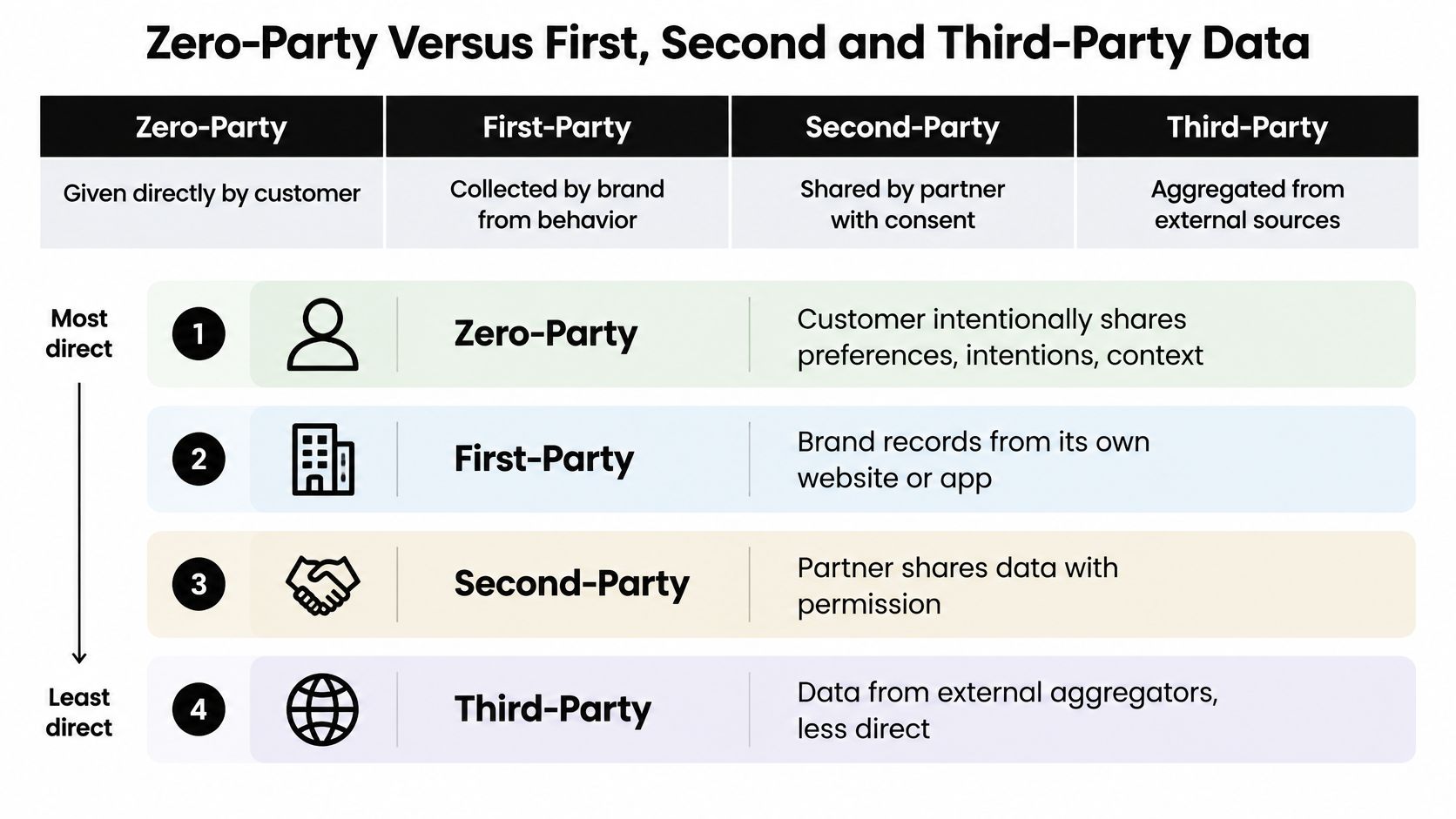
Read those rows from top to bottom and you move from most direct to least direct. Each type answers a different question: what someone told you, what someone did on your site, what a partner knows about them, and what a broker guesses about a crowd.
The one-sentence difference
In zero-party collection, the customer chooses what to tell you. The other three depend on observation or on someone else's records, which means the interpreting is always yours or a stranger's, never theirs.
First-party data is the workhorse. Your own site, app and emails record pages viewed, emails opened and orders placed, and that trail is accurate about actions while staying silent about motives. A shopper who reads three stroller reviews may be expecting, buying a gift or researching for a friend, and your event stream can't separate those. This explainer on what first-party data includes goes deeper on the category.
Second-party data is a partner's first-party data shared under an agreement: a retailer's purchase records, a loyalty coalition, a co-registration list. Its quality is exactly the quality of the partner's consent practices, which makes it a risk you inherit rather than control.
Third-party data is bought from aggregators that collect across many sites and sell audience segments. Sourcing is often opaque and access keeps shrinking as browsers and regulators tighten the rules. You aren't buying knowledge about a person. You're buying a statistical guess about a group they've been sorted into.
The practical result is a trade. Declared data can be wrong or stale. Behavioral data is consistent and frequently unreadable. Neither wins outright.
Rule of thumb: decide which type a signal belongs to before you act on it. The same dashboard tile can hold a declared answer and a modeled score, and those two deserve different levels of trust.
Why Declared Data Improves Personalization
Personalization usually runs on inference. Cluster the behavior, guess the segment, serve the offer. Declared data flips the order: the visitor states the thing, and the system responds to the statement rather than to a hypothesis about it.
A visitor answering one question about their role is the whole mechanism in miniature.
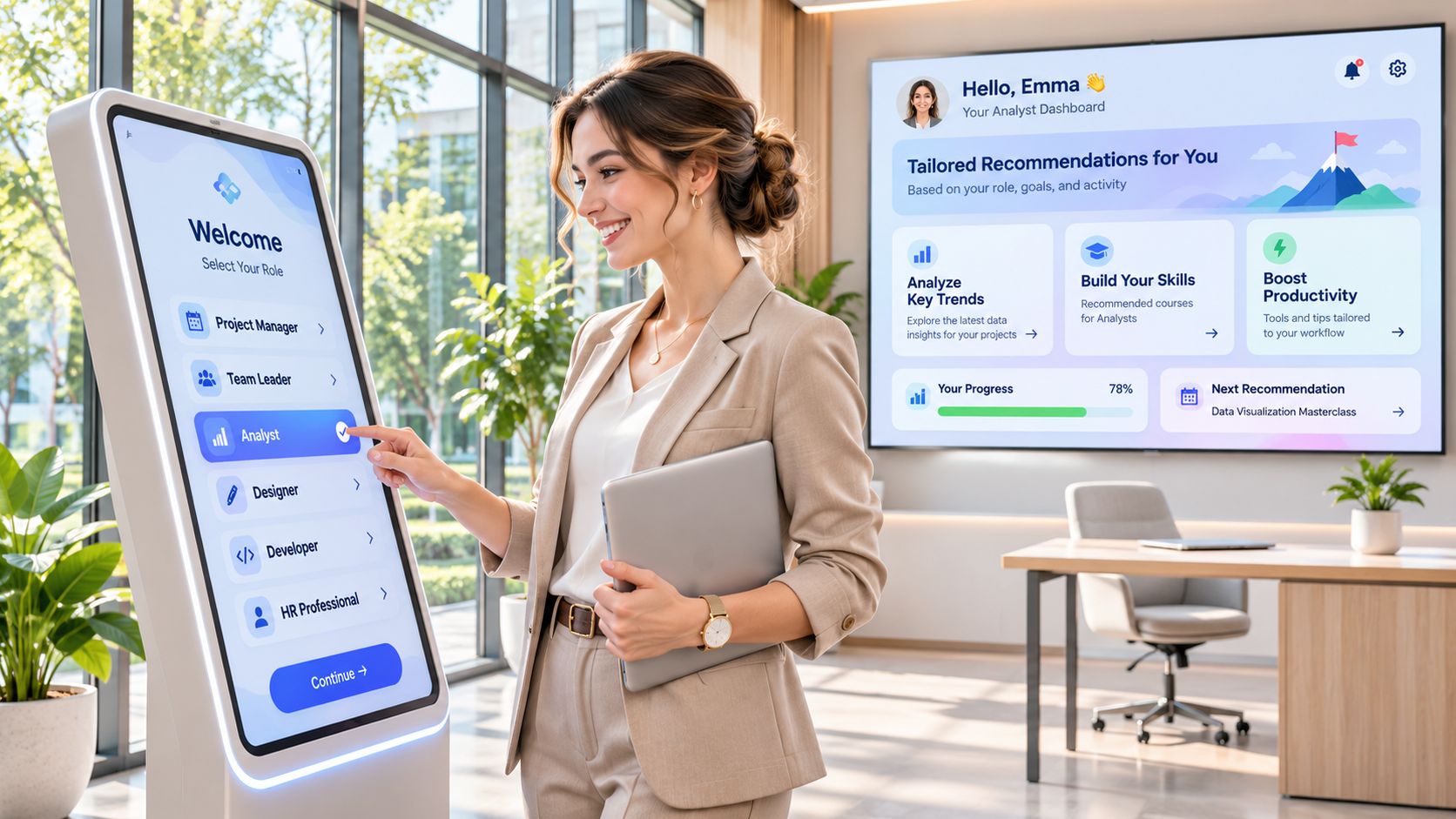
Say a software company's landing page attracts a mix of agency owners and in-house managers. A visitor answers "I manage a team of five." That answer maps to a team plan, a team-oriented case study and a demo booking flow. The agency owner who answers differently sees agency pricing. Neither visitor has to browse three pages before the site works out who they are, and neither one wonders why the page feels off.
Four things improve at once.
- Relevance without the guesswork. A stated use case, budget range or role maps straight to a matching path, including the pricing tier and the proof points that fit.
- A shorter chain from input to outcome. A preference becomes a validated profile attribute, which feeds a rule or a model, which produces a measured result. Fewer hidden steps means fewer places for the logic to drift.
- Explainability. When a colleague asks why a visitor saw the enterprise page, you can point at the answer they gave. The customer can also see what they shared and what changed because of it.
- Less reliance on rented segments. As passive identifiers and third-party tracking decline, an answer a visitor gave you directly is a signal nobody can revoke.
That last point is the commercially interesting one. The website personalization examples that hold up over time tend to run on inputs the business owns rather than segments it licenses.
The catch is that a declared answer is a claim, not a fact. People misread questions, pick the option that sounds impressive, and change their minds three weeks later. A team that treats one quiz response as permanent truth ends up with a confident, wrong profile, and then blames personalization when the numbers don't move.
Practical Use Cases and When to Ask
| Use case | Question to ask | Data it produces | What changes for the visitor |
|---|---|---|---|
| Product finder | Which outcome matters most to you? | Declared need or goal | A matched product path |
| Preference center | How often do you want to hear from us? | Communication frequency and topics | Email cadence and content set |
| Landing page context | What brings you here today? | Stated purpose and use case | Headline and call to action match the goal |
| Returning visitor recognition | How should we greet you? | Name and preferred language | Familiar wording on return visits |
| Purchase planning | What are you planning to buy this quarter? | Purchase intention and timing | Reminders timed to the plan |
Each row is a working pattern, not a theory. The product finder earns its keep because it turns a browsing session into a stated goal, and the preference center earns its keep because it prevents unsubscribes from people who wanted less email rather than none.
When to ask and when to infer
Timing decides whether the question feels helpful or intrusive. Asking a first-time visitor to fill in a five-field profile before they've read a headline adds friction and invites throwaway answers. Asking after someone has opened a pricing page or reached a product category makes the same question feel like a service.
Evidence on the format is encouraging but limited in scope. In a US survey of 1,500 working-age consumers, 27% preferred online forms as the way brands capture information, while interactive surveys drew the larger share, and the same study found that being asked directly made people more likely to trust a brand, according to the Attest research on zero-party data in the US. Those figures measure preference and trust. They don't measure accuracy, conversion lift or long-term data quality.
That's the honest limit. Declared context such as acquisition source, country, device or returning status can sit alongside observed results, but it stays a hypothesis until conversions confirm it. A visitor who says they're evaluating for a team of fifty may be a consultant building a proposal for a client who hasn't decided anything yet.
Ask one question when the answer changes what the visitor sees next. Infer everything else.
The rule keeps you honest. If an answer wouldn't alter the next screen, the offer or the follow-up email, you're collecting for a database rather than for the visitor.
Ways to Ask Visitors and What They Prefer
| Method | Best for | Example | Trade-off |
|---|---|---|---|
| Interactive survey | Understanding needs in depth | Multi-step questions about goals and budget | Longer; completion drops with length |
| Online form | Collecting profile details | Name, company and role fields | Feels like paperwork and draws less interest |
| Product-finder quiz | Matching visitors to products | Which outcome matters most? | Needs careful question design |
| Preference center | Managing email and content | Topics and sending frequency | Mainly suits existing subscribers |
| Single progressive question | Landing pages and fast decisions | One question per visit | Slow to build a full profile |
Format matters as much as the wording. A 2023 Attest research program surveyed 1,885 working-age consumers in the United Kingdom across three nationally representative surveys, and found that 36.8% preferred online forms as the way a brand captures data about them, with interactive surveys taking the larger share, according to the Attest zero-party data research. The preference held across the age range, from 49.3% of respondents aged 18 to 24 to 50.5% of respondents aged 55 to 64 selecting surveys as their preferred collection method. The same research found that 50.0% of respondents would be more likely to trust brands seeking zero-party data instead of relying on passive collection methods.
Two things follow. Interactive questions aren't an exotic technical build; quizzes, forms and preference centers are familiar furniture on most websites. And explicit collection connects personalization with the control people expect to have over their own details.
A quiz suits someone at the start of research who doesn't yet know the vocabulary. A preference center suits an existing subscriber managing their inbox. A single question on a landing page suits a fast decision where the visitor is already halfway to a choice. The phrasing of the ask moves response rates too, and this roundup of website feedback examples from Otter A/B shows how differently two versions of the same question read on a live page.
If forms are your main mechanism, the field choices matter more than the design. This guide to website forms for lead generation covers how to keep them short enough that people finish.
One caution before you celebrate the completion rate. A high completion rate is not the same as an accurate answer. People finish forms quickly, pick the middle option and move on.
Accuracy and Privacy Limits to Plan For
The most common mistake in articles about declared data is the assumption that volunteered information is automatically compliant or risk-free. It isn't either.
A person sharing a preference has not handed over permission for every later use of it. Organizations still need a clearly stated purpose, an appropriate lawful basis, access and deletion processes, and a working way for people to withdraw permission, as this guide to zero-party data surveys and consent explains. Consent is one lawful basis among several, and asking a question doesn't make every subsequent use permissible.
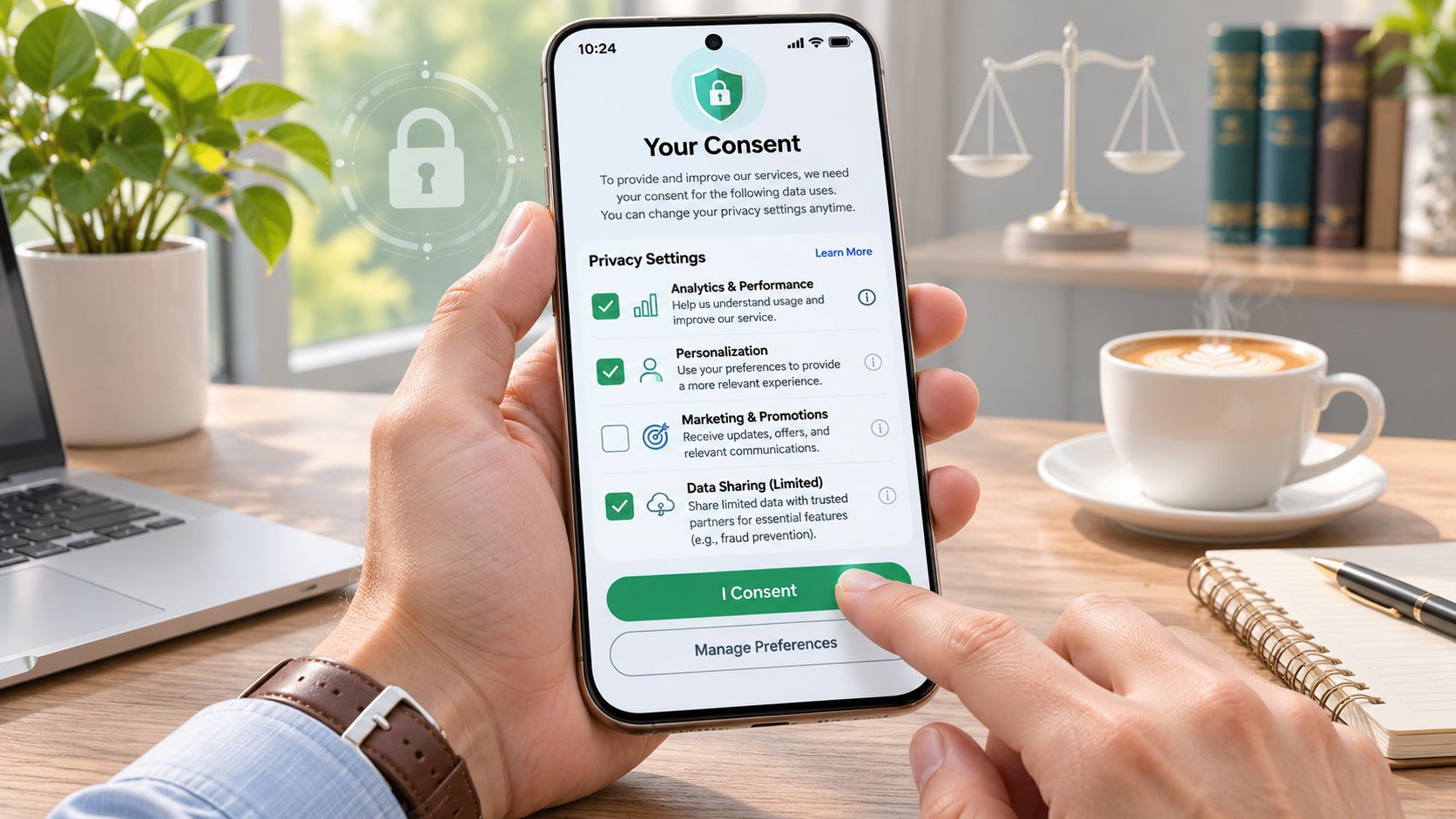
Privacy requirements differ by jurisdiction, so global teams need one habit that travels well: explain why the data is requested, use it inside that stated context, and keep evidence of the choice. Treating a declared preference as a license for unrelated personalization burns the goodwill that produced the disclosure.
Accuracy is the second gap. Customers misread questions, give the answer they think is expected, and change their situation. A visitor ticks "enterprise" to access a demo and turns out to be a student comparing options for a course project. A shopper selects "sensitive skin" because a friend's recommendation is on the same page. Sizing is the classic case: a declared size tells you what someone believes about their body, not what a tape measure would find, which is why apparel teams pair stated preferences with something closer to physical reality, like this fit measurement guide for apparel retailers.
There's a cleaner way to keep the record honest. Separate what a customer declared from what your system concluded. A customer saying "I need enterprise security" is zero-party data. A model predicting "high-value enterprise lead" is an inference, and it should be labeled as one and governed accordingly, as this analysis of zero-party data practices argues.
Before every use: what does this data allow us to do, and what does it not allow us to do?
That question catches most of the trouble early, before a campaign ships.
Start with One Clear Question on Your Landing Page
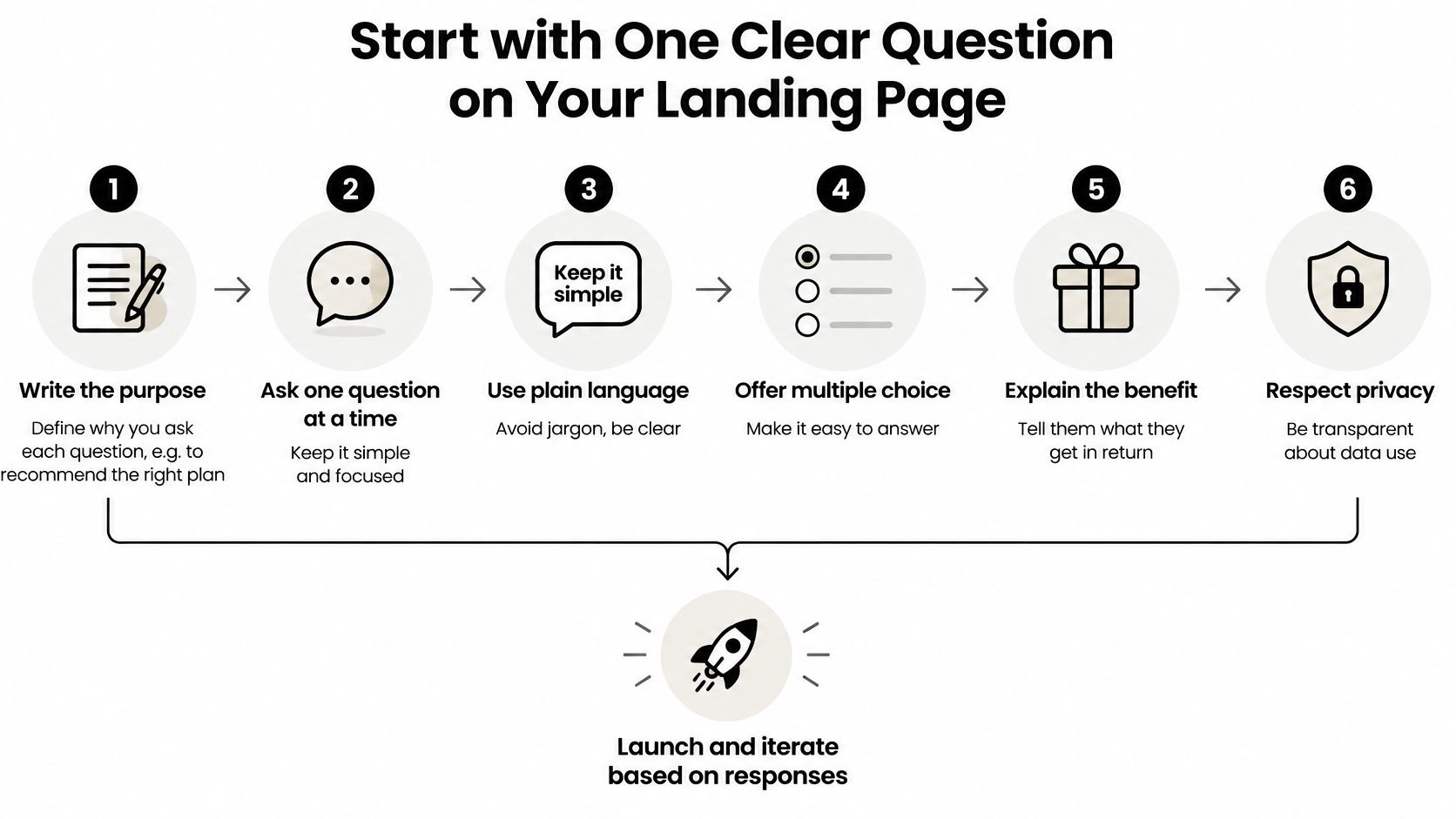
You don't need a data platform to begin. You need one question whose answer changes what the next visitor sees, and six habits that keep it useful.
- Write the purpose before the question. "To recommend the right plan" or "to choose the right onboarding path". If you can't finish that sentence, delete the field.
- Ask one question per visit. Progressive profiling beats a long form, and it lets you add a second question when the visitor comes back.
- Store the answer with its context. Timestamp, question version, page it came from, and the purpose or consent it was collected under. Without those, you can't explain the decision later or prove the permission existed.
- Map each answer to a rule the business can explain. Answer goes in, matched experience comes out. Anyone on the team should be able to trace which input drove which result.
- Re-ask high-impact attributes. Roles change, budgets change, skin changes. Research commissioned by Forrester found accuracy is a major challenge in acquiring and using zero-party data, because customers can misunderstand questions, give socially desirable answers or change preferences over time, as this Forrester study on zero-party data reports.
- Test declared segments against behavior-only segments. Compare conversion and downstream retention. If the declared signal doesn't earn its place, you've learned something more useful than another dashboard metric.
Here's the action to take this week. Add one clear question to your highest-traffic landing page and check whether the answer changes what the next visitor sees. Judge it on a single measure: did visitors who answered convert differently from visitors who got the default page? We built Polish around a related principle, where the tool reads the visit rather than the person and uses no cookies, so answering what is zero party data in practice starts with a question you can act on.
Treat every answer as a declared signal that sharpens targeting, never as unquestionable ground truth.
Polish writes a different landing page for every visitor, which is what makes a single well-chosen question worth asking. Install one script and it reads your page, writes new versions of the headline, subheading and CTA, then picks the one that converts best for people like the visitor in front of you, based on the ad, post or search that brought them, the campaign, the device, the country, and whether it's a first visit or a return. Start with one question on your highest-traffic page, then let Polish test where each answer should take the next visitor.
- zero party data
- first-party data
- data privacy
- declared data
- customer preferences
Your website rewrites itself until it converts.
Polish writes new versions of your headlines and CTAs, tests them on your real visitors and keeps the ones that win.
Start free