AI Website Optimization That Converts in 2026
Learn how AI website optimization drives higher conversions in 2026, with practical tactics for personalization, testing, copy, and tech stack decisions.
Published on 15 min read

Table of contents
- Your Landing Page Is Bleeding Revenue Every Minute
- The three arenas a page must win
- What AI Website Optimization Actually Means
- Three jobs, one operating system
- Personalization That Matches Each Visitor
- A practical signal map
- Automated Testing Without the A/B Test Backlog
- Guardrails matter more than clever routing
- AI Copy Optimization Beyond Generic Content Generation
- The integration shape
- Where teams get this wrong
- Choosing Your Optimization Stack and Integration Path
- Designing Pages for AI Discovery and Agentic Traffic
- Your First 90 Days Rolling Out AI Website Optimization
- Days 1 through 30 build the foundation
- Days 31 through 60 create controlled learning
- Days 61 through 90 expand what earns trust
A growth lead is staring at a funnel dashboard late at night. The landing page is attracting qualified visitors, paid campaigns are still spending, and the conversion rate looks acceptable until it's compared with the cost of every lost click. The team has a backlog of experiments, but nobody trusts the results enough to ship them. By the time a winner is approved, the campaign, audience, or offer has already changed.
That's the problem with static pages meeting dynamic traffic. One headline, one hero section, and one CTA are expected to persuade people arriving from different searches, campaigns, devices, countries, and stages of consideration. AI website optimization treats the page as a per-visitor conversion system. It adapts the message, tests alternatives continuously, and makes the page readable not only to humans, but also to AI-mediated discovery systems and agents acting on a buyer's behalf.
Your Landing Page Is Bleeding Revenue Every Minute
A static landing page makes the same argument to everyone. A visitor from a competitor comparison query sees the same headline as someone arriving from a brand campaign. A returning prospect gets the same introduction as a first-time visitor. A mobile shopper sees the same layout decisions made for a desktop screen.
That approach creates a quiet form of revenue leakage. Your team may improve traffic quality, fix tracking, and increase ad relevance, yet the page still loses visitors because it doesn't respond to the context that brought them there. The issue isn't always that the offer is weak. Often, the page asks every visitor to understand the offer from the same starting point.
AI website optimization changes the page from a fixed asset into an adaptive system. It can generate and serve alternative headlines, subheads, proof points, layouts, and CTAs based on visitor context. The important distinction is that the system shouldn't rewrite pages for novelty. It should make a clearer argument for a defined conversion event, then measure whether that argument works.
The three arenas a page must win
A conversion page now has three audiences:
- Human attention: People scan quickly, decide whether the page is relevant, and look for enough evidence to continue.
- AI-mediated discovery: Search assistants and answer engines summarize pages before a visitor clicks, so your offer needs to be clear, structured, and easy to interpret.
- Agentic traffic: Software agents may compare products, retrieve pricing, or initiate an action without consuming the page like a human does.
The first arena rewards relevance and speed. The second rewards semantic clarity and structured information. The third rewards accessible actions, machine-readable offers, and predictable page architecture.
Practical rule: Don't ask whether AI should “write your website.” Ask which page decisions can safely adapt, which outcomes will prove the change, and which visitors should never see an experimental message.
Before adding a model, document the current funnel. Identify the page, source, device, and conversion event that matter most. Resources such as how to ship landing page experiments can help your team turn scattered ideas into controlled page changes, while this landing page optimization guide offers another useful reference for assessing the page before you start experimenting.
What AI Website Optimization Actually Means
The term gets used for everything from AI-written blog posts to automated SEO audits. That's too broad to be useful. In a conversion program, AI website optimization has three connected jobs: personalize the page for the visitor, test the available choices continuously, and improve the wording at the message level.
Three jobs, one operating system
Per-visitor personalization determines which version fits the current visitor. It can use acquisition context, declared audience information, device class, geography, visit history, or behavior on the page. The output might be a different headline, a more relevant proof point, or a CTA that matches the visitor's readiness.
Continuous automated testing learns whether those choices work. Without experimentation, personalization becomes guesswork with attractive screenshots. The system needs a control experience, clear goals, and enough discipline to retire variants that don't contribute to the desired action.
Message-level copy optimization supplies the alternatives. It doesn't exist to publish endless content. It rewrites the elements that influence a decision, such as the headline, subhead, benefit bullets, CTA label, objection handling, and proof near the form.
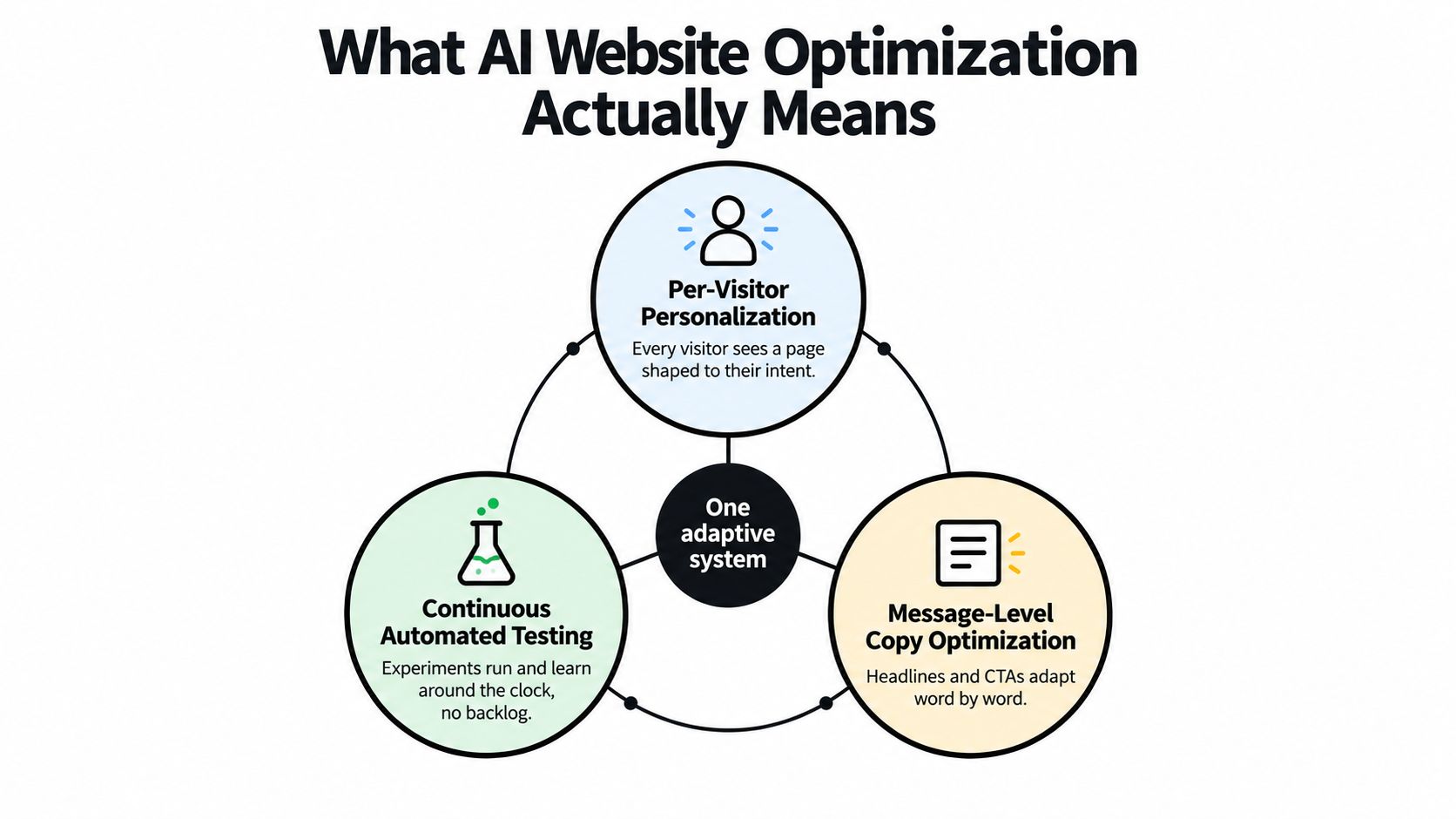
These jobs interlock. Personalization needs testing to learn. Testing needs meaningful variants to compare. Copy optimization needs visitor context to stay relevant. Remove any one of the three and the system becomes less useful.
Traditional CRO tools usually depend on hand-built audience rules and scheduled A/B tests. A marketer defines a segment, creates a page variation, waits for a result, and chooses whether to keep it. That workflow still has a place for high-risk changes, but it creates a queue and treats the page as a sequence of isolated decisions.
An AI-driven system can make model-assisted decisions across more combinations, while still operating inside human-defined constraints. It can propose message candidates, route visitors toward promising experiences, and learn from conversion events. That doesn't make judgment unnecessary. It makes judgment more valuable because the team focuses on goals, guardrails, positioning, and evidence instead of manually producing every variation.
Personalization That Matches Each Visitor
Personalization should answer one question: what does this visitor need to understand next? It shouldn't change a page just because the system knows something about the visitor.
A paid-search visitor may need immediate confirmation that the page matches the promise in the ad. An organic visitor may need category context and proof. A referral visitor may already trust the source and need a clearer explanation of how the product works. A returning visitor may be ready for a demo, checkout, or comparison instead of another introduction.
The strongest implementations start with the message, not the visual effect. Change the headline when the visitor's intent is materially different. Change the CTA when the visitor's readiness is different. Change the hero image only when the image helps the visitor recognize their use case faster.
A practical signal map
| Visitor Signal | Page Element Rewritten | Example Variant |
|---|---|---|
| Competitor comparison search | Headline and proof point | “A simpler way for SaaS teams to manage campaign experiments” |
| Product-category organic search | Subhead and benefit bullets | “Test landing page messages without rebuilding your entire funnel” |
| Paid campaign source | Headline alignment and CTA | “See the workflow from your campaign” |
| Returning visitor | CTA and objection handling | “Continue your evaluation” |
| Mobile device | Hero layout and CTA placement | A shorter headline with the primary action visible earlier |
| Country or market | Offer language and supporting proof | Local terminology, currency, or market-specific availability |
A SaaS trial page might use “Start your free trial” for a broad visitor, then use “See how finance teams ship faster” for someone arriving from a finance-focused campaign. The second version doesn't claim a different product. It makes the relevance explicit.
The boundary matters. Over-personalization creates an uncanny experience, especially when the page reveals information the visitor didn't knowingly provide. Use frequency caps so the same person doesn't see a different message on every visit. Exclude logged-in users from acquisition experiments when their needs are already known. Keep regulated, contractual, and pricing claims behind approval rules.
Research cited in the academic study of AI-powered personalization reports conversion and recommendation gains in specific personalization settings, but the operational lesson is more important than the headline result: personalization works best when the segment, message, and conversion event fit together. Don't judge it only by hero clicks. Track qualified signups, demo completion, add-to-cart, checkout progression, activation, and revenue quality.
For a deeper treatment of session-level adaptation, see real-time personalization. The useful standard is simple: each variant should make the visitor's next decision easier, and the team should be able to explain why it was shown.
Automated Testing Without the A/B Test Backlog
The classic A/B test process fails when every idea requires a separate project. The team writes a hypothesis, designs a variation, waits for development, launches the test, checks a dashboard, and schedules a review. Meanwhile, the audience keeps changing and the page remains locked to yesterday's assumptions.
AI automated testing flips the workflow. One page template can support multiple headline, hero, layout, and CTA combinations. The system allocates traffic according to performance, learns which combinations suit different visitor contexts, and retires weak experiences instead of leaving them in circulation indefinitely.
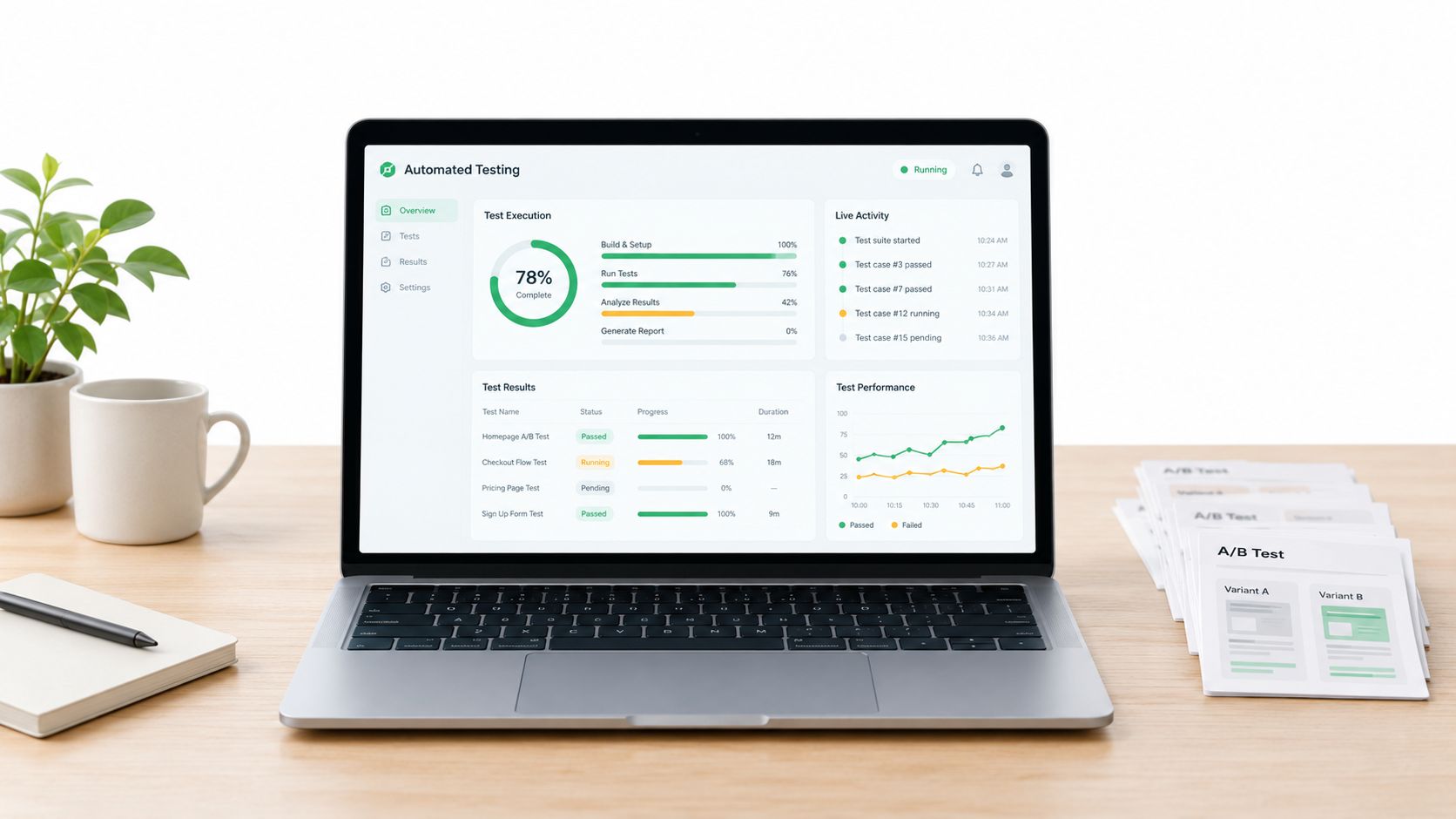
Start with a baseline, not a complicated model. Establish the canonical page, primary conversion event, attribution window, and audience exclusions. Let the system learn from a controlled set of variants before expanding the number of combinations. If traffic is limited, use simple personalization rules and focused tests rather than splitting visitors across too many experiences.
Guardrails matter more than clever routing
An automated testing layer needs protections that a normal dashboard may not provide:
- Sequential testing: Evaluate results as data arrives without pretending every interim check is a final conclusion.
- False-discovery control: Prevent a large collection of weak variants from producing misleading winners.
- Minimum effect thresholds: Don't promote a change just because it wins by a negligible margin.
- Holdback traffic: Keep a portion of visitors on a stable experience to measure whether short-term clicks become durable conversions.
- Business-event tracking: Connect page behavior to qualified leads, activated accounts, completed orders, or another outcome beyond the first click.
The multi-armed bandit approach is useful when the cost of sending traffic to a weak experience is high and the team wants to shift exposure toward promising variants. It isn't a substitute for experiment design. A bandit can optimize toward the wrong event just as efficiently as it can optimize toward the right one.
Give the team a regular review cadence. The review should show which variants were introduced, which segments responded, what was retired, and whether the page changed downstream performance. That creates a product-style shipping log rather than a statistics ritual.
Guardrail: Never let automated routing promote a message that compliance, product, or sales teams haven't approved for use. Speed is valuable only when the system stays inside a safe message space.
The operational shift is significant. Marketers spend less time maintaining a queue of isolated experiments and more time defining useful inputs, reviewing learning, and deciding where the system should expand.
AI Copy Optimization Beyond Generic Content Generation
Generic AI writing tools produce text. AI copy optimization produces testable messages tied to a conversion goal. The difference is context.
A useful copy system reads the page template, traffic source, visitor behavior, brand voice rules, approved claims, prior test results, and target event. It then proposes alternatives for specific components, such as a headline for paid search visitors, a subhead for returning prospects, or CTA microcopy for a visitor who has already engaged with the product explanation.
That's different from asking a model to “write a landing page.” The page already exists. The optimization layer identifies where a visitor may be hesitating and generates a bounded alternative that addresses that hesitation.
The integration shape
A practical implementation can connect a copy service to the CMS or experimentation layer through an API or edge function. The workflow should:
- Read the page structure and approved brand context.
- Pull the visitor segment and acquisition information.
- Generate a small set of message candidates.
- Check claims, tone, terminology, and compliance.
- Register each candidate as a named experiment variant.
- Serve it to an eligible audience.
- Send the conversion outcome back to the measurement layer.
The system should rewrite message-level components, not alter the whole page. Keep the product promise stable. Let the model explore ways to explain that promise more clearly.
The Unbounce Conversion Benchmark Report analyzed more than 44 million conversions across 33,000 landing pages and reported an overall median landing-page conversion rate of 3.4%. It also reported that AI-optimized pages converted 30% higher than the median across industries, with gains of 41% in finance, 37% in healthcare, and 32% in e-commerce, while visitors spent 29% less time engaging with digital content before deciding. Those figures support a practical conclusion: message clarity and rapid adaptation matter, especially when visitors make decisions quickly. They don't justify publishing unreviewed copy everywhere.
Where teams get this wrong
- Hallucinated claims: The model invents outcomes, integrations, customers, or performance statements.
- Off-brand tone: The page starts sounding like a generic software advertisement.
- Infinite variants: Too many candidates divide traffic and make learning meaningless.
- Unowned changes: Nobody knows who approved the message or how to disable it.
Every generated message needs a clear owner, a test ID, an approval state, and a kill-switch. If it can't be measured inside the funnel, it isn't optimization. It's uncontrolled publishing.
Choosing Your Optimization Stack and Integration Path
Teams often choose between a bolt-on system and a native optimization platform. Vendor demos frequently make both paths look effortless. The tradeoffs become clearer when you evaluate who owns the page, the data, and the decision logic.
A bolt-on stack adds AI personalization and experimentation to an existing CMS such as WordPress, Webflow, or Shopify. Tools such as Mutiny, Optimizely Web Experimentation, Convert, and Dynamic Yield can sit around the current site, while a connected AI service supplies approved copy variants.
A native stack gives the optimization layer more control. That might mean a headless CMS with personalization built into the content model, or an experimentation-first platform such as Statsig or GrowthBook with model-assisted variant generation.
| Dimension | Bolt-On AI Tools | Native AI-Native Platform |
|---|---|---|
| Time to first experiment | Faster for an existing site | Slower while the page model is established |
| Cost at scale | Often combines seats, usage, or impression fees | May provide broader platform pricing, with implementation work |
| Data control | Can depend on vendor profiles and integrations | More control over first-party events and decision logic |
| CMS fit | Works through themes, scripts, and page-layer changes | Works through components and a structured content model |
| Team skills required | Marketing operations and analytics | Engineering, data, product, and marketing operations |
Choose bolt-on when speed matters, the team is small, and the current CMS already supports the page experience you need. It's the sensible path for validating whether adaptive messaging earns a place in the growth system.
Choose native when personalization, experimentation, and content delivery are already central to the product architecture. Native systems make more sense when the business has strong data gravity, complex product surfaces, or a long-term reason to own the decision layer.
A custom in-house stack is rarely justified below $50 million in annual recurring revenue unless the data model itself is the company's moat. That threshold is a strategic rule of thumb, not a universal law. Most organizations underestimate maintenance, QA, attribution, governance, and the cost of keeping model behavior reliable.
The build-versus-buy decision should follow operational reality. Buy speed when you're still proving the motion. Build control when the optimization layer becomes a durable part of the product.
Designing Pages for AI Discovery and Agentic Traffic
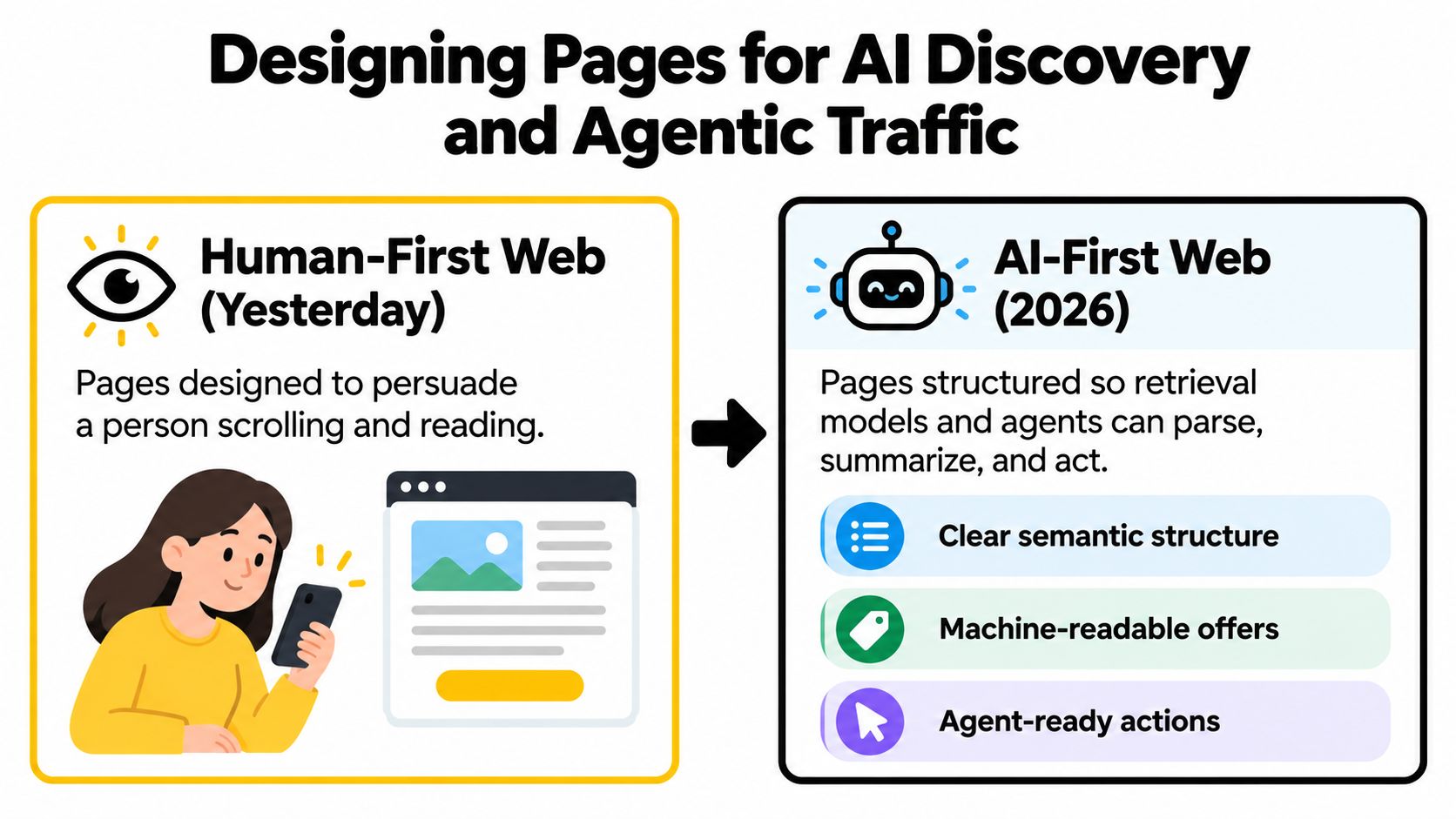
The next conversion bottleneck may occur before a person reaches your website. A retrieval model may summarize your product for the buyer, or an agent may compare your offer with alternatives and decide whether to click, request information, or continue searching.
That makes dual legibility a design requirement. The page must persuade a human scanner while giving machines clean facts they can retrieve, summarize, and act on. A beautiful hero section with key information hidden behind JavaScript may work for a visitor who waits for every interaction to load. It may be much less useful to a system extracting structured page content.
The 2025 Previsible AI Traffic Report tracked 19 GA4 properties and found that traffic from large language models rose from about 17,000 sessions to 107,000 sessions when comparing January through May in consecutive years. The same industry summary notes that some sites receive more than 1% of total sessions from platforms including ChatGPT, Perplexity, and Copilot, while AI Overviews have appeared in roughly 30% of U.S. desktop keywords and 12.8% of searches by volume globally in some measurements. Treat these figures as signals of changing acquisition patterns, not as a forecast for every site.
Build commercial pages so both audiences can understand them:
- Put pricing, product capabilities, integrations, eligibility, and primary actions in accessible HTML.
- Use structured data that accurately labels products, offers, reviews, and other relevant entities.
- Keep the core value proposition visible without requiring a client-side interaction to reveal it.
- Add a machine-readable product feed or an appropriate
/llms.txtfile when it fits your publishing and governance model. - Segment AI referrals and agentic visits in analytics instead of treating all non-human traffic as noise.
The AI search trends analysis also highlights rising demand for AI visibility tracking, including queries for “ai search tracking” up 184% and “ai rank tracking” up 175%. The point isn't to chase every new label. It's to understand where your brand appears in mediated discovery and whether the resulting visitors can complete the next action.
Design principle: If a buyer's first impression is drafted by an AI system, your page needs to be easy for that system to describe accurately before it tries to persuade the buyer directly.
Your First 90 Days Rolling Out AI Website Optimization
Most optimization programs fail because the team buys a tool, changes a hero banner, and judges the entire strategy before the measurement system has learned anything useful. Start with one commercial page and one business outcome. Expansion comes after the team can explain what changed, for whom, and whether the change improved the funnel beyond a superficial click.
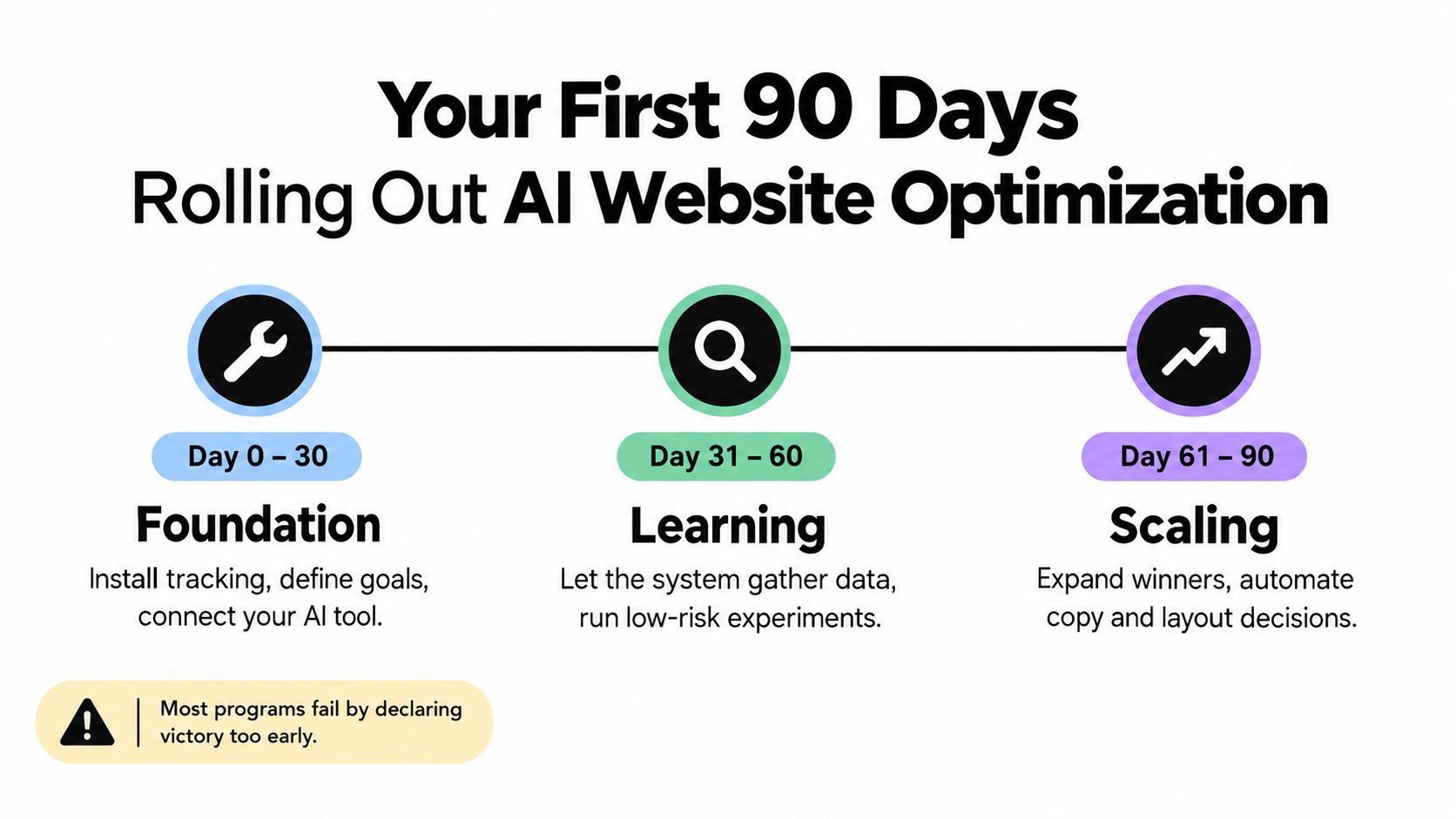
Days 1 through 30 build the foundation
Audit the funnel by traffic source, device, geography, and new versus returning status. Select one high-value landing page, define the primary event, and verify that analytics can connect each experience to that event. Document approved claims, prohibited claims, brand voice, and the conditions that should exclude a visitor from personalization.
Your baseline should include more than the hero CTA. Track the meaningful steps that lead to revenue, such as qualified signups, demo completion, add-to-cart, checkout progression, or activation.
Days 31 through 60 create controlled learning
Launch one personalization segment with a clear reason for the change. Add a limited set of headline, subhead, or CTA variants, then protect the experience with a holdback and approval workflow. Review the results regularly, but don't promote a winner because it produces an attractive early click if downstream quality falls.
Use this stage to establish ownership. Marketing should own the message brief, growth should own the experiment, analytics should own measurement, and legal or compliance should approve sensitive claims.
Days 61 through 90 expand what earns trust
Add segments only when the first one produces interpretable learning. Codify sequential testing, false-discovery control, minimum effect thresholds, and exclusion rules. Complete the machine-legibility pass by checking semantic structure, accessible commercial facts, structured data, and agent-ready actions.
A practical scorecard compares the predicted improvement with actual business impact. For AI visibility and brand citation in AI answers, add a monitoring process that records where the brand appears, how the offer is described, and whether those mentions lead to useful visits.
The rollout should leave you with:
- A measured pilot: One page, one primary event, and a documented baseline.
- A controlled segment: A defined audience with an explicit personalization rationale.
- A safe variant system: Approved messages, named tests, and a kill-switch.
- A quality scorecard: Micro-conversions connected to qualified outcomes.
- An AI-ready page: Clear HTML, structured commercial information, and accessible actions.
Polish provides an autonomous landing page optimization workflow that reads a page, generates headline, subheadline, and CTA variants, serves them to visitors based on context, and keeps learning from performance. Visit Polish to evaluate whether that per-visitor approach fits your next AI website optimization pilot.
- ai website optimization
- conversion rate
- personalization
- A/B testing
- landing pages
Your website rewrites itself until it converts.
Polish writes new versions of your headlines and CTAs, tests them on your real visitors and keeps the ones that win.
Start free