10 AI Copywriting Tools for Better Marketing Copy
Compare 10 ai copywriting tools for headlines, CTAs, landing pages, SEO content, workflows, pricing considerations, and practical use cases.
Published on 21 min read
Table of contents
- 1. Polish
- Where Polish fits
- 2. Jasper
- Best use case
- 3. Copy.ai
- The workflow is the product
- 4. Anyword
- Use it before the test
- 5. Writesonic
- Generate assets, then govern AI visibility
- 6. Rytr
- Where Rytr fits in a copy workflow
- 7. Hypotenuse AI
- Built for catalog workflows
- 8. Semrush Content Toolkit
- Research before drafting
- 9. Surfer
- A drafting and optimization layer
- 10. Frase
- From search brief to publishable draft
- Top 10 AI Copywriting Tools Comparison
- Build a Workflow, Not Just a Tool Stack
You need a stronger headline, a clearer CTA, a landing page for a new campaign, and enough supporting copy for ads, email, and search. The problem is that these aren't the same writing job. A tool that produces polished product descriptions may be a poor choice for testing a landing-page hero, while an SEO editor may help a blog article but do little for paid social.
This roundup compares 10 AI copywriting tools by the job they perform in a real marketing workflow. The practical differences are less about whether each platform can produce a readable paragraph and more about brand control, repeatable production, predictive scoring, visitor-level testing, ecommerce scale, SEO research, and AI-search visibility. For broader content workflows, this guide to tools for repurposing content with AI is a useful companion.
The list starts with Polish, which sits closest to the conversion event. It personalizes and tests landing-page copy for visitors. Jasper and Copy.ai help teams generate governed marketing assets, Anyword evaluates performance-oriented variants, and Writesonic and Rytr cover broad, fast production. Hypotenuse AI is built for product catalogs, while Semrush Content Toolkit, Surfer, and Frase focus on SEO and visibility in AI-generated answers.
The right choice depends on where copy slows your team down. You may need a better generator, a stronger approval system, or a way to learn which version converts.
1. Polish
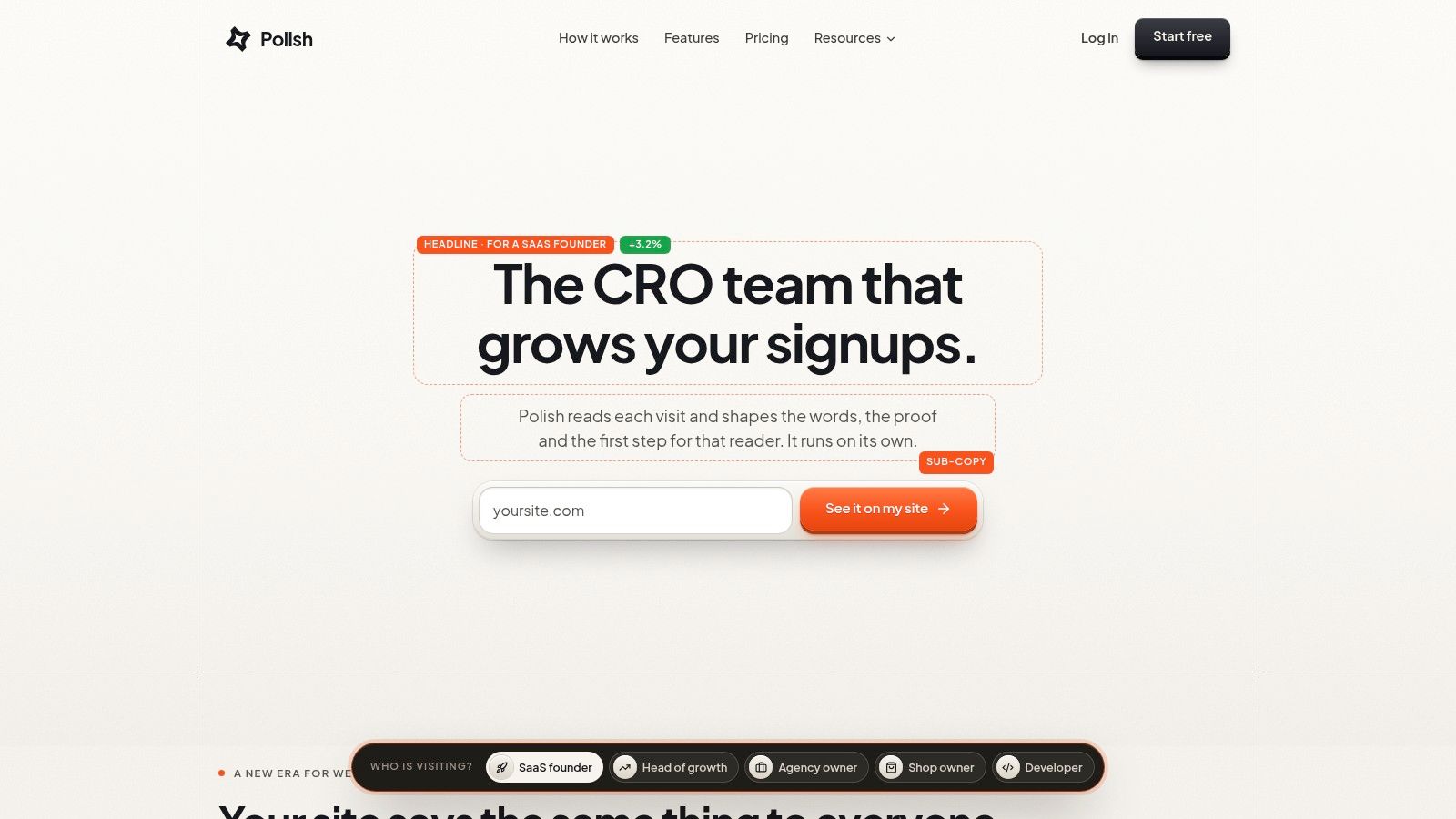
A campaign can have strong traffic and still lose conversions because the landing page shows the wrong message. Polish addresses that problem by acting as an autonomous AI agent for landing pages. It can rewrite headlines, sub-copy, calls to action, proof points, and section order in the website's voice and language, then serve different versions to different visitors.
Polish uses visit context rather than requiring a separate audience page for every campaign. Referrer, campaign, device, language, and new-versus-returning status can shape which copy a visitor sees. The URL and visual design stay the same while the platform measures conversion performance and retains stronger variants.
Where Polish fits
Setup requires one script snippet. Its asynchronous first-party pixel is designed to work without cookies, and it supports Next.js, Webflow, WordPress, Shopify, and plain HTML. No-code conversion detection lets a growth manager begin testing without building a separate experimentation stack.
The workflow is built for live conversion copy, not campaign planning or catalog production. Reviewers can inspect a readable feed of pages and variants, approve copy, pause a change, guide the tone, or permit auto-publishing. Multilingual writing and a conversational CRO copilot support iteration, while the headline generator helps explore options before a variant reaches live personalization.
For disclosure-sensitive campaigns, keep approved disclosure wording in the variant review process and exclude versions that do not meet legal or brand requirements. That governance still belongs to the team. Survey evidence on AI advertising and disclosure is available from the American Impact Review.
Practical rule: Use Polish as a conversion optimization layer, then pair it with dedicated tools for campaign messaging, SEO research, or ecommerce copy.
The current plan is $99 per month with a 3-day free trial, unlimited pageviews, AI-written copy in your brand voice, autonomous testing across pages, the first-party pixel, and the CRO copilot. Some advanced capabilities, including page-per-visitor rollout features, may be in early access. The cost fits a site where one additional conversion has meaningful value better than a small project with little traffic.
Polish is strongest when the question is, “Which message should this visitor see?” Human review remains necessary for factual claims, regulated wording, exclusions, and brand boundaries. Teams should also monitor whether dynamic variants support the campaign's promise rather than optimize a message that the rest of the funnel cannot support.
2. Jasper
Jasper is designed for teams that need consistent marketing copy across channels, rather than occasional help with one headline. Its core value is brand governance. You can centralize brand voice, style guidance, product knowledge, and audience context so writers, paid media specialists, and lifecycle marketers aren't each prompting from a different set of assumptions.
Best use case
Use Jasper when the same company needs landing-page copy, ad variants, email campaigns, social posts, and articles that sound like they came from one brand. Brand Voice and Brand IQ provide the control layer, while the workspace brings chat, documents, and agents into one environment.
That setup takes effort. A team will get more from Jasper after it supplies clear source material, approved terminology, product facts, tone rules, and examples of strong existing copy. Without that preparation, the platform can still generate text, but the main reason to buy it is underused.
Jasper's plans combine seats with credits for some advanced features, including agents and its GEO hub. That hybrid model gives larger teams governance, but it also means procurement needs to model how people will use the advanced modules. The advertised seat price isn't the whole operating cost if frequent workflows consume credits.
The practical connection between AI and conversion rate improvement is important here. Jasper can help produce more landing-page options, but it doesn't automatically establish which option improves qualified leads or revenue per visitor. A human or an experimentation platform still has to connect the copy to an outcome.
Pros
- Brand consistency: Strong controls for teams producing copy across multiple channels.
- Broad coverage: Ads, emails, articles, social content, and landing pages live in one workspace.
- Team governance: Workspace defaults and in-editor adjustments help standardize production.
- Documentation: Help and billing materials make evaluation easier for procurement.
Cons
- Credit complexity: Advanced features can add cost as usage grows.
- Setup overhead: Brand controls only become valuable after the team supplies useful guidance.
- Limited testing ownership: Jasper generates variants, but it isn't a complete live conversion testing system.
Choose Jasper when brand inconsistency is the main problem. Don't choose it solely because it can write a competent first draft.
3. Copy.ai
Copy.ai has moved beyond a template library. Its most useful feature is the ability to build repeatable go-to-market workflows that chain multiple AI actions together. That makes it a better fit for teams that produce the same family of assets repeatedly, such as launch copy, nurture messages, outbound openers, or sales enablement material.
The workflow is the product
A typical Copy.ai workflow might take product information, enrich it with approved context, produce several messaging formats, and route the results to the next person or system. Brand Voice and the Infobase provide shared context, while Teamspace supports collaboration and governance.
This is more operationally useful than asking a chatbot to write one email at a time. It also creates a new maintenance burden. Someone has to design the workflow, define inputs, decide what happens when information is missing, and review whether the output remains useful after the campaign changes.
Copy.ai is particularly relevant to growth teams that sit between marketing and sales. It can support repeatable outbound or lifecycle production, not just creative drafting. The trade-off is that the best results require a structured process and ongoing upkeep. A workflow that was built around one product launch may need revision for the next one.
The platform's pricing varies by seats and usage, and enterprise configurations may require help from the vendor. Confirm the current limits before committing, especially if the team expects to run frequent automations rather than occasional generations.
The first workflow to automate should be narrow, repetitive, and easy to evaluate. Don't automate an entire campaign before you know which input fields produce reliable copy.
Copy.ai won't decide whether a generated landing-page variant improves downstream lead quality. It can make the production side faster, but measurement, approval, and publication still need clear ownership. It also shouldn't become a place where unverified product claims are multiplied across channels.
For teams with a defined repeatable process, Copy.ai is stronger than a blank prompt window. For a solo marketer who needs one polished headline, its workflow capabilities may be more machinery than necessary.
4. Anyword
Anyword is built around a performance marketer's decision: which variation deserves testing budget? It generates copy for ads, email, landing pages, social channels, and websites, then adds predictive performance scores and score panels to help teams compare alternatives before launch.
Use it before the test
Anyword's strongest fit is pre-click optimization. A paid media manager can create several versions of a headline or primary text, compare the tool's scoring, and use that information to narrow the initial test set. Persona and pain-point inputs help frame the message around a specific audience rather than a generic buyer.
Content Intelligence also supports optimization of existing assets. That matters when the team already has a library of ads, email subject lines, or page copy and wants to identify opportunities instead of generating everything from scratch.
Predictive scoring should be treated as a prior, not proof. A score can help a team discuss variants with less subjective argument, but it can't replace a controlled experiment. Real performance depends on the audience, offer, traffic source, landing-page experience, device mix, and what happens after the click.
The scoring layer is gated to higher-tier plans, so check whether the plan you're considering includes the feature that makes Anyword distinctive. Teams focused mainly on long-form thought leadership or SEO research may get less value because the platform is designed around performance marketing copy rather than search-led editorial production.
A good Anyword workflow looks like this:
- Define the audience: Supply persona, pain point, offer, acquisition source, and funnel stage.
- Generate alternatives: Ask for meaningful differences in angle, not ten cosmetic rewrites.
- Use the score as a filter: Shortlist candidates without treating the number as a verdict.
- Run a live test: Keep a control version and measure conversion, revenue, or qualified leads.
- Review the losers: A low-scoring variant may reveal a useful message that needs a different audience.
This approach matters because independent benchmark evidence often measures writing quality rather than business outcomes. A 2024 blind evaluation of 10 AI writing tools showed that comparative testing is possible, but also that the task, rubric, and reviewer method determine what a score means (AI Agent Square).
5. Writesonic
Writesonic fits teams that need to move from a brief to usable marketing copy quickly. It covers ads, emails, landing pages, CTAs, and product descriptions, while its more distinctive role is Generative Engine Optimization, or GEO. That makes it relevant when a brand must manage both traditional search visibility and how ChatGPT, Gemini, or Google AI Overviews describe it.
Generate assets, then govern AI visibility
Templates and bulk generation support routine production. API access, Zapier, and a Microsoft Power Platform connector also let teams route drafts into an existing content or campaign workflow. Set the brief first, including audience, offer, proof points, and required claims. Human review remains necessary for positioning, factual accuracy, and conversion intent.
The GEO layer addresses a separate job from writing. Conventional traffic reports cannot show whether answer engines mention a brand accurately. Only about 22% of marketers tracked brand visibility or traffic in AI-generated search environments in 2025, according to Search Engine Land. A team can publish more content while missing incorrect or absent brand references.
Use the GEO report or AI visibility dashboard as a weekly review, checking which prompts produce mentions, whether the cited pages support the claims, and where competitors appear instead. Record changes in a shared log, then update source content or messaging before generating another batch.
Writesonic suits a small team seeking broad production and an entry point into AI-search monitoring. A dedicated SEO suite may provide stronger keyword research, while a CRO platform is better for live conversion experiments. Writesonic can prepare variants, but it cannot replace controlled testing or post-click analysis.
Judge the workflow by discoverability, accuracy, qualified traffic, and conversion quality, not asset volume.
Confirm current plan limits and GEO access before purchase. The Writesonic alternative for startups may suit teams that need a lighter, more focused setup.
6. Rytr
A solo marketer needs five ad variations before lunch, a product blurb by the afternoon, and a cleaner version of yesterday's email. Rytr fits that workload. It targets short-form marketing copy, including social captions, product descriptions, emails, ads, bios, and quick rewrites, without requiring a large content operations platform.
Where Rytr fits in a copy workflow
Rytr is most useful at the drafting and editing stage. Choose a marketing use case, set a tone, and work in the web editor. Rewrite, expand, and shorten actions let users improve an existing sentence instead of building a detailed prompt from scratch. Multilingual generation can produce first drafts for additional markets, provided a fluent reviewer checks meaning, tone, and local usage.
That setup keeps the tool easy to adopt. Onboarding is straightforward, and its lower-cost starting point suits occasional workloads. A solo marketer or small team can keep review close to the person creating the copy, which limits the risk of unnoticed errors.
Use Rytr for these jobs:
- One-off drafts: Create a starting point for a caption, email, or product description.
- Quick revisions: Shorten, expand, or rewrite existing copy without configuring a campaign system.
- Small-team production: Give one or a few users a structured alternative to a blank chat interface.
- Multilingual first drafts: Prepare initial versions for review by someone fluent in the target language.
Rytr becomes less suitable as messaging governance becomes more demanding. Compared with Jasper or Copy.ai, it offers less depth in shared brand controls, workflow administration, and oversight across multiple brands. Product claims, positioning, and protected voice still require human review. For conversion-sensitive copy, another tool or a controlled test is also needed.
The early adoption pattern for AI writing supports this assisted workflow. A systematic review in PMC reported that a survey shortly after ChatGPT's release found 22% of researchers had already used it. In a summarized sample of 150 respondents, grammar checking was the most common use at 55.3%, followed by writing suggestions at 48.7%. Rytr addresses that same entry point by improving familiar drafting and editing tasks.
Choose Rytr for speed, accessible setup, and cost control. Choose a broader platform when governance, experimentation, or enterprise administration drives the decision.
7. Hypotenuse AI
An ecommerce team with thousands of products faces a production problem, not a blank-page problem. Each description must reflect structured product data, follow category rules, support the required languages, and avoid claims that the source fields cannot support. Hypotenuse AI is designed for that workflow.
Built for catalog workflows
The platform focuses on bulk product-description generation and enrichment across ecommerce catalogs. It supports retail content types, multilingual workflows, and data-handling processes for teams managing product information at scale. Enterprise plans add workflow controls and compliance options for organizations with more complex approval requirements.
A practical setup starts with a representative catalog export. Define which source fields the system may use, then set rules for prohibited claims about performance, availability, certifications, and materials. Category requirements should differ by product type, so apparel, electronics, beauty, and regulated goods need their own formats and checks.
Approval rules determine whether every description receives human review or whether low-risk updates can use sampling. Teams also need a change process for revised prices, specifications, and inventory attributes. Without these controls, bulk generation can spread one incorrect field across many product pages.
Human review remains necessary for product facts, measurements, compatibility, materials, category restrictions, and any claim that could affect customer expectations. Hypotenuse AI can produce consistent drafts from structured inputs, but it does not validate whether those inputs are current or complete.
The catalog focus is the main reason to choose it. A general AI copywriter may create an attractive page for one item, while Hypotenuse AI is better suited to repeatable production across a large inventory. It is less suitable for narrative editorial work, campaign strategy, or testing whether one category-page CTA converts better than another. Those jobs require a different tool or a controlled experiment.
Public self-serve pricing for ecommerce tiers is limited, and several plans are sales-gated. Smaller merchants should request a demonstration using representative catalog data rather than accepting a polished sample product as proof of fit. Hypotenuse AI earns its place when catalog consistency and throughput matter more than creative range.
8. Semrush Content Toolkit
Semrush Content Toolkit, formerly ContentShake AI, connects AI-assisted writing with Semrush SEO data. It is designed for the search-content workflow, from topic discovery and briefs through drafting, optimization, and in-editor assistance. Choose it when the team needs a repeatable process for planning and improving organic-search articles, not a general-purpose workspace for every copy format.
Research before drafting
Start in Topic Finder by grouping related queries and identifying the reader's intent. Turn that research into a brief with the SEO Brief Generator. A useful brief should define the primary question, supporting subtopics, audience, desired action, product or service evidence, and internal sources the writer can verify. The AI Article Generator can then produce a first draft against those requirements.
The sequence matters. A search-focused tool can organize coverage, but it cannot decide whether the company has credible proof or whether the proposed angle is worth publishing. Add original examples, customer language, product constraints, and expert review before asking the optimizer to assess the page.
Run the optimizer after adding your own product evidence and a customer quote. Fix only high-relevance intent subtopics that are truly missing. Do not add awkward phrases or repeat points just to raise the score.
Semrush Content Toolkit fits an SEO team better than a paid media manager who needs large sets of ad variations. It can help create related assets around an article, but it does not replace landing-page testing, a product catalog system, or a lifecycle copy workspace. Teams still need another tool or a controlled experiment for conversion decisions.
The subscription is sold separately from the core Semrush SEO toolkit. Existing customers should confirm included datasets and usage limits. New users should price this content workflow independently from the wider platform.
Editorial standard: Use the optimizer to find omissions and structural weaknesses. Publish only after the article sounds like it was written for a real buyer.
AI-written content also requires checks beyond rankings. Search visibility can change while factual errors damage trust, so editorial review and brand measurement remain necessary. Search Engine Land discusses the broader shift in search and AI-assisted content. Semrush supports production and optimization, not final approval.
9. Surfer
Surfer combines an AI content writer with SEO guidance and AI Search Analytics. It suits teams that want to draft or improve long-form pages while also tracking how their brand appears in AI-generated answers.
A drafting and optimization layer
Surfer AI provides guided, SEO-structured drafts. Its broader SEO scaffolding helps writers understand what ranking pages cover and where a draft may be incomplete. AI Search Analytics adds a separate visibility question: whether assistants mention the brand, how they position it, and where competitors appear instead.
That combination is useful for content teams working across traditional search and AI-answer environments. It doesn't make Surfer a complete marketing copy suite. Ad, email, and lifecycle templates are limited, so a team buying it for long-form SEO may still need Jasper, Copy.ai, or another tool for campaign production.
The main risk is optimizing for the interface instead of the reader. A content score can reveal missing subtopics, but it can't judge whether the page has a distinctive point of view, accurate evidence, or a persuasive next step. Writers should use the guidance as an editing aid, then remove repetition and unnatural phrasing before publication.
Examples of AI in marketing show why generation and deployment should be considered separately. Surfer can help prepare search-facing copy, while a conversion platform or analytics setup is still needed to learn whether that copy changes visitor behavior.
Plan selection also requires care. Trial access and documentation help with initial evaluation, but pricing for some tiers is sales-led and less transparent. Model the number of documents your team will optimize, the frequency of revisions, and whether AI Search Analytics is included in the plan you need.
Choose Surfer when SEO structure and AI-answer visibility are central. Don't choose it expecting a general-purpose campaign writer.
10. Frase
Frase fits the research stage of a real copy workflow. A content lead can start with a search question, review ranking pages, build an outline, generate a draft, and score revisions in one workspace. That reduces the handoffs between research, briefing, writing, and optimization.
From search brief to publishable draft
The platform is most useful before and during the first draft. It examines competing pages, surfaces headings and questions, and turns those findings into a brief that gives the writer a defined assignment. Its AI writer can produce a starting draft or scaffold, while the editor and content score help identify areas for revision.
The trade-off is clear: Frase speeds preparation, but it does not replace editorial judgment. Writers still need to fact-check claims, add original examples, apply brand-specific insight, and decide whether the article genuinely answers the reader's question. Similarity to ranking pages is not proof of usefulness.
For teams managing an existing site, audits can reveal gaps and update opportunities across published content. API access and an agent can support research-to-draft tasks in a larger production process. GEO-aware features also give search-led teams a way to examine how content may perform in AI-answer environments. Check the plan details before buying because feature availability varies by tier.
Frase makes the strongest case for SEO long-form production. Jasper, Anyword, or Copy.ai may fit better when the workflow centers on ads, email, lifecycle campaigns, or broader marketing asset creation. Frase does not turn a landing page into a live visitor-level experiment, and it is not designed to enrich thousands of ecommerce product records.
Use it when the workflow needs to:
- Build better briefs: Give writers search context before drafting begins.
- Audit existing content: Find gaps and opportunities across published pages.
- Reduce tool switching: Keep research, writing, and optimization together.
- Support AI-search work: Add GEO-aware analysis to a search-led editorial process.
A research-first tool should be judged by what happens after publication, not only by how quickly it produces a draft. Teams still need to assess qualified acquisition, conversions, accuracy, and continued usefulness. Frase can make production more disciplined, while human editors remain responsible for evidence, clarity, and the decision to publish.
Top 10 AI Copywriting Tools Comparison
| Product | Core features | UX / Quality | Value & Price | Target audience | Unique selling point |
|---|---|---|---|---|---|
| 🏆 Polish | Per-visitor page personalization, autonomous real‑traffic testing, cookieless first‑party pixel | ★★★★★, hands-off autopilot, transparent feed | 💰 $99/mo (3‑day trial), unlimited pageviews | 👥 Heads of Growth, CROs, Marketing Managers, CEOs | ✨ Per-visitor rewriting + automatic winner-serving; multilingual, no-code |
| Jasper | Brand Voice & Brand IQ, multi‑channel assets, workspace governance | ★★★★☆, team-centric editor & controls | 💰 Seat-based plans + credits for advanced modules | 👥 Large marketing teams, brand governance teams | ✨ Strong brand-governance & consistency at scale |
| Copy.ai | No-code workflows, Infobase, brand voice, teamspaces | ★★★★☆, workflow automation & collaboration | 💰 Usage/seats; variable by plan | 👥 GTM teams, marketers automating repeat tasks | ✨ Chainable automations for repeatable copy workflows |
| Anyword | Predictive performance scores, persona-driven suggestions, variant panels | ★★★★☆, marketer-focused variant UI | 💰 Tiered plans; scoring on higher tiers | 👥 Performance marketers, paid media teams | ✨ Predictive pre-click scoring to estimate ad/landing performance |
| Writesonic | Templates, bulk tools, API, GEO/AI visibility modules | ★★★★☆, versatile for marketing + AI-search | 💰 Tiered plans; GEO features often on higher tiers | 👥 Startups & marketers optimizing AI-search visibility | ✨ GEO modules to optimize for AI-answer visibility |
| Rytr | Many templates, rewrite/expand tools, multilingual output | ★★★☆☆, fast short‑form outputs, simple editor | 💰 Low-cost, straightforward plans | 👥 Solo marketers, freelancers, early-stage teams | ✨ Budget-friendly, quick short-form copy generator |
| Hypotenuse AI | Bulk product descriptions, catalog workflows, 40+ languages | ★★★★☆, built for catalog scale | 💰 Sales‑gated ecommerce pricing for larger catalogs | 👥 Ecommerce merchants, marketplaces, catalog teams | ✨ Catalog-scale generation & enrichment for thousands of SKUs |
| Semrush Content Toolkit | Topic finder, SEO briefs, AI article generator, optimizer | ★★★★☆, SEO-driven drafting & optimization | 💰 Subscription; add-on to Semrush suite | 👥 SEO teams, content studios, agencies | ✨ Tight coupling with Semrush keyword & competitive datasets |
| Surfer (Surfer AI + AI Search Analytics) | SEO-guided drafts, AI Search Analytics, optimization tools | ★★★★☆, strong SEO scaffolding & monitoring | 💰 Subscription tiers; some sales‑led | 👥 SEO/content teams focused on visibility & AI answers | ✨ AI Search Analytics to track AI-answer presence and positioning |
| Frase | SERP research, AI writer, GEO scoring, agent-assisted workflows | ★★★★☆, end‑to‑end research→draft workflow | 💰 Tiered plans with clear packaging | 👥 Content & SEO teams, agencies | ✨ Integrated research + drafting + GEO-aware scoring |
Build a Workflow, Not Just a Tool Stack
The best AI copywriting tool is the one that fits the bottleneck your team can measure. If the problem is that every visitor sees the same generic landing page, choose Polish for continuous, visitor-level personalization and live conversion optimization. It can generate alternative headlines, supporting copy, proof, and CTAs, then test those variants against real traffic instead of leaving the team with a folder of suggestions.
Choose Jasper when several people produce campaign copy and brand consistency has become difficult to control. Its value comes from shared brand voice, product knowledge, and workspace governance. Choose Copy.ai when the same go-to-market workflow repeats across marketing and sales. It makes more sense to automate a sequence of inputs and outputs than to ask a team to recreate the process manually every week.
Anyword is the performance-oriented choice for teams comparing ad, email, and landing-page variants before spending media budget. Its predictive scoring can narrow the field, but the live experiment remains the authority. Use it to prioritize tests, not to declare a winner without exposure to the actual audience.
For broad, fast marketing production, Writesonic covers more formats and adds AI-search visibility features. Rytr is better for simple short-form work, quick rewrites, and solo marketers who don't need a full governance layer. The choice between them depends on whether breadth and integrations matter more than low-cost simplicity.
Hypotenuse AI belongs in an ecommerce workflow with a substantial product catalog. Its bulk generation and structured data handling address a different problem from campaign copy. Make sure product facts, forbidden claims, category rules, and approval steps are defined before scaling any catalog workflow.
For search-led content, choose Semrush Content Toolkit, Surfer, or Frase based on where your process needs help. Semrush is a natural fit when integrated SEO data and content optimization are the priority. Surfer combines guided SEO drafting with AI Search Analytics. Frase focuses on research, briefs, audits, and the path from search question to optimized article.
Don't buy several tools just because each one has a long feature list. Start with one defined workflow, such as testing landing-page headlines, producing a weekly nurture sequence, enriching product descriptions, or building search-led briefs. Give the tool the actual inputs it will receive, then review the output for brand voice, factual accuracy, compliance, conversion relevance, and downstream quality.
A marketing survey found that 85% of teams had increased AI usage since 2024, while copywriting was the leading application at 68% and email subject-line optimization reached 65% (Customer.io). The same research found that nearly four in ten marketers still relied mainly on trial and error. That gap is where the practical advantage lies. The tool matters, but the operating method matters more.
Keep a control version for conversion tests. Randomize eligible traffic. Prevent repeated exposure from contaminating assignments. Track conversion rate alongside revenue per visitor, qualified-lead rate, retention, brand recall, and trust. A variant that wins the immediate CTA click while weakening lead quality isn't a durable improvement.
Governance also needs to match how the copy reaches people. AI-assisted drafting, AI-selected copy, and fully AI-generated visitor-facing copy create different disclosure and approval questions. Marketers commonly check brand voice and factual accuracy, but bias and legal review receive less attention, even though dynamic copy can expose different claims to different visitors (American Impact Review).
Finally, confirm current pricing, plan limits, credits, document allowances, integrations, and gated features before committing. Product plans change, and the most important capability may sit behind a higher tier. A short, measured pilot will tell you more than a long feature comparison.
For broader operational use cases, AI tools for smarter operations can help you think beyond writing and connect generation to the rest of the marketing process.
Polish gives your team an autonomous way to rewrite landing-page copy for each visitor, test the variants on live traffic, and keep the version that converts best in your brand voice and language. If conversion copy is the bottleneck, visit Polish to see how one script can turn a static landing page into a continuously optimized experience.
- ai copywriting tools
- AI marketing tools
- landing page copy
- headline generator
- conversion copywriting
Your website rewrites itself until it converts.
Polish writes new versions of your headlines and CTAs, tests them on your real visitors and keeps the ones that win.
Start free