What Is SEM in Marketing? a Simple Guide for 2026
What is SEM in marketing? Learn how paid search ads work, how SEM differs from SEO, key KPIs, bidding models and how to launch a basic campaign.
 Sacha Kleynjans

Table of contents
- What SEM Means and Which Meaning Your Team Uses
- Separate the activity from the payment model
- The pieces you'll recognize
- The Core Difference
- SEM vs SEO at a glance
- A shoe-store example
- How the Ad Auction Decides Your Position
- What Google evaluates
- Why relevance can beat a bigger bid
- Channels and Ad Formats You Will Use
- Common search ad formats and when to use them
- Match the format to the task
- KPIs and Bidding Models to Track
- Core SEM KPIs and what each one tells you
- Quality Score isn't the auction formula
- Choose bidding around the outcome
- Launch a Small Test Campaign This Month
- Build the test around a business decision
- Judge more than the keyword list
You're comparing agency proposals. One includes SEO in its SEM budget; another quotes only paid advertising. The labels match, but the work doesn't.
Before comparing prices, agree on a naming rule: use “paid search” for advertising, “SEO” for organic search work, and “search marketing” when discussing both. SEM can mean different things across markets and teams, so define it consistently in your budgets, agency agreements and reports.
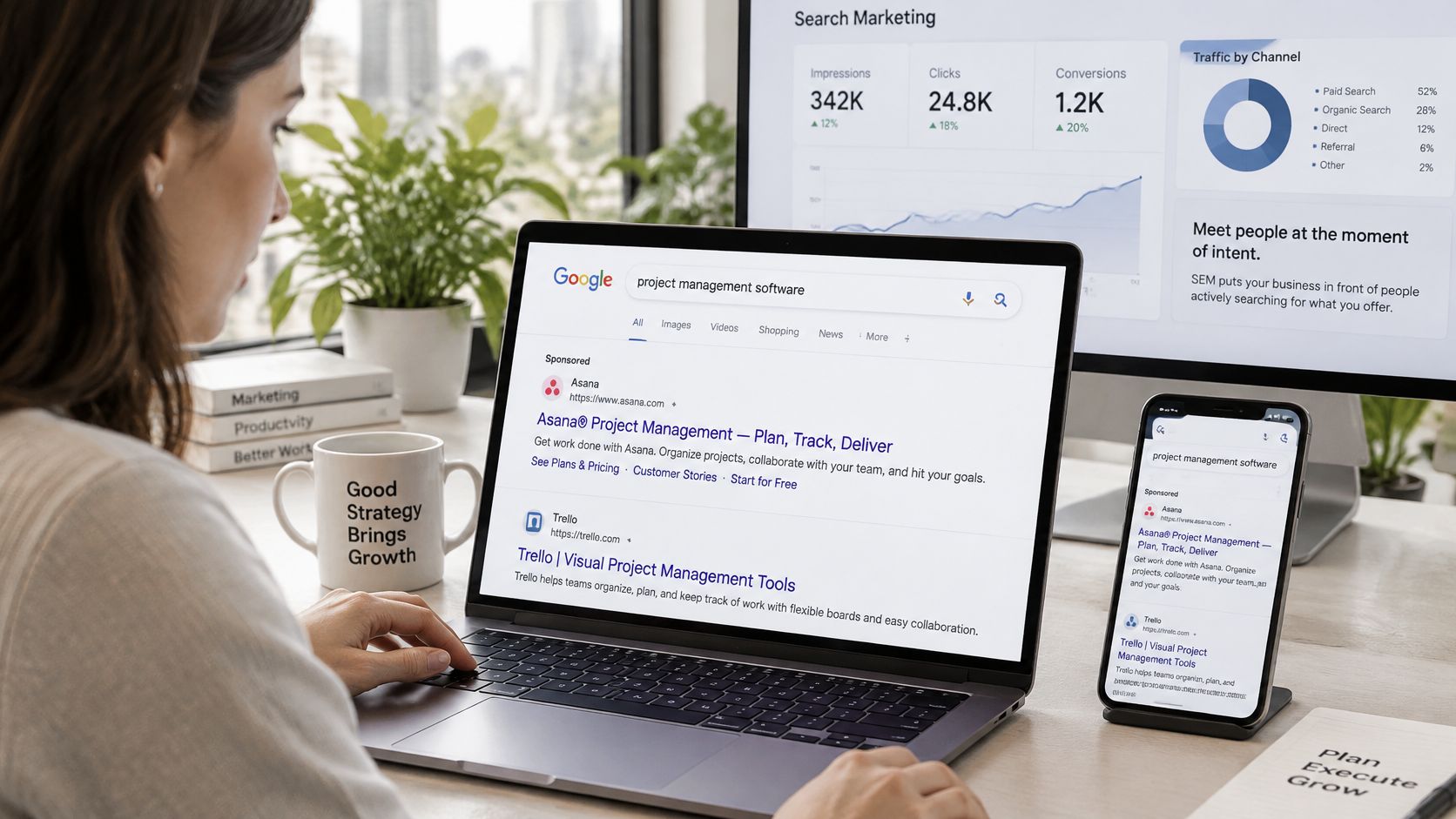
For paid search, ads reach people searching for a relevant product, service or answer. According to the IAB Internet Advertising Revenue Report, U.S. search advertising revenue reached $102.9 billion in 2024. That scale makes a clear definition useful: everyone should know what the budget buys.
What SEM Means and Which Meaning Your Team Uses
SEM, or search engine marketing, can describe paid search alone or the combination of paid search and SEO. The meaning depends on the market, agency or team using it. The acronym is an umbrella label; the confusion starts when people put different activities underneath it.
English-language marketing content often uses the narrower, paid-search meaning. Older definitions and some European usage include both paid and organic search activity. Neither usage tells you exactly what a proposal covers without a clear scope.
Separate the activity from the payment model
These terms answer different questions:
- SEM: Which search marketing activities are included? The answer depends on the team's definition.
- SEO: Work aimed at earning visibility in unpaid search results.
- SEA: Search engine advertising, an explicit name for paid search activity.
- PPC: Pay-per-click, a payment model used in search advertising and other advertising channels.
PPC and SEM aren't interchangeable. One describes how you pay; the other describes a category of marketing work.
For consistent budgets and reports, write the definition alongside the label: “SEM: paid search” or “SEM: paid search and SEO.” Use that same scope in agency agreements, job descriptions and dashboards.
The pieces you'll recognize
For the paid-search meaning used in this article, a basic keyword-led campaign connects three elements:
- Keywords: The search themes you want to compete for.
- Ads: The messages searchers see, marked with an advertising label such as Ad or Sponsored.
- Landing pages: The destinations visitors reach after clicking.
A plumbing business makes the connection concrete. A search for an emergency plumber nearby signals a need. The keyword makes the ad eligible to appear, the ad presents the offer, and the landing page gives the visitor somewhere to act. It's like a shop window matched to what a passerby is looking for.
Intent is a signal, not a sale.
Paid search also accounts for a substantial share of advertising spending: search represented 39.8% of total U.S. digital advertising revenue in 2024, according to the IAB Internet Advertising Revenue Report.
The Core Difference
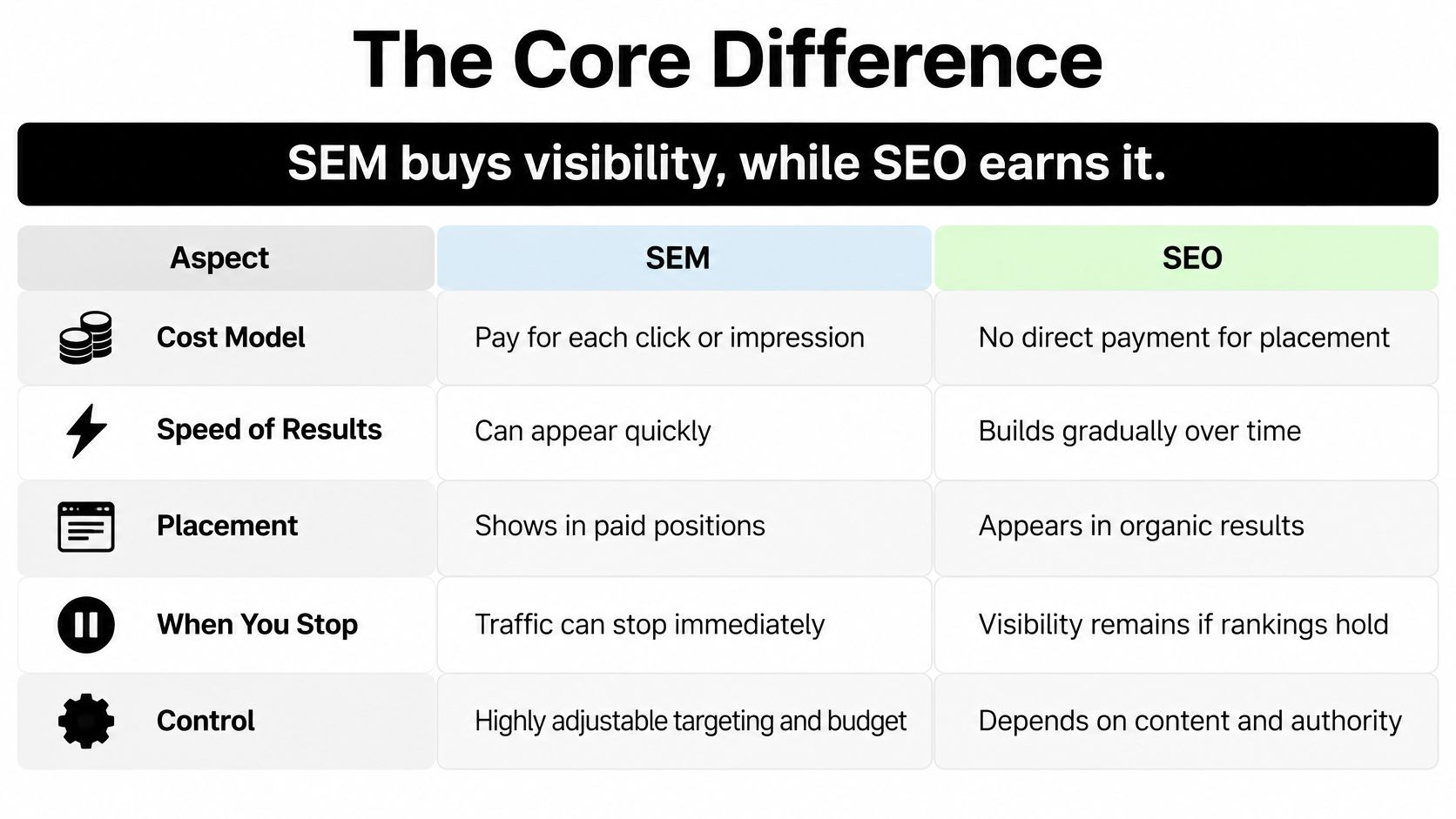
SEM buys visibility, while SEO earns it. Here, SEM means paid search, so the comparison stays consistent.
SEM vs SEO at a glance
| Factor | SEM (paid search) | SEO (organic search) |
|---|---|---|
| Cost model | Pay per click or per impression, according to the campaign | No direct media cost; invest in content and technical work |
| Speed of results | Can appear quickly after approval and activation | Builds gradually as search engines assess pages |
| Placement | Labelled ads in eligible paid positions | Unpaid listings in organic results |
| Traffic when spending stops | Paid traffic stops when ads stop serving | Can continue while rankings hold; may decline if neglected |
| Control over position | Adjustable bids and targeting, but the auction determines placement | Indirect influence through content, technical quality and authority |
Cost isn't the same as effort. With paid search, you fund media as well as campaign management and creative work. With SEO, you don't pay the search engine for organic placement, but writers, developers and SEO specialists still cost money.
Speed also means different things. An approved ad can start attracting visitors while a new category page is still being discovered and evaluated. Neither route guarantees profitable customers because your business appears in search.
A shoe-store example
Say a new online shoe store is launching its summer collection. Search ads can introduce the collection to people looking for lightweight sandals while the team improves category descriptions, internal links and product information for organic search.
The store shouldn't treat its ad launch date as a promise of immediate sales. Stock availability, delivery charges, product appeal and checkout usability all affect what happens after someone arrives.
The distinction between a campaign and its payment method can also be confusing. The AI Optimization Services PPC explainer is a useful companion for understanding what a pay-per-click campaign includes beyond the click charge itself.
Control is another common misunderstanding. Paid search lets you adjust settings directly, but you can't reserve the top position indefinitely. SEO offers less direct placement control, and competitors or search-engine changes can affect rankings even when you haven't changed your site.
Use paid search when you need a controlled demand test or timely visibility. Use SEO to develop an ongoing source of relevant visits that doesn't require buying every click.
You don't have to choose a permanent winner. Choose the role each channel should play, then give each an appropriate budget and success measure.
How the Ad Auction Decides Your Position
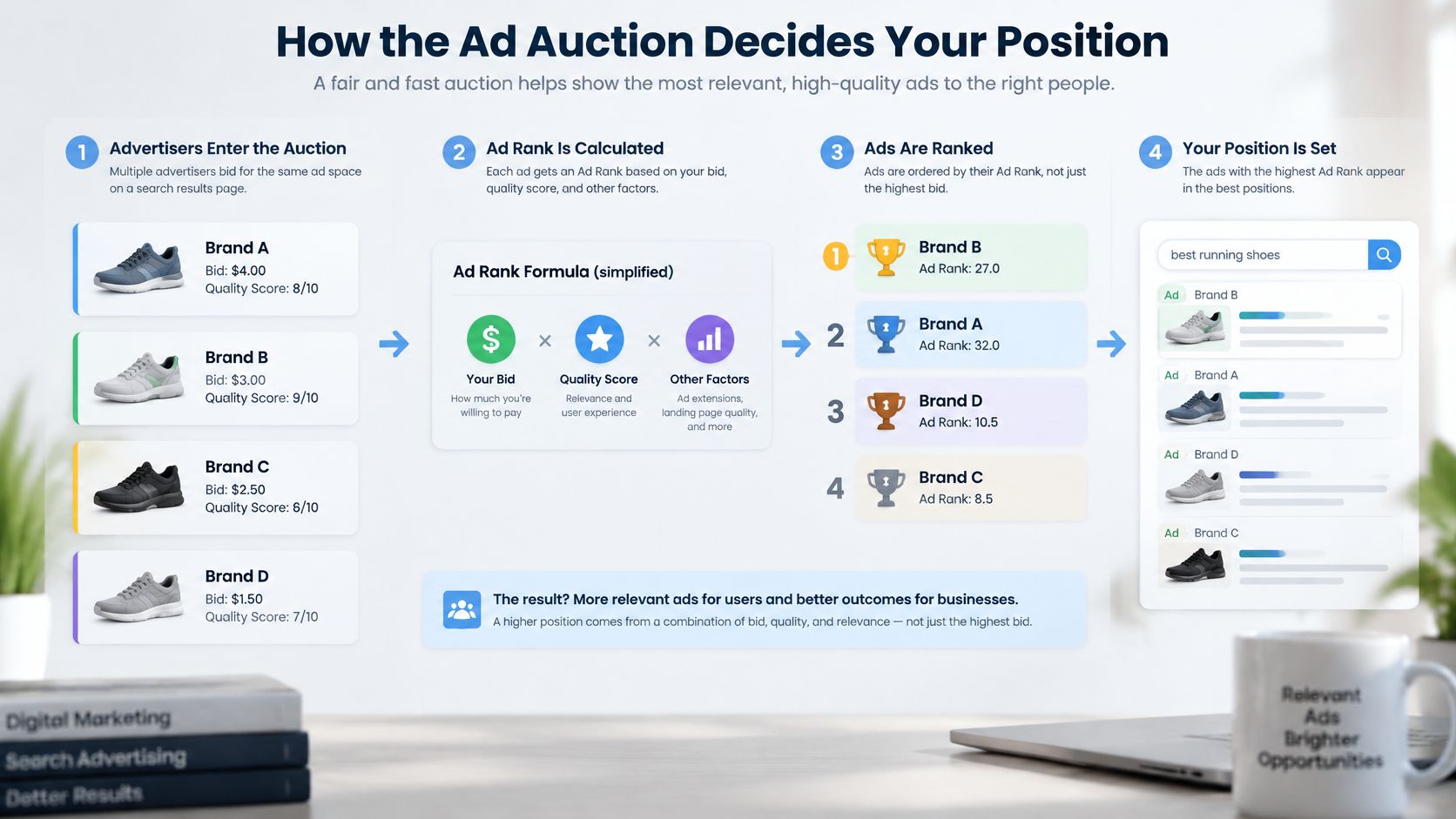
An eligible search can trigger an auction among advertisers competing to appear. You're not purchasing a fixed position like a billboard beside a road.
Think of a sealed-bid competition where the organizer considers both your offer and how useful it will be to the audience. The biggest bid matters, but it isn't the only deciding factor.
This visual introduces the auction process.
What Google evaluates
According to Google's Ad Rank documentation, the auction considers:
- Your bid: What you're prepared to pay under your bidding strategy.
- Auction-time quality: The relevance and usefulness of your ad and destination.
- Minimum thresholds: Requirements an ad must meet to appear.
- Search context: Factors such as the query, device and location.
- Competition: Other eligible advertisers in that auction.
- Ad assets: The expected effect of additions such as sitelinks and call buttons.
The result, Ad Rank, determines whether your ad can appear and its relative position. It isn't your bid multiplied by the diagnostic Quality Score shown in your account.
Why relevance can beat a bigger bid
Consider a search for emergency boiler repair. An ad offering that service, leading to a relevant repair page, is better aligned than a generic home-services ad leading to a crowded homepage.
That alignment can improve competitiveness and potentially reduce the cost needed to obtain a position. It doesn't mean a relevant ad always wins, because the other auction inputs still matter.
For a practical companion to diagnosing relevance problems, use SimpleLab Digital's Quality Score walkthrough. Treat the reported score as a clue, not a position guarantee.
The video offers another way to understand the mechanics.
Organize each ad group around a shared need, then make the ad's promise easy to find on the destination page. A campaign message-match check helps you inspect that connection before paying to send visitors through it.
Channels and Ad Formats You Will Use
Name the channel, format and any supporting assets separately in your campaign briefs and reports. Because SEM can mean different things across markets and teams, “SEM campaign” alone may leave an agency unsure what work the budget covers.
A channel is where you advertise, such as Google Search or Microsoft Bing. A format is how the ad appears, such as a text ad or product listing. Assets add information or actions to an ad, such as sitelinks or a call button. They work like extra details on a shop sign, rather than a separate shop.
Common search ad formats and when to use them
| Format or Asset | Where It Appears | Best Used For |
|---|---|---|
| Responsive search ads | Eligible positions toward the top or bottom of search results | Text ads assembled from several headline and description options |
| Shopping ads | Product placements and grids in search results | Online stores with product feeds containing prices and images |
| Calling ads, including older call-only formats where supported | Eligible mobile search placements with a calling action | Service businesses prioritizing phone inquiries |
| Local ads | Maps and local search results | Businesses with physical locations or defined service areas |
| Ad assets, formerly called extensions | Alongside or beneath the main ad | Adding sitelinks, callouts and location details to text ads |
Format names and availability can change. Older tutorials may refer to extensions or call-only ads even when your account uses different options.
Match the format to the task
Start with the customer's next action.
A dental clinic seeking phone inquiries about urgent appointments needs an easy calling option. A search ad with a call asset, or a supported mobile calling format, can fit that task. Schedule the calling option around staffed phone hours so someone can answer.
An online retailer has a different need: shoppers may want to see the product and its price before clicking. Shopping ads draw those details from the product feed, making accurate pricing and availability part of the ad itself.
With a responsive search ad, you supply headline and description options rather than one fixed advertisement. Each option should make sense alongside the others. Avoid wording that depends on a particular headline appearing first.
For a third-party configuration reference from NotFair, browse the Google Ads platform docs. Check format names and available settings inside your advertising account before choosing them.
Adding an asset does not buy a guaranteed extra placement. It supplies more information or another action for the searcher; whether it appears and how interactions are charged follow the platform's applicable rules.
KPIs and Bidding Models to Track
Core SEM KPIs and what each one tells you
| KPI | What It Tells You | When to Act |
|---|---|---|
| Click-through rate | Share of impressions that produce clicks | Investigate weak messaging or irrelevant targeting |
| Cost per click | Average amount paid for a click | Check competition, relevance and traffic mix when costs rise |
| Conversion rate | Share of clicks completing your chosen goal | Inspect page fit, usability and tracking when results weaken |
| Cost per acquisition | Advertising spend per recorded acquisition | Compare with the value and profitability of that acquisition |
| Return on ad spend | Attributed revenue per unit of advertising spend | Shift budget with margins and attribution limits in mind |
| Quality Score | A diagnostic of expected CTR, ad relevance and landing-page experience | Address the weakest component rather than chasing the score |
Read these metrics together. Cheap clicks aren't a bargain when visitors never become suitable customers, and a high conversion rate isn't useful if the recorded action is merely opening a form.
Define the conversion carefully. A submitted inquiry, qualified opportunity and paying customer are different outcomes, with different values to your business.
Quality Score isn't the auction formula
Google's Quality Score guide describes a 1 to 10 diagnostic covering expected click-through rate, ad relevance and landing-page experience, benchmarked against advertisers whose ads appeared for the same search during the previous 90 days.
Use those components to choose the right repair. Weak expected CTR suggests reviewing messaging and targeting; weak relevance suggests tighter keyword-to-ad grouping; weak page experience calls for a more useful destination.
A perfect diagnostic score doesn't guarantee a top position, a sale or a profitable campaign.
Keep campaign naming consistent too. A UTM builder helps standardize campaign parameters for site analytics, but tagging doesn't replace testing your conversion events.
Choose bidding around the outcome
- Manual cost per click: Manage bids directly where the platform supports it.
- Maximize clicks: Ask the system to pursue clicks within your budget.
- Target cost per acquisition: Optimize toward a desired average conversion cost.
- Target return on ad spend: Optimize toward conversion value relative to spend.
- Maximize conversions: Pursue recorded conversions within the campaign's budget.
Automated conversion bidding depends on trustworthy conversion signals. A new campaign isn't automatically better on manual bidding, nor does it need to wait a fixed period before using automation.
Choose according to tracking quality, available history, budget and account options. Don't use a clicks-focused strategy and then assume the system is optimizing for qualified buyers.
Launch a Small Test Campaign This Month
Keep your first test narrow enough that you can explain the result. A campaign covering unrelated products, regions and customer needs makes it difficult to identify what deserves more investment.
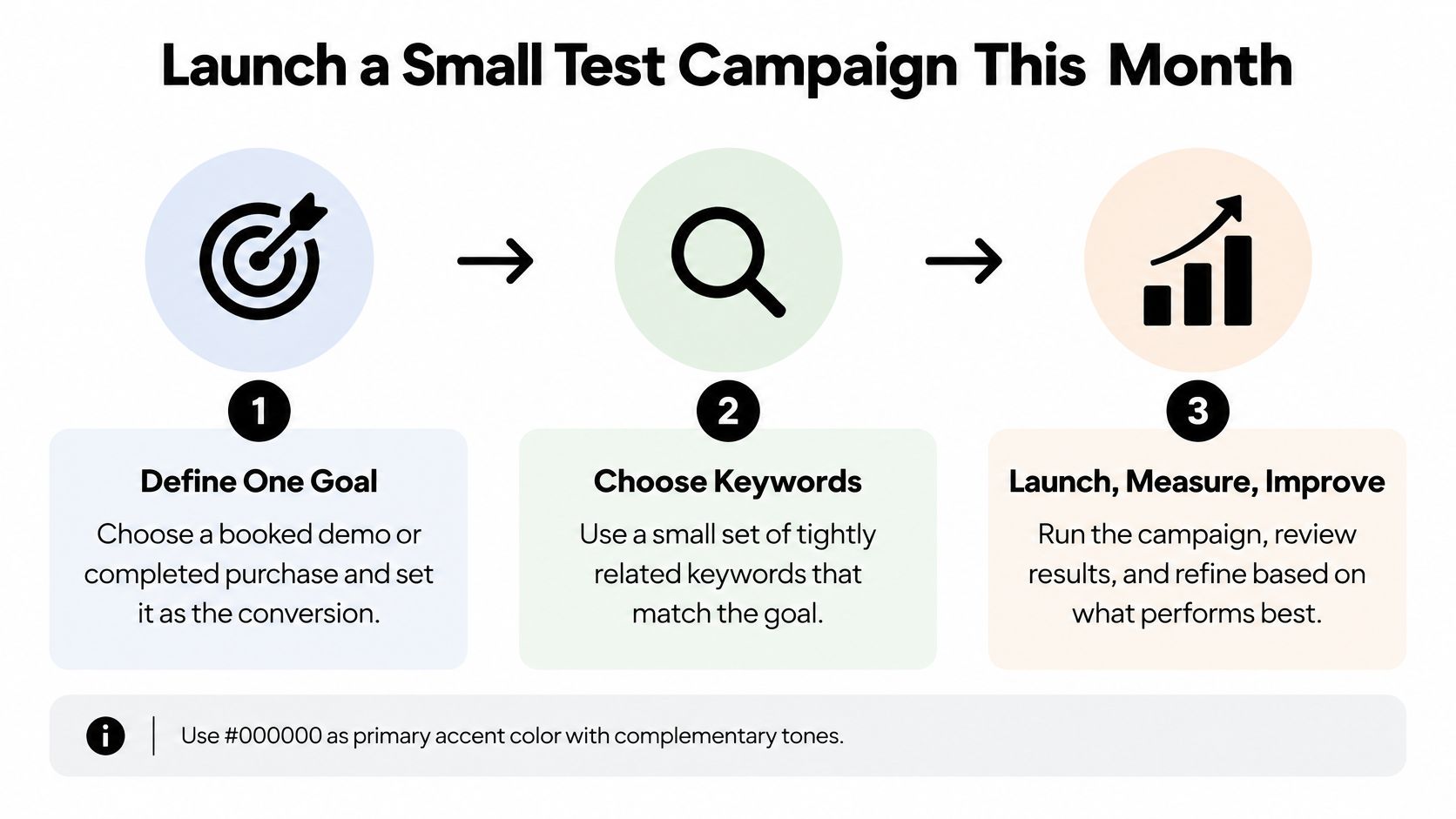
Use this simple outline to keep the launch focused.
Build the test around a business decision
-
Define a meaningful goal. Choose a completed purchase, booked demo or another action you can verify. Test the conversion event before launch, because bidding and reporting become misleading when the wrong action counts as success.
-
Select a tightly related keyword group. Use Google Keyword Planner to explore language around the offer, then choose match types deliberately. Exact match refers to meaning, not necessarily identical wording; add negative keywords for clearly irrelevant needs, such as employment searches when you're selling a service.
-
Write distinct ad options. Test different benefits rather than cosmetic word changes. For a bookkeeping service, a message about reducing administrative work tests a different appeal from one about preparing reliable financial records.
-
Prepare a focused destination. Keep the offer, eligibility requirements and next action clear on mobile as well as desktop. Use a landing-page optimization checklist to inspect the page before launch. At Polish, we write the headline, proof, call to action and content order for each reader, in the customer's voice and inside the customer's design.
-
Set an affordable learning budget. Decide what you can spend without relying on the test to pay for itself immediately. Choose manual CPC or maximize clicks when controlled traffic acquisition is your purpose, or conversion-based bidding when your tracking and goal support it.
-
Add useful assets. Include relevant sitelinks, call details and location information where appropriate. Check that every destination works and that someone can answer calls during advertised hours.
-
Schedule a decision review. Set the review date before launch, but don't force a conclusion while conversions are still pending. Compare acquisition cost, conversion rate and lead quality, then pause clear waste and document what you'll change.
Judge more than the keyword list
Check the search-term report for irrelevant searches, but don't assume it reveals every detail behind every click. Search Engine Journal's reporting on AI-mediated paid search highlights longer, more complex searches and limitations in query visibility.
Keep auction performance separate from business impact. Clicks and attributed conversions describe recorded activity; they don't, by themselves, prove that advertising created additional demand rather than capturing customers who would've arrived anyway.
For lead generation, review whether inquiries fit your service, location and buying requirements. For retail, inspect actual purchases and their value rather than celebrating product-page visits.
Run this small test through its planned review before increasing the budget. Scale only when you can explain what worked, what it cost and whether the resulting customers are worth acquiring.
Polish rewrites headlines, calls to action and copy, then serves the best-performing version to visitors. To work on the page experience your search ads lead to, visit Polish and explore how it adapts content within your existing voice and design.
- SEM in marketing
- search engine marketing
- SEM vs SEO
- paid search ads
- PPC advertising
Your website rewrites itself until it converts.
Polish writes new versions of your headlines and CTAs, tests them on your real visitors and keeps the ones that win.
Start free