What Is Online Marketing? a Simple Guide for 2026
What is online marketing? Learn the main channels, goals, KPIs and starter tactics for small and large businesses, explained in plain language.
 Sacha Kleynjans

Table of contents
- Online Marketing Explained Through a Simple Analogy
- Being Found, Chosen, and Remembered
- The Main Online Marketing Channels Compared
- Online Marketing Channels Compared
- How Channels Work Together in a Growth Funnel
- A Dentist's Campaign in Practice
- Goals and KPIs That Show Whether It Works
- Business Goals and the KPIs That Measure Them
- The Formulas You'll Meet Most Often
- Where to Start by Business Type
- Starting Channels by Business Type
- Put the Basics in Place
- Common Misconceptions and Where Online Marketing Falls Short
- Automation Needs Accountable Owners
- Accessibility Is Part of Performance
- Measure the First Month and Decide Next Steps
- A Practical Measurement Routine
- Decide What the Results Support
You've put up a website, posted about your business, and perhaps paid for an ad. People visit, but you're not sure what brought them, why they left, or whether any of it helped you win customers. When someone suggests doing more online marketing, it can sound like another list of platforms to manage.
The better starting point is a system: attract the right people, help them decide, measure what happens, and improve the experience. You don't need to be everywhere. You need to understand how each activity contributes to a business result.
Online Marketing Explained Through a Simple Analogy
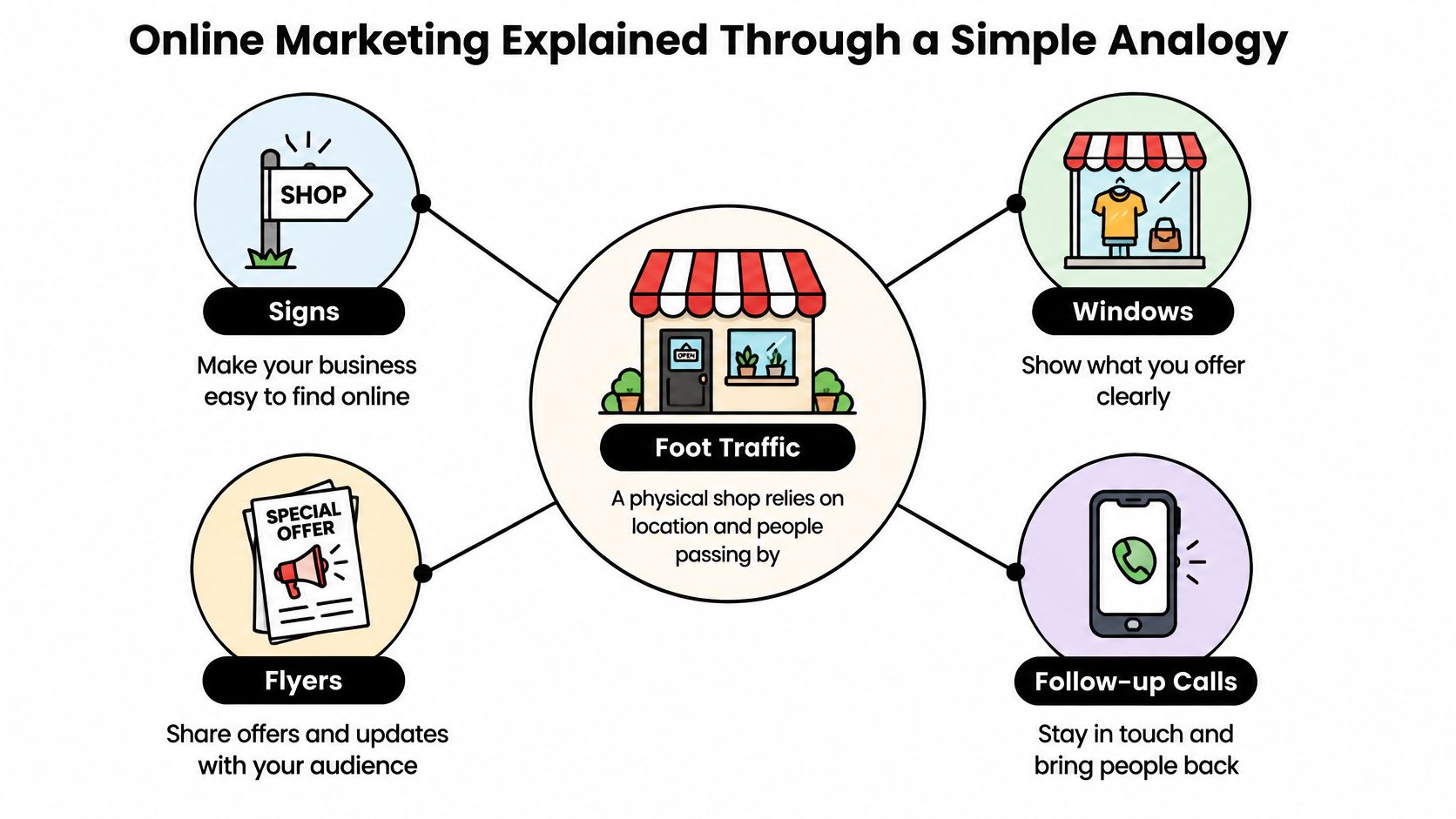
Say you open a small shop. You put a sign outside so people can find it, arrange the window so they understand what you sell, distribute flyers, and follow up with customers who want updates.
Your website needs the online equivalents. A search listing helps people find you. A product page shows what's available. An email gives an interested customer a reason to return.
Online marketing is the use of internet-connected channels to attract, inform, convert, and retain customers, together with the measurement systems used to improve those outcomes.
The shop comparison makes the different jobs easier to see.
The potential audience is substantial: the International Telecommunication Union estimated that 6.0 billion people, or 74% of the world's population, used the internet in 2025, while 2.2 billion people remained offline. Online reach is large, but it isn't universal. Your customers' location, language, devices, connectivity, and digital skills still matter.
Being Found, Chosen, and Remembered
For a bakery, being found might mean appearing when someone searches for birthday cakes nearby. Being chosen means showing useful photos, collection details, and a clear ordering process. Being remembered might mean sending an opted-in customer a seasonal menu.
The measurement matters just as much as the message. If people reach the ordering page but can't complete the form, buying more traffic won't fix the problem.
That's the practical answer to what is online marketing: not just getting attention, but helping people take useful actions and learning from the results.
A quick test: if an activity helps someone discover, choose, or return to a business online, and you can evaluate its contribution, it belongs in online marketing.
The Main Online Marketing Channels Compared
Paid advertising is a substantial part of the field. Sensor Tower's 2025 State of Digital Advertising report projected $144 billion in digital advertising spending for 2025, representing 12% year-over-year growth. But an advertising budget is only part of an online marketing system.
Each channel serves a different purpose. Start by matching the channel to how your customers discover and evaluate an offer, rather than choosing whichever platform gets the most attention.
Online Marketing Channels Compared
The timing below is a planning guide, not a promise of profitable results.
| Channel | What it is | Cost model | Best used for | Time to results |
|---|---|---|---|---|
| Search engine optimization (SEO) | Improving pages so they appear in organic search | Staff or agency time, no fee per click | Steady traffic from search intent | Months |
| Paid search (PPC) | Ads displayed alongside search results | Pay per click | Capturing buyers searching now | Days |
| Paid social | Ads shown in social feeds | Pay per click or per thousand impressions | Reaching people by interest or profile | Days to weeks |
| Display and video ads | Banner and video placements across sites and apps | Cost per thousand impressions or per view | Awareness and retargeting | Days to weeks |
| Email marketing | Messages sent to people who opted in | Email subscription plus writing time | Nurturing leads and repeat sales | Weeks to months |
| Content marketing | Articles, guides, and videos answering questions | Production time | Trust and organic reach | Months |
| Organic social media | Unpaid posts on your profiles | Staff time and production costs | Community and brand presence | Months |
| Affiliate and partnerships | Partners promoting you for a commission | Commission per sale or lead | Reaching new audiences | Weeks |
Owned channels include your website, landing pages, email list, and app. You control their content and experience more directly than you control a social feed. Paid channels rent access to an audience.
Paid campaigns can generate traffic quickly, but that traffic usually stops when spending stops. Search content takes longer to develop and earn visibility, but useful pages can continue attracting visitors without a charge for each click.
For search terminology, this explanation of SEM in marketing helps distinguish paid search from organic visibility. When evaluating SEO, SEO authority metrics from SemDash provide context for understanding authority signals, which shouldn't replace checks on relevant traffic and sales.
A small business rarely needs every channel at once. Choose the ones you can maintain and measure properly.
How Channels Work Together in a Growth Funnel
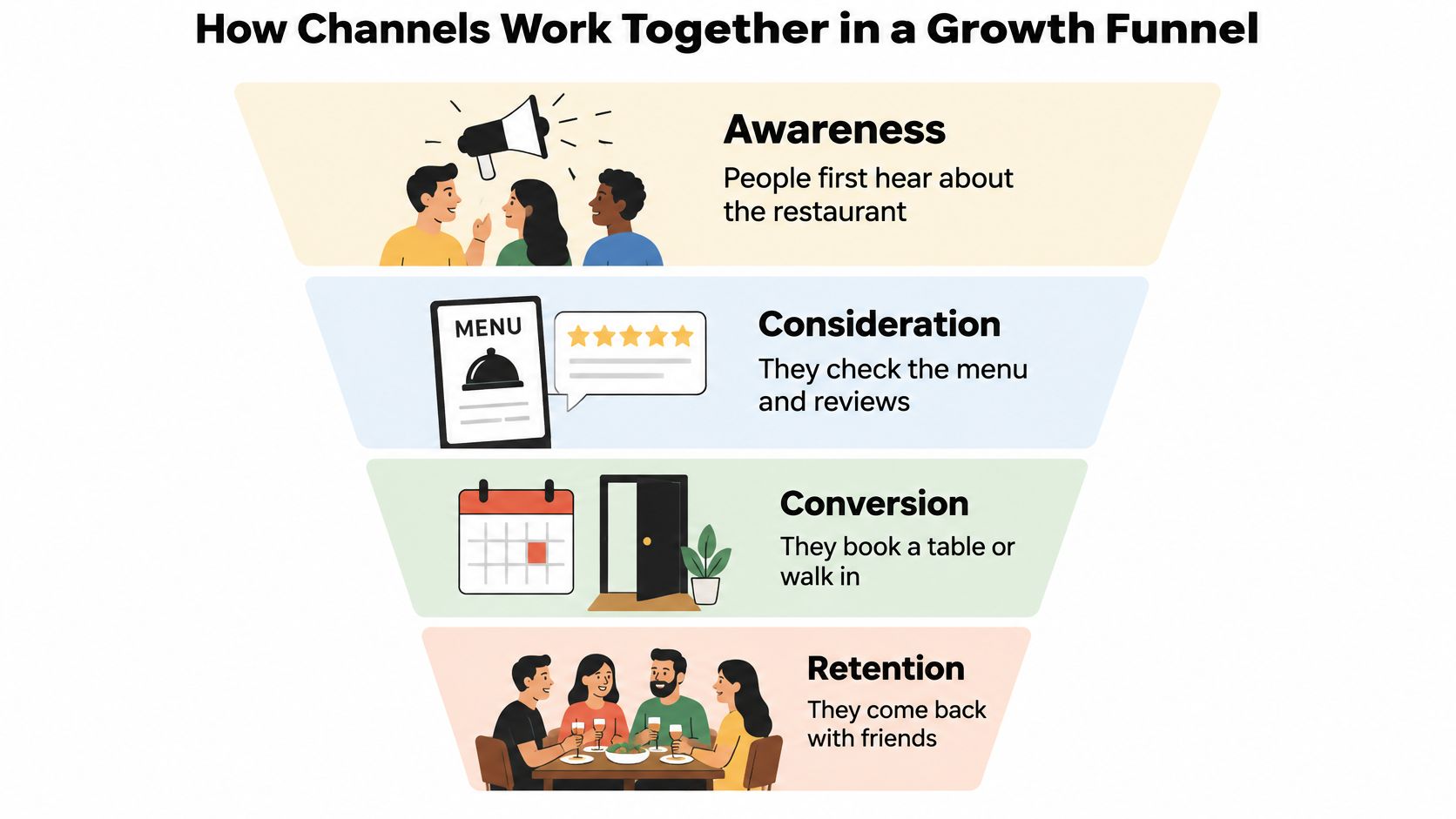
Think about choosing a restaurant. You hear its name, check the menu and reviews, book a table, and perhaps return with friends. Marketers describe those different jobs as awareness, consideration, conversion, and retention.
The funnel gives each activity a purpose beyond generating another click.
A Dentist's Campaign in Practice
Say a local dental practice wants more appointment bookings. Its marketer could connect the stages like this:
- Awareness: A short social video introduces the practice and shows what a visit feels like.
- Consideration: A helpful article answers questions about treatment, while patient reviews help visitors evaluate the practice.
- Conversion: A search ad reaches someone actively looking for a dentist and sends them to a page with appointment availability.
- Retention: A reminder email helps an existing patient arrange their next checkup.
The connection between messages matters. If the video promotes appointments for nervous patients, the landing page should explain how the practice supports them. A generic page that ignores that concern makes the visitor do extra work.
This video offers another way to think about the relationship between marketing activities.
A funnel isn't a strict route everyone follows. Someone searching for the practice by name may book immediately. Another person may read several pages, leave, and return through a direct visit.
Don't force every visitor through the same sequence. Make the next useful action easy wherever they arrive.
Judge each stage by its job. A helpful video may introduce the practice without producing immediate bookings. A booking page, however, needs to make appointment completion straightforward. Treating both as immediate sales tools can lead you to stop useful activity or keep ineffective activity running.
Goals and KPIs That Show Whether It Works
A key performance indicator, or KPI, is a measure tied to a goal. Start with what the business needs, then choose the number that helps you judge progress.
Business Goals and the KPIs That Measure Them
| Goal | Main KPI | Supporting KPI |
|---|---|---|
| Awareness | Reach and impressions | Branded search volume |
| Traffic | Sessions from each channel | Engaged sessions |
| Leads | Cost per lead | Lead-to-customer rate |
| Sales | Conversion rate | Return on ad spend |
| Retention | Repeat purchase rate | Customer lifetime value |
| Efficiency | Customer acquisition cost | Payback period |
Impressions aren't proof of sales. They tell you that an ad or piece of content was displayed, not that someone understood it or became a customer. Likewise, inexpensive leads aren't necessarily valuable if your sales team can't qualify them.
Supporting measures help you interpret the main KPI. For example, cost per lead may look attractive while lead-to-customer rate shows that the campaign is attracting unsuitable inquiries.
The Formulas You'll Meet Most Often
- Conversion rate: Conversions divided by visits, expressed as a percentage. Define the conversion first, such as a completed purchase or submitted booking.
- Cost per lead: Relevant campaign spend divided by leads generated.
- Customer acquisition cost: Total acquisition costs divided by new customers acquired. Include the costs your team has agreed belong in that calculation, not just advertising.
- Return on ad spend: Revenue attributed to advertising divided by advertising spend.
For a worked example without assuming a particular budget, take a campaign's total acquisition cost and divide it by the new customers it generated. Compare that result with the gross profit those customers are expected to contribute, not their order revenue.
Revenue isn't profit, and acquisition cost isn't automatically affordable because it looks low. Product costs, returns, service effort, and the time before customers buy again all affect what you can spend.
If visitors arrive but don't complete the intended action, conversion rate optimization focuses on improving that experience. Check whether the offer is clear and the task works before changing button colors.
Choose one primary KPI per channel. Keep supporting measures available for diagnosis, rather than treating every number in the dashboard as equally important.
Where to Start by Business Type
An Intuit SMB MediaLabs analysis using survey and U.S. Census Bureau business data estimated the average U.S. small-business advertising budget at approximately US$78,000 in 2025. That's context, not a recommended starting budget for your business.
Start with an owned destination and a manageable way to attract relevant visitors. Decide how much you can afford to learn before committing to ongoing spending.
Put the offer, costs, and measurement plan on paper before launching.

Starting Channels by Business Type
Use this as a suggested opening plan, not a requirement to launch everything listed immediately.
| Business type | Start with | First 90 days | Main KPI |
|---|---|---|---|
| Local service business | Free business listing and search ads | Claim profile, collect genuine reviews, run a focused local search campaign | Cost per call or booking |
| Online store | Paid social and email | Launch a product-focused ad set and a welcome email series | Return on ad spend |
| B2B software | Content marketing and search | Publish problem-focused guides and a demo landing page | Cost per qualified lead |
| Creator or coach | Organic social and email list | Post weekly and offer a useful free guide for sign-ups | Email sign-up rate |
A local plumber may benefit from a complete Google Business Profile before paying for ads. A software company selling a complex product may need clear explanations and qualification questions before increasing demo traffic.
Put the Basics in Place
- Claim your profiles. Check business details, service areas, contact information, and destination links.
- Install analytics thoughtfully. Configure Google Analytics or another suitable tool, respect consent requirements, and verify important events.
- Choose a specific offer. Give visitors a clear action, such as requesting a quote, buying a product, or booking a demonstration.
- Maintain a focused channel plan. Keep messaging consistent long enough to learn, while correcting technical problems promptly.
- Review customer quality. Ask whether inquiries became suitable customers, not merely whether the dashboard recorded leads.
Your starting channel should fit how people buy. An urgent repair service needs to be discoverable when a problem occurs. A coach may need to demonstrate an approach before someone feels ready to inquire.
Common Misconceptions and Where Online Marketing Falls Short
A consultant posts three times a week and still loses the inquiry. The service page never says who they help, and the form never states the next step. Online marketing works like a feedback loop: the message, the page, and the result have to report back to each other. Posting is only the first signal.
Spending more on that same unclear offer raises the bill without bringing better customers. A larger set of vague articles has the same gap. Buyers still cannot find an answer to their specific question, so trust does not grow just because the archive got longer.
Automation Needs Accountable Owners
The Jasper State of AI in Marketing 2025 report found that 63% of marketing teams used generative AI, yet only 43% of adopters had a formal AI program. Using a tool is not the same as running a governed process.
Treat automation like a junior colleague who drafts quickly but cannot sign the work. Name the person who approves claims and handles failures before the system may change messages on its own. Set consent rules, collect only the data you need, and write down which edits may go live without a human check.
Accessibility Is Part of Performance
An inaccessible form can turn an interested visitor into a missing conversion. A keyboard trap, a missing label, weak contrast, no captions, or an error a screen reader cannot read all look, on the dashboard, like a poor audience. Accessibility barriers can reduce both conversions and search visibility, because people who cannot finish the task never become the signal your measurement expects. Test those basics on pages you build by hand and on versions a tool generates automatically.
Practical rule: Before blaming the audience, check whether people can understand and complete the task.
Keep these controls in place:
- Approval rules: Require review for sensitive claims, offers, and creative, with a clear rollback process.
- A record of what appeared: Keep appropriate, privacy-conscious logs of page versions and experiment settings so staff can investigate problems.
- Segment monitoring: Check outcomes by device and country, and investigate accessibility barriers without unnecessarily collecting sensitive information.
Measure the First Month and Decide Next Steps
Treat the first month as a measurement exercise, not a final verdict on whether online marketing works. Your immediate job is to establish a trustworthy baseline and identify problems that could distort your decisions.
A Practical Measurement Routine
- Write down the business goal. Choose the main KPI and record its current value. If you don't know it, label it unknown rather than entering a misleading zero.
- Make comparisons fair. Use matching date ranges, consistent conversion definitions, and clear channel names. Separate completed purchases from actions that merely show interest.
- Label campaign links. Use a UTM builder to create consistent campaign tags for email, ads, and other links you control. Don't add campaign tags to internal website links.
- Test the complete journey. Submit forms and check confirmation events. Verify that purchases aren't counted twice and that your team receives the resulting inquiries.
- Review weekly patterns. Look for sudden changes by device, country, and traffic source. Investigate whether a drop reflects customer behavior, a tracking failure, or an unusable page.
Keep the offer, audience, and budget reasonably stable while establishing the baseline. Don't preserve a broken checkout or let spending exceed your limits merely to keep a test unchanged.
Decide What the Results Support
After the month, answer these questions in writing: Which channel moved the main KPI, and what evidence supports that conclusion? What would you expect to change if the budget doubled?
The second question is a scenario, not a forecast. Check whether the business could handle more inquiries and whether the channel still has suitable customers to reach.
If the evidence is too limited, say so. Continue measuring rather than declaring success or failure from a small set of outcomes. Once the baseline is reliable, test a focused change to the headline, call to action, or landing page, with clear approval and monitoring.
For teams ready to improve the landing-page part of this system, Polish is an option that uses an installed script to adapt headlines, subheadings, and calls to action to visitor context while measuring conversions. Visit to explore whether that approach fits your campaigns, and define your baseline, approval rules, and accessibility checks before enabling automated changes.
- online marketing
- digital marketing basics
- marketing channels
- marketing KPIs
- growth funnel
Your website rewrites itself until it converts.
Polish writes new versions of your headlines and CTAs, tests them on your real visitors and keeps the ones that win.
Start free