Search Engine Marketing Strategy: Build It Right
Master your search engine marketing strategy with this step-by-step guide. Learn keyword research, campaign structure, bidding, and measurement tactics that
Published on 11 min read
Table of contents
- Why Search Engine Marketing Strategy Still Matters
- The problem isn't demand capture, it's execution
- Keyword Research That Filters for Intent, Not Just Volume
- Build the list around buying intent
- Mine the search term report every week
- Campaign and Ad Group Structure for Maximum Relevance
- Structure by theme, not by platform
- Keep ad groups small enough to control
- Bidding Strategies That Match Your Business Goals
- Match the bid strategy to the account stage
- Read the market before you read the dashboard
- Ad Creative and Landing Pages That Convert Together
- Message match is the conversion lever
- Measurement, Reporting, and Continuous Optimization
- Use a short review loop
Paid search doesn't fail because the auction is crowded. It fails when the keyword, the ad, and the landing page all answer different questions. That's why a strong search engine marketing strategy is less about chasing cheaper clicks and more about building one system that turns intent into revenue.
Why Search Engine Marketing Strategy Still Matters
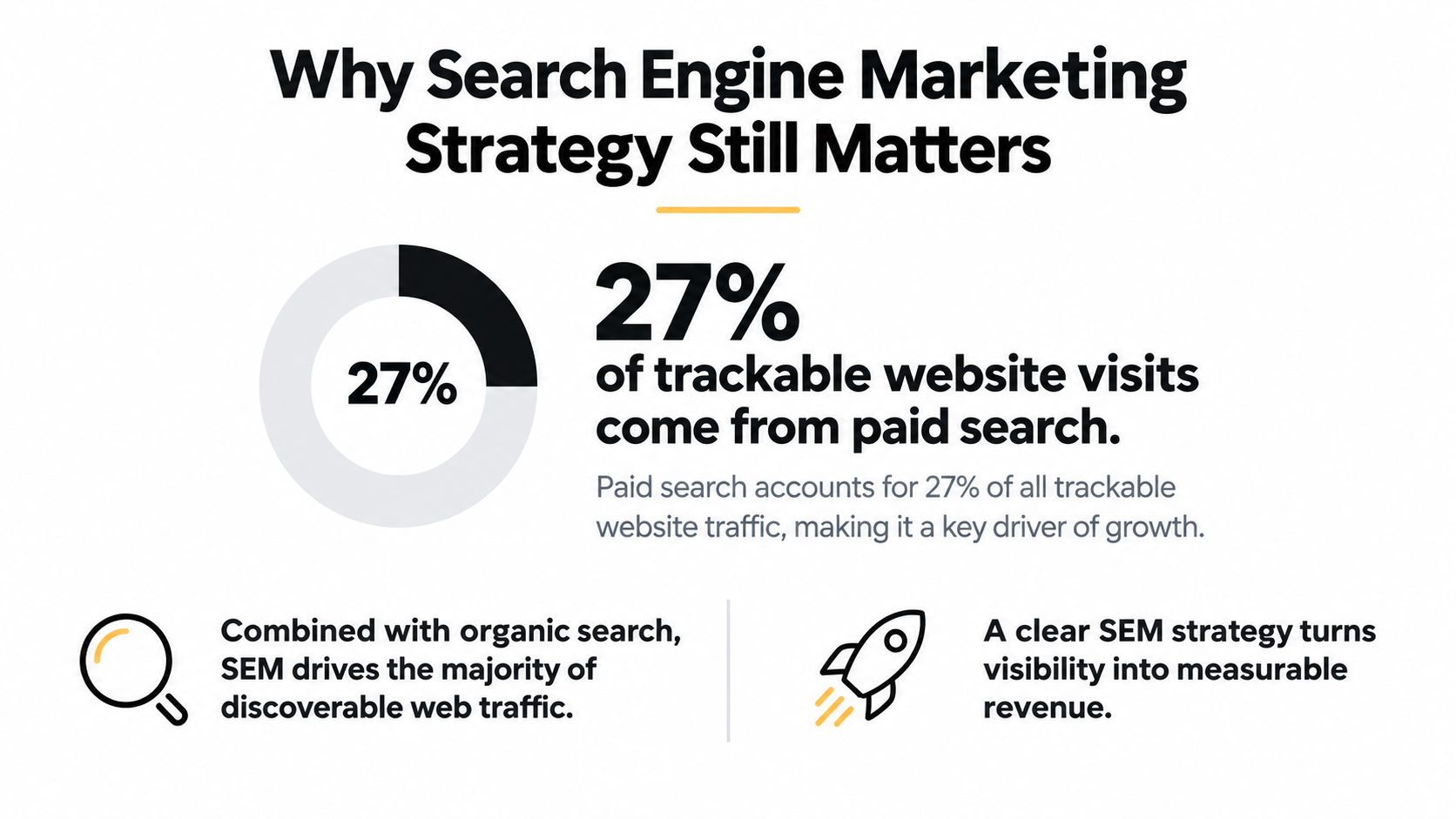
Paid search still sits close to the center of discoverability. In broader marketing data, organic plus paid search account for about 80% of all trackable website visits, with 53% from organic and 27% from paid search Ahrefs. That share explains why teams keep investing here, even as the channel gets noisier and more automated.
Search engine marketing became distinct in the late 1990s and early 2000s, with Open Text launching pay-per-placement in 1996, GoTo.com introducing pay-per-click in 1998, and the term itself popularized in 2001. By 2007, U.S. advertisers were already spending $24.6 billion on SEM Search engine marketing history, which shows how quickly search moved from experiment to core media.
The problem isn't demand capture, it's execution
Treating SEM as a bidding exercise is the most common mistake. The account outcome depends on how tightly you connect query intent, ad relevance, and page experience. When those pieces line up, paid search can scale cleanly. When they don't, CPCs rise while conversion efficiency erodes.
Recent benchmark data makes the trade-off visible. One 2026 dataset put paid search at 3.48% conversion rate, $42 average cost per acquisition, and 2.8x return on ad spend. Another 2026 benchmark reported 5.4% average paid search conversion rate across all industries Ahrefs. The spread is the point. Structure matters more than channel averages.
Practical rule: if your Quality Score is weak and your landing page is generic, lowering bids won't fix the account. It just makes bad structure cheaper for a while.
Real gains come from alignment. Accounts with low Quality Scores pay more per click, and generic pages convert worse than intent-matched pages. The strategy has to connect the whole path from query to sale, because most SEM problems are alignment problems first and bidding problems second.
Keyword Research That Filters for Intent, Not Just Volume
Keyword research goes wrong when teams start with a spreadsheet and end with a volume race. A keyword like “shoes” tells you almost nothing about intent. A query like “buy running shoes near me” does. The job isn't to collect more terms, it's to separate the queries worth paying for from the ones that only look attractive in a planner.
Build the list around buying intent
Start with seed terms that reflect your product or service, then expand them into intent clusters. Commercial modifiers like buy, price, best, vs, and alternative usually tell you more than raw volume does, because they reveal how close the searcher is to a decision. Informational queries can still matter, but they belong in a different campaign or a different stage of the funnel.
A useful map looks like this:
- Commercial intent: the searcher wants to compare or purchase now.
- Informational intent: the searcher wants guidance, definitions, or education.
- Competitor intent: the searcher is comparing brands.
- Navigational intent: the searcher already knows the brand and is trying to find it.
That separation matters because match type changes the traffic mix. Broad match can uncover useful variations, but it also invites irrelevant queries if you don't control it with exclusions and structure. Exact and phrase match still have a place when the intent is narrow and the margin for waste is low.
A practical resource for building exclusions is this collection of negative keyword list examples. Use it as a reference point, then tailor the list to your own query patterns instead of copying it blindly.
Mine the search term report every week
The work happens after launch. Search term reports tell you what users typed, which means they show both opportunity and waste. Add high-intent queries into their own ad groups, and exclude terms that signal research-only traffic, job seekers, freebie hunters, or competitor browsing that doesn't convert.
Query selection should dictate page messaging, not the other way around.
That's the part many teams miss. If the searcher is asking a narrow buying question, the landing page should answer that exact question immediately. If the query is informational, the campaign should either nurture the user differently or avoid the click entirely. Keyword research is not a one-time task, it's an ongoing filter that protects budget and sharpens relevance.
Campaign and Ad Group Structure for Maximum Relevance
Most accounts leak money because the structure is too broad. One campaign with hundreds of keywords and a single ad group looks tidy until you review the search terms. Then the gaps show up, mismatched ads, generic creative, and landing pages that cannot speak to every query in the bucket. Relevance slips, and cost rises with it.
Build the account around intent tiers. Keep brand, non-brand commercial, and non-brand informational traffic separate so performance is readable. Within those campaigns, split ad groups by product line, service type, or persona, and keep each theme tight enough that one ad can naturally fit the whole group.
Structure by theme, not by platform
Teams migrating from a single-campaign setup often mirror the platform's default structure, one campaign per network, ad groups pulled from the keyword planner. That organizes reporting, but it weakens creative and blurs the path from query to page.
A theme-based structure gives tighter control over message match, landing-page assignment, and negatives across the account. That matters because query selection should shape the page message. If the ad group is built around one commercial question, the landing page should answer that question immediately. If the theme is informational, the page needs a different role, or the click should be excluded altogether.
Use this pattern:
- Brand campaign for defensive and navigational queries.
- Non-brand commercial campaign split by product or service category.
- Non-brand informational campaign only if you have a real reason to capture upper-funnel demand.
- Shared negative list to stop irrelevant terms from flowing into every campaign.
Account architecture connects directly to cost. The 2026 cross-industry dataset from Google Ads benchmarks 2026 reports Search Network averages of $4.34 CPC, 6.84% CTR, 5.71% conversion rate, $76.12 cost per conversion, and 4.21x ROAS, and shows that accounts with Quality Scores of 1 to 3 paid $8.52 per click, a 96% premium over the average. That premium is often a structure problem wearing a bidding mask.
Keep ad groups small enough to control
Three to five tightly related keywords per ad group is usually enough to keep messaging focused. Once an ad group becomes a catchall, ad copy turns vague and landing pages lose specificity. If the same ad cannot serve every query in the group, the group is too broad.
Use message match guidance as a sanity check, and then test the page against the query theme itself. A strong structure does more than improve relevance, it also makes testing easier. When one theme underperforms, you know where to look instead of sorting through a mixed bucket of unrelated traffic.
Bidding Strategies That Match Your Business Goals
Bidding works best when it follows business reality, not platform hype. Manual CPC gives you direct control, but it demands constant attention. Automated bidding can save time, but it needs enough data and clean conversion signals to work properly. The right choice depends on how mature the account is, what margin you're protecting, and how much conversion history you have.
Match the bid strategy to the account stage
A new account usually needs more control than automation. If you only have a small volume of conversions, the algorithm doesn't have enough signal to optimize confidently. In that stage, manual CPC or a restrained enhanced CPC approach is usually safer because you can see exactly where spend goes.
Once conversion volume is steadier, Target CPA or Target ROAS becomes more practical. That's especially true when the business has a clear margin target and conversion tracking is reliable. A mature account with cleaner data can let the machine do the auction-level work while you focus on structure, messaging, and budget allocation.
A simple decision frame looks like this:
| Business situation | Safer bidding choice | Why it fits |
|---|---|---|
| Low conversion volume | Manual CPC | More control, less guesswork |
| Stable conversion history | Target CPA | Optimizes toward a cost goal |
| Revenue-focused eCommerce | Target ROAS | Optimizes toward value, not just volume |
| Thin data or new tracking | Manual CPC | Reduces the risk of automation drift |
If you need tools for pacing and automation, automated bidding and pacing tools can help once your data is stable enough to support them.
Read the market before you read the dashboard
A lot of marketers panic when spend rises, but rising spend doesn't always mean worse efficiency. In Q3 2025, Google paid search spend rose 10% year over year, clicks rose 11%, and CPC fell 1% Tinuiti. In Q2 2025, spend rose 11%, clicks rose 7%, and CPC growth slowed to 3% Tinuiti. That pattern can signal healthier auction dynamics, not just inflated costs.
The practical move is to compare your account against the market only after you've segmented by brand, non-brand, and intent class. A higher CPC might be acceptable if conversion quality improves. A lower CPC is useless if the traffic is drifting into irrelevant intent. Bidding should serve the business, not the other way around.
Ad Creative and Landing Pages That Convert Together
Ad copy and landing pages should read like one conversation. If the ad says affordable running shoes for flat feet, the page needs to answer affordability and support immediately. A generic homepage or a broad product grid forces the user to do the thinking your ad already promised to do for them.
Message match is the conversion lever
Use the primary query in the headline when it makes sense, then mirror the promise in the subheading. If the ad emphasizes price, the page should talk about pricing or value quickly. If it emphasizes a specific use case, the page should surface that use case above the fold, not bury it halfway down the page.
Keep the CTA consistent with the original intent. If the ad invites a quote, the page shouldn't force a demo request. If the ad is about shopping, the page shouldn't feel like a lead-gen form. That mismatch is where a lot of paid traffic dies.
A useful audit checklist:
- Headline alignment: does the page headline reflect the same keyword intent as the ad?
- Subheading alignment: does the supporting copy reinforce the same benefit?
- CTA alignment: does the call to action match the user's expected next step?
- Distraction control: are unrelated offers pushing the user away from the path to conversion?
Generic pages do not fail because they look bad. They fail because they make searchers work harder than they expected to.
A practical internal reference for this work is landing page optimization. The point isn't to add more sections, it's to make the first screen answer the query cleanly and quickly.
One example I keep seeing in live accounts is simple. A generic page can limp along with weak conversion performance, while an intent-matched page lifts response because the user sees their own question reflected back immediately. That's not design magic. It's relevance.
Later in the journey, the same logic still applies. The ad sets the promise, the page keeps it, and every stray element that dilutes that promise should be removed. I've seen teams spend weeks tuning bids when the page was the bottleneck the whole time.
Measurement, Reporting, and Continuous Optimization
A strong SEM strategy needs a weekly rhythm, not a monthly panic. The account tells you where the leaks are if you read it consistently. If you don't, the same waste keeps repeating under a cleaner-looking dashboard.
Use a short review loop
Every week, check search term reports first. Add new negatives, then look at Quality Score movement by ad group. Rewrite ads that are losing relevance, and compare landing-page conversion rates by traffic source so you can see where the funnel is breaking.
That review only needs to answer four questions:
- What new irrelevant queries appeared?
- Which ad groups slipped in Quality Score?
- Which ads lost click or conversion efficiency?
- Which landing pages are underperforming for their traffic source?
A report should tell you what to change, not just what happened. Track CPA, conversion rate, and ROAS together, because any one of them alone can mislead you. Click-through rate and impressions still matter, but they're inputs, not outcomes.
If you want a quick way to estimate what a conversion lift could mean before you test, the conversion lift calculator is a practical starting point. It's more useful than staring at raw traffic because it forces the conversation back to business impact.
Useful discipline: if a metric doesn't change a budget, an ad, or a page, it's probably just clutter.
A tool like Polish fits naturally alongside your workflow. It rewrites landing-page copy based on visitor behavior and tests variants on live traffic, which makes it relevant for search-driven pages that need continual message match improvements. The point isn't automation for its own sake. It's faster learning from real visitors.
Treat your SEM program like a system, not a set of isolated tasks. Polish helps teams do that by changing the page copy in response to visitor context, then learning from live traffic instead of guesswork. If you want to tighten the link between query intent and landing-page performance, visit Polish and see how it can support your search engine marketing strategy.
- search engine marketing
- SEM strategy
- paid search
- digital marketing
- PPC guide
Your website rewrites itself until it converts.
Polish writes new versions of your headlines and CTAs, tests them on your real visitors and keeps the ones that win.
Start free